
Pulau Tikus, Penang
 Go Back - HOME | Latest PENANG | Travel Tips | Penang Hokkien : Dictionary | YouTube | Facebook | Contact Me
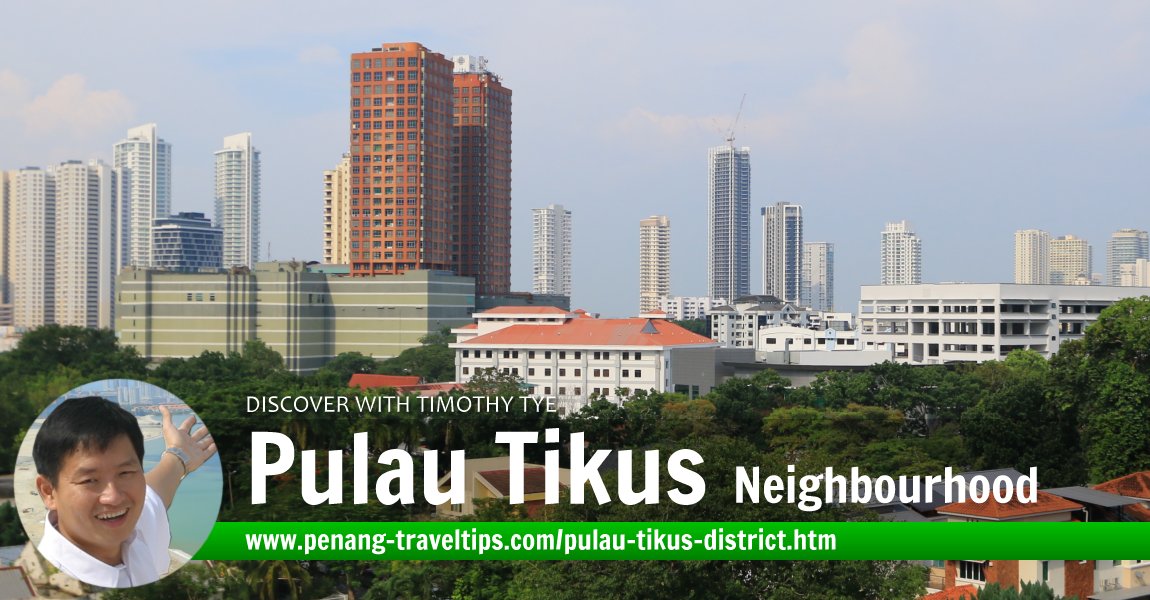 Pulau Tikus neighbourhood, Penang (22 July 2017)
Pulau Tikus (Traditional Chinese: 浮羅地滑; Simplified Chinese: 浮罗地滑; Pinyin: Fúluó Dìhuá) is the name of an affluent suburb of George Town, Penang. Located on the northwestern part of the city, Pulau Tikus proper starts near the junction of Burmah Road with Edgecumbe Road, and ends just before the Bagan Jermal junction. Burmah Road forms the main artery through Pulau Tikus, with the heart of town at the intersection of Burmah Road with Cantonment Road.
Measured from the intersection of Jalan Kelawai with Jalan Cantonment (GPS: 5.433293, 100.312619), Pulau Tikus is 4.0 km to Komtar, 10.7 km to the Penang Bridge, 18.7 km to the Second Penang Bridge and 20.2 km to the Penang International Airport.
YouTube Videos related to Pulau Tikus
Map of Pulau Tikus, Penang
Residential properties in Pulau Tikus
- Adventist Court (GPS: 5.43327, 100.30768)

- Arcadia (GPS: 5.43445, 100.31011)

- Belle Vue Apartment (GPS: 5.43639, 100.30841)

- Bellisa Court (GPS: 5.43356, 100.31032)

- Berjaya Court (GPS: 5.42982, 100.3089)

- Cantonment Court (GPS: 5.43413, 100.31238)

- Cascadia (GPS: 5.42723, 100.31054)

- Codrington Residence (GPS: 5.42798, 100.31289)

- Danauria (GPS: 5.42892, 100.31261)

- Desa Mas (GPS: 5.43438, 100.31186)

- Desa Melor (GPS: 5.43229, 100.30721)

- Desa Palma (GPS: 5.42829, 100.31237)

- Edgecumbe Court (GPS: 5.42938, 100.31677)

- Edgecumbe House (GPS: 5.42899, 100.31643)

- Festival Apartment (GPS: 5.43313, 100.31215)

- Forest Field Apartment (GPS: 5.43573, 100.29476)

- Formal Apartments (GPS: 5.435964, 100.308761)

- Gurney Villa (GPS: 5.43799, 100.30879)

- Gurney Ville (GPS: 5.43439, 100.31267)

- Halaman Pulau Tikus (GPS: 5.43201, 100.309)

- Indahria (GPS: 5.4295, 100.31743)

- Kondo Berjaya (GPS: 5.43056, 100.30931)

- Maica Court (GPS: 5.43422, 100.31346)

- Menara Yayasan Flat Kelawei (GPS: 5.43115, 100.3151)

- Midlands Condo (GPS: 5.43352, 100.3071)

- Midlands Court (GPS: 5.43544, 100.30825)

- Moulmein Rise (GPS: 5.42944, 100.31236)

- Mutiara Gurney (GPS: 5.43493, 100.31222)

- Naninong (GPS: 5.42522, 100.30848)

- Pen Villa (GPS: 5.43596, 100.30856)

- Porta Mas (GPS: 5.42911, 100.31098)

- Precious Court (GPS: 5.43485, 100.31299)

- The Cantonment (GPS: 5.42997, 100.31122)

- The L.O.O.C Residence (GPS: 5.43521, 100.31232)

- The Palazzo (GPS: 5.43007, 100.31708)

Roads in Pulau Tikus
- Gerbang Bell
- Gerbang Berjaya
- Gerbang Midlands
- Jalan Berjaya
- Jalan Birch
- Jalan Brother James
- Jalan Burma
- Jalan Cantonment
- Jalan C.O. Lim
- Jalan Edgecumbe
- Jalan Jones
- Jalan Kelawai
- Jalan Lim Chin Guan
- Jalan Lunas
- Jalan Midlands
- Jalan Pasar
- Jalan Pemenang
- Jalan Yeoh Guan Seok
- Lebuh Midlands
- Lebuhraya Cantonment
- Lebuhraya Codrington
- Lebuhraya Maktab
- Lebuhraya Scott
- Lengkok Berjaya
- Lengkok Burma
- Lorong Bangkok
- Lorong Berjaya
- Lorong Burma
- Lorong Kelawai
- Lorong Kuching
- Lorong Leandros
- Lorong Midlands
- Lorong Pulau Tikus
- Medan Lim Cheng Teik
- Medan Maktab
- Persiaran Cantonment
- Persiaran Midlands
- Solok Bagan Jermal
- Solok Bell
- Solok Cantonment
- Solok Codrington
- Solok Midlands
- Solok Moulmein
- Tingkat Kelawai
- Tingkat Midlands
Street Art in Pulau Tikus
 Hotels in Pulau Tikus
- Evergreen Laurel Hotel (GPS: 5.43124, 100.31788)

- G Hotel Gurney (GPS: 5.43745, 100.31044)

- G Hotel Kelawai (GPS: 5.43604, 100.31153)

- Georgetown City Hotel (GPS: 5.43339, 100.3071)

Villages in Pulau Tikus
- Kampung Syed (GPS: 5.42876, 100.31697)

What to eat in Pulau Tikus
- Benzemin Ooi recommended the koay teow thng at the Pulau Tikus Market Hawker Centre in Pulau Tikus, Penang, on 19 December, 2019.
- Sam Lim recommended the Duck Soup Koay Teow and Dry Koay Teow at Seng Lee Cafe in Pulau Tikus, Penang on 19 October, 2019.
- William Tan recommended the BM Yam Rice opposite Maybank and Public Bank Pulau Tikus on 15 October, 2019.
- Takahashi Rika recommended the Thai Nasi Campur at One-Stop Midlands Park Centre in Pulau Tikus, Penang, on 8 October, 2019.
- Hestia Teh recommended the Nasi Padang at Tommy Nasi Padang, on Burmah Road, in Pulau Tikus, Penang, on 9 October, 2019.
- Wan Than Mee at Wantan Mee House in Pulau Tikus, was recommended by Russ B King on 9 October, 2019
- Chicken Cordon Bleu at Yaw's Grill was recommended by Chuck Chan on 2 October, 2019.
- Vegetarian Lor Mee was recommended by Alice S G Seah at The Shark Food Court in Pulau Tikus, Penang, on 29 September, 2019.
- Char Koay Kak at Goodall Cafe on Gottlieb Road was recommended by Easter Yeoh on 13 September, 2019
- Western Food at Hai Beng Coffee Shop was recommended by Aaron Boey K Hg on 11 September, 2019
- Jawa Mee at New Cathay on Burmah Road was recommended by Deric Ong on 10 September, 2019
- The Fried Oyster at the Pulau Tikus Night Stalls was recommended by WL Teoh on 7 September, 2019
- Edgecumbe Lane Mee Mamak at Gurney Drive was recommended by Atok Eric Looi, 24 August, 2019

- Curry Mee with two big fresh prawns and cockles at Pulau Tikus Market Hawker Centre, in Pulau Tikus, Penang, was recommended by Agnes Cheah on 27 August, 2019
Businesses in Pulau Tikus
- Bakers' Friend (GPS: 5.42926, 100.31164)

- Ban San Hoe Medical Hall
- Bikelah
- Fluffy Dogs R Us (pet supplies shop) (GPS: 5.43832, 100.30788)
- Hao Sheng Motor
- Jenni's Homemade Cakes and Bakery
- Kedai Motor Lay Seng
- Pulau Tikus Mini Mart
Coffee Shops and Restaurants in Pulau Tikus
- Aroi Thai Restaurant
- Bangkok Lane Mee Goreng
- Bee Hooi
- Burmah Crescent Hawker Centre (GPS: 5.42649, 100.31421)

- Chang Yen Vegetarian Food
- Guan Hiang
- Hai Beng
- Hup Guan
- Hup Kee
- Jin Hoe Cafe
- Kong Bee Lee
- Kristal
- Loong Heng
- New Cathay
- Poly Coffee Garden
- Pulau Tikus Market Hawker Centre
- Restoran Hock Kheng (GPS: 5.42957, 100.31362)

- Restoran 77 Food Yard
- Restoran Mohd Raffe
- Seng Lee Cafe
- Seng Lee Cafe Hokkien Mee
- Sin Hup Aun Cafe
- Sin Hwa
- Stall at Tua Pek Kong Temple
- Sushi Kappo Miyasaka
- Wag & Romp Cafe (GPS: 5.43832, 100.30788)
- Wang Thai Restaurant
What's good to eat in Pulau Tikus
Looking for something to eat in the Pulau Tikus area? Get the recommendation from locals who are members of the Penang Hawker Food and Penang Restaurant Food Facebook Groups.Details
Shopping Centres in Pulau Tikus
The shopping centres in Pulau Tikus are, honestly, not as exciting as Gurney Plaza, which technically is part of Gurney Drive, but can also be considered as part of Pulau Tikus.- Axis Complex (GPS: 5.43146, 100.31133)

- Gurney Paragon (GPS: 5.43604, 100.31153)

- Gurney Plaza (GPS: 5.43733, 100.30921)

- Midlands One Stop (GPS: 5.43349, 100.30654)

Buddhist Temples of Pulau Tikus
Apart from the Thai Eurasians, Thai and Burmese of Buddhist faith also made Pulau Tikus their home, carving out enclaves and erecting their places of worship that outlast the villages themselves.- Dhammikarama Burmese Temple (GPS: 5.43098, 100.31409)
 Major Burmese temple, probably the only one of its kind in Malaysia.
 - Wat Buppharam (GPS: 5.42572, 100.31663)
 The "other" Thai temple in Pulau Tikus, this one located along Perak Road.
 - Wat Chaiyamangkalaram (GPS: 5.4319, 100.3136)
 The famous reclining Buddha temple, located right across the road from Dhammikarama Burmese Temple.
Museums in Pulau Tikus
- Colonial Penang Museum (GPS: 5.42902, 100.30633)

Schools in Pulau Tikus
- Convent Pulau Tikus (GPS: 5.43377, 100.30933)

Historic Buildings in Pulau Tikus
- Loke Mansion (GPS: 5.43582, 100.3123)

Amenities in Pulau Tikus
- Pulau Tikus Post Office (GPS: 5.43213, 100.31221)

- Taman Poket Persiaran Midlands (GPS: 5.43664, 100.3062)

Organisations in Pulau Tikus
- Penang Institute (GPS: 5.43021, 100.30449)

Chinese Temples in Pulau Tikus
In comparison, the Chinese community in Pulau Tikus built rather low-profile temples.
- Hong San Tai Ong Temple (GPS: 5.426, 100.31288)

- Hor Kai Kong Temple (GPS: 5.42864, 100.31018)

- Tua Pek Kong Temple (GPS: 5.42974, 100.31348)

- Poh Oo Toong Temple (GPS: 5.42801, 100.31469)

Churches in Pulau Tikus
- Church of the Immaculate Conception (GPS: 5.4332, 100.30932)

- St Andrew's Presbyterian Church (GPS: 5.42612, 100.31224)

Catholic Heritage Sites in Pulau Tikus
The Thai Eurasian Catholics were the earliest group to settle in Pulau Tikus. Their heritage sites can still be visited in Pulau Tikus today.- St Chastan Monument (GPS: 5.4332, 100.30932) Monument to one of the two teachers at College General who was martyred in Korea, beatified in 1925 and canonised in 1984.
- St Joseph's Novitiate (GPS: 5.43604, 100.31153) The St Joseph Training College that was once next to College General, now the site of Gurney Paragon.
- Penang Eurasian Association (GPS: 5.43393, 100.31019)
 Association of the small community of Eurasians in Penang, based at their former settlement in Pulau Tikus.
 - Kelawei Road Catholic Cemetery (GPS: 5.43692, 100.30799)
 Cemetery of the early Eurasian settlers in Pulau Tikus.
Medical Institutions in Pulau Tikus
- Eng Dental Surgery
- Penang Adventist Hospital (GPS: 5.43236, 100.30524)

Petrol Stations in Pulau Tikus
There's a Shell petrol station along Burmah Road next to Midlands One-Stop.
Hospitals in Pulau Tikus
Penang Adventist Hospital was established as a hospital for the destitute and penniless. While it has long abandoned that mission, this private hospital continues to be one of the best and most affordable in Penang. Its bakery is famous in Penang for producing some of the healthiest (but not cheapest) breads.About Pulau Tikus
The Burmese and Eurasians were the earliest settlers in Pulau Tikus. The Eurasians were the ones to give Pulau Tikus its name. They had fled Phuket, and arrived in Penang via Kuala Kedah. Their boat arrived on the shore off a rocky outcrop, which had a sand bank. To them, it resembled a mouse, or tikus in Malay . They duly called that rocky outcrop Pulau Tikus. The Eurasians then made their way along the coastline moving south until they reached a spot where they decided to establish their settlement. They decided to honour their settlement after the rocky isle which they had earlier named, and that settlement became known as Pulau Tikus.The Eurasians are of mixed parentage, between the Portuguese and the Thais, and are Roman Catholics. The people of Portuguese descent had had no peace to practise their faith since the Dutch arrive in Malacca in 1641. Religious persecution drove them out of Malacca. They settled in various Malay states as well as in Phuket, which at that time was called Ujung Salang (corrupted in English to Junk Ceylon), an island claimed by the Kingdom of Kedah but ruled by Siam. By the late 18th century, the Eurasians were on the run again, this time due to a decree by the increasingly demented king of Siam, Phraya Taksin @ Phya Tak, who ordered all Christians in Siam to be massacred. The Eurasians fled to Kuala Kedah, and from there, they made their way to Penang, forming the second wave of Eurasians to settlement in Penang.
(The first wave of Eurasian arrivals in Penang settled in town in the area bordered by Church Street, Bishop Street, Pitt Street and China Street, in rather rudimental housing, before moving with their church, the Church of Assumption (so named because they arrived in Penang on the day of the Catholic Feast of the Assumption), to the Farquhar Street area, settling along Argus Lane.)
There were still remnants of Eurasian community in Phuket going into the 19th century, until the Phya Tak Massacre of 1810 forced another group to Penang. Pulau Tikus had become an attractive location to settle down. They were parishioners of the Church of Our Lady Free From Sin. They arrived in 1811, headed by Father John Baptist Pasqual. In Pulau Tikus they built their church which the pope later renamed The Immaculate Conception.
The Burmese had formed a settlement here in the early 19th century, and their presence remained until the early part of the 20th century. At that time, there was a Burmese village here called Kampong Ava - probably named after the town of Ava (today Inwa) in Myanmar. When the British administrators created the main road here, they named it Burmah Road. Off shoots of Burmah Road were also named after places in Burma. Hence we now have road names that are of Burmese origin including Burmah, Irrawaddi, Mandalay, Moulmein, Salween, Tavoy and Thaton.
Today, the Burmese presence in Pulau Tikus is best represented by the Dhammikarama Burmese Temple at Lorong Burma. It has been around since the beginning of the 19th century. The oldest part of the temple, the stupa, dates back to 1805.
As George Town continues to grow, it eventually swallows up the village of Pulau Tikus, making it one of its suburbs. Gone are the Burmese and Eurasian villages. What remains are their temples and churches. A reminder that they were once here is etched in the names of the streets in this area.
To the south of Pulau Tikus, and often regarded as part of the district, is the affluent neighbourhood of Ayer Rajah. It is named after the Ayer Rajah Estate that once belonged to James Scott, who was a partner in business with David Brown, subsequently through intermarriage within the two families. Road names such as Brown Road and Scott Road commemorates these two pioneers.
The etymology of Pulau Tikus
The name Pulau Tikus means "rat island". It took its name from Pulau Tikus, the rocky outcrop off the north coast of Penang, which ironically is not within sight of Pulau Tikus district. When I wrote this passage back in 2004, I speculated over the name, saying that it was probably called Pulau Tikus because of some rodent infestation here. Since then, I have found the historical response to the toponym.Updates on Pulau Tikus
27 July, 2013: Kelawei Road and Burmah Road are made one way, with traffic on Kelawei Road going from east to west, while that of Burmah Road from west to east. Parts of Gurney Drive is also made one way, with traffic flowing west to east.Update: 21 September, 2010
Over six years after this page was written, I found someone who explained to me how Pulau Tikus got its name.
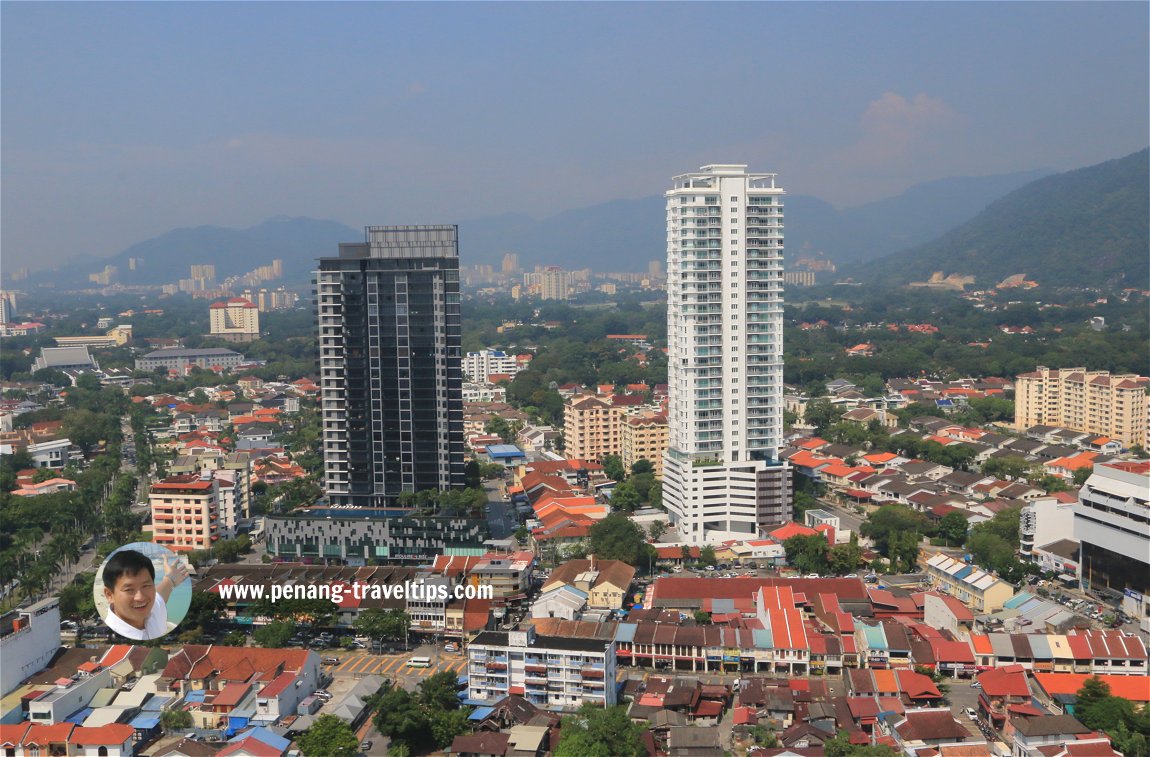 View of Pulau Tikus with Moulmein Rise (left) and The Cantonment (right) (13 July 2019)
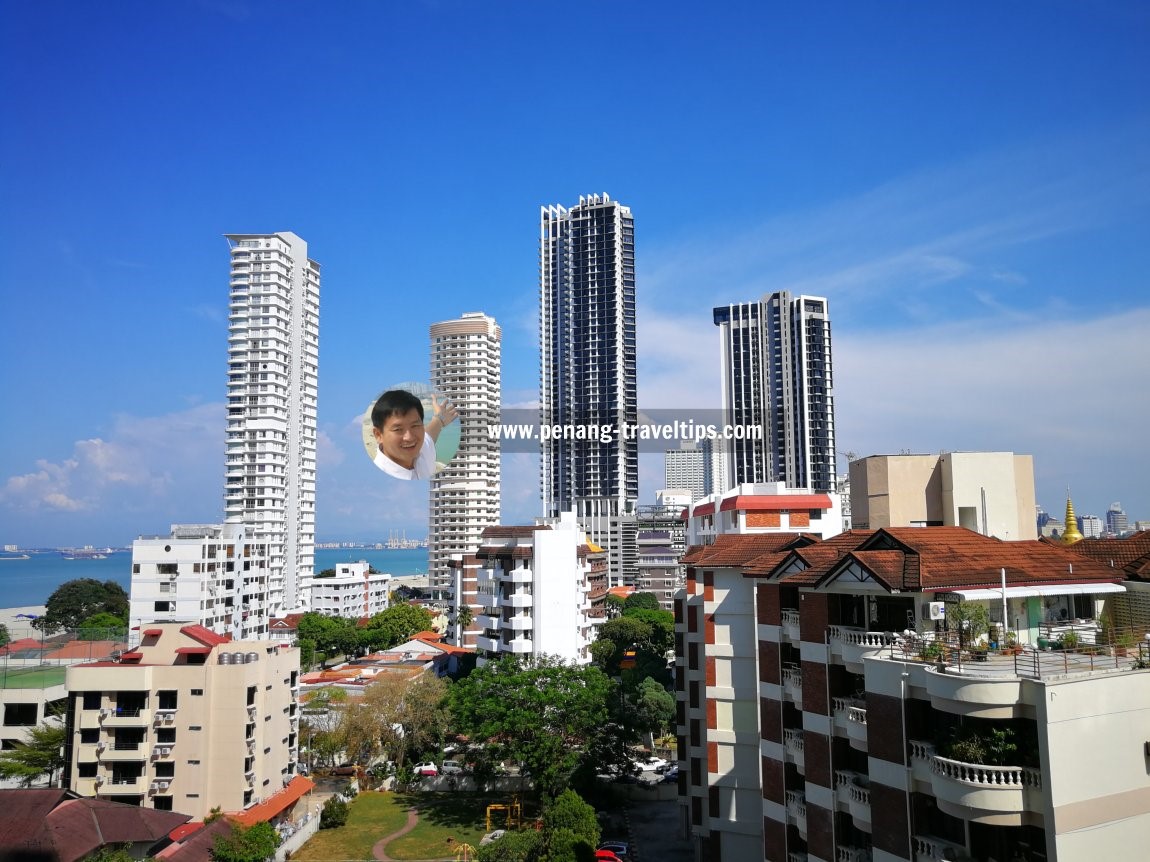 The luxury condominiums of Gurney Drive, as seen from Pulau Tikus (13 March 2019)
Further Reading
- Church of the Assumption: Church built by the first wave of Eurasians that came over with Father Arnaud-Antoine Garnault at the invitation of Captain Francis Light.
- How Pulau Tikus Got Its Name: Newly discovered information on the origin of the name for Pulau Tikus district.
List of Towns in Penang and Towns in Malaysia
Want to share your Penang travel experiences or get tips from fellow travellers?
Join the Penang Travel Tips Facebook GroupUseful guides for visiting Penang

