
MRT Putrajaya Line
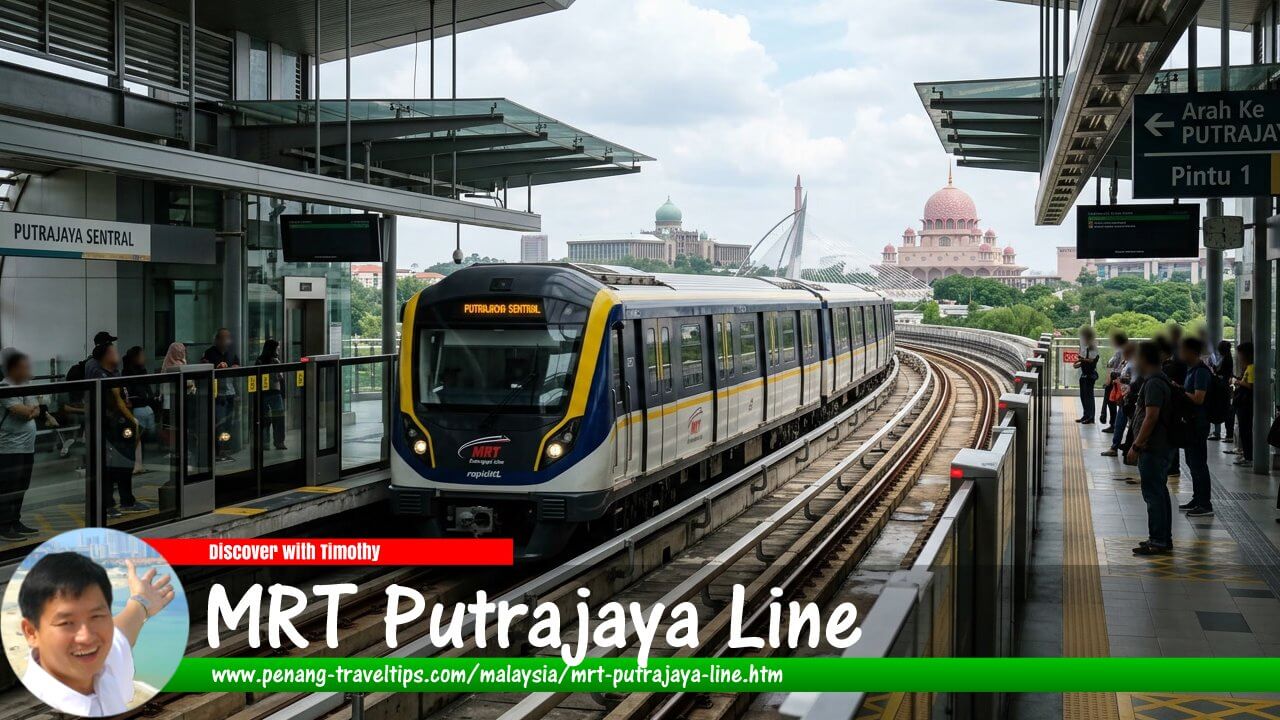 Train of the MRT Putrajaya Line entering station (Picture edited with AI on 29 June 2026)
MRT Putrajaya Line (also known as MRT2) is the second line of the Klang Valley Mass Rapid Transit network. It stretches from Kwasa Damansara MRT Station in the northwest of the Klang Valley to Putrajaya Sentral MRT Station in the federal administrative capital. The line enhances regional connectivity by linking key residential, business, and governmental areas. 1
Quick Facts
- Total length: ~57.7 km (38.7 km elevated, 13.5 km underground) 2
- Stations in service: 36 stations (27 elevated, 9 underground) 2
- Operator: Rapid Rail (Rapid KL)
- Depot: Serdang Depot 3
- Opening phases: Phase 1 (Kwasa Damansara → Kampung Batu) on 16 June 2022; Phase 2 (Kampung Batu → Putrajaya Sentral) on 16 March 2023 1
- Interchanges with other rail systems: 10 interchange stations with MRT, LRT, Monorail and KTM Komuter 4
History & Development
The MRT Putrajaya Line was proposed as part of Malaysia’s long-term plan to expand the Klang Valley’s rail network following the success of the Kajang Line. Construction began in 2016 under MRT Corp’s supervision, with MMC Gamuda KVMRT as the turnkey contractor. The project was designed to complement the first MRT line by providing north–south connectivity through dense urban corridors and extending service to government precincts in Putrajaya. 2
Route Overview
The line begins at Kwasa Damansara MRT Station, which also serves as an interchange with the Kajang Line, and continues through Sungai Buloh, Kepong, Sentul, and Titiwangsa before passing underground through the city centre — connecting Tun Razak Exchange (TRX), Persiaran KLCC and Chan Sow Lin — then proceeding southwards through Serdang and Cyberjaya before terminating at Putrajaya Sentral MRT Station. 2
List of MRT Stations
The following are stations of the Putrajaya Line that are described on this website.- Kwasa Damansara MRT Station
- Kampung Selamat MRT Station
- Sungai Buloh MRT Station
- Damansara Damai MRT Station
- Sri Damansara Barat MRT Station
- Sri Damansara Sentral MRT Station
- Sri Damansara Timur MRT Station
- Metro Prima MRT Station
- Kepong Baru MRT Station
- Jinjang MRT Station
- Sri Delima MRT Station
- Kampung Batu MRT Station
- Kentonmen MRT Station
- Jalan Ipoh MRT Station
- Sentul Barat MRT Station
- Titiwangsa MRT Station
- Hospital Kuala Lumpur MRT Station
- Raja Uda MRT Station
- Ampang Park MRT Station
- Persiaran KLCC MRT Station
- Conlay MRT Station
- Tun Razak Exchange MRT Station
- Chan Sow Lin MRT Station
- Bandar Malaysia Utara MRT Station non operational
- Bandar Malaysia Selatan MRT Station non operational
- Kuchai MRT Station
- Taman Naga Emas MRT Station
- Sungai Besi MRT Station
- Serdang Raya Utara MRT Station
- Serdang Raya Selatan MRT Station
- Serdang Jaya MRT Station
- UPM MRT Station
- Taman Universiti MRT Station non operational
- Taman Equine MRT Station
- Putra Permai MRT Station
- 16 Sierra MRT Station
- Cyberjaya North MRT Station
- Cyberjaya City Centre MRT Station
- Putrajaya Sentral MRT Station
Station Interchanges
The MRT Putrajaya Line provides numerous interchange options across the Klang Valley’s rail network:
- Kwasa Damansara — interchange with MRT Kajang Line. 2
- Kampung Batu — interchange with KTM Komuter (Batu Caves–Seremban Line). 4
- Titiwangsa — interchange with LRT Ampang/Sri Petaling Line and Monorail. 4
- TRX (Tun Razak Exchange) — interchange with MRT Kajang Line. 2
- Chan Sow Lin — interchange with LRT Ampang/Sri Petaling Line. 4
- Putrajaya Sentral — interchange with ERL (KLIA Transit). 3
Underground Section
The underground section of the line spans approximately 13.5 km and includes nine stations such as Sentul Barat, Hospital Kuala Lumpur, Titiwangsa, TRX, and Persiaran KLCC. This segment was built using advanced tunnel boring technology to navigate the densely developed city centre without disrupting existing structures. 2
Neighbourhoods Served
The Putrajaya Line serves a diverse mix of neighbourhoods, including Kepong, Sentul, Damansara Heights, Ampang fringes, and Putrajaya. The line also improves access to educational and administrative hubs such as Universiti Malaya, Serdang, Cyberjaya, and Putrajaya government precincts. 2
Rolling Stock & Capacity
The line operates 49 sets of 4-car driverless trains supplied by HAP Consortium (Siemens, Siemens Mobility and SMH Rail). Each train can carry approximately 1,200 passengers and operates on an automated signaling system similar to the Kajang Line. 3
Journey Time & Frequency
Travel time between Kwasa Damansara MRT Station and Putrajaya Sentral MRT Station is about 84 minutes end-to-end. During peak hours, trains run at 4-minute intervals, making it one of the most efficient long-distance urban rail options in Greater Kuala Lumpur. 2
Impact on Connectivity
The completion of the MRT Putrajaya Line has significantly enhanced cross-city mobility by connecting previously underserved suburbs and reducing reliance on private cars. Together with the MRT Kajang Line, it forms the backbone of the Klang Valley’s integrated rapid transit system operated by Rapid KL. 1
Future Developments
Future proposals include the MRT Circle Line (MRT3), which will further connect both the Kajang and Putrajaya Lines through additional interchange stations, creating a loop around central Kuala Lumpur. 4
Map of Klang Valley Mass Transit Lines & Stations
References
- MRT Corp — Putrajaya Line Project Overview
- MRT Corp — Fast Facts
- MMC Gamuda — MRT Putrajaya Line
- MRT.com.my — Putrajaya Line Details and Interchanges
Page Details
This page was created on 9 October 2025. Hi, my name is Timothy and created it from my research, for my own entertainment, knowledge and to satisfy my curiosity. I am providing the information to you in good faith and hope it is useful. I try to get the details as accurate as possible. I also try to update the page whenever I stumble on new details. So this and all my other pages are perpetual work in progress. If you discover any error, please politely inform me, pointing out where the error lies, and I will correct it as soon as possible. Your helpfulness will keep this page accurate, relevant and helpful to those who need the information.Return to Kuala Lumpur MRT, Malaysia Rail Transportation Network
Rapid Transit Lines
 Latest updates on Penang Travel Tips
Buy Me A Coffee
If you enjoy the information I provide and want to support the work I do, please buy me a coffee! I appreciate it immensely, thank you so much!
