
Jiangsu Province, China
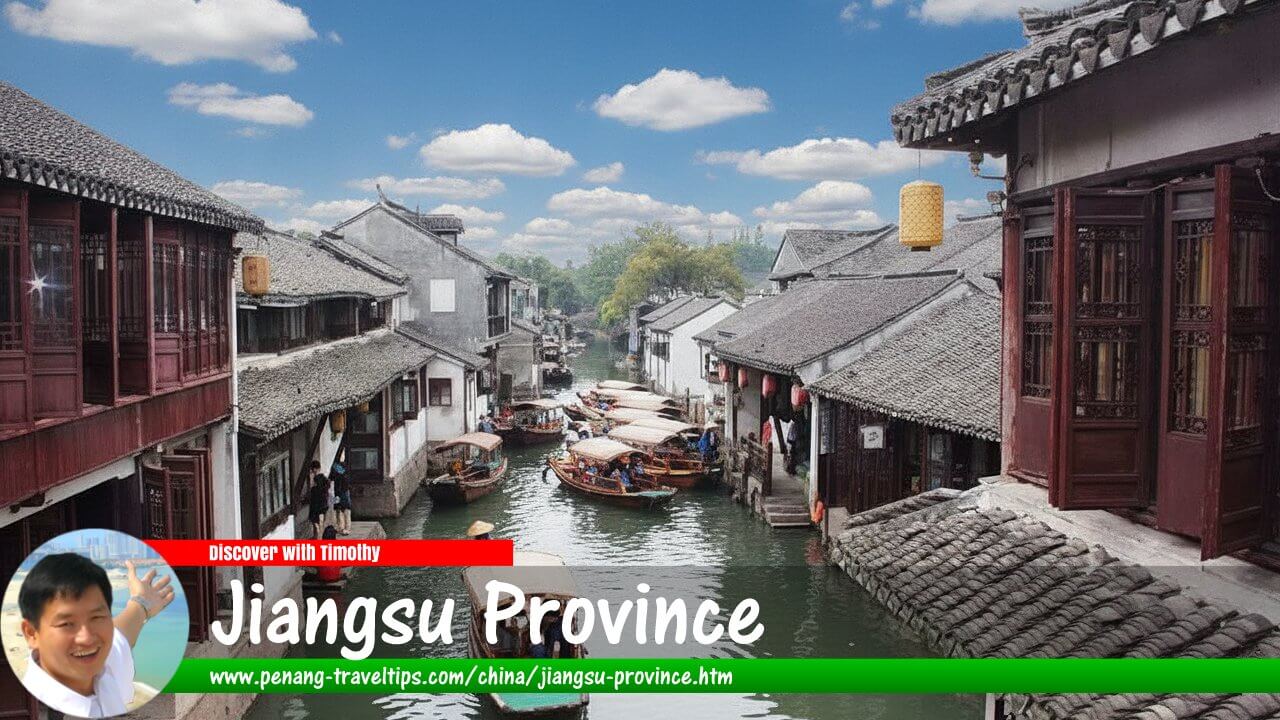 Jiangsu Province, China (Photo edited with AI on 18 June 2026)
Jiangsu Province (江苏省, Jiāngsū Shěng) is a coastal province in eastern China situated along the lower reaches of the Yangtze River and bordering the Yellow Sea. It is one of the most economically developed, urbanized, and densely populated provinces in China. Jiangsu is renowned for its prosperous cities, classical Chinese gardens, ancient canals, rich cultural traditions, advanced manufacturing industries, and significant contributions to Chinese history. The provincial capital is Nanjing, one of China's historic capitals, while cities such as Suzhou, Wuxi, and Changzhou form part of the highly developed Yangtze River Delta region.1
The name Jiangsu (江苏, Jiāngsū) is derived from the names of two important historical cities: Jiangning (江宁), the former name of Nanjing, and Suzhou (苏州). During the Qing Dynasty, administrators combined the first character of Jiangning (江) and the first character of Suzhou (苏) to create the provincial name Jiangsu. The province's official abbreviation is "Su" (苏).2
Quick Facts
- Chinese Name: 江苏省
- Pinyin: Jiāngsū Shěng
- Abbreviation: 苏 (Sū)
- Capital: Nanjing
- Location: Eastern China
- Area: Approximately 107,200 square kilometres
- Population: About 85 million people
- Highest Point: Mount Yuntai (approximately 625 metres)
- Coastline: More than 950 kilometres
- Major Rivers: Yangtze River, Huai River
- Main Languages: Mandarin and Wu Chinese dialects
- Climate: Humid subtropical to warm temperate
- GDP: Among the highest of all Chinese provinces
- Major Cities: Nanjing, Suzhou, Wuxi, Changzhou, Nantong, Xuzhou
- Famous Attractions: Classical Gardens of Suzhou, Sun Yat-sen Mausoleum, Grand Canal, Taihu Lake
Geography
Jiangsu is located on the eastern coast of China and occupies a strategic position within the Yangtze River Delta. The province borders Shandong to the north, Anhui to the west, Zhejiang and Shanghai to the south, and the Yellow Sea to the east.3
The province is one of the flattest regions in China. Much of Jiangsu consists of low-lying plains, river deltas, lakes, and wetlands. The fertile alluvial soils deposited by the Yangtze and Huai rivers have made the province one of China's most productive agricultural areas.
The Yangtze River crosses the southern portion of the province and serves as an important transportation corridor. Other major waterways include the Huai River, Qinhuai River, and the ancient Grand Canal. Jiangsu is famous for its extensive network of canals, rivers, and lakes, earning it the reputation of being a classic "water region" of China.
Lake Tai (Taihu), shared with Zhejiang Province, is one of China's largest freshwater lakes and plays an important role in tourism, fisheries, and water supply. Other notable lakes include Hongze Lake, Gaoyou Lake, and Luoma Lake.
Jiangsu experiences a humid subtropical climate in the south and a transitional climate in the north. Summers are hot and humid, while winters are cool and relatively dry. The province receives abundant rainfall due to the East Asian monsoon system.
Administrative Divisions
Jiangsu is divided into thirteen prefecture-level cities, each of which is highly developed and integrated into regional transportation and economic networks.4
- Nanjing (Provincial Capital)
- Suzhou
- Wuxi
- Changzhou
- Zhenjiang
- Nantong
- Yangzhou
- Taizhou
- Yancheng
- Huai'an
- Lianyungang
- Xuzhou
- Suqian
These cities are further divided into districts, county-level cities, counties, towns, and townships. Jiangsu is notable because all of its prefecture-level cities rank among China's relatively developed urban centers.
History
The history of Jiangsu extends back thousands of years. Archaeological evidence indicates that human settlements existed in the region during the Neolithic period. Ancient cultures flourished along the Yangtze River and around Lake Tai, contributing significantly to the development of Chinese civilization.5
During the Spring and Autumn Period and the Warring States Period, southern Jiangsu formed part of the powerful states of Wu and Yue. The city of Suzhou served as the capital of the State of Wu and became an important political and cultural center.
Under the Qin and Han dynasties, the region was incorporated into the unified Chinese empire. The construction and expansion of the Grand Canal during later dynasties significantly enhanced Jiangsu's importance by linking northern and southern China.
During the Tang Dynasty, Jiangsu became one of the wealthiest regions in the empire due to agriculture, silk production, handicrafts, and commerce. The prosperity continued during the Song Dynasty, when cities such as Suzhou and Yangzhou emerged as major centers of trade and culture.
Nanjing gained national prominence during several periods of Chinese history. It served as the capital of the Southern Dynasties, the early Ming Dynasty, the Taiping Heavenly Kingdom, and the Republic of China. The city therefore occupies a unique place in Chinese political history.6
During the Qing Dynasty, the region was among China's most prosperous economic zones. Following the reforms initiated in the late twentieth century, Jiangsu became a global manufacturing powerhouse and one of China's leading export-oriented economies.
Ethnic Groups
The overwhelming majority of Jiangsu's population belongs to the Han Chinese ethnic group, accounting for more than 99 percent of residents.
Various minority ethnic groups are also represented in the province, including the Hui, Manchu, Mongol, Miao, Zhuang, Tujia, Yi, and Korean peoples. Most minority communities are concentrated in urban centers where migration and economic opportunities have attracted residents from across China.
The Hui people constitute one of the most visible minority groups and maintain numerous mosques and Islamic cultural traditions, particularly in cities such as Nanjing and Xuzhou.
Languages and Dialects
Standard Mandarin (Putonghua) is the official language used throughout Jiangsu in government, education, and media.
However, Jiangsu is linguistically diverse and contains several major Chinese dialect groups. The province lies at the meeting point of northern and southern Chinese linguistic traditions.
Jianghuai Mandarin
Jianghuai Mandarin is widely spoken in central Jiangsu, including Nanjing, Yangzhou, and Taizhou. It possesses distinctive pronunciation and vocabulary features that differ from Standard Mandarin.
Wu Chinese
Wu dialects are prevalent in southern Jiangsu, especially in Suzhou, Wuxi, and Changzhou. These dialects are closely related to those spoken in Shanghai and Zhejiang Province.
Northern Mandarin
In northern Jiangsu, especially around Xuzhou and Lianyungang, dialects belong largely to the Northern Mandarin family.
Due to modernization, education, and migration, Standard Mandarin has become increasingly dominant, although local dialects remain important markers of regional identity.
Economy
Jiangsu possesses one of the largest provincial economies in China and ranks among the country's wealthiest regions. Its GDP consistently ranks near the top among all Chinese provinces and municipalities.7
The province benefits from its location in the Yangtze River Delta, one of the most economically dynamic regions in the world. Strong transportation infrastructure, access to international markets, and a highly skilled workforce have contributed to sustained economic growth.
Major industries include:
- Electronics and semiconductors
- Information technology
- Automobile manufacturing
- Petrochemicals
- Machinery and equipment manufacturing
- Textiles and garments
- Biotechnology
- Financial services
- E-commerce
- Shipbuilding
Suzhou is one of China's leading centers for high-tech manufacturing and foreign investment. Wuxi is known for advanced industry and integrated circuits, while Nanjing serves as a major educational, technological, and research hub.
Agriculture remains important despite urbanization. Major agricultural products include rice, wheat, rapeseed, cotton, freshwater fish, crabs, tea, fruits, and vegetables. Yangcheng Lake hairy crabs are among Jiangsu's most famous culinary specialties.
Main Cities
Nanjing
The provincial capital and one of China's Four Great Ancient Capitals, famous for historical monuments and universities.
Suzhou
Known worldwide for its UNESCO-listed classical gardens, canals, silk production, and economic prosperity.
Wuxi
An industrial and commercial center located on the shores of Lake Tai.
Changzhou
A major manufacturing city with rapidly expanding technology industries.
Nantong
An important port city on the northern side of the Yangtze estuary.
Yangzhou
A historic city renowned for gardens, canals, and cultural heritage.
Zhenjiang
Known for its location on the Yangtze River and famous vinegar production.
Xuzhou
A major transportation hub in northern Jiangsu with significant historical importance.
Lianyungang
A coastal city and major seaport connecting eastern China with inland regions.
How to Go There
By Air
Jiangsu is served by numerous airports that connect the province with domestic and international destinations.
- Nanjing Lukou International Airport – The province's largest airport, serving destinations throughout China, Asia, Europe, and other international markets.
- Sunan Shuofang International Airport (Wuxi) – Serving southern Jiangsu.
- Changzhou Benniu International Airport
- Nantong Xingdong International Airport
- Yancheng Nanyang International Airport
- Xuzhou Guanyin International Airport
- Lianyungang Huaguoshan International Airport
Airlines operating services include Air China, China Eastern Airlines, China Southern Airlines, Shenzhen Airlines, Hainan Airlines, XiamenAir, Spring Airlines, Juneyao Air, Cathay Pacific, and various international carriers.
By Rail
Jiangsu has one of China's most extensive high-speed railway systems. Major stations include:
- Nanjing South Railway Station
- Nanjing Railway Station
- Suzhou Railway Station
- Suzhou North Railway Station
- Wuxi Railway Station
- Changzhou Railway Station
- Xuzhou East Railway Station
- Nantong Railway Station
High-speed trains connect Jiangsu with Beijing, Shanghai, Guangzhou, Shenzhen, Wuhan, Hangzhou, Xi'an, Chengdu, and many other cities.
By Long-Distance Bus
Major long-distance bus terminals are located throughout the province, including Nanjing Central Bus Station, Suzhou North Bus Station, Wuxi Bus Station, Yangzhou West Bus Station, and Xuzhou Bus Terminal.
How to Travel Locally
Transportation within Jiangsu is modern, efficient, and widely available.
- Metro/Subway: Nanjing, Suzhou, Wuxi, Changzhou, Nantong, and Xuzhou operate urban rail transit systems.
- Public Buses: Comprehensive networks serve cities and suburbs.
- Taxis: Widely available throughout the province.
- E-Hailing Services: Didi Chuxing is the primary ride-hailing platform.
- Bicycle Sharing: Popular in major cities.
- Ferries: Available across sections of the Yangtze River and around major lakes.
- Intercity Rail: High-speed and commuter rail services provide convenient travel between cities.
Traditional forms of transportation such as rickshaws, trishaws, and tuk-tuks are generally uncommon in modern Jiangsu cities.
Tourist Attractions
Classical Gardens of Suzhou
A UNESCO World Heritage Site featuring exquisite examples of traditional Chinese garden design.
Sun Yat-sen Mausoleum
A monumental memorial in Nanjing dedicated to the founder of modern China.
Ming Xiaoling Mausoleum
The tomb of the Hongwu Emperor, founder of the Ming Dynasty.
Nanjing City Wall
One of the world's longest surviving ancient city walls.
Confucius Temple (Fuzimiao)
A popular cultural and commercial district in Nanjing.
Grand Canal of China
The world's longest artificial waterway and a UNESCO World Heritage Site.
Tiger Hill
A historic landmark in Suzhou famous for its leaning pagoda.
Zhouzhuang Water Town
One of China's most famous ancient canal towns.
Tongli Water Town
A well-preserved historic town featuring canals, stone bridges, and traditional architecture.
Taihu Lake
A scenic freshwater lake known for boating, gardens, and lakeside resorts.
Slender West Lake
A picturesque park in Yangzhou featuring elegant bridges and classical landscaping.
Yunlong Lake
A scenic recreational area in Xuzhou surrounded by hills and cultural attractions.
Huaguo Mountain
Associated with the legend of the Monkey King from the classic novel Journey to the West.
Jiangsu Province is  the Map of the Provinces of China
References
- Jiangsu Provincial Government – Overview
- History and Name of Jiangsu
- Encyclopaedia Britannica – Jiangsu
- Administrative Divisions of Jiangsu
- UNESCO World Heritage Centre – Liangzhu and Related Cultures
- Encyclopaedia Britannica – Nanjing
- National Bureau of Statistics of China
Page Details
This page was created/modified on 18 June 2026. Hi, my name is Timothy and created it from my research, for my own entertainment, knowledge and to satisfy my curiosity. I am providing the information to you in good faith and hope it is useful. I try to get the details as accurate as possible. I also try to update the page whenever I stumble on new details. So this and all my other pages are perpetual work in progress. If you discover any error, please politely inform me, pointing out where the error lies, and I will correct it as soon as possible. Your helpfulness will keep this page accurate, relevant and helpful to those who need the information.