
Nantong, China
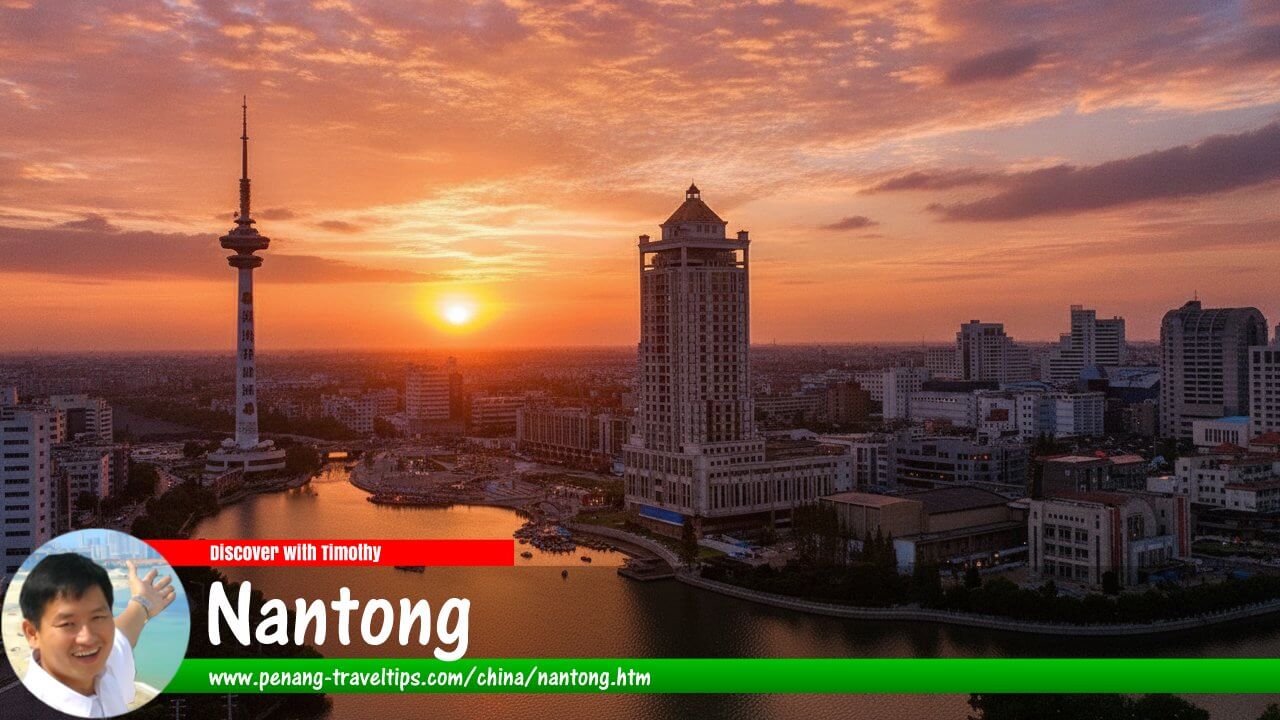 Nantong, China (Photo edited with AI on 18 June 2026)
Nantong (南通, Nántōng) is a prefecture-level city in southeastern Jiangsu Province, China, situated on the northern bank of the Yangtze River near its mouth at the East China Sea. Often referred to as the "Gateway to Northern Jiangsu," Nantong occupies a strategic position within the Yangtze River Delta and serves as an important centre for manufacturing, shipping, education, and commerce.1 With a history spanning more than a thousand years, the city has evolved from a coastal salt-producing region into one of China's most prosperous and modern urban centres. Today, Nantong is known for its textile industry, extensive port facilities, cultural heritage, and strong economic ties with nearby Shanghai.
The name "Nantong" literally means "Southern Passage" or "Southern Connection." The character 南 (nán) means "south," while 通 (tōng) means "to connect," "communicate," or "pass through." Historically, the name reflected the city's role as an important transportation and communication link between northern and southern China via the Yangtze River and coastal shipping routes.2 The name has been in use since the Later Zhou period during the Five Dynasties era.
Quick Facts
- Chinese Name: 南通
- Pinyin: Nántōng
- Province: Jiangsu
- Location: Northern bank of the Yangtze River estuary
- Area: Approximately 8,549 square kilometres
- Population: About 7.7 million
- Administrative Centre: Chongchuan District
- Main Languages: Mandarin, Nantong dialect (Wu Chinese and Jianghuai influences)
- Climate: Humid subtropical climate
- Main Industries: Textiles, manufacturing, shipping, electronics, renewable energy
- Famous Products: Textiles, blue calico cloth, seafood, shipbuilding products
- Airport: Nantong Xingdong International Airport
- Major Attractions: Hao River, Langshan, Nantong Museum, Wolf Hill
Geography
Nantong is located in southeastern Jiangsu Province, directly across the Yangtze River from Shanghai and Suzhou. The city occupies a strategic position where the Yangtze River approaches the East China Sea, making it one of China's most important river-sea transportation hubs.3
The city's terrain consists primarily of flat alluvial plains formed by centuries of sediment deposited by the Yangtze River. The fertile soil supports intensive agriculture, while extensive river networks and waterways facilitate transportation and commerce.
Nantong possesses a long coastline along the East China Sea and extensive riverfront areas along the Yangtze. The city also administers several islands and reclaimed coastal lands that have become important centres for industry, agriculture, and logistics.
Despite the generally flat landscape, Nantong is famous for a small group of scenic hills known collectively as the "Five Mountains," of which Langshan (Wolf Hill) is the most famous. These hills stand out prominently in the otherwise level terrain.4
The climate is humid subtropical, with four distinct seasons. Summers are hot and humid, while winters are relatively cool. Spring and autumn are mild and pleasant, making them popular seasons for tourism and outdoor activities.5
Languages and Dialects
Mandarin is the official language used in education, government, and public life. However, Nantong's linguistic landscape reflects its location at the intersection of several Chinese dialect regions.
- Nantong Dialect: Traditionally classified within the Wu Chinese language family, though it also contains influences from Jianghuai Mandarin.
- Jianghuai Mandarin: Spoken in some northern and inland areas of the municipality.
- Standard Mandarin: Widely spoken and understood throughout the city.
- Other Chinese Dialects: Due to migration and economic development, dialects such as Cantonese, Min, and Hakka may also be heard.
The local Nantong dialect is considered culturally significant and remains an important marker of local identity despite the increasing influence of Mandarin.
History
The history of Nantong is closely linked to the changing course of the Yangtze River and the gradual formation of coastal land through sediment deposition. Much of the area was originally underwater before centuries of natural land reclamation created fertile plains suitable for settlement.6
During the Tang Dynasty, the region became an important centre for salt production, a highly valuable commodity in imperial China. Salt fields along the coast generated significant wealth and contributed to the development of local communities.
The city acquired the name Nantong during the Later Zhou period (951–960 AD). Throughout the Song, Yuan, Ming, and Qing dynasties, it continued to prosper through agriculture, salt production, fishing, and trade.
A major turning point occurred during the late Qing Dynasty when the industrialist and educator Zhang Jian established modern textile mills, schools, museums, and public institutions in Nantong. Zhang Jian is widely regarded as the father of modern Nantong and one of China's most influential reformers.7
During the twentieth century, Nantong expanded its industrial base and developed into a major manufacturing centre. Following China's economic reforms beginning in 1978, the city experienced rapid growth in textiles, electronics, shipbuilding, and international trade.
Today, Nantong is one of the most economically dynamic cities in the Yangtze River Delta and serves as an important bridge between Shanghai and northern Jiangsu.
Economy and Products
Nantong has one of the strongest economies in Jiangsu Province and is particularly famous for its textile industry. For more than a century, textile production has been a cornerstone of the city's economic development.8
The city is a major producer of cotton textiles, garments, home furnishings, and industrial fabrics. Nantong's textile products are exported worldwide and enjoy a strong reputation for quality.
One of the city's most famous traditional products is Nantong blue calico (蓝印花布), a distinctive indigo-dyed fabric featuring white decorative patterns. This traditional handicraft is recognised as an important element of China's cultural heritage.9
Modern industries include shipbuilding, marine engineering, electronics, biotechnology, renewable energy, machinery manufacturing, and advanced materials. Nantong's proximity to Shanghai has attracted significant domestic and foreign investment.
The Port of Nantong is one of the most important river-sea ports in China. It handles bulk cargo, containers, automobiles, machinery, and industrial materials, supporting both domestic and international trade.
Agriculture remains important in surrounding rural areas, producing rice, wheat, cotton, vegetables, and seafood. Coastal aquaculture and freshwater fisheries contribute significantly to the local economy.
How to Go There
By Air
Nantong is served by Nantong Xingdong International Airport, located approximately 12 kilometres northeast of the city centre.
The airport offers domestic flights to major Chinese cities including Beijing, Guangzhou, Shenzhen, Chengdu, Chongqing, Xi'an, Kunming, Harbin, Qingdao, and Wuhan. Airlines operating there include Air China, China Eastern Airlines, China Southern Airlines, Shenzhen Airlines, Xiamen Airlines, and Spring Airlines.10
The airport also operates selected international and regional routes depending on seasonal schedules and market demand.
By Train
Nantong is connected to China's national railway network through several major stations.
- Nantong Railway Station – located in Chongchuan District and serving conventional and high-speed rail services.
- Nantong West Railway Station – a major high-speed rail station.
- Haimen Railway Station – serving eastern parts of the municipality.
- Qidong Railway Station – serving coastal districts.
High-speed rail services connect Nantong with Shanghai, Nanjing, Suzhou, Hangzhou, Beijing, and many other major cities.
By Long-Distance Bus
Major bus terminals include Nantong Long-Distance Bus Station and Nantong East Bus Station. Frequent coach services operate throughout Jiangsu Province and neighbouring regions.
Local Transportation
Nantong possesses a modern transportation system that provides convenient access throughout the municipality.
- Metro: Nantong Metro operates multiple lines connecting key districts, commercial areas, railway stations, and residential neighbourhoods.
- Taxis: Widely available throughout the city.
- E-hailing Services: Didi Chuxing is the most popular ride-hailing platform.
- Public Buses: Extensive routes cover both urban and suburban areas.
- Bicycle Sharing: Public bicycles and shared bikes are widely available.
- E-bikes: Common for short-distance travel.
Traditional trishaws, rickshaws, and tuk-tuks are generally not used as part of the city's public transportation network.
Tourist Attractions
1. Langshan (Wolf Hill)
Langshan is Nantong's most famous landmark. Rising about 107 metres above the surrounding plain, it offers scenic views, historic temples, and cultural attractions. The hill has been an important Buddhist centre for centuries.11
2. Hao River Scenic Area
Often described as one of China's best-preserved ancient city moats, the Hao River encircles the historic city centre and provides beautiful waterfront scenery, parks, and boat tours.
3. Nantong Museum
Founded by Zhang Jian in 1905, this is one of China's earliest public museums. Its collections include archaeology, natural history, art, and local cultural artefacts.
4. Zhang Jian Memorial Hall
This museum commemorates the life and achievements of Zhang Jian, whose contributions transformed Nantong into a modern industrial and educational centre.
5. Nantong Blue Calico Museum
Dedicated to the city's famous textile tradition, the museum showcases the history, techniques, and artistic significance of blue calico production.
6. Junshan Scenic Area
One of Nantong's Five Mountains, Junshan offers gardens, temples, and panoramic views of the surrounding landscape.
7. Binjiang Park
This riverside park along the Yangtze River features walking paths, recreational facilities, gardens, and scenic river views.
8. Qidong Golden Beach
Located near the coast, this scenic area offers opportunities for beach walks, birdwatching, and enjoying coastal landscapes.
9. Nantong Adventure Kingdom
A family-friendly theme park featuring rides, entertainment, and recreational attractions.
10. Haimen Lotus Garden
Known for its seasonal lotus displays and traditional Chinese landscaping, this garden is a popular destination for nature lovers and photographers.
Nantong, China is  the Map of Cities in China
References
- Encyclopaedia Britannica – Nantong
- Wikipedia – Nantong
- Travel China Guide – Nantong
- China Daily – Nantong Overview
- Climate Information for Nantong
- Encyclopaedia Britannica – Jiangsu History
- Zhang Jian
- Nantong Municipal Government
- Traditional Textile Heritage Resources
- Nantong Xingdong International Airport
- Langshan Scenic Area
Page Details
This page was created/modified on 18 June 2026. Hi, my name is Timothy and created it from my research, for my own entertainment, knowledge and to satisfy my curiosity. I am providing the information to you in good faith and hope it is useful. I try to get the details as accurate as possible. I also try to update the page whenever I stumble on new details. So this and all my other pages are perpetual work in progress. If you discover any error, please politely inform me, pointing out where the error lies, and I will correct it as soon as possible. Your helpfulness will keep this page accurate, relevant and helpful to those who need the information.