
Yangtze River, China
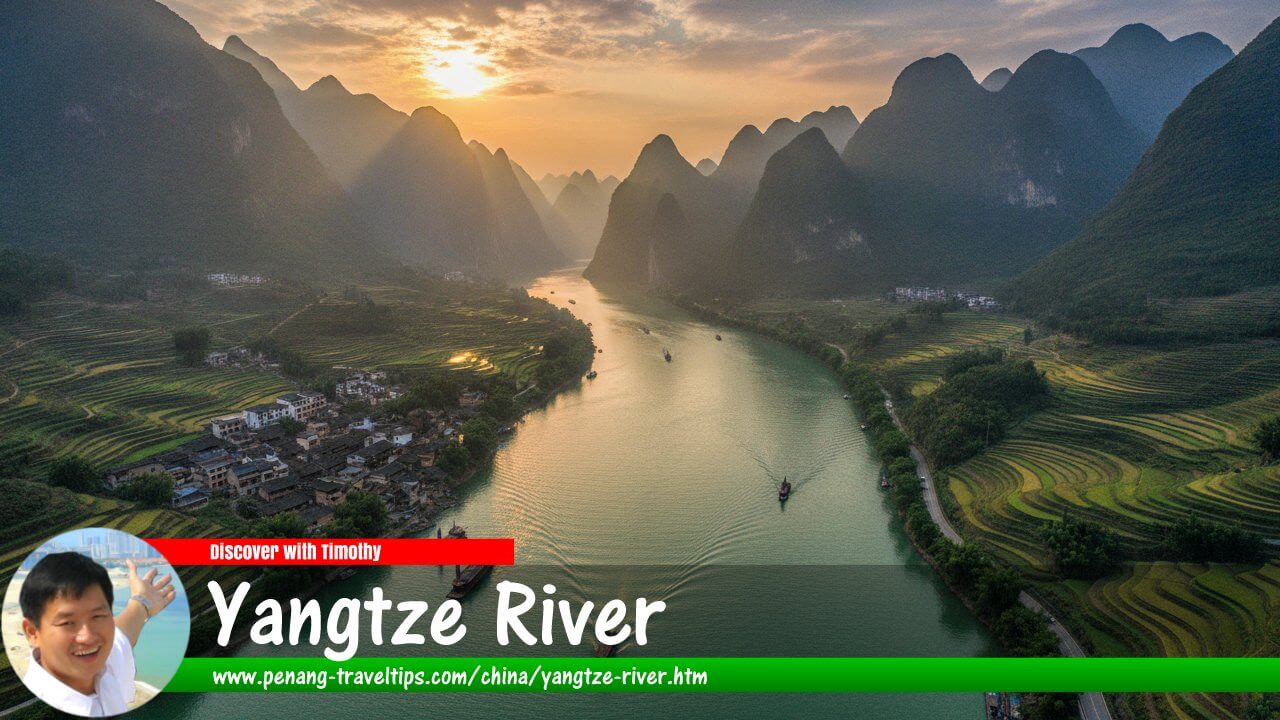 Yangtze River, China (AI generated artist impression created on 16 June 2026)
Yangtze River, known in Chinese as 长江 and in pinyin as Cháng Jiāng, is the longest river in Asia and the third-longest river in the world after the Nile and the Amazon. Stretching across much of China from the Tibetan Plateau to the East China Sea, it has played a central role in the country's geography, history, economy, and culture for thousands of years. The river serves as a vital transportation corridor, a source of water and agricultural prosperity, and a defining feature of the Chinese landscape.1
Quick Facts
- English Name: Yangtze River
- Chinese Name: 长江
- Pinyin: Cháng Jiāng
- Length: Approximately 6,300 km
- Source: Tanggula Mountains, Qinghai Province
- Mouth: East China Sea near Shanghai
- Drainage Basin: Approximately 1.8 million square kilometres
- Countries: China
- Major Cities: Yibin, Chongqing, Yichang, Wuhan, Jiujiang, Nanjing, Shanghai
- Notable Feature: Asia's longest river
Name and Origin
The river is officially known in Chinese as Cháng Jiāng (长江), which literally means "Long River." This name reflects its immense length and significance within China. Historically, different sections of the river were known by different local names, but the term Cháng Jiāng eventually became the standard name for the entire waterway.2
The English name "Yangtze" derives from "Yangzi Jiang" (扬子江), a name that originally referred only to a lower section of the river near Yangzhou. Early European traders and missionaries mistakenly applied this local name to the entire river, and the term "Yangtze River" subsequently became widely used in Western languages.3
Geography
The Yangtze River originates in the Tanggula Mountains of Qinghai Province on the Tibetan Plateau. From its source, it flows generally eastward across central China before emptying into the East China Sea near Shanghai. The river traverses a remarkable variety of landscapes, including high plateaus, deep gorges, fertile plains, wetlands, and coastal lowlands.
At approximately 6,300 kilometres in length, the Yangtze is the longest river in Asia and the third-longest river in the world. Its drainage basin covers nearly one-fifth of China's land area and supports hundreds of millions of people.4
The river system includes numerous tributaries, among them the Min River, Jialing River, Han River, Wu River, and Yalong River. Together, these waterways create one of the world's largest and most productive river basins.
Major Cities Along the Yangtze
The river passes through or near many of China's most important cities, including:
- Yibin
- Luzhou
- Chongqing
- Yichang
- Jingzhou
- Wuhan
- Jiujiang
- Anqing
- Wuhu
- Nanjing
- Zhenjiang
- Shanghai
These cities have historically benefited from access to transportation, trade routes, water resources, and fertile agricultural land.
Major Geographic Features
The Yangtze River is associated with several famous geographic landmarks:
- The Three Gorges
- Poyang Lake
- Dongting Lake
- The Sichuan Basin
- The Yangtze Delta
- The Three Gorges Dam
The lower reaches of the river form the Yangtze River Delta, one of the most densely populated and economically developed regions in the world.
History
The Yangtze River has been a cradle of Chinese civilization for thousands of years. Archaeological discoveries reveal that agricultural communities flourished along its banks during prehistoric times. Fertile floodplains supported the cultivation of rice, contributing significantly to the development of settled societies.5
Throughout Chinese history, the river served as both a transportation corridor and a cultural boundary. Northern and southern China often developed distinct cultural traditions, yet the Yangtze also facilitated communication and trade between regions.
During the Qin Dynasty (221–206 BCE) and Han Dynasty (206 BCE–220 CE), imperial authorities expanded infrastructure and navigation along the river. The Yangtze became increasingly important for moving troops, agricultural products, and commercial goods.
By the Tang Dynasty (618–907 CE) and Song Dynasty (960–1279 CE), economic activity along the river flourished. Cities such as Nanjing and Wuhan emerged as major commercial centres. Trade networks connected inland provinces with coastal ports, promoting economic growth and cultural exchange.
The river played significant roles in military history as well. Numerous battles occurred along its banks, including famous engagements during the Three Kingdoms period. The Battle of Red Cliffs, fought in 208–209 CE, remains one of the most celebrated military events in Chinese history.6
In the nineteenth and twentieth centuries, treaty ports along the Yangtze opened to foreign trade, increasing international economic connections. Modern industrialization transformed many river cities into major manufacturing centres.
A major milestone in the river's modern history was the construction of the Three Gorges Dam. Completed in stages during the early twenty-first century, it became the world's largest hydroelectric power station by installed capacity.7
Economy and Products Along the River
The Yangtze River basin is one of the most economically important regions in China. It contributes a substantial share of the nation's agricultural output, industrial production, transportation activity, and population.
The river serves as a major inland shipping route. Ocean-going vessels can navigate significant portions of the lower river, while smaller cargo ships travel much farther inland. The Yangtze functions as a commercial highway linking western, central, and eastern China.
Key industries along the river include:
- Automobile manufacturing
- Steel production
- Petrochemicals
- Electronics
- Shipbuilding
- Textiles
- Machinery manufacturing
- Hydroelectric power generation
Shanghai, located at the river's mouth, is China's largest city and one of the world's busiest ports. Chongqing serves as a major industrial and logistics hub in western China, while Wuhan is a leading centre for manufacturing, transportation, and education.
Agriculture remains vital throughout the basin. The fertile lands support production of:
- Rice
- Wheat
- Cotton
- Rapeseed
- Tea
- Freshwater fish
- Vegetables and fruits
The Yangtze basin is often described as China's most important rice-growing region. Abundant water supplies and fertile soils have supported agricultural prosperity for centuries.
The river is also a major source of hydroelectric power. In addition to the Three Gorges Dam, numerous other dams generate electricity and contribute to flood control and water management.
Environment and Wildlife
The Yangtze River basin contains a wide range of ecosystems, from alpine grasslands near its source to wetlands and estuaries near its mouth. These habitats support remarkable biodiversity.
Historically, the river was home to unique species such as the Chinese paddlefish and the baiji, or Yangtze river dolphin. Unfortunately, rapid industrialization, habitat loss, pollution, and heavy river traffic have placed significant pressure on aquatic ecosystems.8
Conservation efforts have expanded in recent decades. Government agencies and environmental organizations have implemented fishing restrictions, habitat restoration projects, and pollution-control measures aimed at protecting the river's ecological health.
Tourist Attractions Along the Yangtze River
The Yangtze River offers some of China's most famous natural and cultural attractions.
1. Three Gorges
The Three Gorges—Qutang Gorge, Wu Gorge, and Xiling Gorge—are among China's most spectacular scenic areas. Towering cliffs and dramatic landscapes attract millions of visitors each year.
2. Three Gorges Dam
This engineering marvel is one of the world's largest hydroelectric projects and offers visitor centres and observation platforms.
3. Chongqing Riverfront
Known for its dramatic skyline and mountainous setting, Chongqing provides popular Yangtze River cruises and urban sightseeing opportunities.
4. Yellow Crane Tower
Located in Wuhan, this historic tower is one of China's most famous cultural landmarks and offers views of the Yangtze River.
5. Poyang Lake
China's largest freshwater lake is connected to the Yangtze and is renowned for birdwatching and wetland scenery.
6. Nanjing Yangtze River Bridge
This historic bridge symbolizes China's engineering achievements and remains an important transportation link.
7. Shanghai Bund
The Bund offers iconic views of the Huangpu River near the Yangtze estuary, featuring historic architecture and a modern skyline.
8. Shibaozhai Pagoda
This striking wooden pagoda near Chongqing is one of the most famous architectural landmarks along the river.
9. Fengdu Ghost City
A unique cultural attraction featuring temples, shrines, and folklore associated with the Chinese afterlife.
10. Yangtze River Cruises
Multi-day cruises between Chongqing and Yichang allow visitors to experience the river's scenery, history, and engineering achievements.
Legacy and Significance
The Yangtze River has profoundly influenced the development of China for millennia. As the country's longest river, it has nurtured civilizations, supported agriculture, enabled commerce, and connected distant regions. Today, it remains one of the world's most important waterways, serving hundreds of millions of people while continuing to shape China's economic and cultural future.
References
- Encyclopaedia Britannica – Yangtze River
- Encyclopaedia Britannica – Chang Jiang
- National Geographic – Yangtze River
- World Wildlife Fund – Yangtze River Basin
- UNESCO – Cultural Landscapes and Yangtze Region History
- Encyclopaedia Britannica – Battle of Red Cliffs
- Encyclopaedia Britannica – Three Gorges Dam
- IUCN – Yangtze River Conservation
Page Details
This page was created/modified on 16 June 2026. Hi, my name is Timothy and created it from my research, for my own entertainment, knowledge and to satisfy my curiosity. I am providing the information to you in good faith and hope it is useful. I try to get the details as accurate as possible. I also try to update the page whenever I stumble on new details. So this and all my other pages are perpetual work in progress. If you discover any error, please politely inform me, pointing out where the error lies, and I will correct it as soon as possible. Your helpfulness will keep this page accurate, relevant and helpful to those who need the information.