
Tibetan Plateau, China
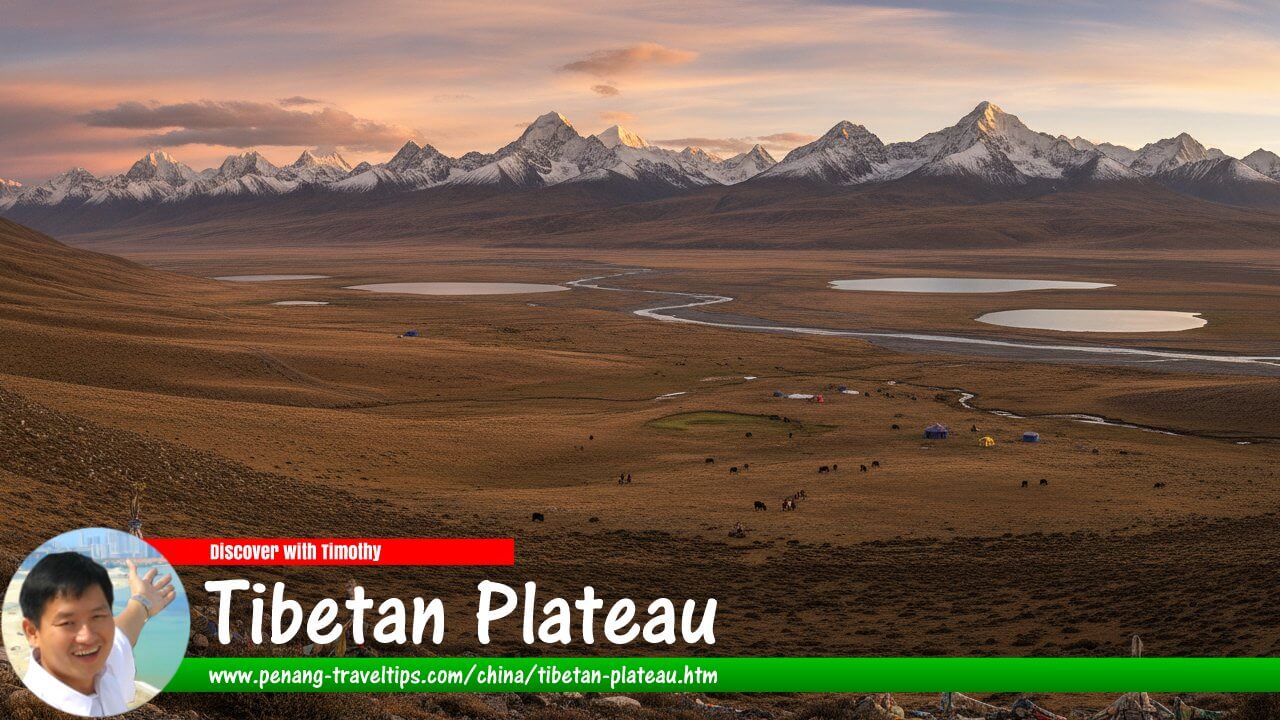 Tibetan Plateau, China (Photo edited with AI on 16 June 2026)
Tibetan Plateau, known in Chinese as 青藏高原 and in pinyin as Qīngzàng Gāoyuán, is the highest and one of the largest plateaus on Earth. Often referred to as the “Roof of the World,” it occupies a vast area of western China and extends into several neighboring countries. The plateau is renowned for its extraordinary elevation, dramatic mountain ranges, extensive grasslands, glaciers, and unique cultural heritage. It plays a crucial role in Asia’s geography and climate, serving as the source region for many of the continent’s major rivers. The Tibetan Plateau has long been a center of Tibetan civilization and remains one of the most distinctive regions in the world.1
Quick Facts
- English Name: Tibetan Plateau
- Chinese Name: 青藏高原
- Pinyin: Qīngzàng Gāoyuán
- Nickname: Roof of the World
- Location: Western China and parts of neighboring countries
- Area: Approximately 2.5 million square kilometers
- Average Elevation: About 4,500 meters above sea level
- Major Chinese Regions: Tibet Autonomous Region, Qinghai, western Sichuan, southern Xinjiang, and parts of Gansu and Yunnan
- Highest Nearby Peak: Mount Everest (8,848.86 meters)
- Major Rivers Originating Here: Yangtze, Yellow, Mekong, Salween, Brahmaputra, and Indus
- Main Economic Activities: Animal husbandry, mining, tourism, hydropower, and agriculture
Name and Origin
The English name “Tibetan Plateau” derives from its association with Tibet, the historic homeland of the Tibetan people. The Chinese name, 青藏高原 (Qīngzàng Gāoyuán), combines the characters 青 (Qing), referring to Qinghai Province, and 藏 (Zang), a traditional Chinese abbreviation for Tibet. The term 高原 (gāoyuán) means “plateau.” Thus, the Chinese name literally means the “Qinghai-Tibet Plateau.”2
The plateau earned the nickname “Roof of the World” because of its immense average elevation, which exceeds 4,500 meters above sea level. It is not only the highest plateau on Earth but also one of the most influential geographic features in Asia due to its effects on weather patterns, ecosystems, and water resources.3
Geography
Location and Size
The Tibetan Plateau covers approximately 2.5 million square kilometers, making it one of the largest plateaus in the world. It occupies much of southwestern and western China and extends into parts of India, Nepal, Bhutan, Pakistan, and other neighboring regions. Within China, the plateau encompasses most of the Tibet Autonomous Region and Qinghai Province, as well as portions of Sichuan, Gansu, Yunnan, and Xinjiang.4
The plateau was formed through the collision of the Indian and Eurasian tectonic plates, a geological process that began roughly 50 million years ago and continues today. This collision uplifted the land and created many of Asia’s highest mountain ranges.5
Mountain Ranges
The Tibetan Plateau is surrounded and crossed by some of the world's most famous mountain systems. These include:
- Himalayas to the south
- Kunlun Mountains to the north
- Karakoram Range to the west
- Hengduan Mountains to the southeast
- Tanggula Mountains in the central plateau
Among these mountains stands Mount Everest, the world's highest peak, located on the border between Tibet and Nepal. Numerous other peaks exceed 7,000 and 8,000 meters in elevation.6
Rivers and Lakes
The Tibetan Plateau is often described as Asia’s “Water Tower” because many of the continent’s major rivers originate there. These rivers provide water to billions of people downstream.
- Yangtze River (Chang Jiang)
- Yellow River (Huang He)
- Mekong River (Lancang Jiang)
- Salween River (Nu Jiang)
- Brahmaputra River (Yarlung Tsangpo)
- Indus River
The plateau is also home to thousands of lakes, including Qinghai Lake, Namtso, Yamdrok Lake, and Siling Lake. Many of these lakes are situated at extremely high elevations and contribute to the region’s unique ecology.7
Climate
The Tibetan Plateau experiences a harsh high-altitude climate characterized by low temperatures, strong solar radiation, thin air, and relatively low precipitation in many areas. Winters are long and cold, while summers are short and cool. Climatic conditions vary considerably between the wetter southeastern regions and the arid northwestern areas.8
Major Cities
Although sparsely populated compared to eastern China, the plateau contains several important urban centers:
- Lhasa – Capital of the Tibet Autonomous Region
- Xining – Capital of Qinghai Province
- Shigatse – Tibet’s second-largest city
- Chamdo – Major eastern Tibetan city
- Nagqu – Important high-altitude administrative center
- Yushu – Significant city in southern Qinghai
History
Human habitation on the Tibetan Plateau dates back thousands of years. Archaeological discoveries indicate that prehistoric peoples adapted to the plateau’s challenging environment long before recorded history. These early inhabitants developed specialized lifestyles suited to high-altitude conditions.9
By the 7th century, the region was unified under the Tibetan Empire established by Songtsen Gampo. During this period, Tibet expanded significantly and became a major political power in Central Asia. Buddhism was introduced and gradually became the dominant religion, profoundly influencing Tibetan culture, art, literature, and governance.10
Following the decline of the Tibetan Empire in the 9th century, the plateau experienced periods of fragmentation and regional rule. Various kingdoms and religious institutions held influence over different areas. Tibetan Buddhism continued to flourish and shaped the social and political landscape.
From the 13th century onward, Tibet came under varying degrees of influence from successive Chinese dynasties, including the Yuan, Ming, and Qing dynasties. Relations between Tibetan leaders and Chinese governments evolved over centuries through administrative arrangements, religious patronage, and political alliances.11
In the modern era, major infrastructure projects such as highways, airports, and the Qinghai–Tibet Railway have improved connectivity between the plateau and other parts of China. These developments have transformed transportation, commerce, and tourism across the region.12
Economy
Animal Husbandry
Animal husbandry remains one of the most important economic activities on the Tibetan Plateau. Nomadic and semi-nomadic herders raise yaks, sheep, goats, and horses on the extensive grasslands. Yaks are particularly valuable because they provide meat, milk, wool, hides, and transportation in high-altitude environments.13
Agriculture
Agriculture is concentrated in river valleys and lower-elevation areas. Barley, especially highland barley known as qingke, is the region’s traditional staple crop. Other crops include wheat, potatoes, rapeseed, and vegetables cultivated in suitable climatic conditions.14
Mining and Natural Resources
The plateau contains significant mineral resources, including copper, gold, lithium, chromite, lead, zinc, and other valuable minerals. Resource extraction has become an increasingly important contributor to regional economic growth. Careful management of mining activities is necessary due to the plateau’s ecological sensitivity.15
Energy Production
The region possesses substantial hydropower potential because of its high mountains and powerful river systems. Solar and wind energy projects have also expanded rapidly due to abundant sunshine and open landscapes. Renewable energy development plays an important role in supporting local communities and national energy goals.
Tourism
Tourism has become one of the fastest-growing sectors of the plateau’s economy. Visitors are attracted by breathtaking scenery, Tibetan culture, Buddhist monasteries, wildlife, and adventure travel opportunities. The expansion of transportation networks has significantly increased accessibility for domestic and international tourists.16
Tourist Attractions
The Tibetan Plateau contains numerous attractions that showcase its natural beauty, cultural heritage, and spiritual significance.
- Potala Palace – Historic palace and UNESCO World Heritage Site in Lhasa.
- Jokhang Temple – Tibet’s most sacred Buddhist temple.
- Namtso Lake – One of the world’s highest large saltwater lakes.
- Yamdrok Lake – Famous turquoise-colored sacred lake.
- Mount Everest North Base Camp – Accessible from Tibet and offers spectacular views of Everest.
- Qinghai Lake – China’s largest inland saltwater lake.
- Sanjiangyuan National Park – Source area of the Yangtze, Yellow, and Lancang rivers.
- Tashilhunpo Monastery – Major Tibetan Buddhist monastery in Shigatse.
- Sakya Monastery – Historic monastery known for its architecture and manuscripts.
- Yarlung Tsangpo Grand Canyon – One of the deepest canyons in the world.
- Qinghai-Tibet Railway – Engineering marvel crossing vast high-altitude landscapes.
- Hoh Xil Nature Reserve – Important wildlife conservation area and UNESCO World Heritage Site.
These attractions collectively highlight the plateau’s remarkable combination of natural grandeur, religious traditions, and ecological importance. Visitors often regard journeys across the Tibetan Plateau as among the most memorable travel experiences in Asia.17
References
- Encyclopaedia Britannica – Tibetan Plateau
- Encyclopaedia Britannica – Tibetan Plateau
- National Geographic – Tibetan Plateau
- Encyclopaedia Britannica – Tibetan Plateau
- NASA Earth Observatory – Tibetan Plateau
- UNESCO World Heritage Centre
- World Wildlife Fund – Tibetan Plateau
- National Geographic – Tibetan Plateau
- Nature – Research on Early Human Settlement of the Tibetan Plateau
- Encyclopaedia Britannica – Tibet
- Encyclopaedia Britannica – Tibet
- Travel China Guide – Qinghai-Tibet Railway
- Food and Agriculture Organization – Pastoral Systems of the Tibetan Plateau
- Encyclopaedia Britannica – Tibet Agriculture
- United States Geological Survey – Mineral Resources
- China Daily – Tourism Development in Tibet
- UNESCO World Heritage Centre
Page Details
This page was created/modified on 16 June 2026. Hi, my name is Timothy and created it from my research, for my own entertainment, knowledge and to satisfy my curiosity. I am providing the information to you in good faith and hope it is useful. I try to get the details as accurate as possible. I also try to update the page whenever I stumble on new details. So this and all my other pages are perpetual work in progress. If you discover any error, please politely inform me, pointing out where the error lies, and I will correct it as soon as possible. Your helpfulness will keep this page accurate, relevant and helpful to those who need the information.