
Yellow River, China
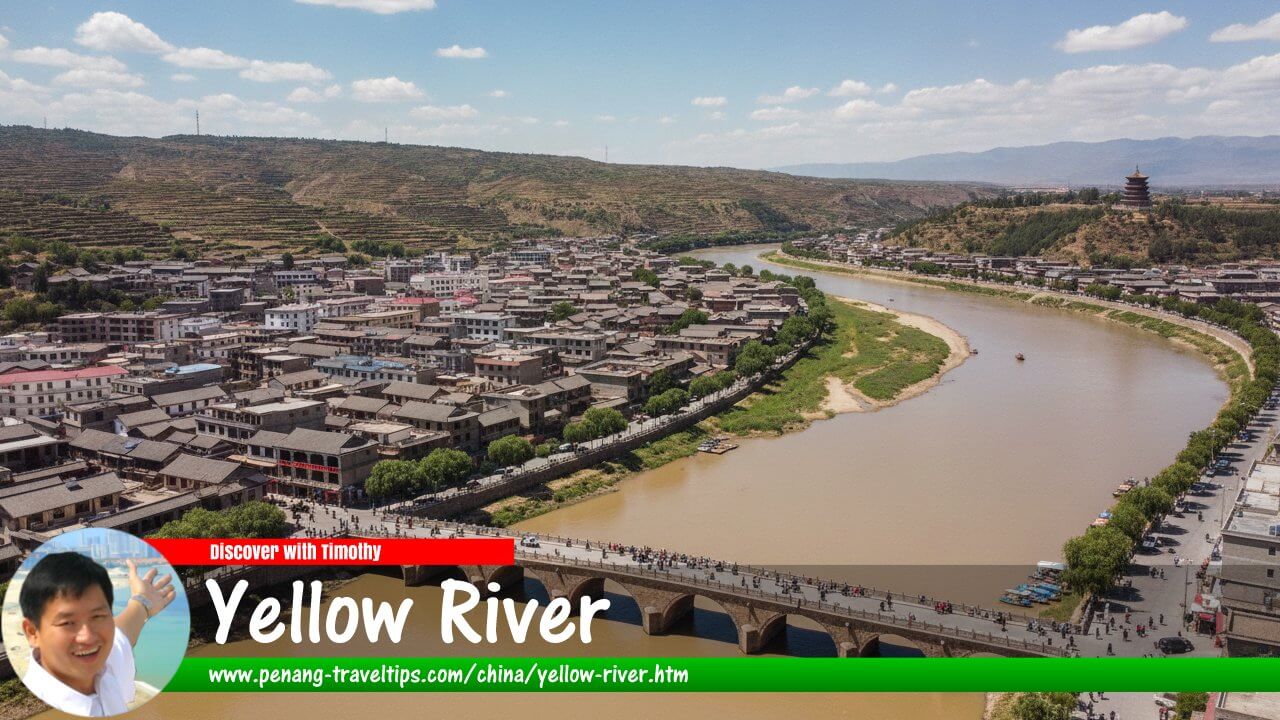 Yellow River, China (AI generated artist impression created on 16 June 2026)
Yellow River (Huanghe), known in Chinese as 黄河 and in pinyin as Huáng Hé, is the second-longest river in China and one of the most historically significant rivers in the world. Often called the "Mother River of China" and the "Cradle of Chinese Civilization," the Yellow River has nurtured human settlement, agriculture, and cultural development for thousands of years. Flowing across northern China from the Tibetan Plateau to the Bohai Sea, the river has profoundly influenced the history, economy, and identity of the Chinese nation.1
Quick Facts
- English Name: Yellow River
- Chinese Name: 黄河
- Pinyin: Huáng Hé
- Length: Approximately 5,464 km
- Source: Bayan Har Mountains, Qinghai Province
- Mouth: Bohai Sea, Shandong Province
- Drainage Basin: Approximately 795,000 square kilometres
- Countries: China
- Major Provinces: Qinghai, Sichuan, Gansu, Ningxia, Inner Mongolia, Shaanxi, Shanxi, Henan, Shandong
- Nickname: Mother River of China
- Notable Characteristic: Extremely high sediment load
Name and Origin
The river's English name, "Yellow River," is a direct translation of its Chinese name, Huáng Hé (黄河), which literally means "Yellow River." The name derives from the river's distinctive yellow-brown colour, caused by enormous quantities of fine sediment known as loess. This sediment is eroded from the Loess Plateau in north-central China and carried downstream by the river.2
The Yellow River transports more sediment than almost any other major river in the world. The suspended particles give the water its characteristic appearance and have shaped both the landscape and the history of northern China. Over thousands of years, the deposition of sediment created fertile agricultural plains while also contributing to devastating floods.
Geography
The Yellow River originates in the Bayan Har Mountains on the northeastern edge of the Tibetan Plateau in Qinghai Province. From its source, it travels approximately 5,464 kilometres before emptying into the Bohai Sea near Dongying in Shandong Province. It is the second-longest river in China after the Yangtze River and the sixth-longest river in the world.3
The river basin covers roughly 795,000 square kilometres and spans a diverse range of landscapes, including alpine grasslands, deserts, plateaus, mountains, and fertile plains. The river follows a broad arc across northern China and is commonly divided into upper, middle, and lower reaches.
Upper Reaches
The upper reaches extend from the source in Qinghai to Hekou Town in Inner Mongolia. This section flows through mountainous terrain, deep valleys, and grasslands. Water quality is generally high, and numerous tributaries contribute to the river's flow.
Middle Reaches
The middle reaches pass through the Loess Plateau, where erosion contributes vast quantities of sediment to the river. This section includes dramatic gorges and valleys and is responsible for the river's famous yellow colour.
Lower Reaches
The lower reaches flow across the North China Plain before reaching the Bohai Sea. Here, sediment deposition raises the riverbed above the surrounding landscape in some areas, creating a "suspended river" that has historically posed severe flood risks.
Major Cities and Towns Along the River
Several important cities and towns are located along or near the Yellow River, including:
- Lanzhou
- Yinchuan
- Wuhai
- Baotou
- Ordos
- Tongguan
- Luoyang
- Zhengzhou
- Kaifeng
- Jinan
- Dongying
These settlements have long depended on the river for transportation, irrigation, and economic development.
History
The Yellow River is widely regarded as the birthplace of Chinese civilization. Archaeological evidence indicates that some of China's earliest agricultural societies emerged along its fertile banks thousands of years ago. The river basin provided water, fertile soil, and transportation routes that supported the growth of early communities.4
Several important Neolithic cultures, including the Yangshao and Longshan cultures, flourished in the Yellow River basin. These societies developed agriculture, pottery, and increasingly sophisticated social structures that laid the foundations for later Chinese civilization.
The earliest Chinese dynasties, including the Xia, Shang, and Zhou, were centred in regions influenced by the Yellow River. Ancient capitals and political centres frequently arose near the river because of its strategic and economic importance.
Throughout history, the river has been both a source of prosperity and a cause of destruction. The enormous sediment load often caused the river to change course dramatically. Floods periodically devastated communities, earning the river the nickname "China's Sorrow."5
One of the most remarkable characteristics of the Yellow River is its tendency to alter its course. Historical records document numerous major shifts in the river's path, some moving its mouth hundreds of kilometres north or south. These changes affected agriculture, trade routes, and political stability.
Successive Chinese governments invested heavily in flood-control measures, including levees, canals, and dams. Managing the Yellow River became one of the most important responsibilities of imperial administrations and remains a priority today.
During the twentieth century, large-scale engineering projects improved flood control, irrigation, and hydroelectric generation. These efforts have significantly reduced the frequency of catastrophic floods while supporting economic development across northern China.
Economy and Products Along the River
The Yellow River basin remains an important economic region despite receiving less rainfall than southern China. The river provides water resources essential for agriculture, industry, and urban development across northern China.
Agriculture has long been the foundation of the basin's economy. Irrigation systems supplied by the river support extensive cultivation in otherwise semi-arid regions.
Major agricultural products include:
- Wheat
- Maize (corn)
- Millet
- Cotton
- Soybeans
- Potatoes
- Fruit crops
- Vegetables
The North China Plain, nourished by the Yellow River, is one of the country's most important agricultural regions. Wheat production is particularly significant and contributes substantially to China's food security.
Industrial development has expanded rapidly along the river. Important industries include:
- Petrochemicals
- Coal mining
- Energy production
- Steel manufacturing
- Machinery production
- Food processing
- Textiles
The basin contains significant coal reserves, particularly in Shanxi and Inner Mongolia. These resources have supported the development of major industrial centres.
Hydroelectric power is another important economic activity. Large dams such as the Longyangxia Dam, Liujiaxia Dam, and Xiaolangdi Dam generate electricity, regulate water flow, and help control flooding.6
Environment and Ecology
The Yellow River basin encompasses a wide variety of ecosystems, ranging from alpine meadows and wetlands to deserts and coastal environments. These habitats support numerous species of plants and animals adapted to diverse climatic conditions.
Environmental challenges include soil erosion, water scarcity, desertification, and pollution. The Loess Plateau is particularly vulnerable to erosion, contributing large amounts of sediment to the river. Conservation projects have focused on reforestation, sustainable land management, and water conservation.
In recent decades, ecological restoration programs have helped improve vegetation cover and reduce erosion in parts of the basin. These efforts contribute to environmental sustainability and help preserve water quality for future generations.
Tourist Attractions Along the Yellow River
The Yellow River is home to numerous natural, historical, and cultural attractions that reflect its importance in Chinese civilization.
1. Hukou Waterfall
Located on the border between Shaanxi and Shanxi provinces, Hukou Waterfall is the largest waterfall on the Yellow River. It is famous for its dramatic appearance and powerful flow.
2. Yellow River Scenic Area (Zhengzhou)
This attraction features monuments, viewpoints, and cultural exhibits dedicated to the history and significance of the Yellow River.
3. Lanzhou Yellow River Bridges
Lanzhou is the only major Chinese city through which the Yellow River flows directly. Its historic bridges and riverfront parks are popular attractions.
4. Sanmenxia Reservoir
This large reservoir offers scenic landscapes, birdwatching opportunities, and recreational activities.
5. Xiaolangdi Scenic Area
The Xiaolangdi Dam and surrounding region attract visitors interested in engineering, river management, and natural scenery.
6. Ordos Grasslands
Located near the river's great northern bend, these grasslands provide opportunities to experience Mongolian culture and landscapes.
7. Longmen Grottoes
Near Luoyang, this UNESCO World Heritage Site contains thousands of Buddhist statues carved into limestone cliffs and is closely associated with the Yellow River cultural region.7
8. Mount Song and Shaolin Temple
Situated within the broader Yellow River basin, these iconic sites are among China's most famous cultural and religious landmarks.
9. Kaifeng Ancient City
One of China's historic capitals, Kaifeng preserves numerous monuments and traditions linked to the Yellow River's history.
Legacy and Significance
The Yellow River occupies a unique place in Chinese history and culture. As the cradle of Chinese civilization, it fostered the emergence of early dynasties, agricultural societies, and cultural traditions that shaped the nation's development. Although its floods and shifting course brought hardship, the river also provided the fertile soil and water resources necessary for prosperity.
Today, the Yellow River continues to support millions of people through agriculture, industry, transportation, and tourism. Its enduring influence on China's history, economy, and identity ensures its place as one of the world's most significant rivers.
References
- Encyclopaedia Britannica – Huang He (Yellow River)
- National Geographic – Yellow River
- WorldAtlas – Yellow River Facts
- Encyclopaedia Britannica – Chinese Civilization
- Encyclopaedia Britannica – The River and Its Basin
- Yellow River Conservancy Commission
- UNESCO World Heritage Centre – Longmen Grottoes
Page Details
This page was created/modified on 16 June 2026. Hi, my name is Timothy and created it from my research, for my own entertainment, knowledge and to satisfy my curiosity. I am providing the information to you in good faith and hope it is useful. I try to get the details as accurate as possible. I also try to update the page whenever I stumble on new details. So this and all my other pages are perpetual work in progress. If you discover any error, please politely inform me, pointing out where the error lies, and I will correct it as soon as possible. Your helpfulness will keep this page accurate, relevant and helpful to those who need the information.