
Yangzhou, China
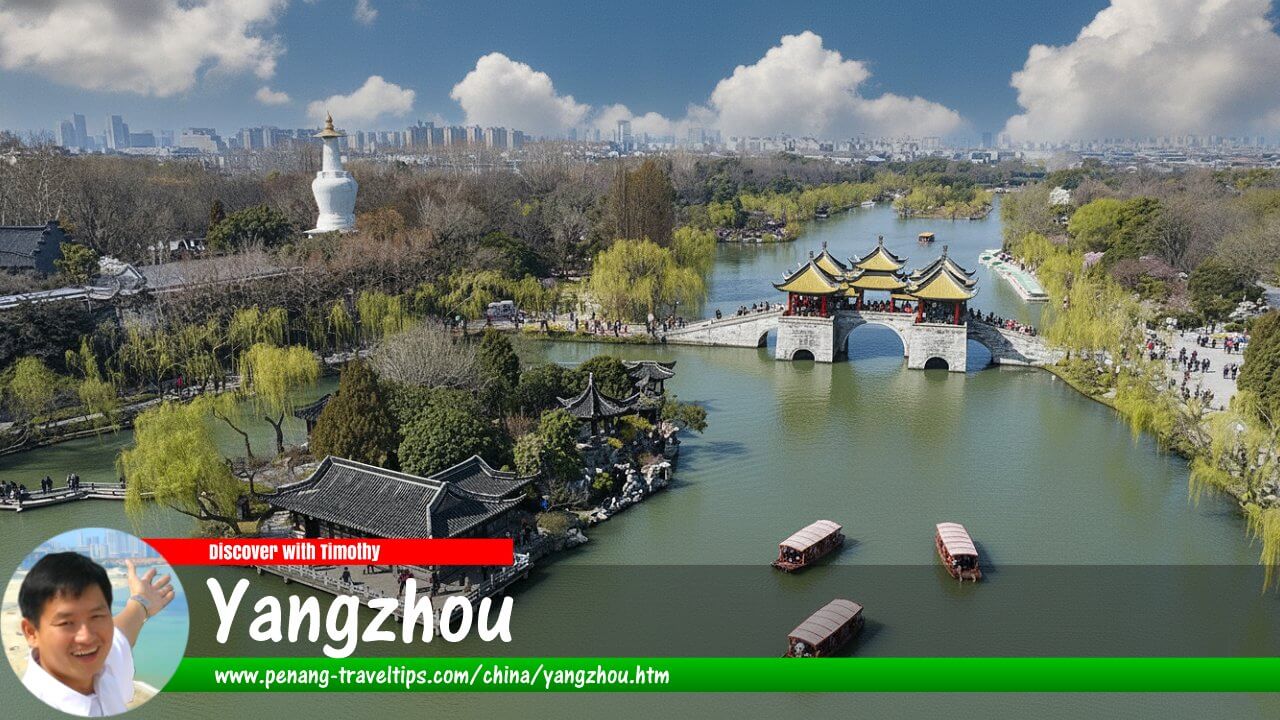 Yangzhou, China (Photo edited with AI on 18 June 2026)
Yangzhou (扬州, Yángzhōu) is a prefecture-level city in central Jiangsu Province, China, located on the northern bank of the Yangtze River and along the historic Grand Canal. Renowned as one of China's most elegant and culturally significant cities, Yangzhou has been an important centre of trade, culture, literature, and scholarship for more than 2,500 years.1 During the Tang and Qing dynasties, Yangzhou became one of the wealthiest cities in China due to its strategic location on the Grand Canal and its role in the lucrative salt trade. Today, the city is celebrated for its classical gardens, historical sites, refined cuisine, and rich cultural heritage.
The name "Yangzhou" consists of the characters 扬 (yáng), meaning "to raise," "spread," or "promote," and 州 (zhōu), meaning "prefecture" or "administrative region." The name has ancient origins dating back to the legendary Nine Provinces described in early Chinese texts. Historically, Yangzhou referred to a much larger region of southeastern China before becoming associated specifically with the present-day city.2
Quick Facts
- Chinese Name: 扬州
- Pinyin: Yángzhōu
- Province: Jiangsu
- Location: Central Jiangsu, north of the Yangtze River
- Area: Approximately 6,634 square kilometres
- Population: About 4.5 million
- Administrative Centre: Hanjiang District
- Main Languages: Mandarin, Yangzhou dialect (Jianghuai Mandarin)
- Climate: Humid subtropical climate
- Main Industries: Tourism, manufacturing, machinery, automobiles, food processing
- Famous Products: Yangzhou lacquerware, Huaiyang cuisine, jade carvings
- Airport: Yangzhou Taizhou International Airport
- Major Attractions: Slender West Lake, Daming Temple, Geyuan Garden, He Garden
Geography
Yangzhou is situated in central Jiangsu Province, approximately 100 kilometres northeast of Nanjing and about 300 kilometres northwest of Shanghai. The city occupies a strategic position between the Yangtze River and the Huai River basin, making it an important transportation and commercial centre throughout Chinese history.3
The terrain is generally flat, consisting of fertile alluvial plains formed by centuries of river deposits. Numerous rivers, lakes, canals, and waterways crisscross the landscape, contributing to both agricultural productivity and scenic beauty.
The Grand Canal, a UNESCO World Heritage Site, passes through Yangzhou and played a vital role in the city's development as a commercial hub connecting northern and southern China.4
Among Yangzhou's most notable natural features is Slender West Lake, a scenic waterway surrounded by gardens, pavilions, and historical landmarks. The city is also known for its network of parks and landscaped areas that blend natural beauty with traditional Chinese design.
Yangzhou experiences a humid subtropical climate with hot, humid summers and cool winters. Spring and autumn are generally mild and are considered the best times to visit.5
Languages and Dialects
Mandarin is the official language used in government, education, and media. However, many local residents also speak the traditional Yangzhou dialect.
- Yangzhou Dialect (扬州话): A variety of Jianghuai Mandarin with distinctive pronunciation, vocabulary, and cultural significance.
- Standard Mandarin: Universally understood and widely spoken.
- Other Chinese Dialects: Due to migration and commerce, dialects such as Wu Chinese, Cantonese, Hakka, and Min may also be heard.
The Yangzhou dialect has historically been influential and was once regarded as a prestigious form of speech in parts of eastern China.
History
Yangzhou has a history spanning more than 2,500 years. The city emerged as an important settlement during the Spring and Autumn Period and gained prominence because of its strategic location along waterways connecting northern and southern China.6
During the Han Dynasty, Yangzhou became an important administrative centre and trading port. Its prosperity continued to grow during the Sui Dynasty following the construction of the Grand Canal.
The Tang Dynasty marked a golden age for Yangzhou. The city became one of China's wealthiest commercial centres, attracting merchants, scholars, diplomats, and travellers from across Asia. Foreign traders from Persia, Arabia, and other regions established communities in the city, contributing to its cosmopolitan character.7
During the Ming and Qing dynasties, Yangzhou became famous for the salt trade. Wealthy salt merchants financed the construction of magnificent gardens, temples, academies, and cultural institutions. Many of the city's most famous historical landmarks date from this period.
Yangzhou also played an important role in Chinese art and literature. The city was home to the famous "Eight Eccentrics of Yangzhou," a group of influential Qing Dynasty painters known for their innovative artistic styles.8
Following the economic reforms of the late twentieth century, Yangzhou modernised rapidly while preserving much of its historical and cultural heritage. Today, it is recognised as one of China's leading cultural tourism destinations.
Economy and Products
Yangzhou has a diversified economy based on manufacturing, tourism, commerce, transportation, and modern services. The city's strategic location within the Yangtze River Delta has facilitated sustained economic growth and industrial development.9
Manufacturing industries include automobiles, machinery, shipbuilding equipment, electronics, renewable energy technologies, and precision engineering products. Industrial parks throughout the municipality attract both domestic and international investment.
Tourism is a major contributor to the local economy. Millions of visitors travel to Yangzhou annually to experience its historic gardens, cultural sites, and scenic landscapes.
Yangzhou is famous throughout China for its traditional handicrafts, including lacquerware, jade carving, paper-cutting, and embroidery. Yangzhou lacquerware, known for its intricate decorative techniques, has been produced for centuries and is highly regarded both domestically and internationally.10
The city is also renowned for Huaiyang cuisine, one of China's Four Great Culinary Traditions. Famous dishes include Yangzhou fried rice, lion's head meatballs, braised tofu dishes, and delicately prepared seafood specialities.
How to Go There
By Air
Yangzhou is served by Yangzhou Taizhou International Airport, located approximately 30 kilometres northeast of the city centre.
The airport operates flights to major Chinese cities including Beijing, Shanghai, Guangzhou, Shenzhen, Chengdu, Chongqing, Xi'an, Kunming, Harbin, Qingdao, and Sanya. Airlines serving the airport include Air China, China Eastern Airlines, China Southern Airlines, Shenzhen Airlines, Xiamen Airlines, and Spring Airlines.11
Selected international and regional routes may also be available depending on seasonal schedules.
By Train
Yangzhou is connected to China's national railway network through several stations.
- Yangzhou Railway Station – located in Hanjiang District and serving conventional and high-speed trains.
- Yangzhou East Railway Station – the city's primary high-speed rail station.
- Jiangdu Railway Station – serving eastern parts of the municipality.
High-speed trains connect Yangzhou with Nanjing, Shanghai, Beijing, Hangzhou, Suzhou, Hefei, Wuhan, and numerous other cities.
By Long-Distance Bus
The city is served by Yangzhou West Bus Station, Yangzhou East Bus Station, and several regional passenger transport centres. Frequent coach services connect Yangzhou with destinations throughout Jiangsu and neighbouring provinces.
Local Transportation
Yangzhou has a modern and efficient transportation system suitable for both residents and visitors.
- Taxis: Widely available throughout the city.
- E-hailing Services: Didi Chuxing is the most commonly used ride-hailing platform.
- Public Buses: Extensive routes connect tourist attractions, residential areas, and transportation hubs.
- Tourist Sightseeing Buses: Special routes serve major attractions.
- Bicycle Sharing: Public bicycle and shared-bike systems are widely available.
- E-bikes: Popular for short-distance travel.
Yangzhou currently does not operate a metro, MRT, subway, or LRT system. Traditional trishaws, rickshaws, and tuk-tuks are generally not part of the city's transportation network.
Tourist Attractions
1. Slender West Lake (瘦西湖)
The most famous attraction in Yangzhou, Slender West Lake is celebrated for its elegant bridges, pavilions, gardens, and waterways. Often compared to West Lake in Hangzhou, it is considered one of China's finest scenic areas.12
2. Geyuan Garden (个园)
A UNESCO-listed classical Chinese garden famous for its bamboo groves, rockeries, and artistic representation of the four seasons.
3. He Garden (何园)
Built during the Qing Dynasty, He Garden is known for its sophisticated architectural design, corridors, ponds, and landscaped grounds.
4. Daming Temple (大明寺)
One of Jiangsu Province's most important Buddhist temples, Daming Temple has a history dating back more than 1,500 years.
5. Dongguan Historic Street
This well-preserved old street features traditional architecture, local food, handicraft shops, and cultural exhibits.
6. China Grand Canal Museum
A modern museum showcasing the history, engineering, and cultural significance of the Grand Canal through interactive exhibits and artefacts.
7. Puhaddin Tomb
This historic Islamic site commemorates Puhaddin, believed to be a descendant of the Prophet Muhammad, reflecting Yangzhou's historical international connections.
8. Twenty-Four Bridge
One of the city's most famous landmarks, immortalised in classical Chinese poetry and celebrated for its elegant design.
9. Zhuyu Bay Scenic Area
A large ecological park featuring gardens, waterways, wildlife exhibits, and recreational facilities.
10. Yangzhou Museum
The museum houses extensive collections of archaeological artefacts, artworks, historical documents, and cultural relics relating to the city's rich history.
Yangzhou, China is  the Map of Cities in China
References
- Encyclopaedia Britannica – Yangzhou
- Wikipedia – Yangzhou
- Travel China Guide – Yangzhou
- UNESCO – Grand Canal
- Climate Information for Yangzhou
- Encyclopaedia Britannica – Jiangsu History
- Yangzhou Historical Overview
- Eight Eccentrics of Yangzhou
- Yangzhou Municipal Government
- Traditional Chinese Handicrafts Resources
- Yangzhou Taizhou International Airport
- Slender West Lake Scenic Area
Page Details
This page was created/modified on 18 June 2026. Hi, my name is Timothy and created it from my research, for my own entertainment, knowledge and to satisfy my curiosity. I am providing the information to you in good faith and hope it is useful. I try to get the details as accurate as possible. I also try to update the page whenever I stumble on new details. So this and all my other pages are perpetual work in progress. If you discover any error, please politely inform me, pointing out where the error lies, and I will correct it as soon as possible. Your helpfulness will keep this page accurate, relevant and helpful to those who need the information.