
Grand Canal, China
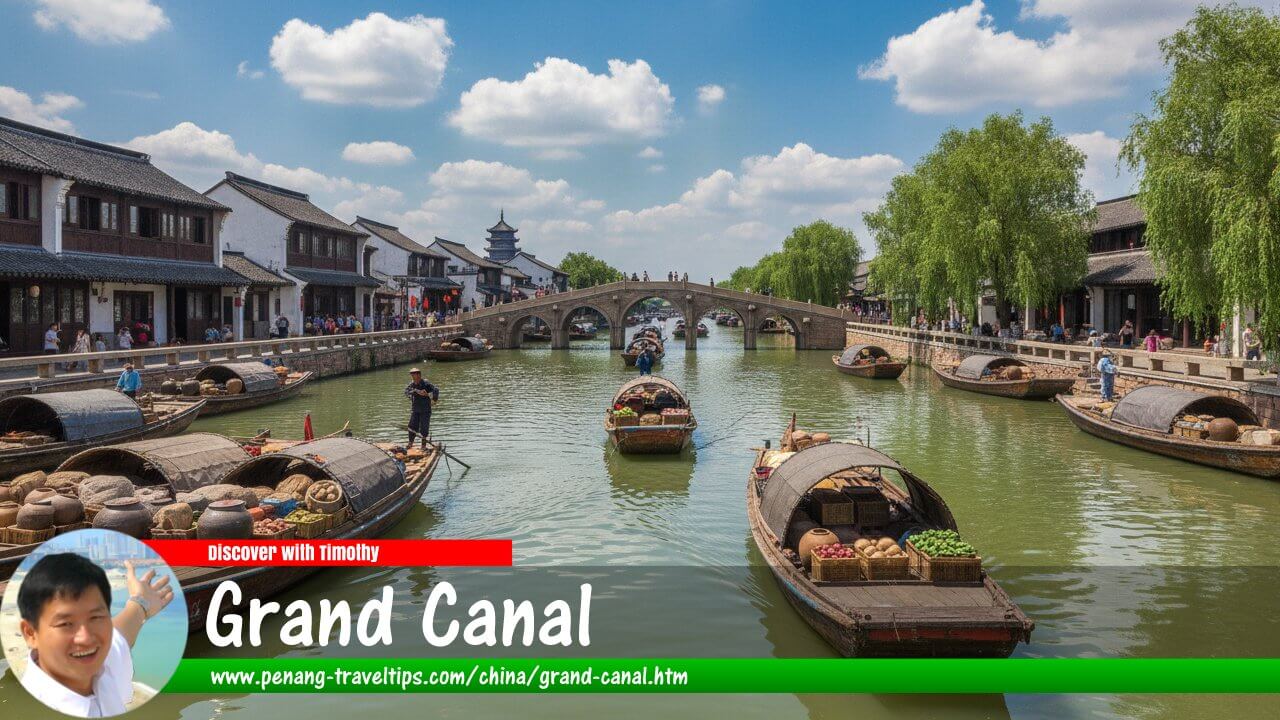 Grand Canal, China (Photo edited with AI on 18 June 2026)
Grand Canal (Chinese: 大运河; pinyin: Dà Yùnhé) is the longest artificial waterway in the world and one of China's greatest engineering achievements. Stretching across eastern China, it has served for centuries as a vital transportation and economic corridor connecting northern and southern regions of the country.1 The name "Grand Canal" is a translation of the Chinese term Dà Yùnhé, meaning "Great Transport Canal." The word "yun" (运) refers to transportation or conveyance, while "he" (河) means river or canal, reflecting its historic role in transporting grain, goods, and people throughout imperial China.2
Quick Facts
- English Name: Grand Canal
- Chinese Name: 大运河
- Pinyin: Dà Yùnhé
- Type: Artificial canal system
- Location: Eastern China
- Total Length: Approximately 1,794 km
- Construction Began: 5th century BC, with major expansions during the Sui Dynasty
- UNESCO Status: World Heritage Site (2014)
- Purpose: Transportation, trade, irrigation, and grain shipment
- Major Cities: Beijing, Tianjin, Cangzhou, Dezhou, Jining, Xuzhou, Huai'an, Yangzhou, Suzhou, Hangzhou
Geography and Location
The Grand Canal is located in eastern China and extends from Beijing in the north to Hangzhou in Zhejiang Province in the south. It traverses several provinces and municipalities, including Beijing, Tianjin, Hebei, Shandong, Jiangsu, and Zhejiang.3
The canal links five major river systems of China: the Hai River, Yellow River, Huai River, Yangtze River, and Qiantang River. This unique geographical position enabled it to become a strategic transportation artery that connected diverse agricultural and commercial regions across the country.4
The southern sections pass through fertile plains and water-rich regions renowned for rice cultivation, while the northern sections cross flatter terrain where water management and engineering solutions were required to maintain navigation. The canal's route helped integrate different economic zones and facilitated the movement of resources across vast distances.4
Dimensions and Route
The Grand Canal measures approximately 1,794 kilometers (1,115 miles) in length, making it the world's longest man-made waterway.1 It consists of interconnected sections that were constructed and expanded over many centuries.
The canal passes through numerous important cities and towns, including:
- Beijing – Northern terminus and imperial capital.
- Tianjin – Major port city near the Bohai Sea.
- Cangzhou – Historic transportation center in Hebei.
- Dezhou – Important canal city in Shandong Province.
- Jining – Located near the highest elevation point of the canal.
- Xuzhou – Historic commercial hub in Jiangsu Province.
- Huai'an – Known for its role in water management.
- Yangzhou – Prosperous trading center during imperial times.
- Suzhou – Famous for classical gardens and canal scenery.
- Hangzhou – Southern terminus of the canal.
The canal includes locks, embankments, reservoirs, and waterways designed to overcome differences in elevation and water supply. Its highest section occurs near Jining in Shandong Province, requiring sophisticated hydraulic engineering to ensure continuous navigation.5
History
Early Origins
The origins of the Grand Canal can be traced to the Spring and Autumn Period during the 5th century BC. Various states constructed local canals for military and transportation purposes. One of the earliest significant sections was the Han Gou Canal, built by the State of Wu to connect regional waterways.6
Sui Dynasty Expansion
The most significant phase of construction occurred during the Sui Dynasty (581–618 AD). Emperor Yang of Sui ordered the connection of existing waterways and the excavation of new sections to create a unified canal network linking northern political centers with the prosperous agricultural regions of the south.7
Hundreds of thousands of workers participated in the massive undertaking. Although the project imposed heavy burdens on the population, it transformed China's transportation system and established the framework of the canal that would endure for centuries.7
Tang and Song Dynasties
During the Tang (618–907) and Song (960–1279) dynasties, the canal became an essential route for moving grain, tax revenues, military supplies, and commercial goods. Cities located along the canal prospered as trade expanded and regional markets became increasingly interconnected.8
The canal also facilitated cultural exchange, allowing ideas, technologies, and artistic influences to spread between northern and southern China.
Yuan Dynasty Improvements
Under the Yuan Dynasty (1271–1368), substantial modifications shortened the route and improved navigation. The canal was redirected to better serve Beijing, which had become the imperial capital. These improvements enhanced efficiency and strengthened the city's supply network.9
Ming and Qing Dynasties
The canal reached the height of its importance during the Ming (1368–1644) and Qing (1644–1912) dynasties. Vast quantities of grain were transported annually from southern provinces to Beijing. Government agencies managed maintenance, dredging, and navigation to ensure the canal remained operational.10
Canal cities such as Yangzhou and Suzhou flourished economically, becoming centers of commerce, culture, and craftsmanship.
Modern Era
The development of railways and modern transportation in the late nineteenth and twentieth centuries reduced the canal's importance as a primary transportation route. Nevertheless, many sections continued to support regional shipping and water management.11
Recognizing its outstanding historical and engineering significance, UNESCO inscribed the Grand Canal on the World Heritage List in 2014. The designation acknowledged its role as a masterpiece of hydraulic engineering and a symbol of China's long history of infrastructure development.12
Economic and Cultural Importance
The Grand Canal played a central role in the economic integration of China. By linking agricultural regions in the south with political and military centers in the north, it ensured reliable transportation of grain and other essential commodities.
The canal stimulated urban growth and contributed to the prosperity of numerous cities along its route. Merchants, officials, scholars, and travelers used the waterway, creating a dynamic corridor of economic and cultural exchange.
Beyond commerce, the canal influenced Chinese literature, painting, architecture, and folklore. Historic bridges, warehouses, temples, and waterfront neighborhoods that developed along the canal remain important cultural landmarks today.
Tourist Attractions
The Grand Canal contains numerous attractions that showcase its historical significance and scenic beauty.
Hangzhou Grand Canal Scenic Area
The southern terminus in Hangzhou features restored waterfront districts, museums, traditional architecture, and boat cruises that allow visitors to experience the canal's historic atmosphere.
Beijing-Hangzhou Grand Canal Museum
Several museums along the canal interpret its history, engineering, and economic impact. These institutions display artifacts, maps, and historical documents related to the canal's development.
Suzhou Canal Districts
Suzhou's canal neighborhoods are known for picturesque waterways, stone bridges, traditional houses, and classical Chinese gardens that reflect centuries of canal-based urban life.
Yangzhou Ancient Canal
Yangzhou preserves some of the most historically significant sections of the canal. Evening boat tours offer views of illuminated bridges and heritage buildings.
Tongzhou Canal Area
Located near Beijing, Tongzhou served as a crucial transfer point for grain shipments destined for the imperial capital. Historic sites and modern parks highlight its importance.
Historic Bridges
The canal is crossed by numerous historic bridges, many dating to imperial dynasties. These structures illustrate traditional Chinese engineering techniques and architectural styles.
Water Towns Near the Canal
Several famous water towns connected to the Grand Canal attract visitors with narrow canals, traditional residences, and centuries-old streets. These communities preserve aspects of daily life shaped by the canal.
UNESCO World Heritage Status
In 2014, UNESCO designated the Grand Canal as a World Heritage Site. The inscription includes dozens of component sites, historic canal sections, hydraulic structures, and associated cultural landscapes.12
UNESCO recognized the canal as an extraordinary example of ancient hydraulic engineering and as a transportation system that significantly influenced China's economic development, political unity, and cultural exchange over more than two millennia.12
Conclusion
The Grand Canal stands as one of humanity's greatest engineering accomplishments. Extending nearly 1,800 kilometers across eastern China, it connected major river systems, linked distant regions, and facilitated trade and communication for centuries. Its influence on China's economic growth, political administration, and cultural development has been profound. Today, preserved historic sections, vibrant canal cities, and UNESCO recognition ensure that the Grand Canal remains both a functioning waterway and a treasured symbol of Chinese civilization.
References
- UNESCO World Heritage Centre – The Grand Canal
- Encyclopaedia Britannica – Grand Canal
- UNESCO World Heritage Centre – Location and Description
- China Highlights – Grand Canal Geography
- Britannica – Engineering and Route
- Britannica – Early History
- UNESCO – Sui Dynasty Development
- The Metropolitan Museum of Art – The Grand Canal and Chinese Trade
- Britannica – Yuan Dynasty Modifications
- Britannica – Ming and Qing Administration
- Britannica – Modern Developments
- UNESCO World Heritage Centre – World Heritage Inscription
Page Details
This page was created/modified on 18 June 2026. Hi, my name is Timothy and created it from my research, for my own entertainment, knowledge and to satisfy my curiosity. I am providing the information to you in good faith and hope it is useful. I try to get the details as accurate as possible. I also try to update the page whenever I stumble on new details. So this and all my other pages are perpetual work in progress. If you discover any error, please politely inform me, pointing out where the error lies, and I will correct it as soon as possible. Your helpfulness will keep this page accurate, relevant and helpful to those who need the information.