
Beijing
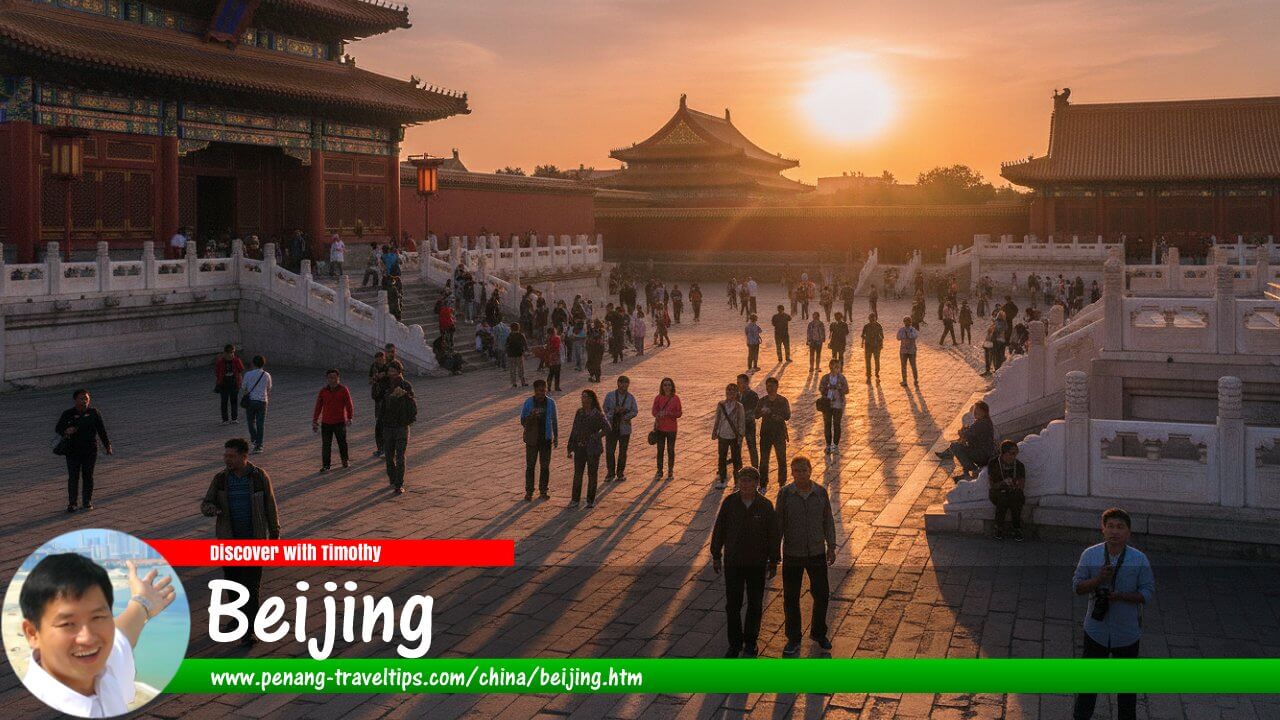 The Forbidden City in Beijing at dusk (Photo edited with AI on 8 June 2026)
Also available: Beijing (Malay Edition)
Beijing is the capital of the People's Republic of China and one of the world's most historic and influential cities. Located in northern China, Beijing serves as the country's political, cultural, educational, and international diplomatic center.1 With a history spanning more than three millennia and nearly nine centuries as a national capital, Beijing contains some of China's most important cultural treasures, including imperial palaces, ancient temples, and sections of the Great Wall. Today, it is a global metropolis that combines ancient traditions with modern development, serving as a major center of government, commerce, technology, and tourism.2
Quick Facts
- Country: China
- Status: National Capital
- Chinese Name: 北京 (Běijīng)
- Meaning of Name: Northern Capital
- Municipality Area: Approximately 16,410 square km
- Population: More than 21 million
- Region: Northern China
- Climate: Monsoon-influenced continental climate
- Main Airports: Beijing Capital International Airport and Beijing Daxing International Airport
- Major Railway Stations: Beijing Railway Station, Beijing West, Beijing South, Beijing North, Beijing Chaoyang
- UNESCO Sites: Forbidden City, Temple of Heaven, Summer Palace, Ming Tombs, Great Wall sections
- Famous Attractions: Tiananmen Square, Forbidden City, Great Wall, Summer Palace
The Name of Beijing and Its Origin
The name "Beijing" (北京) literally means "Northern Capital." The first character, bei (北), means "north," while the second character, jing (京), means "capital."3 The name reflects the city's status as the northern capital of China.
Throughout its long history, the city has been known by several names. During the Jin Dynasty it was called Zhongdu, meaning "Central Capital." Under Mongol rule during the Yuan Dynasty, it became known as Dadu or Khanbaliq. During the Ming Dynasty, the city was renamed Beijing after the Yongle Emperor moved the imperial capital from Nanjing, the "Southern Capital," to the north in 1421.4
Since then, the name Beijing has remained closely associated with China's political authority and national identity.
Geography
Beijing is located in northern China at the northwestern edge of the North China Plain. The municipality is surrounded by Hebei Province on most sides and lies approximately 120 kilometers from the Bohai Sea.1
The city's geography is characterized by plains in the south and east, while mountains dominate the northern and western portions of the municipality. The Yan Mountains rise to the north, and the Taihang Mountains are located to the west. These mountain ranges historically provided natural defenses for the capital.
Several rivers flow through the municipality, including the Yongding River and Chaobai River. Reservoirs and water diversion projects play important roles in supplying water to the city.
Beijing experiences a monsoon-influenced humid continental climate. Summers are typically hot and humid, with most rainfall occurring between June and August. Winters are cold and dry, often influenced by winds from Siberia. Spring can be windy, while autumn is generally regarded as the most pleasant season for visitors.
The municipality covers approximately 16,410 square kilometers and contains urban districts, suburban districts, rural communities, forests, mountains, and agricultural land.2
History
Archaeological evidence indicates that human settlements existed in the Beijing area thousands of years ago. During the Zhou Dynasty, the region formed part of the ancient State of Yan, one of the major states of northern China.5
Beijing's importance increased during the Liao Dynasty, when it became one of the dynasty's capitals. The Jin Dynasty later established Zhongdu in the area, transforming it into a major political center.
The Mongol ruler Kublai Khan selected the city as the capital of the Yuan Dynasty in the thirteenth century. The city, known as Dadu, became one of the largest and most magnificent cities in the world at the time. The Venetian traveler Marco Polo famously described its grandeur.6
One of the most significant events in Beijing's history occurred during the Ming Dynasty when the Yongle Emperor relocated the capital from Nanjing to Beijing. Massive construction projects followed, including the Forbidden City, the Temple of Heaven, and extensive city walls.4
Under the Qing Dynasty, Beijing remained the imperial capital and became the administrative center of one of the world's largest empires. The city witnessed major historical events, including foreign invasions, internal rebellions, and political reforms during the nineteenth and early twentieth centuries.
Following the fall of the Qing Dynasty in 1911, Beijing remained an important political center. After the establishment of the People's Republic of China in 1949, Chairman Mao Zedong proclaimed the founding of the new state in Tiananmen Square, confirming Beijing's role as the national capital.7
In the modern era, Beijing has become one of the world's leading cities in government, technology, education, finance, and international diplomacy. The city hosted the 2008 Summer Olympics and the 2022 Winter Olympics, becoming the first city in history to host both events.8
Economy and Products
Beijing possesses one of China's largest and most sophisticated urban economies. As the national capital, it serves as the headquarters for many state-owned enterprises, government agencies, multinational corporations, and international organizations.2
The city's economy is primarily service-oriented, with finance, information technology, telecommunications, scientific research, media, education, and professional services playing major roles.
Key economic sectors include:
- Information technology and software development
- Artificial intelligence and advanced research
- Financial services
- Telecommunications
- Education and research institutions
- Healthcare and biotechnology
- Media and cultural industries
- Tourism and hospitality
- Aerospace and defense industries
Beijing is home to renowned universities such as Peking University and Tsinghua University, which contribute significantly to innovation and scientific advancement. The Zhongguancun district is often referred to as China's "Silicon Valley" due to its concentration of technology companies and research institutions.9
Traditional products associated with Beijing include Peking duck, cloisonné enamelware, carved jade, silk products, calligraphy art, and traditional Chinese handicrafts.
How to Go to Beijing
By Air
Beijing is served by two major international airports.
Beijing Capital International Airport (PEK) is located approximately 25 kilometers northeast of the city center. It is one of the busiest airports in the world and serves airlines including Air China, China Eastern Airlines, China Southern Airlines, Hainan Airlines, Cathay Pacific, Singapore Airlines, Lufthansa, British Airways, Emirates, Qatar Airways, and many others. Flights connect Beijing with destinations throughout Asia, Europe, North America, Oceania, Africa, and the Middle East.10
Beijing Daxing International Airport (PKX) is situated approximately 46 kilometers south of Tiananmen Square. Opened in 2019, it serves numerous domestic and international airlines and has become one of China's principal aviation hubs.11
By Train
Beijing is the hub of China's high-speed and conventional railway networks.
- Beijing Railway Station – Located southeast of the Forbidden City in Dongcheng District.
- Beijing West Railway Station – Located in Fengtai District and serves western and southern routes.
- Beijing South Railway Station – Major high-speed rail hub serving Shanghai, Tianjin, and southern China.
- Beijing North Railway Station – Gateway to northwestern destinations.
- Beijing Chaoyang Railway Station – Serves northeastern high-speed rail routes.
High-speed trains connect Beijing with Shanghai, Guangzhou, Shenzhen, Xi'an, Chengdu, Harbin, Tianjin, and many other cities.
By Long-Distance Bus
Several major bus terminals serve Beijing, including Liuliqiao Bus Station, Sihui Long-Distance Bus Station, Zhaogongkou Bus Station, and Yongdingmen Bus Station. These terminals provide services to cities and towns throughout northern China.
Traveling Within Beijing
Subway
The Beijing Subway is one of the world's largest metro systems, with extensive coverage throughout the municipality. It is generally the fastest and most convenient means of transportation for visitors.12
Taxis
Taxis are widely available throughout the city and can be hailed on the street or found at transportation hubs, hotels, and tourist attractions.
E-Hailing Services
Didi is the dominant ride-hailing platform in Beijing and functions similarly to Uber.
Public Buses
An extensive bus network complements the subway system and serves areas not directly accessible by rail.
Bicycles and Shared Bikes
Shared bicycle systems are extremely popular and provide an economical way to explore local neighborhoods.
Rickshaws
Traditional cycle rickshaws can still be found in some historic hutong districts, particularly in tourist areas, where they are often used for sightseeing tours.
Tuk-Tuks and Trishaws
Tuk-tuks are not commonly used in Beijing. Traditional trishaws survive mainly as tourist attractions rather than everyday transportation.
Tourist Attractions
Forbidden City
The Forbidden City is China's most famous imperial palace complex. Built during the Ming Dynasty, it served as the residence of emperors for nearly five centuries and is now home to the Palace Museum.13
Tiananmen Square
One of the largest public squares in the world, Tiananmen Square is the symbolic heart of modern China and contains several important national monuments.
Great Wall of China
Several well-preserved sections of the Great Wall, including Badaling, Mutianyu, and Jinshanling, are accessible from Beijing and attract millions of visitors annually.
Temple of Heaven
This UNESCO World Heritage Site was used by Ming and Qing emperors for ceremonial prayers for good harvests.
Summer Palace
The Summer Palace is an extensive imperial garden featuring Kunming Lake, Longevity Hill, ornate pavilions, and traditional Chinese landscaping.
Ming Tombs
Located northwest of the city, the Ming Tombs contain the mausoleums of thirteen Ming emperors and represent an important example of imperial funerary architecture.
Beihai Park
One of Beijing's oldest imperial gardens, Beihai Park features lakes, temples, and the iconic White Dagoba.
Lama Temple
Also known as Yonghe Temple, this Tibetan Buddhist monastery contains impressive halls, statues, and religious artwork.
National Stadium (Bird's Nest)
Constructed for the 2008 Olympic Games, the Bird's Nest has become one of Beijing's most recognizable modern landmarks.
Hutongs
The historic hutongs are traditional alleyway neighborhoods that offer insight into old Beijing's architecture, culture, and daily life.
Places of Interest in Beijing
I mark a star ( * ) for sights of considerable significance, and two stars ( * * ) for sights of major significance. Also, if it's a considerable distance from Beijing city center, I mark it with a hash ( # )
- Ancient Observatory
- Badachu Park
- Bei Hai Park
- Beijing Botanical Garden *
- Beijing Museum of Natural History
- Beijing Zoo
- Chinese Military History Museum
- Chuandixia * #
- Confucius Temple
- Cow Street Mosque
- Dazhalan & Liulichang
- Di Tan Park
- Dong Yue Miao
- Drum & Bell Towers
- Eastern Qing Tombs * #
- Fayuan Temple
- Forbidden City * *
- Great Bell Temple
- Jing Shan Park
- Lama Temple
- Mansion of Prince Gong
- Marco Polo Bridge
- Miaoying Temple
- Ming Tombs of Chang Ling * #
- National Art Museum of China
- National Olympic Stadium *
- Peking Man Site at Zhoukoudian #
- Qian Men
- South Cathedral
- Southeast Corner Watchtower
- St Joseph's Church
- Tanzhe Temple #
- Tiananmen Square *
- Underground City
- Wangfujing Street
- White Clouds Temple
- Xiang Shan Park
- Yuanming Yuan
References
- Encyclopaedia Britannica – Beijing
- Beijing Municipal Government
- Britannica – Name and Geography
- UNESCO – Imperial Palaces of the Ming and Qing Dynasties
- Britannica – History of Beijing
- Britannica – Marco Polo
- Britannica – Founding of the People's Republic of China
- Olympics – Beijing Olympic Games
- Zhongguancun Science Park
- Beijing Capital International Airport
- Beijing Daxing International Airport
- Beijing Subway
- The Palace Museum (Forbidden City)
Page Details
This page was created/modified on 7 June 2026. Hi, my name is Timothy and created it from my research, for my own entertainment, knowledge and to satisfy my curiosity. I am providing the information to you in good faith and hope it is useful. I try to get the details as accurate as possible. I also try to update the page whenever I stumble on new details. So this and all my other pages are perpetual work in progress. If you discover any error, please politely inform me, pointing out where the error lies, and I will correct it as soon as possible. Your helpfulness will keep this page accurate, relevant and helpful to those who need the information.