
Hangzhou, China
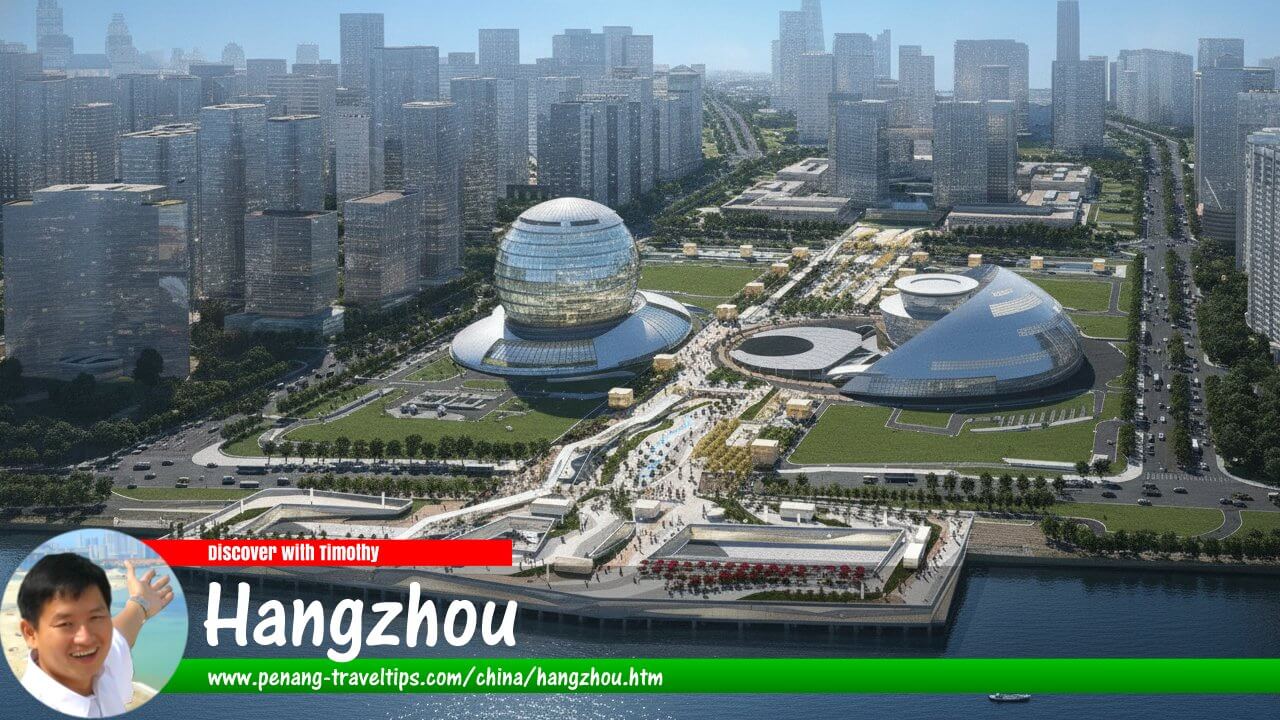 Hangzhou, China (Photo edited with AI on 18 June 2026)
Hangzhou (杭州, Hángzhōu) is the capital city of Zhejiang Province in eastern China and one of the country's most historically significant and picturesque cities. Located at the southern end of the Grand Canal and along the lower reaches of the Qiantang River, Hangzhou has been celebrated for centuries for its natural beauty, cultural heritage, and economic prosperity.1 The city has long been regarded as one of China's most beautiful urban centres, with the famous saying, "Above there is heaven; below there are Suzhou and Hangzhou." Today, Hangzhou is also a major centre for technology, innovation, e-commerce, tourism, and education.
Quick Facts
- Chinese Name: 杭州
- Pinyin: Hángzhōu
- Province: Zhejiang
- Administrative Status: Prefecture-level city and provincial capital
- Population: Approximately 12 million
- Area: About 16,850 square kilometres
- Famous Landmark: West Lake
- Main River: Qiantang River
- UNESCO Site: West Lake Cultural Landscape
- Major Industries: Technology, e-commerce, tourism, manufacturing, finance
- Airport: Hangzhou Xiaoshan International Airport
- Dialects: Hangzhou dialect (Wu Chinese), Mandarin
Name and Etymology
The English name "Hangzhou" is derived from the Mandarin pronunciation of the Chinese characters 杭州, written in pinyin as Hángzhōu. The character "Hang" (杭) originally referred to a large boat or ferry, reflecting the city's historical association with waterways and transportation. The character "Zhou" (州) means prefecture or administrative region.2
The city acquired the name Hangzhou during the Sui Dynasty when it became an important administrative centre. Its strategic location along rivers and canals contributed significantly to its growth as a commercial and cultural hub.
Geography
Hangzhou lies in northern Zhejiang Province, approximately 180 kilometres southwest of Shanghai. The city occupies a strategic position within the Yangtze River Delta, one of China's most economically developed regions.3
The municipality covers an area of about 16,850 square kilometres and consists of urban districts, suburban counties, mountains, lakes, rivers, and agricultural land. The terrain is diverse, with hills and mountains dominating the western and southern portions, while plains extend toward the east.
The city's most famous geographical feature is West Lake, a freshwater lake located in the urban centre. Covering approximately 6.5 square kilometres, West Lake is surrounded by gardens, pagodas, temples, and causeways that have inspired poets, painters, and travellers for over a thousand years.
The Qiantang River flows through Hangzhou and is famous for the Qiantang Tidal Bore, one of the world's largest tidal phenomena. Every year, thousands of visitors gather to witness the spectacular tidal wave surging upstream.
Hangzhou experiences a humid subtropical climate characterized by four distinct seasons. Summers are warm and humid, while winters are generally cool and damp. Spring and autumn are widely regarded as the best seasons for tourism.
Languages and Dialects
Mandarin Chinese is the official language used in government, education, media, and business throughout Hangzhou.
Apart from Mandarin, many local residents speak the Hangzhou dialect, which belongs to the Wu Chinese language family. Wu dialects are significantly different from Mandarin in pronunciation and vocabulary. The Hangzhou dialect has historically been influenced by both Wu-speaking populations and migrants from northern China.4
Due to rapid urbanization and migration from other provinces, Mandarin has become increasingly dominant in daily communication, though the local dialect remains an important marker of regional identity.
History
Human settlement in the Hangzhou area dates back thousands of years. Archaeological discoveries linked to the Liangzhu Culture reveal advanced Neolithic communities that flourished near present-day Hangzhou more than 5,000 years ago.5
During the Qin and Han dynasties, the region gradually developed as an administrative and commercial centre. Its importance increased significantly during the Sui Dynasty when the Grand Canal was extended to connect northern and southern China.
Hangzhou achieved its greatest historical prominence during the Southern Song Dynasty (1127–1279), when it served as the imperial capital after northern China was lost to invading forces. Known at the time as Lin'an, the city became one of the world's largest and wealthiest urban centres.
The Venetian traveller Marco Polo famously described Hangzhou as one of the finest and most magnificent cities in the world. Although historians debate the accuracy of some of his observations, there is little doubt that Hangzhou was among the most prosperous cities of its era.6
During the Ming and Qing dynasties, Hangzhou remained an important centre of trade, silk production, and culture. The city suffered damage during periods of conflict but consistently recovered due to its advantageous location and economic significance.
Following China's economic reforms in the late twentieth century, Hangzhou emerged as a major centre for manufacturing, technology, and entrepreneurship. The city gained international attention as the headquarters of Alibaba Group and as the host city of the 2022 Asian Games.
Economy and Products
Hangzhou possesses one of the strongest urban economies in China. It serves as a major centre for technology, digital commerce, finance, tourism, logistics, and advanced manufacturing.7
The city is globally known as the headquarters of Alibaba Group, one of the world's largest e-commerce and technology companies. The presence of Alibaba has encouraged the growth of numerous start-ups, technology firms, and innovation centres.
Traditional industries continue to play important roles. Hangzhou has long been famous for silk production, and Hangzhou silk remains one of China's best-known luxury textile products.
The city is also renowned for Longjing Tea, commonly known as Dragon Well Tea. Produced in the hills surrounding West Lake, Longjing is regarded as one of China's most prestigious green teas and is exported worldwide.
Tourism generates substantial income, with millions of visitors arriving annually to explore West Lake, historical sites, tea plantations, and cultural attractions. Financial services, biotechnology, artificial intelligence, and digital industries continue to expand rapidly.
How to Go There
By Air
Hangzhou is served by Hangzhou Xiaoshan International Airport, located approximately 27 kilometres east of the city centre.8 The airport handles domestic and international flights and serves as a hub for several Chinese airlines.
Airlines operating at the airport include Air China, China Eastern Airlines, China Southern Airlines, Hainan Airlines, XiamenAir, Sichuan Airlines, and numerous international carriers. Direct flights connect Hangzhou with Beijing, Shanghai, Guangzhou, Shenzhen, Chengdu, Hong Kong, Singapore, Bangkok, Tokyo, Seoul, Kuala Lumpur, and many other destinations.
By Rail
Hangzhou is one of China's major high-speed rail hubs. Key railway stations include:
- Hangzhou East Railway Station – the primary high-speed rail station.
- Hangzhou Railway Station – centrally located near the old city.
- Hangzhou West Railway Station – serving additional high-speed routes.
- Hangzhou South Railway Station – serving southern districts.
Frequent high-speed trains connect Hangzhou with Shanghai, Beijing, Nanjing, Suzhou, Ningbo, Guangzhou, Shenzhen, and many other Chinese cities.
By Long-Distance Bus
Major coach terminals include Hangzhou North Bus Station, East Bus Station, South Bus Station, and West Bus Station. These terminals provide services to cities and towns throughout Zhejiang Province and neighbouring provinces.
How to Travel Locally
Hangzhou has one of China's most comprehensive urban transportation systems.
- Metro: The Hangzhou Metro network covers much of the city and provides efficient connections to major districts, railway stations, and the airport.
- Buses: Extensive public bus routes serve urban and suburban areas.
- Taxis: Metered taxis are widely available throughout the city.
- E-Hailing Services: Didi is the dominant ride-hailing platform in China and is widely used in Hangzhou.
- Bicycle Sharing: Hangzhou pioneered public bicycle-sharing programmes and remains highly bicycle-friendly.
- Airport Express Services: Metro and shuttle buses connect the airport with central districts.
- Water Transport: Tourist boats operate on West Lake and parts of the Grand Canal.
Traditional trishaws, rickshaws, tuk-tuks, LRT systems, and MRT systems distinct from the metro are generally not part of Hangzhou's regular public transportation network.
Tourist Attractions
1. West Lake
West Lake is Hangzhou's most famous attraction and a UNESCO World Heritage Site. Visitors enjoy scenic causeways, gardens, bridges, temples, and picturesque lake views.
2. Lingyin Temple
Founded in the fourth century, Lingyin Temple is one of China's most important Buddhist monasteries. It is renowned for its ancient halls and stone carvings.
3. Feilai Peak
Located near Lingyin Temple, Feilai Peak contains hundreds of Buddhist grotto sculptures carved into limestone cliffs.
4. Longjing Tea Plantations
The tea-growing hills surrounding West Lake offer beautiful scenery and opportunities to learn about traditional tea cultivation and processing.
5. Six Harmonies Pagoda
Built during the Song Dynasty, this historic pagoda overlooks the Qiantang River and provides panoramic views of the surrounding area.
6. Xixi National Wetland Park
This extensive wetland reserve features waterways, wildlife habitats, traditional villages, and ecological tourism activities.
7. Grand Canal Historic Area
The southern terminus of China's Grand Canal includes museums, restored waterfront districts, and historical architecture.
8. Hefang Street
This traditional commercial street showcases historical architecture, local snacks, handicrafts, tea shops, and cultural performances.
9. Liangzhu Ancient City Ruins
This UNESCO-listed archaeological site preserves remains of an advanced Neolithic civilization dating back over five millennia.
10. Qiantang River Tidal Bore Viewing Area
Visitors can witness the dramatic tidal bore that surges upstream along the Qiantang River during specific times of the year.
Hangzhou, China is  the Map of Cities in China
References
- Encyclopaedia Britannica – Hangzhou
- China.org.cn – History and Name of Hangzhou
- Travel China Guide – Hangzhou Geography
- Encyclopaedia Britannica – Wu Chinese Languages
- UNESCO World Heritage Centre – Liangzhu Archaeological Site
- Encyclopaedia Britannica – Marco Polo
- Hangzhou Municipal Government
- Hangzhou Xiaoshan International Airport
Page Details
This page was created/modified on 18 June 2026. Hi, my name is Timothy and created it from my research, for my own entertainment, knowledge and to satisfy my curiosity. I am providing the information to you in good faith and hope it is useful. I try to get the details as accurate as possible. I also try to update the page whenever I stumble on new details. So this and all my other pages are perpetual work in progress. If you discover any error, please politely inform me, pointing out where the error lies, and I will correct it as soon as possible. Your helpfulness will keep this page accurate, relevant and helpful to those who need the information.