
Xuzhou, China
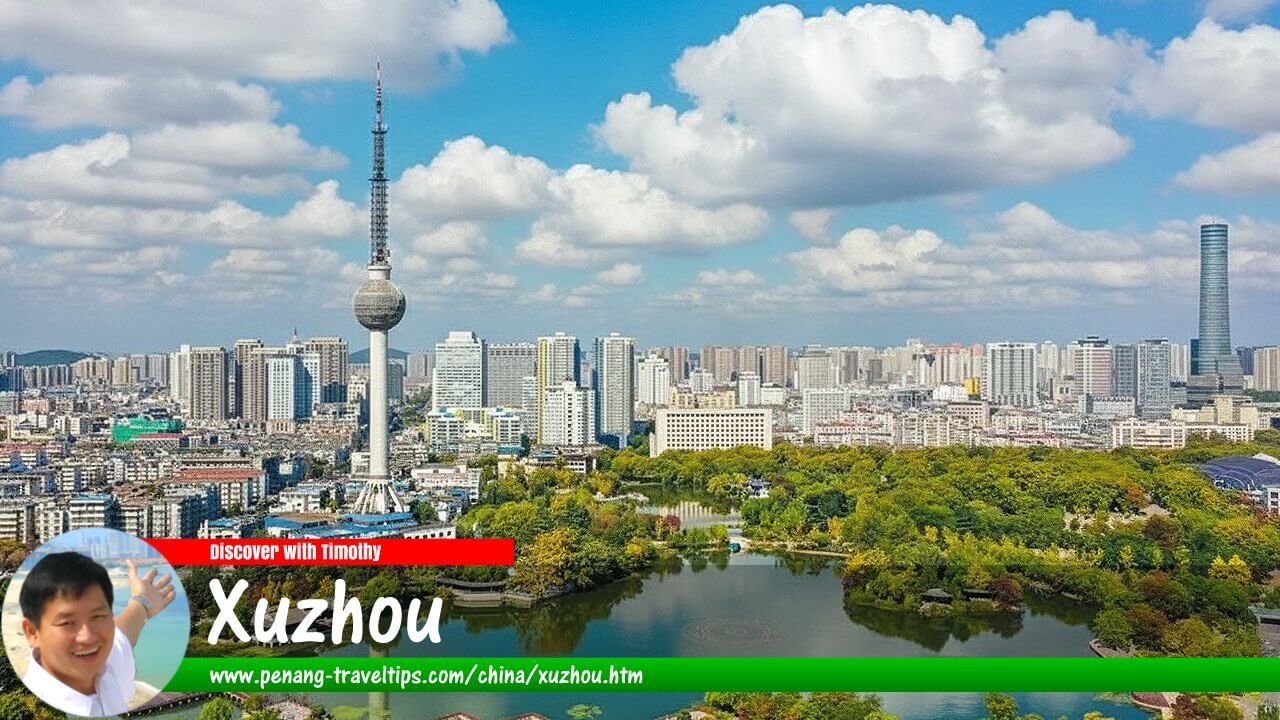 Xuzhou, China (Photo edited with AI on 23 June 2026)
Xuzhou (徐州, Xúzhōu) is a major prefecture-level city in northwestern Jiangsu Province, China. Situated at the crossroads of eastern and northern China, it has long been regarded as an important transportation, military, and commercial centre. The city is particularly renowned for its association with the Han Dynasty and is often referred to as the "Hometown of Han Culture." With a history spanning more than 4,000 years, Xuzhou combines ancient heritage with modern urban development, making it one of the most historically significant cities in Jiangsu Province.
Quick Facts
- English Name: Xuzhou
- Chinese Name: 徐州
- Pinyin: Xúzhōu
- Province: Jiangsu
- Location: Northwestern Jiangsu Province, China
- Administrative Status: Prefecture-level city
- Population: Over 9 million
- Area: Approximately 11,258 square kilometres
- Famous For: Han Dynasty heritage, transportation hub, Yunlong Lake
- Main Airport: Xuzhou Guanyin International Airport
- Main Railway Stations: Xuzhou Railway Station, Xuzhou East Railway Station
- Dialects: Zhongyuan Mandarin and Jianghuai Mandarin varieties
- Nickname: Hometown of Han Culture
Name and Etymology
The name Xuzhou is written in Chinese as 徐州 and romanised as Xúzhōu in Pinyin. The character "Xu" (徐) originally referred to the ancient Xu region and the people who inhabited it in antiquity. The character "zhou" (州) means a prefecture or administrative region.
The name has existed for more than two millennia and was used during various imperial dynasties as an administrative designation. Historically, Xuzhou occupied a strategic location between northern and southern China, making it an important political and military centre. The city's name reflects its long-standing role as the principal city of the ancient Xu region.
Geography
Xuzhou is located in the northwestern corner of Jiangsu Province, bordering Shandong Province to the north, Anhui Province to the south and west, and other parts of Jiangsu to the east. The city occupies a strategic position where several major transportation routes intersect.
Unlike much of Jiangsu, which is characterised by flat river plains, Xuzhou features a landscape of low mountains, hills, lakes, and plains. The area lies within the transition zone between northern and southern China's geographical regions.
Several rivers and lakes contribute to the city's environment. The ancient Grand Canal passes through the region, while Yunlong Lake is one of the city's most famous scenic landmarks. The terrain includes hills such as Yunlong Mountain, Quanshan Mountain, and Jiuli Mountain.
Xuzhou experiences a temperate monsoon climate with four distinct seasons. Summers are warm and humid, while winters can be cold and dry. Spring and autumn are generally considered the most pleasant seasons for visitors.
Languages and Dialects
Mandarin Chinese is the official language used in government, education, and media throughout Xuzhou.
In addition to Standard Mandarin, local residents commonly speak dialects belonging to the broader Mandarin family. The most prominent local speech varieties include:
- Xuzhou Dialect – A variety of Zhongyuan Mandarin, featuring distinctive pronunciation and vocabulary.
- Zhongyuan Mandarin – Spoken across parts of Henan, Anhui, Shandong, and northern Jiangsu, influencing local speech.
- Jianghuai Mandarin – Found in parts of central Jiangsu and neighbouring regions, with some influence in southern parts of the municipality.
The local dialect differs noticeably from Standard Mandarin in pronunciation, tone patterns, and expressions, although mutual comprehension is generally possible.
History
Xuzhou possesses one of the longest recorded histories among Chinese cities. Archaeological discoveries indicate human settlement in the region dating back thousands of years.
Ancient Period
The area formed part of the ancient Xu region and was associated with various prehistoric cultures. During the Zhou Dynasty, it developed into an important administrative and military territory.
Qin and Han Dynasties
Xuzhou gained particular prominence during the Han Dynasty. Liu Bang, the founder of the Han Dynasty who became Emperor Gaozu of Han, had strong connections to the broader region. As a result, Xuzhou became an important centre of Han culture.
Numerous Han-era tombs, sculptures, and archaeological remains have been discovered in and around the city. These findings provide valuable insights into ancient Chinese civilisation.
Three Kingdoms Period
During the turbulent Three Kingdoms era, Xuzhou occupied a strategic position contested by rival warlords. Several famous historical figures, including Cao Cao and Liu Bei, were associated with events in the region.
Imperial China
Throughout the Tang, Song, Yuan, Ming, and Qing dynasties, Xuzhou remained an important transport and commercial centre. Its location along the Grand Canal facilitated trade between northern and southern China.
Modern Era
In the twentieth century, Xuzhou emerged as a major industrial city. Coal mining, manufacturing, transportation, and heavy industry contributed significantly to its economic development. Today, the city continues to modernise while preserving its rich historical heritage.
Economy and Products
Xuzhou is one of the economic centres of northern Jiangsu and serves as a major transportation and industrial hub.
Industrial Production
The city is particularly known for its engineering and heavy machinery industries. Xuzhou is home to major manufacturers of construction equipment, mining machinery, and industrial machinery.
Coal mining historically played an important role in the local economy, although economic diversification has become increasingly important in recent decades.
Manufacturing
Manufacturing sectors include:
- Construction machinery
- Heavy equipment
- Electronic products
- Building materials
- Automotive components
- Chemical products
Agriculture
The surrounding countryside produces wheat, corn, rice, vegetables, peanuts, and fruits. Agricultural products from the region support both local consumption and wider markets.
Tourism
Tourism has become an increasingly important sector, particularly heritage tourism centred on Han Dynasty culture, historical sites, museums, and scenic attractions.
How to Go There
By Air
Xuzhou is served by Xuzhou Guanyin International Airport (徐州观音国际机场), located approximately 45 kilometres southeast of the city centre.
The airport offers domestic flights to major Chinese cities including Beijing, Shanghai, Guangzhou, Shenzhen, Chengdu, Chongqing, Xi'an, Kunming, and other destinations. Airlines serving the airport typically include Air China, China Eastern Airlines, China Southern Airlines, Shenzhen Airlines, Hainan Airlines, and several other domestic carriers.
By Train
Xuzhou is one of China's most important railway hubs.
- Xuzhou Railway Station is located near the city centre and serves conventional rail services connecting many parts of China.
- Xuzhou East Railway Station is situated in the eastern part of the city and serves high-speed rail services on major routes linking Beijing, Shanghai, Nanjing, Zhengzhou, Qingdao, and other cities.
High-speed trains make Xuzhou easily accessible from major Chinese urban centres.
By Long-Distance Bus
The city has several long-distance bus terminals. The principal bus stations are located near Xuzhou Railway Station and provide services to destinations throughout Jiangsu Province and neighbouring provinces such as Anhui, Shandong, and Henan.
By Road
Several major expressways pass through Xuzhou, making travel by private car or coach convenient. The city serves as a road transportation crossroads between northern and eastern China.
How to Travel Locally
Metro
Xuzhou Metro operates multiple urban rail transit lines connecting major districts, railway stations, residential areas, universities, and commercial centres. The metro is one of the most convenient ways to travel within the city.
Taxis
Taxis are widely available throughout Xuzhou and can be hailed on the street or found at transport hubs, shopping districts, and tourist attractions.
E-Hailing Services
E-hailing platforms such as DiDi are commonly used and provide convenient transport throughout the city using smartphone applications.
Public Buses
An extensive public bus network covers most urban and suburban areas. Buses provide affordable transportation for residents and visitors.
Bicycles and Shared Bikes
Shared bicycle systems are available throughout the city and are particularly useful for short-distance travel.
Traditional trishaws, rickshaws, and tuk-tuks are generally not part of the city's modern transportation system.
Tourist Attractions
Yunlong Lake (云龙湖)
Yunlong Lake is the most famous scenic area in Xuzhou. Surrounded by hills, gardens, and parks, it offers beautiful landscapes, walking paths, boating opportunities, and recreational facilities.
Yunlong Mountain (云龙山)
Located beside Yunlong Lake, Yunlong Mountain provides panoramic views of the city and contains historic temples, pavilions, and scenic viewpoints.
Han Culture Scenic Area
This attraction showcases Xuzhou's rich Han Dynasty heritage through museums, reconstructed historical sites, and archaeological displays.
Terracotta Warriors of the Han Dynasty
Xuzhou is famous for its Han-era terracotta figurines. These smaller-scale terracotta armies were buried with royal family members and are displayed in museums and archaeological sites.
Guishan Han Tomb (龟山汉墓)
The Guishan Han Tomb is one of China's most impressive Han Dynasty archaeological discoveries. The tomb contains elaborate underground chambers carved directly into a mountain.
Xuzhou Museum
The museum houses a remarkable collection of Han Dynasty artefacts, jade burial suits, pottery, bronze objects, and historical relics from the region.
Hubu Mountain Ancient Buildings
This historic district preserves traditional architecture and cultural heritage, offering visitors a glimpse into the city's past.
Pengzu Garden (彭祖园)
Named after the legendary figure Pengzu, who was reputed to have enjoyed exceptional longevity, the garden features landscaped grounds, cultural exhibits, and leisure facilities.
Jiuli Mountain Ancient Battlefield
Associated with historical military events and legends, this area provides insight into the strategic importance of Xuzhou throughout Chinese history.
Pan'an Lake Wetland Park
This ecological park demonstrates successful environmental restoration and offers wetlands, walking trails, birdwatching opportunities, and scenic landscapes.
Conclusion
Xuzhou stands as one of China's most historically significant cities, blending ancient heritage with modern development. Its strategic location, rich Han Dynasty legacy, extensive transportation network, and growing economy make it both an important regional centre and an attractive destination for visitors. Whether exploring ancient tombs, enjoying the scenery of Yunlong Lake, or discovering the city's vibrant cultural heritage, visitors to Xuzhou encounter a city that reflects thousands of years of Chinese civilisation.
Xuzhou, China is  the Map of Cities in China
References
- Xuzhou
- Xuzhou Guanyin International Airport
- Xuzhou Guanyin International Airport Information
- Xuzhou Guanyin Airport Overview
- TravelChina Discussion: Xuzhou
- TravelChina Discussion: Historical Attractions in Xuzhou
Page Details
This page was created/modified on 23 June 2026. Hi, my name is Timothy and created it from my research, for my own entertainment, knowledge and to satisfy my curiosity. I am providing the information to you in good faith and hope it is useful. I try to get the details as accurate as possible. I also try to update the page whenever I stumble on new details. So this and all my other pages are perpetual work in progress. If you discover any error, please politely inform me, pointing out where the error lies, and I will correct it as soon as possible. Your helpfulness will keep this page accurate, relevant and helpful to those who need the information.