
Suqian, China
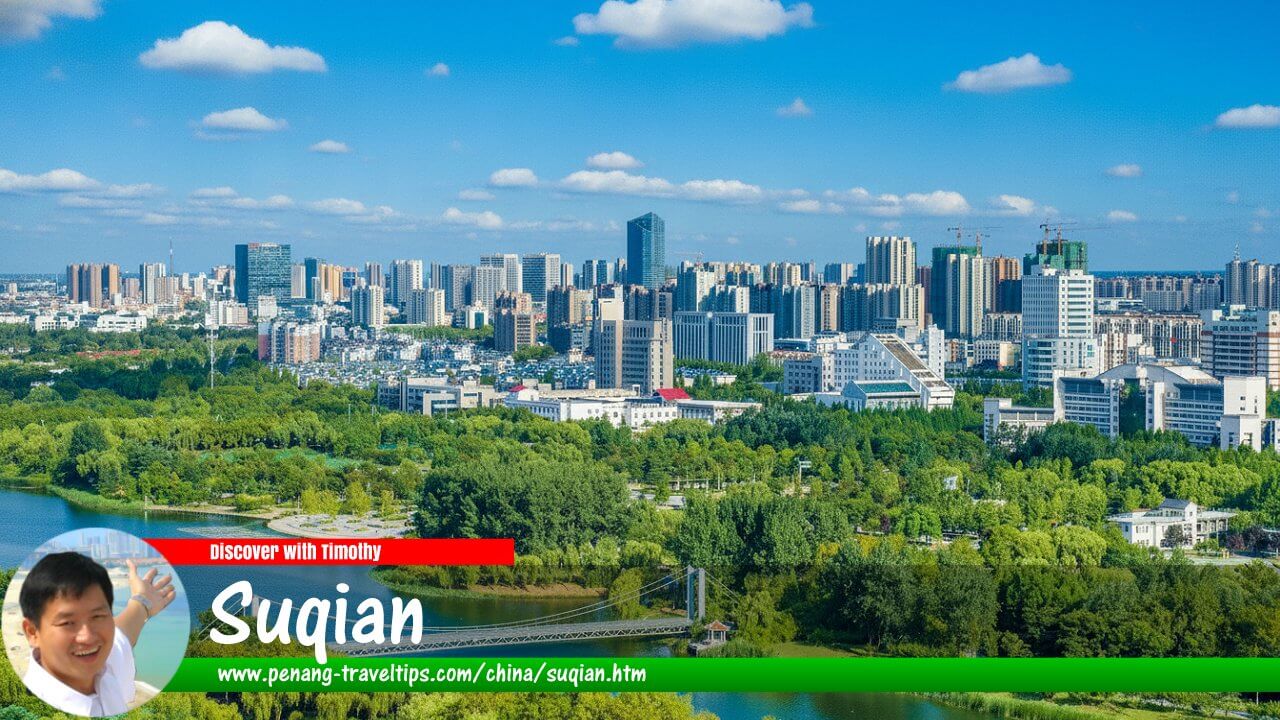 Suqian, China (Photo edited with AI on 23 June 2026)
Suqian (宿迁, Sùqiān) is a prefecture-level city in northern Jiangsu Province, China. Located in the lower reaches of the Huai River and along the historic Grand Canal, Suqian is one of Jiangsu's youngest prefecture-level cities in administrative terms but possesses a history stretching back more than 2,000 years. Today, it is known for its ecological environment, thriving liquor industry, rich cultural heritage, and strategic position connecting eastern and central China.1
Quick Facts
- English Name: Suqian
- Chinese Name: 宿迁
- Pinyin: Sùqiān
- Province: Jiangsu
- Location: Northern Jiangsu Province, China
- Administrative Status: Prefecture-level city
- Population: Approximately 5 million
- Area: About 8,555 square kilometres
- Famous For: Yanghe liquor, wetlands, Grand Canal heritage
- Main Airport: Xuzhou Guanyin International Airport (nearest major airport)
- Main Railway Station: Suqian Railway Station
- Main Dialects: Jianghuai Mandarin and Zhongyuan Mandarin varieties
- Nickname: Water City of Northern Jiangsu
Name and Etymology
The name Suqian is written as 宿迁 in Chinese and romanised as Sùqiān in Pinyin. The character "Su" (宿) originally referred to a place of lodging, residence, or overnight stay, while "Qian" (迁) means relocation or migration.1
The name dates back to the Western Han Dynasty. Historical records indicate that the area was renamed after local administrative relocations and population movements. Over the centuries, the name Suqian became firmly associated with the region and survived numerous dynastic changes.1
Geography
Suqian is situated in northern Jiangsu Province, bordering Xuzhou to the northwest, Huai'an to the southeast, Lianyungang to the northeast, and Anhui Province to the west. The city lies within the Huai River basin and occupies an important transitional zone between northern and southern China.1
The terrain is predominantly flat, consisting of fertile alluvial plains shaped by rivers, lakes, and canal systems. Water plays a significant role in the local landscape, with numerous waterways contributing to agriculture, transportation, and tourism.
One of the city's most notable geographical features is Hongze Lake, one of China's largest freshwater lakes, which extends into parts of Suqian's territory. The Beijing–Hangzhou Grand Canal also passes through the municipality and has influenced local development for centuries.1
Suqian experiences a temperate monsoon climate with four distinct seasons. Summers are warm and humid, while winters are cool and relatively dry. Spring and autumn offer comfortable temperatures and are considered ideal times to visit.
Languages and Dialects
Standard Mandarin is the official language used throughout Suqian in government, education, business, and media.
In addition to Standard Mandarin, local residents commonly speak regional Mandarin dialects that reflect Suqian's position between northern and southern China.1
- Jianghuai Mandarin – Widely spoken in much of southern and eastern Suqian.
- Zhongyuan Mandarin – More common in areas closer to northern Jiangsu and neighbouring provinces.
- Suqian Local Dialect – A local speech variety containing distinctive vocabulary and pronunciation characteristics.
These dialects differ from Standard Mandarin in tones, pronunciation, and certain expressions, although speakers generally communicate effectively with Mandarin speakers from elsewhere in China.
History
Suqian's history spans more than two millennia, making it one of the historically important cities of northern Jiangsu.1
Ancient Origins
Archaeological discoveries indicate human habitation in the region since prehistoric times. During the Qin and Han dynasties, the area became increasingly important due to its location along transportation and trade routes.
Han Dynasty Connections
Suqian is especially famous as the birthplace of Xiang Yu, one of the most celebrated military leaders in Chinese history. Xiang Yu played a major role in the collapse of the Qin Dynasty and the struggle that ultimately led to the establishment of the Han Dynasty.1
Imperial China
During the Tang, Song, Yuan, Ming, and Qing dynasties, Suqian benefited greatly from its location along the Grand Canal. The canal facilitated trade, transportation, and cultural exchange between northern and southern China.2
The city's economy grew through agriculture, river commerce, and handicraft production. Numerous market towns emerged throughout the region.
Modern Development
In modern times, Suqian developed into an important regional economic centre. It was elevated to prefecture-level city status in 1996, making it one of the newest prefecture-level municipalities in Jiangsu Province.1
Economy and Products
Suqian's economy is based on manufacturing, agriculture, logistics, food processing, and tourism. The city's strategic location makes it an important transportation and distribution centre in northern Jiangsu.
Liquor Production
The city's most famous product is Yanghe liquor (Yanghe Daqu), one of China's most prestigious baijiu brands. Produced in Yanghe Town, the liquor enjoys nationwide recognition and represents one of Suqian's most important industries.23
Agriculture
The fertile plains surrounding Suqian support extensive agricultural production. Major products include:
- Rice
- Wheat
- Corn
- Cotton
- Vegetables
- Aquatic products
- Fruit
Manufacturing
Modern industries include machinery manufacturing, textiles, food processing, electronics, packaging materials, and renewable energy equipment.
E-Commerce and Logistics
Suqian has gained national attention as a centre for e-commerce and logistics development, attracting investments from major Chinese technology and retail companies.4
How to Go There
By Air
Suqian does not currently have a major commercial airport serving extensive passenger traffic. Most visitors arrive through Xuzhou Guanyin International Airport, located approximately 90 kilometres northwest of Suqian city centre.5
The airport offers flights to major Chinese cities including Beijing, Shanghai, Guangzhou, Shenzhen, Chengdu, Xi'an, Kunming, and Chongqing. Airlines typically include Air China, China Eastern Airlines, China Southern Airlines, Shenzhen Airlines, and other domestic carriers.5
By Train
Suqian Railway Station is located in the urban area and serves high-speed rail services connecting the city with Nanjing, Shanghai, Beijing, Xuzhou, and other destinations.6
The arrival of high-speed rail significantly improved accessibility and economic integration with other major Chinese cities.
By Long-Distance Bus
The city's principal long-distance bus terminals are located within the urban district and provide regular services to destinations throughout Jiangsu Province and neighbouring provinces.
By Road
Several national highways and expressways pass through Suqian, making road travel convenient for both passenger and freight transport.
How to Travel Locally
Taxis
Taxis are widely available throughout the city and remain one of the most convenient methods of transportation.
E-Hailing Services
DiDi and other Chinese e-hailing platforms operate extensively in Suqian and provide convenient app-based transportation services.
Public Buses
An extensive municipal bus network connects residential districts, commercial centres, railway stations, and tourist attractions.
Bicycles and Shared Bikes
Shared bicycle services are available in urban areas and are suitable for short-distance journeys.
Metro and Rail Transit
Suqian currently does not operate a subway, MRT, metro, or LRT system.
Traditional Transport
Traditional trishaws, rickshaws, and tuk-tuks are generally not a significant part of the city's transportation system.
Tourist Attractions
Xiang Yu Hometown Scenic Area
This attraction commemorates Xiang Yu, the famous military leader of the late Qin Dynasty. Visitors can explore memorial halls, gardens, statues, and exhibits dedicated to his life and achievements.7
Hongze Lake Wetland Scenic Area
One of the largest wetland reserves in eastern China, this scenic area features rich biodiversity, birdlife, waterways, ecological exhibits, and recreational facilities.8
Yanghe Distillery Cultural Tourism Area
Visitors can learn about the production of Yanghe Daqu baijiu, tour distillery facilities, and discover the history of one of China's most famous liquor brands.3
Luoma Lake Scenic Area
Luoma Lake is a popular destination for boating, fishing, lakeside recreation, and relaxation. The surrounding area offers attractive natural scenery and leisure facilities.
Grand Canal Heritage Sites
Several locations within Suqian preserve historic sections of the Grand Canal and showcase the city's long relationship with inland water transportation.2
Santai Mountain National Forest Park
This large ecological park features forests, flower gardens, walking trails, wetlands, and seasonal displays that attract visitors throughout the year.9
Zaohe Dragon King Temple
This historic temple reflects traditional Chinese folk beliefs associated with rivers, water management, and navigation.
Conclusion
Suqian combines a rich historical legacy with rapid modern development. From its association with Xiang Yu and the Grand Canal to its famous Yanghe liquor industry and extensive wetland landscapes, the city offers visitors a distinctive blend of culture, history, ecology, and economic vitality. As one of northern Jiangsu's rising urban centres, Suqian continues to strengthen its position as an important destination and regional hub.1
Suqian, China is  the Map of Cities in China
References
- Suqian
- The Grand Canal (UNESCO World Heritage Centre)
- Yanghe Distillery Official Website
- Jiangsu Provincial People's Government
- Xuzhou Guanyin International Airport
- Suqian Railway Station
- Xiang Yu
- Hongze Lake Wetland Information
- Santai Mountain National Forest Park
Page Details
This page was created/modified on 23 June 2026. Hi, my name is Timothy and created it from my research, for my own entertainment, knowledge and to satisfy my curiosity. I am providing the information to you in good faith and hope it is useful. I try to get the details as accurate as possible. I also try to update the page whenever I stumble on new details. So this and all my other pages are perpetual work in progress. If you discover any error, please politely inform me, pointing out where the error lies, and I will correct it as soon as possible. Your helpfulness will keep this page accurate, relevant and helpful to those who need the information.