
Taizhou, Jiangsu Province, China
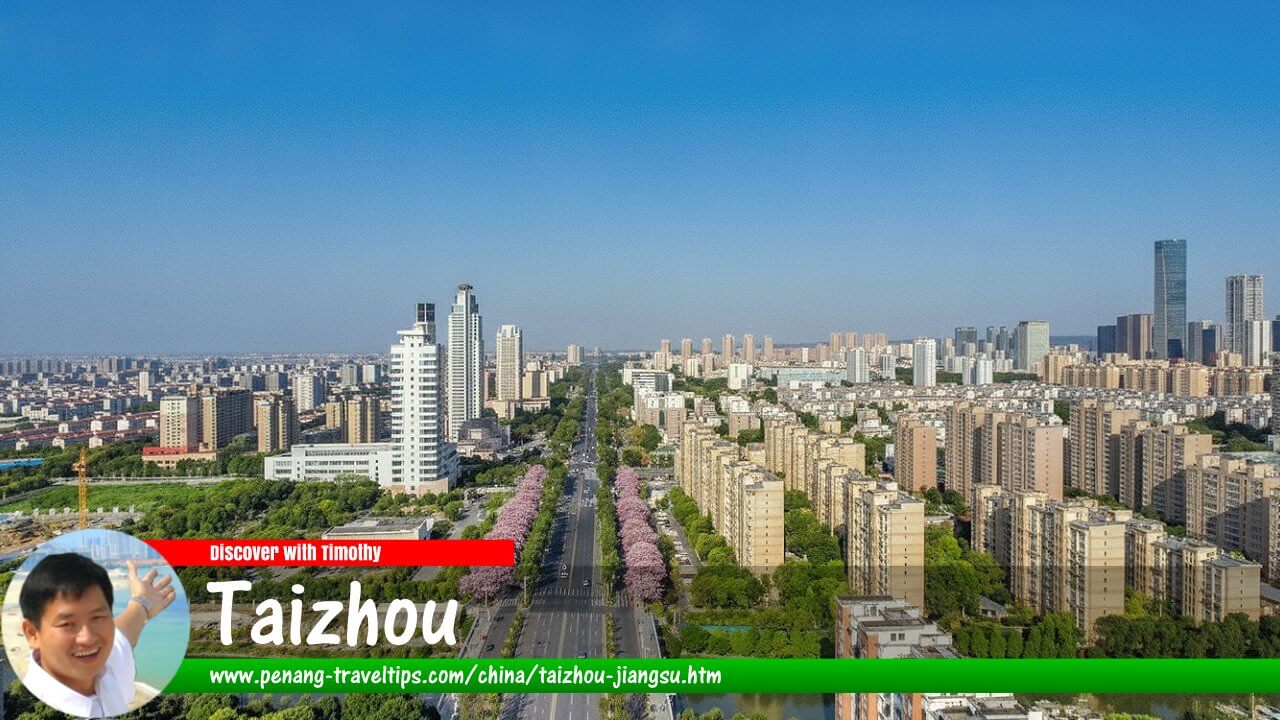 Taizhou, Jiangsu Province, China (Photo edited with AI on 18 June 2026)
Taizhou (泰州, Tàizhōu) is a prefecture-level city in central Jiangsu Province, China, situated on the north bank of the Yangtze River between Yangzhou and Nantong. Although less internationally known than nearby Nanjing, Suzhou, and Yangzhou, Taizhou has a long and distinguished history stretching back more than 2,000 years.1 The city has historically been an important centre for commerce, transportation, salt production, education, and culture. Today, Taizhou is recognised as one of China's leading pharmaceutical and medical technology hubs, while also preserving its traditional waterways, ancient streets, temples, and cultural heritage.
The name "Taizhou" is written as 泰州 in Chinese and romanised as Tàizhōu in pinyin. The character 泰 (tài) means "peaceful," "grand," or "prosperous," while 州 (zhōu) means "prefecture" or "administrative region." The name may be interpreted as "Prosperous Prefecture" or "Peaceful Prefecture." Taizhou was formally established as an administrative prefecture during the Southern Tang period in the 10th century, and the name has remained in use ever since.2
Despite having the same English spelling, Taizhou in Jiangsu is written with a different Chinese character from Taizhou (台州) in Zhejiang Province.
Quick Facts
- Chinese Name: 泰州
- Pinyin: Tàizhōu
- Province: Jiangsu
- Location: Central Jiangsu, north of the Yangtze River
- Area: Approximately 5,787 square kilometres
- Population: About 4.5 million
- Administrative Centre: Hailing District
- Main Languages: Mandarin, Taizhou dialect (Jianghuai Mandarin)
- Climate: Humid subtropical climate
- Main Industries: Pharmaceuticals, biotechnology, manufacturing, shipping, agriculture
- Famous Products: Traditional Chinese medicine, medical equipment, rice, aquatic products
- Airport: Yangzhou Taizhou International Airport
- Major Attractions: Qinhu Wetland, Fengcheng River Scenic Area, Guangxiao Temple, Qintong Ancient Town
Geography
Taizhou is located in the central portion of Jiangsu Province, occupying part of the fertile Yangtze River Delta region. The city lies approximately 150 kilometres east of Nanjing and about 250 kilometres northwest of Shanghai. It borders Nantong to the east, Yangzhou to the west, and the Yangtze River to the south.3
The terrain of Taizhou is predominantly flat and low-lying, consisting of alluvial plains formed by centuries of river sediment deposition. Numerous rivers, lakes, canals, and drainage channels intersect the landscape, creating an extensive water network that has supported agriculture and transportation throughout the city's history.
One of the city's most important natural features is Qinhu Lake, a large freshwater wetland ecosystem that supports diverse wildlife and serves as an important ecological conservation area. The extensive waterways have earned Taizhou a reputation as a traditional water town region.
The climate is humid subtropical, characterised by four distinct seasons. Summers are typically hot and humid, while winters are cool and damp. Spring and autumn are generally mild and pleasant, attracting visitors to the city's parks, wetlands, and scenic areas.4
Languages and Dialects
Mandarin is the official language used in government, education, business, and media. However, the local dialect remains an important part of Taizhou's cultural identity.
- Taizhou Dialect: A variety of Jianghuai Mandarin spoken by many local residents.
- Jianghuai Mandarin: The broader dialect group to which the Taizhou dialect belongs.
- Standard Mandarin: Widely spoken throughout the municipality.
- Other Chinese Dialects: Due to migration and economic development, speakers of Wu Chinese, Cantonese, Hakka, and Min dialects can also be found.
The Taizhou dialect differs noticeably from Standard Mandarin in pronunciation and vocabulary and forms an important component of local cultural traditions.
History
Human settlement in the Taizhou region dates back thousands of years. Archaeological discoveries indicate that communities existed here long before the formation of the modern city. The area's abundant waterways and fertile soil made it attractive for agriculture and fishing.5
During the Han Dynasty, the region became increasingly important as agricultural production expanded throughout the Yangtze Delta. Trade routes connecting inland China with the coast passed through the area, contributing to its economic growth.
Taizhou gained administrative significance during the Southern Tang Dynasty (937–975), when the prefecture of Taizhou was formally established. Over subsequent dynasties, the city prospered through agriculture, salt production, commerce, and river transport.
During the Ming and Qing dynasties, Taizhou became known for its educational achievements and scholarly traditions. Numerous academies, temples, and cultural institutions were established, contributing to the city's intellectual reputation.6
The city is also associated with several notable historical figures, including the Qing Dynasty literary critic and writer Liu Xizai, as well as the famous Peking Opera master Mei Lanfang, whose ancestral roots are connected to the region.
Following the economic reforms initiated in the late twentieth century, Taizhou underwent rapid industrialisation and urban development. It emerged as one of China's most important centres for pharmaceutical manufacturing, biotechnology research, and medical innovation.
Economy and Products
Taizhou has developed a highly diversified economy that combines advanced manufacturing, biotechnology, agriculture, logistics, and tourism. It is particularly renowned as one of China's leading centres for pharmaceutical production.7
The city's China Medical City (CMC) project has attracted major domestic and international pharmaceutical companies, research institutions, and biotechnology firms. The pharmaceutical industry produces medicines, vaccines, medical devices, and healthcare products for both domestic and global markets.
Manufacturing sectors include machinery, shipbuilding equipment, electronics, automotive components, and chemical products. Industrial parks throughout the municipality support innovation and export-oriented production.
Agriculture remains important in rural areas surrounding the urban core. Major agricultural products include rice, wheat, rapeseed, vegetables, freshwater fish, shrimp, and crabs. The region's extensive waterways support aquaculture and fisheries.
Taizhou is also known for traditional Chinese medicine products and herbal remedies. These industries build upon centuries of local expertise in healthcare and medicinal plant cultivation.
Tourism contributes to the economy through attractions such as wetlands, ancient towns, cultural festivals, and historical landmarks.
How to Go There
By Air
Taizhou is served by Yangzhou Taizhou International Airport, located approximately 25 kilometres southwest of Taizhou's urban area and around 30 kilometres northeast of Yangzhou city centre.
The airport offers flights to major Chinese cities including Beijing, Shanghai, Guangzhou, Shenzhen, Chengdu, Chongqing, Xi'an, Kunming, Qingdao, Harbin, and Sanya. Airlines operating at the airport include Air China, China Eastern Airlines, China Southern Airlines, Shenzhen Airlines, Xiamen Airlines, and Spring Airlines.8
Seasonal international and regional flights may also operate depending on market demand.
By Train
Taizhou is connected to China's extensive railway network through several stations.
- Taizhou Railway Station – located in Hailing District and serving conventional and high-speed trains.
- Taizhou South Railway Station – serving selected regional routes.
- Xinghua Railway Station – serving northern areas of the municipality.
High-speed rail services connect Taizhou with Nanjing, Shanghai, Yangzhou, Nantong, Beijing, Hangzhou, Hefei, and many other cities.
By Long-Distance Bus
The city is served by Taizhou South Bus Station, Taizhou West Bus Station, and several regional passenger terminals. Frequent coach services operate to destinations throughout Jiangsu Province and neighbouring provinces.
Local Transportation
Taizhou's transportation network is modern and convenient for both residents and visitors.
- Taxis: Readily available throughout the city.
- E-hailing Services: Didi Chuxing is widely used.
- Public Buses: Extensive routes connect urban districts, tourist attractions, and suburban communities.
- Bicycle Sharing: Shared bicycles are available in many areas.
- E-bikes: Popular for local travel.
- Tourist Boats: Available in selected scenic areas and waterways.
Taizhou currently does not have a subway, metro, MRT, or LRT system. Traditional trishaws, rickshaws, and tuk-tuks are generally not used for public transportation.
Tourist Attractions
1. Qinhu National Wetland Park (溱湖国家湿地公园)
The most famous natural attraction in Taizhou, Qinhu Wetland is home to extensive marshes, lakes, migratory birds, and diverse ecosystems. Visitors can explore the wetlands by boat and boardwalk.9
2. Qintong Ancient Town (溱潼古镇)
This historic water town preserves traditional architecture, canals, stone bridges, and cultural landmarks dating back several centuries.
3. Fengcheng River Scenic Area (凤城河风景区)
Located in the city centre, this scenic waterway is lined with historical buildings, gardens, museums, and walking paths.
4. Guangxiao Temple (光孝寺)
One of the oldest Buddhist temples in the region, Guangxiao Temple has a history stretching back more than a thousand years.
5. Mei Lanfang Memorial Hall (梅兰芳纪念馆)
This museum commemorates the life and achievements of Mei Lanfang, one of the greatest performers in the history of Peking Opera.
6. China Medical City Exhibition Centre
A modern exhibition complex showcasing Taizhou's achievements in pharmaceuticals, biotechnology, and medical innovation.
7. Tiande Lake Park (天德湖公园)
A large urban park featuring lakes, gardens, walking trails, and recreational facilities.
8. Taizhou Old Street (泰州老街)
This reconstructed historical district contains traditional-style architecture, local restaurants, souvenir shops, and cultural performances.
9. Zhengbanqiao Memorial Hall
Dedicated to the famous Qing Dynasty painter and calligrapher Zheng Banqiao, this museum highlights his artistic achievements and cultural influence.
10. Xinghua Thousand-Island Canola Flower Scenic Area (兴化千垛景区)
One of Jiangsu's most spectacular seasonal attractions, this unique agricultural landscape features raised fields surrounded by waterways, covered with brilliant yellow rapeseed flowers during spring.
Taizhou, Jiangsu Province, China is  the Map of Cities in China
References
- Encyclopaedia Britannica – Taizhou
- Wikipedia – Taizhou, Jiangsu
- Travel China Guide – Taizhou
- Climate Information for Taizhou
- Encyclopaedia Britannica – Jiangsu Province
- Taizhou Municipal Government
- China Medical City
- Yangzhou Taizhou International Airport
- Qinhu National Wetland Park
Page Details
This page was created/modified on 18 June 2026. Hi, my name is Timothy and created it from my research, for my own entertainment, knowledge and to satisfy my curiosity. I am providing the information to you in good faith and hope it is useful. I try to get the details as accurate as possible. I also try to update the page whenever I stumble on new details. So this and all my other pages are perpetual work in progress. If you discover any error, please politely inform me, pointing out where the error lies, and I will correct it as soon as possible. Your helpfulness will keep this page accurate, relevant and helpful to those who need the information.