
Nanjing, China
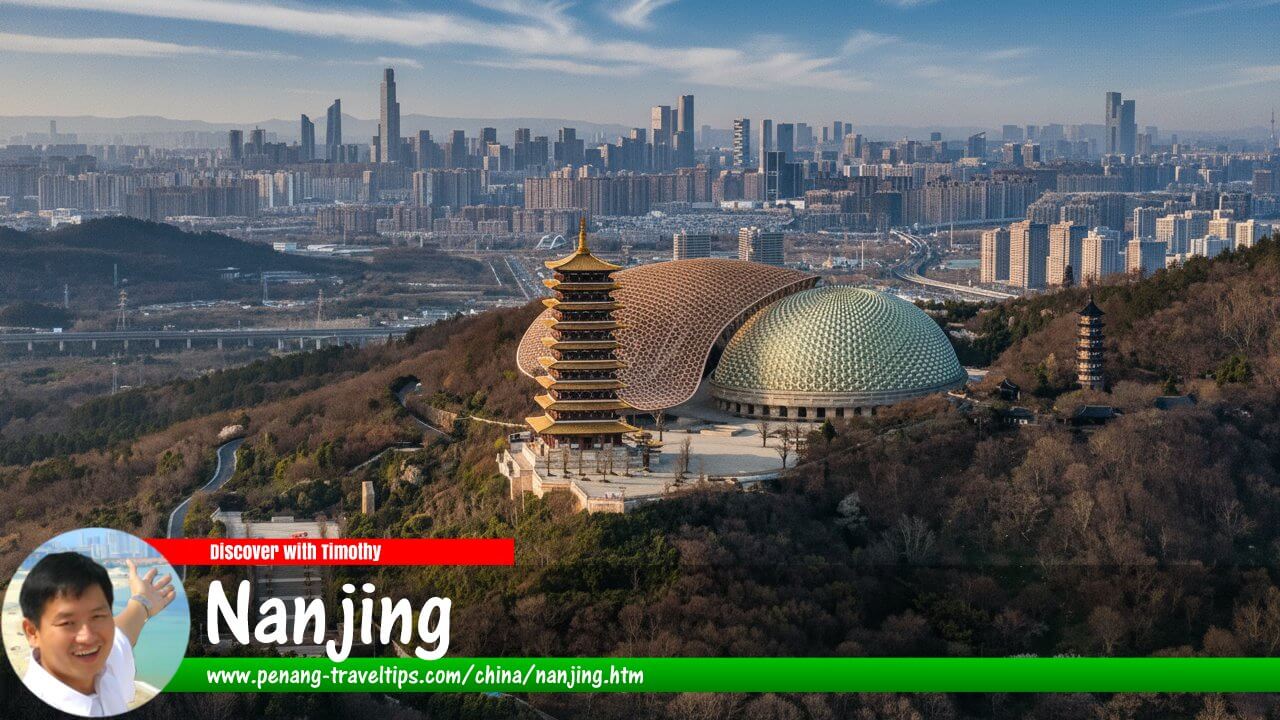 Nanjing, China (Photo edited with AI on 20 June 2026)
Nanjing (南京, Nánjīng), the capital of Jiangsu Province in eastern China, is one of the country's most historically significant and culturally rich cities. Situated on the lower reaches of the Yangtze River, Nanjing has served as the capital of several Chinese dynasties and governments over more than two millennia. Today, it is a major center of education, transportation, industry, and technology, while preserving an impressive collection of historical monuments, ancient city walls, temples, and museums.1
Quick Facts
- Chinese Name: 南京
- Pinyin: Nánjīng
- Province: Jiangsu
- Status: Provincial Capital
- Population: Approximately 9.5 million
- Area: About 6,587 square kilometres
- Location: Southwestern Jiangsu Province, on the Yangtze River
- Airport: Nanjing Lukou International Airport
- Main Railway Stations: Nanjing Railway Station, Nanjing South Railway Station
- Famous Attractions: Sun Yat-sen Mausoleum, Ming Xiaoling Mausoleum, Confucius Temple, Nanjing City Wall, Xuanwu Lake
- Dialect: Nanjing Mandarin
- Economy: Electronics, automotive manufacturing, software, finance, education, logistics
Name and Etymology
The name Nanjing literally means "Southern Capital" in Chinese. The character nan (南) means "south," while jing (京) means "capital." The name reflects the city's historical role as the capital of southern Chinese regimes during periods when northern capitals existed elsewhere in China.2
Throughout history, the city has been known by several names, including Jianye, Jiankang, Jiangning, and Tianjing. The modern name Nanjing was formally adopted during the Ming Dynasty when the city became the capital of the empire before the capital was later moved to Beijing. Despite the move, Nanjing retained its prestigious status and historical significance.3
Geography
Nanjing is located in southwestern Jiangsu Province on the southern bank of the Yangtze River. It occupies a strategic position between eastern China's coastal region and the interior provinces. The city lies approximately 300 kilometres northwest of Shanghai and serves as a gateway between the Yangtze River Delta and central China.4
The landscape of Nanjing is more varied than many cities in the Yangtze Delta. It features hills, rivers, lakes, and forests. Purple Mountain (Zijin Shan), located east of the city centre, rises prominently above the urban landscape and contains many historic monuments and scenic areas.
The Yangtze River flows through the northern part of the municipality and has long been vital to transportation, commerce, and defense. Other important waterways include the Qinhuai River, which flows through the historic city center, and Xuanwu Lake, one of the city's most famous recreational areas.
Nanjing experiences a humid subtropical climate characterized by four distinct seasons. Summers are hot and humid, while winters are cool and occasionally snowy. Spring and autumn are generally regarded as the most pleasant seasons for visitors.
Languages and Dialects
Mandarin Chinese is the official language used throughout Nanjing. However, the city is particularly famous for its local variety known as Nanjing Mandarin (南京话, Nánjīnghuà), which historically served as one of the most influential forms of spoken Chinese.5
Nanjing Mandarin belongs to the Jianghuai Mandarin group and differs from Standard Mandarin in pronunciation, vocabulary, and certain grammatical features. During the Ming and Qing dynasties, the speech of Nanjing was widely regarded as a prestigious form of Chinese and influenced official pronunciation standards.
Due to migration and economic development, Standard Mandarin is now widely spoken across the city. Some residents, particularly older generations, continue to use local dialect forms in daily life.
History
Ancient Origins
The history of Nanjing stretches back more than 2,500 years. Archaeological evidence indicates that the area was inhabited during the Spring and Autumn Period. Due to its strategic location along the Yangtze River, the city became an important military and commercial center.
During the Three Kingdoms period, the state of Eastern Wu established its capital at Jianye, the predecessor of modern Nanjing. This marked the beginning of the city's role as one of China's major capitals.6
Capital of Southern Dynasties
Between the fourth and sixth centuries, Nanjing, then known as Jiankang, served as the capital of several Southern Dynasties. During this period, it became one of the largest cities in the world and a major center of Buddhist scholarship, literature, and art.
Ming Dynasty Capital
Nanjing reached new prominence in the fourteenth century when Zhu Yuanzhang, founder of the Ming Dynasty, selected the city as his imperial capital. Massive construction projects transformed the city, including the building of the famous Nanjing City Wall, imperial palaces, and government institutions.
The city remained the capital until the Yongle Emperor transferred the imperial court to Beijing in 1421. Nevertheless, Nanjing retained significant political importance as the Southern Capital.
Modern Era
In the nineteenth century, Nanjing became the capital of the Taiping Heavenly Kingdom during the Taiping Rebellion. Later, in the twentieth century, it served as the capital of the Republic of China under Sun Yat-sen and Chiang Kai-shek.
Nanjing also witnessed tragic events during the Second Sino-Japanese War. The Nanjing Massacre of 1937 remains one of the most significant and painful episodes in modern Chinese history. Memorial sites throughout the city commemorate the victims and promote peace and remembrance.7
Economy and Products
Nanjing possesses one of the strongest economies in eastern China. As the capital of Jiangsu Province, it serves as a major center for government administration, finance, education, research, and advanced manufacturing.
The city's industrial sectors include electronics, software development, automotive manufacturing, petrochemicals, biotechnology, and telecommunications. Numerous domestic and international companies operate research centers and production facilities in the city.
Nanjing is also known for its universities and research institutions. Prestigious institutions such as Nanjing University and Southeast University contribute significantly to scientific innovation and talent development.
Traditional products associated with Nanjing include cloud-pattern brocade (Yunjin), one of China's most celebrated textile arts, as well as salted duck, which is considered a local culinary specialty. The city also has thriving tourism and cultural industries supported by its rich historical heritage.
How to Go There
By Air
Nanjing is served by Nanjing Lukou International Airport, located approximately 35 kilometres south of the city centre. The airport is one of eastern China's major aviation hubs and offers domestic and international flights.
Airlines operating there include Air China, China Eastern Airlines, China Southern Airlines, Shenzhen Airlines, Xiamen Airlines, and several international carriers. Destinations include Beijing, Shanghai, Guangzhou, Shenzhen, Chengdu, Hong Kong, Seoul, Tokyo, Singapore, and Bangkok.8
By Rail
Nanjing is one of China's most important railway hubs. Major stations include:
- Nanjing South Railway Station – one of the largest high-speed railway stations in Asia, located in Yuhuatai District.
- Nanjing Railway Station – located near Xuanwu Lake, serving both conventional and high-speed trains.
- Nanjing West and Nanjing East stations – handling additional regional and freight services.
Frequent high-speed rail services connect Nanjing with Shanghai, Beijing, Hangzhou, Suzhou, Wuhan, Xi'an, and many other major cities.
By Long-Distance Bus
Several major bus terminals serve Nanjing, including Nanjing Central Bus Station near Nanjing Railway Station and Nanjing South Bus Station near Nanjing South Railway Station. Long-distance buses connect the city with destinations throughout Jiangsu and neighboring provinces.
How to Travel Locally
Nanjing possesses a modern and efficient urban transportation system.
- Metro: The Nanjing Metro network covers most major districts and tourist attractions.
- Taxis: Metered taxis are readily available throughout the city.
- E-Hailing: Didi is the dominant ride-hailing platform. Uber does not operate independently in mainland China.
- Buses: Extensive bus routes connect urban and suburban areas.
- Bicycles: Public bicycle-sharing systems are common.
- Ferries: Passenger ferries cross sections of the Yangtze River.
There are no trishaws, tuk-tuks, MRT systems separate from the metro, or LRT networks operating in the city. Most visitors find the metro system sufficient for reaching major attractions.
Tourist Attractions
Sun Yat-sen Mausoleum
Located on Purple Mountain, this grand mausoleum honors Dr. Sun Yat-sen, regarded as the founder of modern China. The site combines impressive architecture with scenic mountain surroundings.9
Ming Xiaoling Mausoleum
This UNESCO World Heritage Site contains the tomb of the Hongwu Emperor, founder of the Ming Dynasty. Its Sacred Way lined with stone animals is particularly famous.
Nanjing City Wall
One of the world's longest surviving ancient city walls, the Nanjing City Wall remains an outstanding example of Ming-era military architecture.
Confucius Temple (Fuzimiao)
Located along the Qinhuai River, this historic district features traditional architecture, shops, restaurants, and cultural performances.
Xuanwu Lake
Xuanwu Lake is a large urban lake surrounded by parks, gardens, walking trails, and historic sites. It is one of Nanjing's most popular recreational areas.
Purple Mountain (Zijin Shan)
This scenic mountain contains numerous attractions, including observatories, temples, memorial halls, and hiking trails.
Nanjing Museum
One of China's largest museums, it houses extensive collections covering archaeology, history, art, and traditional culture.
Memorial Hall of the Victims in Nanjing Massacre
This important memorial commemorates victims of the events of 1937 and serves as a center for historical education and peace studies.
Presidential Palace
The Presidential Palace complex played a significant role during the Republic of China period and contains exhibits related to modern Chinese political history.
Qinhuai River Scenic Area
The historic river district is famous for illuminated night cruises, traditional architecture, local snacks, and cultural atmosphere.
Nanjing, China is  the Map of Cities in China
References
- Encyclopaedia Britannica – Nanjing
- Encyclopaedia Britannica – History of Nanjing
- China.org.cn – Nanjing Overview
- Jiangsu Provincial Government
- Encyclopaedia Britannica – Chinese Languages
- Ancient Nanjing History
- Historical Resources on Nanjing Massacre
- Nanjing Lukou International Airport
- UNESCO World Heritage Centre
Page Details
This page was created/modified on 20 June 2026. Hi, my name is Timothy and created it from my research, for my own entertainment, knowledge and to satisfy my curiosity. I am providing the information to you in good faith and hope it is useful. I try to get the details as accurate as possible. I also try to update the page whenever I stumble on new details. So this and all my other pages are perpetual work in progress. If you discover any error, please politely inform me, pointing out where the error lies, and I will correct it as soon as possible. Your helpfulness will keep this page accurate, relevant and helpful to those who need the information.