
Lianyungang, China
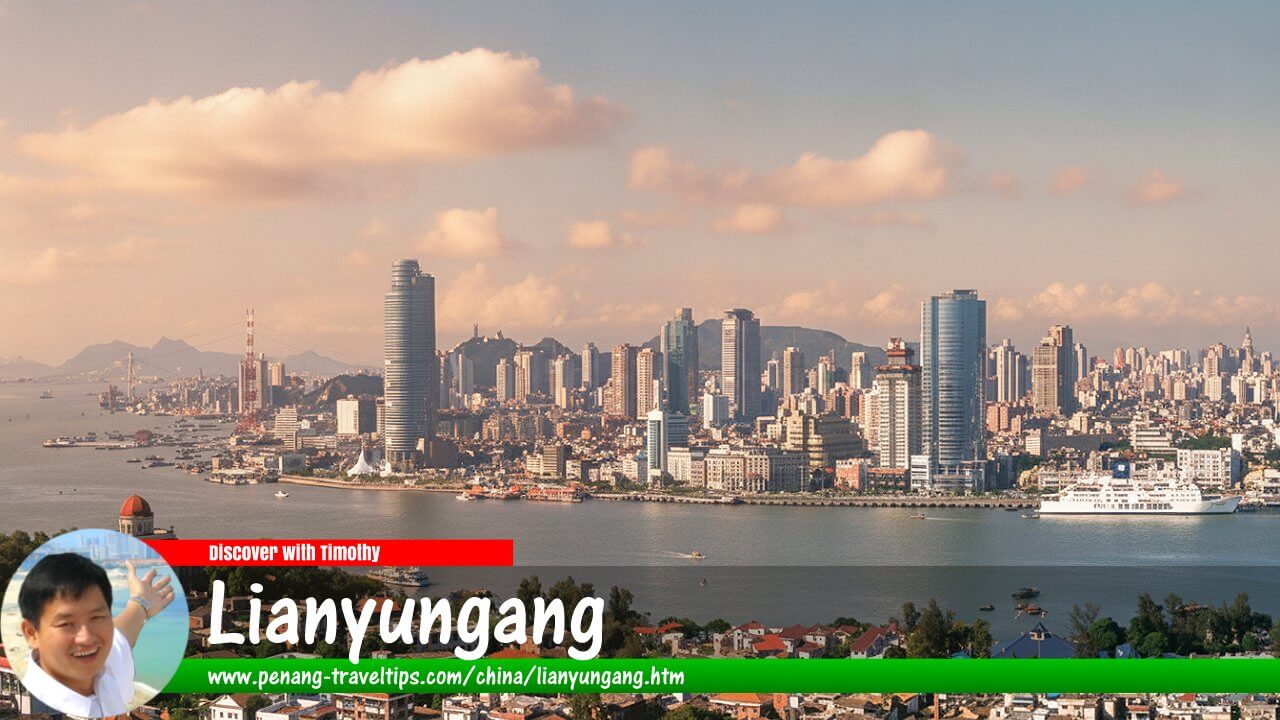 Lianyungang, China (Photo edited with AI on 23 June 2026)
Lianyungang (连云港, Liányúngǎng) is a prefecture-level city in northeastern Jiangsu Province, China, located on the coast of the Yellow Sea. As one of China's important port cities, it serves as the eastern terminus of several major transportation corridors and is often regarded as the eastern gateway of the Eurasian Land Bridge. The city's name combines three elements: "Lian" (连), derived from Lian Island; "Yun" (云), referring to the nearby Yuntai Mountains; and "Gang" (港), meaning harbor or port. Together, the name literally means "Harbor Connecting Clouds," reflecting the city's coastal setting and mountainous backdrop.1
Quick Facts
- Chinese Name: 连云港
- Pinyin: Liányúngǎng
- Province: Jiangsu
- Administrative Status: Prefecture-level city
- Location: Northeastern Jiangsu Province
- Coastline: Yellow Sea coast
- Population: Approximately 4.5 million
- Area: About 7,600 square kilometres
- Major Port: Port of Lianyungang
- Airport: Lianyungang Huaguoshan International Airport
- Known For: Huaguo Mountain, Silk Road terminus, seaport
- Main Dialects: Jianghuai Mandarin, Zhongyuan Mandarin varieties
The Name of Lianyungang
The modern city of Lianyungang was established in the twentieth century through the development and consolidation of several settlements along the coast. Its name reflects the area's distinctive geography. Lian Island, the largest island in Jiangsu Province, lies just offshore, while the Yuntai Mountains rise dramatically near the coast. The addition of the word "gang" highlights the importance of the city's harbor facilities.
The name captures the image of mountains reaching into the clouds above a busy harbor connected to domestic and international trade routes. This poetic naming style is common in Chinese geography and reflects both natural beauty and economic significance.
Geography
Lianyungang occupies a strategic location on the northeastern coast of Jiangsu Province, facing the Yellow Sea. It borders Shandong Province to the north and is positioned between the Yangtze River Delta and the Bohai economic region. This location has made it an important transportation and logistics hub for centuries.2
The city's geography is unusually varied for Jiangsu Province, which is generally known for flat plains. Lianyungang contains coastal areas, islands, hills, and mountains. The Yuntai Mountain range dominates the landscape, with several peaks providing panoramic views of the sea and surrounding countryside.
One of the most notable geographical features is Huaguo Mountain (Flower Fruit Mountain), which is traditionally associated with the classic Chinese novel Journey to the West. The mountain area contains forests, waterfalls, caves, and scenic viewpoints that attract visitors throughout the year.
The city also includes Lian Island, an important tourist destination featuring beaches, fishing villages, and marine scenery. Offshore waters support fisheries and maritime industries.
Lianyungang experiences a temperate monsoon climate. Summers are warm and humid, while winters are relatively cool and dry. The coastal location moderates temperature extremes compared with inland regions. Spring and autumn generally offer the most comfortable conditions for sightseeing.
Natural resources include coastal wetlands, marine ecosystems, and mineral deposits. The city's combination of mountains and sea gives it a distinctive environment rarely found elsewhere in Jiangsu Province.
Languages and Dialects
Standard Mandarin is the official language used throughout Lianyungang in education, government, media, and business. However, local residents often speak regional dialects in daily life.
The dominant dialects belong primarily to the Jianghuai Mandarin and Zhongyuan Mandarin groups. Because Lianyungang lies near the boundary between Jiangsu and Shandong provinces, local speech displays characteristics influenced by both northern and southern Mandarin varieties.
Dialect pronunciation, vocabulary, and intonation can differ significantly from Standard Mandarin. Elderly residents and rural communities often retain stronger dialect usage, while younger generations increasingly use Standard Mandarin due to education and media exposure.
Like many Chinese cities, Lianyungang has become more linguistically diverse because of migration, trade, and economic development. Visitors generally find that Mandarin is widely understood throughout the municipality.
History
The region surrounding Lianyungang has been inhabited since prehistoric times. Archaeological discoveries indicate human activity dating back thousands of years, particularly in coastal and riverine settlements.
During ancient Chinese dynasties, the area served as a coastal frontier and trading zone. Its strategic position along maritime routes facilitated exchanges between inland China and neighboring regions.
Under the Qin and Han dynasties, administrative structures were established to govern the area more effectively. The coastal location enabled maritime trade while also serving defensive functions against potential seaborne threats.
During the Tang and Song dynasties, commerce expanded significantly. Ports in the region participated in domestic and international trade networks that connected China with Korea, Japan, and Southeast Asia.
The city's historical significance increased further during the modern era. In the late nineteenth and early twentieth centuries, Chinese reformers and planners recognized the strategic potential of the harbor. Infrastructure development transformed the area into a modern port city.
Following the establishment of the People's Republic of China in 1949, major investments were made in port facilities, transportation infrastructure, and industrial development. The city became an important gateway for inland provinces seeking access to maritime trade.
In contemporary China, Lianyungang is frequently described as the eastern terminus of the New Eurasian Land Bridge, linking Chinese ports with rail routes extending across Central Asia and Europe.3
Economy and Products
Lianyungang's economy is strongly influenced by its role as a major seaport. The Port of Lianyungang ranks among China's important coastal ports and handles a wide range of cargo, including containers, coal, ore, grain, chemicals, and industrial products.
Logistics and transportation services form a major pillar of the local economy. The city's connections to railways, expressways, and shipping routes make it a key distribution center for eastern and central China.
Manufacturing industries include petrochemicals, pharmaceuticals, machinery, new materials, food processing, and equipment manufacturing. Industrial parks have attracted substantial domestic and foreign investment.
The city is also known for its pharmaceutical sector. Several large pharmaceutical companies maintain production facilities in the area, contributing significantly to economic growth.
Fishing and marine industries remain important. The coastal waters support commercial fisheries, seafood processing, and aquaculture operations.
Agriculture in surrounding rural districts includes wheat, rice, corn, peanuts, vegetables, and fruit cultivation. Coastal salt production has historically been another significant industry.
Tourism has become increasingly important as visitors are drawn to scenic mountains, beaches, cultural heritage sites, and attractions associated with Journey to the West.
How to Go There
By Air
Lianyungang is served by Lianyungang Huaguoshan International Airport, located approximately 25 kilometres south of the city centre. The airport provides domestic flights to major Chinese cities including Beijing, Shanghai, Guangzhou, Shenzhen, Chengdu, Xi'an, Chongqing, Kunming, and other destinations.
Airlines commonly operating there include Air China, China Eastern Airlines, China Southern Airlines, Shenzhen Airlines, XiamenAir, Spring Airlines, and several regional carriers, depending on seasonal schedules.
By Rail
Lianyungang Railway Station serves as the principal rail hub for the city. It provides conventional and high-speed rail connections to major cities throughout China.
Lianyungang Station is located in the urban area and offers convenient access to the city center. Additional stations include Lianyungang East Railway Station and several suburban stations serving regional routes.
High-speed rail services connect the city with Nanjing, Shanghai, Xuzhou, Qingdao, Beijing, and many other destinations.
By Long-Distance Bus
The city operates several long-distance bus terminals offering services throughout Jiangsu Province and neighboring regions. Frequent buses connect Lianyungang with Nanjing, Suzhou, Xuzhou, Qingdao, Rizhao, and other cities.
By Sea
Although primarily a cargo port, ferry and maritime services have occasionally connected the city with coastal destinations. The port remains one of the city's defining transportation assets.
By Road
Modern expressways connect Lianyungang with major cities across eastern China. The road network provides efficient access to both coastal and inland regions.
How to Travel Locally
Lianyungang's public transportation system includes an extensive network of city buses connecting residential districts, commercial centers, tourist attractions, railway stations, and the airport.
Taxis are widely available and relatively affordable. Metered fares are standard, and drivers generally operate throughout the municipality.
E-hailing services are popular, with Didi Chuxing being the primary platform used by residents and visitors. International ride-hailing brands such as Uber do not operate independently in mainland China.
Bicycle-sharing and electric scooter-sharing services are available in many urban districts and provide convenient options for short-distance travel.
Lianyungang does not currently have a subway, MRT, LRT, or metro system. Similarly, trishaws, rickshaws, and tuk-tuks are not common forms of transportation.
Tourist areas such as Huaguo Mountain often provide shuttle buses that help visitors move between major scenic spots.
Tourist Attractions
Huaguo Mountain Scenic Area
The city's most famous attraction, Huaguo Mountain is traditionally regarded as the inspiration for the home of the Monkey King in Journey to the West. Visitors can explore temples, caves, waterfalls, and mountain trails.
Shui Lian Dong (Water Curtain Cave)
This cave is closely associated with the Monkey King legend and is one of the most visited sites within Huaguo Mountain Scenic Area.
Lian Island
The largest island in Jiangsu Province offers beaches, seafood restaurants, fishing villages, and coastal scenery. It is a popular summer destination.
Yuntai Mountain
This mountain range provides hiking opportunities, panoramic views, forests, and cultural sites. It forms an impressive natural backdrop to the city.
Kongwang Mountain
Known for its ancient rock carvings and Buddhist heritage, Kongwang Mountain contains some of the oldest Buddhist-related stone carvings in China.
Lianyungang Seaside Scenic Area
This coastal district features promenades, beaches, observation points, and recreational facilities overlooking the Yellow Sea.
Donglei Scenic Area
A picturesque natural area with mountains, forests, streams, and historical landmarks, suitable for hiking and photography.
West Shuanghu Lake Scenic Area
This urban recreational area combines water features, landscaped gardens, walking paths, and leisure facilities.
Lianyungang Museum
The museum showcases archaeological discoveries, maritime history, Silk Road connections, and local cultural heritage.
Port Viewing Areas
Several observation points allow visitors to appreciate the scale and activity of one of China's major seaports while learning about maritime trade and logistics.
Lianyungang, China is  the Map of Cities in China
References
- Encyclopaedia Britannica – Lianyungang
- Jiangsu Provincial Government
- United Nations ESCAP – Eurasian Land Bridge Information
- Lianyungang Municipal Government
- Travel China Guide – Lianyungang
- China Highlights – Lianyungang Travel Guide
- Lonely Planet – Lianyungang
- UNESCO World Heritage Centre
Page Details
This page was created/modified on 23 June 2026. Hi, my name is Timothy and created it from my research, for my own entertainment, knowledge and to satisfy my curiosity. I am providing the information to you in good faith and hope it is useful. I try to get the details as accurate as possible. I also try to update the page whenever I stumble on new details. So this and all my other pages are perpetual work in progress. If you discover any error, please politely inform me, pointing out where the error lies, and I will correct it as soon as possible. Your helpfulness will keep this page accurate, relevant and helpful to those who need the information.