
Huai'an, China
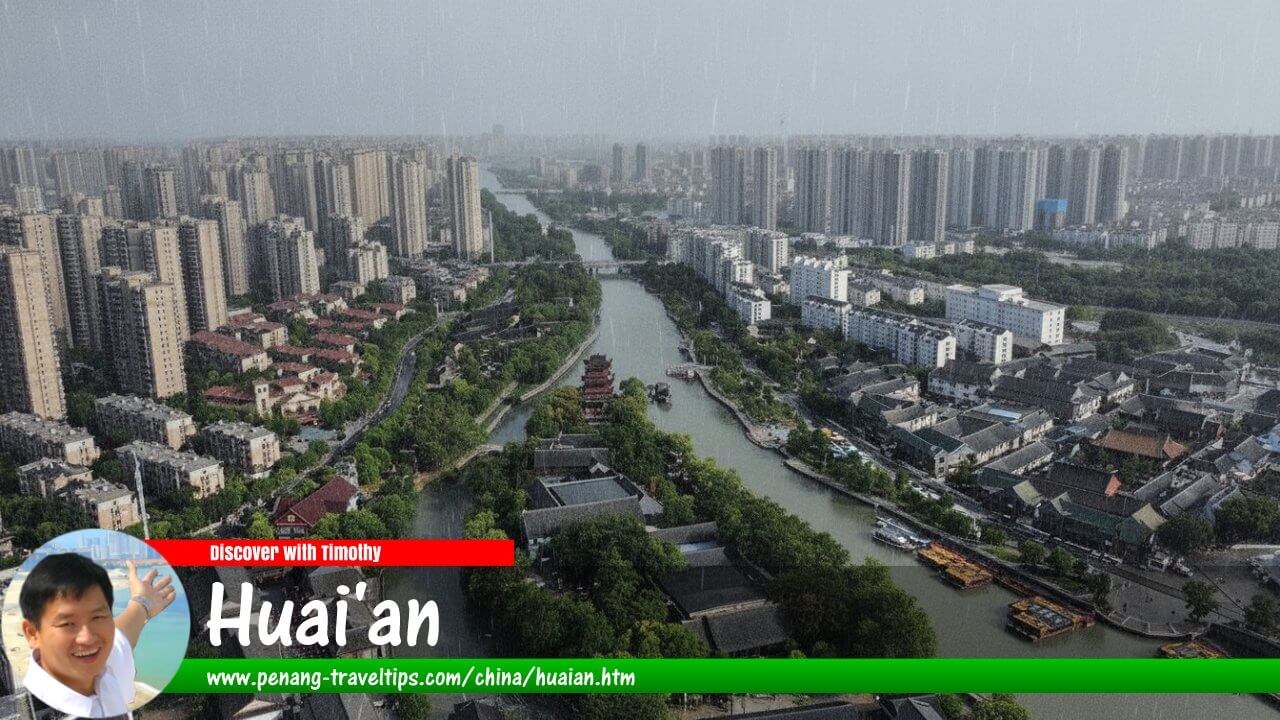 Huai'an, China (Photo edited with AI on 23 June 2026)
Huai'an (淮安, Huái'ān) is a prefecture-level city in northern Jiangsu Province, China. Located at the intersection of major rivers, lakes, and the historic Grand Canal, Huai'an has long served as an important transportation, commercial, and administrative center in eastern China. The city's name combines the character "Huai" (淮), referring to the Huai River, and "An" (安), meaning peace or tranquility. Together, the name conveys the meaning of "peace along the Huai River." Throughout Chinese history, Huai'an played a strategic role in water transport, flood control, and grain distribution, making it one of the most significant inland cities in Jiangsu Province.1
Quick Facts
- Chinese Name: 淮安
- Pinyin: Huái'ān
- Province: Jiangsu
- Administrative Status: Prefecture-level city
- Population: Approximately 4.5 million
- Area: About 10,030 square kilometres
- Location: Northern Jiangsu Province, China
- Major Waterways: Huai River, Grand Canal
- Known For: Canal heritage, Zhou Enlai, Huaiyang cuisine
- Airport: Huai'an Lianshui International Airport
- Railway Stations: Huai'an East, Huai'an, Lianshui stations
Geography
Huai'an is situated in northern Jiangsu Province, approximately midway between Nanjing and the Yellow Sea coast. The city occupies a strategic location within the lower reaches of the Huai River basin and along the route of the Beijing–Hangzhou Grand Canal. Its geographical position has made it a crossroads between northern and southern China for centuries.2
The landscape of Huai'an is predominantly flat and low-lying, consisting of fertile alluvial plains formed by rivers and lakes. The city is surrounded by significant water bodies, including Hongze Lake, one of China's largest freshwater lakes. Numerous rivers, canals, and reservoirs contribute to a dense network of waterways that support agriculture, transportation, and fisheries.
Huai'an experiences a humid subtropical climate with four distinct seasons. Summers are warm and humid, while winters are relatively cool and dry. Spring and autumn are generally pleasant and are considered the best seasons for tourism. Annual rainfall is concentrated during the summer monsoon season.
The city's abundant water resources have historically brought both prosperity and challenges. Flood control and water management have been important concerns for local governments for centuries, leading to the construction of dikes, canals, and hydraulic engineering projects.
Languages and Dialects
Mandarin is the official language used in government, education, and business throughout Huai'an. However, several regional Chinese dialects are spoken by local residents.
The dominant local speech belongs to the Jianghuai Mandarin group, which differs noticeably from Standard Mandarin in pronunciation, vocabulary, and intonation. The Huai'an dialect is often regarded as one of the representative forms of Jianghuai Mandarin.
In different parts of the municipality, particularly in rural areas, local variations of Jianghuai Mandarin can be heard. Due to migration, urbanization, and education policies, Standard Mandarin has become increasingly common among younger generations.
The linguistic position of Huai'an is particularly interesting because it lies near the transitional zone between northern Mandarin-speaking regions and the Wu-speaking areas of southern Jiangsu and Zhejiang.
History
Huai'an has a history stretching back more than two thousand years. Archaeological discoveries indicate that the region was inhabited during ancient times and participated in the cultural development of eastern China.
During the Qin and Han dynasties, the area became increasingly important due to its location along major transportation routes. As waterways expanded, Huai'an emerged as a center for trade and administration.
The city's prominence grew dramatically after the construction and expansion of the Grand Canal. During the Sui, Tang, Song, Yuan, Ming, and Qing dynasties, Huai'an became one of China's most important canal cities. Grain collected from southern China passed through the city on its way to northern capitals, making Huai'an a key node in the imperial supply network.3
During the Ming and Qing periods, Huai'an prospered as a commercial center. Merchants, officials, scholars, and craftsmen gathered in the city, contributing to its cultural and economic development. Elegant gardens, temples, and academies were constructed during this era.
Huai'an is also famous as the birthplace of several important historical figures. The most notable is Zhou Enlai, the first Premier of the People's Republic of China. His birthplace remains one of the city's most significant historical attractions.
In the modern era, railway construction, industrialization, and economic reforms transformed Huai'an into a diversified urban economy while preserving many aspects of its historic canal heritage.
Economy and Products
Huai'an possesses a diverse economy that combines agriculture, manufacturing, logistics, tourism, and modern services. Its central location within Jiangsu Province provides convenient access to major markets throughout eastern China.
Agriculture remains important. The fertile plains surrounding the city produce rice, wheat, corn, rapeseed, vegetables, and freshwater fish. Aquaculture is particularly significant due to the abundance of lakes and rivers.
Manufacturing industries include machinery, electronics, chemicals, textiles, food processing, and building materials. Industrial parks have attracted investment from domestic and international companies seeking locations with lower operating costs than those in the Yangtze River Delta's largest cities.
Logistics and transportation services are growing sectors because of Huai'an's position at the intersection of highways, railways, and waterways. Distribution centers serving northern Jiangsu have expanded rapidly in recent years.
The city is also known for its culinary traditions. Huai'an is one of the birthplaces of Huaiyang cuisine, one of China's Four Great Culinary Traditions. Local specialties emphasize fresh ingredients, delicate preparation, and elegant presentation. Dishes from Huaiyang cuisine are highly respected throughout China.
Tourism contributes to the local economy through visits to historical sites, canal heritage attractions, museums, and natural landscapes surrounding Hongze Lake.
How to Go There
By Air
Huai'an is served by Huai'an Lianshui International Airport, located approximately 22 kilometres northeast of the city centre. The airport offers domestic flights to major Chinese cities including Beijing, Shanghai, Guangzhou, Shenzhen, Chengdu, Chongqing, Xi'an, Kunming, and several other destinations.
Airlines operating at the airport typically include Air China, China Eastern Airlines, China Southern Airlines, Shenzhen Airlines, XiamenAir, Spring Airlines, and other domestic carriers, depending on seasonal schedules.
By Rail
Huai'an East Railway Station is the city's primary high-speed railway hub. It is located in the eastern part of the urban area and provides connections to Nanjing, Shanghai, Beijing, Xuzhou, Suzhou, Hangzhou, and other major cities.
Huai'an Railway Station serves conventional rail services and some regional routes. Additional stations within the municipality include Lianshui Railway Station and other local facilities.
The expansion of China's high-speed rail network has significantly improved travel times between Huai'an and the Yangtze River Delta region.
By Long-Distance Bus
Several long-distance bus terminals operate in Huai'an. The Huai'an Bus Station near the urban center provides services to cities throughout Jiangsu Province and neighboring provinces. Frequent buses connect the city with Nanjing, Shanghai, Suzhou, Yangzhou, Xuzhou, and other destinations.
By Road
Modern expressways connect Huai'an with major economic centers throughout eastern China. Driving from Nanjing generally takes about two to three hours, while travel from Shanghai usually requires four to five hours depending on traffic conditions.
How to Travel Locally
Public transportation in Huai'an is convenient and affordable. An extensive city bus network serves urban districts, railway stations, residential neighborhoods, and major tourist attractions.
Taxis are widely available throughout the city. Metered fares are relatively inexpensive compared with those in China's largest metropolitan areas.
E-hailing services operate extensively in Huai'an. The most commonly used platform is Didi Chuxing, China's leading ride-hailing service. International services such as Uber do not currently operate independently in mainland China.
Bicycle-sharing and electric scooter-sharing systems are available in many districts, providing convenient short-distance transportation.
Huai'an does not currently have a subway, MRT, LRT, or metro system. Likewise, traditional forms of transport such as trishaws, rickshaws, and tuk-tuks are generally not part of the city's transportation network.
Walking is practical in many historic districts, particularly around canal heritage areas and cultural attractions.
Tourist Attractions
Zhou Enlai Memorial Hall
This large memorial complex commemorates Zhou Enlai, one of modern China's most influential leaders. Exhibits showcase his life, political career, and contributions to Chinese history.
Zhou Enlai Former Residence
The restored residence where Zhou Enlai spent part of his childhood provides insight into local architecture and the early life of the former premier.
Ancient Huai'an City
The historic urban area preserves sections of old city walls, traditional streets, and cultural landmarks that reflect Huai'an's importance during imperial times.
Qingyan Garden
One of Jiangsu Province's best-preserved classical gardens, Qingyan Garden features pavilions, bridges, ponds, and elegant landscaping inspired by traditional Chinese garden design.
China Grand Canal Huai'an Section
The canal remains one of the city's defining features. Visitors can explore historic waterways, locks, bridges, and museums dedicated to canal history and transportation.
Hongze Lake Scenic Area
Located near one of China's largest freshwater lakes, this scenic area offers birdwatching, boating, fishing, and opportunities to enjoy the natural environment.
Hongze Lake Ancient Dike
This historic flood-control structure demonstrates the engineering achievements developed to manage water resources and protect surrounding communities.
Hexia Ancient Town
Hexia is a well-preserved historic settlement known for traditional architecture, stone-paved streets, temples, and former merchant residences.
Huai'an Museum
The museum contains archaeological artifacts, historical exhibits, and cultural treasures that illustrate the city's development over thousands of years.
Cherry Blossom and Wetland Parks
Several urban parks provide recreational opportunities and seasonal flower displays that attract both residents and visitors.
Huai'an, China is  the Map of Cities in China
References
- Encyclopaedia Britannica – Huai'an
- Jiangsu Provincial Government
- UNESCO World Heritage Centre – Grand Canal
- Travel China Guide – Huai'an
- China Daily
- Lonely Planet – Huai'an
- Huai'an Municipal Government
- China Highlights – Huai'an Travel Guide
Page Details
This page was created/modified on 23 June 2026. Hi, my name is Timothy and created it from my research, for my own entertainment, knowledge and to satisfy my curiosity. I am providing the information to you in good faith and hope it is useful. I try to get the details as accurate as possible. I also try to update the page whenever I stumble on new details. So this and all my other pages are perpetual work in progress. If you discover any error, please politely inform me, pointing out where the error lies, and I will correct it as soon as possible. Your helpfulness will keep this page accurate, relevant and helpful to those who need the information.