
The West End of London
Geographically, it sits to the west of the historic City of London, and to the north of the River Thames. It includes some of the capital's most iconic districts and overlaps with several well-known neighbourhoods, including:
- Soho
- Covent Garden
- Mayfair
- St James's
- Fitzrovia
- Marylebone (partially)
Size and Demographics
The West End is not formally defined by administrative boundaries, so its exact size varies depending on the source. However, it generally spans about 8-10 square kilometres.Its population is relatively low - estimated at under 30,000 permanent residents - especially when compared to its daytime population, which swells into the hundreds of thousands due to tourism, commerce, and entertainment.
This lower residential population is largely because the area is dominated by commercial buildings, theatres, shops, offices, and government buildings, rather than housing.
As a result, the West End has one of the highest per capita incomes in the UK, due to the concentration of high-earning professionals, wealthy residents, and luxury retail. However, this is offset by areas such as Soho, which have historically been more mixed in terms of affluence.
History of the West End
The West End began to develop in earnest in the late 17th century, as London expanded westwards beyond the confines of the old City.The aristocracy, seeking a healthier and more pleasant environment than the polluted City, built grand townhouses and squares in this area. From the 18th century onwards, the West End became a fashionable place for the wealthy elite to live, shop, and socialise.
By the 19th century, the area had become synonymous with entertainment, with the construction of theatres, music halls, and the growth of London's cultural institutions. Over time, it evolved into the entertainment and commercial powerhouse it is today.
Origin of the Name "West End"
The term "West End" has been used since at least the early 19th century to distinguish the fashionable and prosperous western part of central London from the older and more commercial East End.The name stems simply from its location relative to the City of London. It became commonly used to refer not just to geography, but to lifestyle, wealth, and culture.
The Character of the West End
The West End is overwhelmingly commercial in nature, filled with shops, restaurants, hotels, cinemas, and theatres. It is also the centre of London's theatre district, often called "Theatreland".Residential areas do exist, particularly in Mayfair and Fitzrovia, where grand Georgian and Victorian homes are now among the most expensive real estate in the world.
There is very little industrial activity here. Instead, the area is known for its cultural affluence, buzzing nightlife, and global appeal. It is also a political and media hub, housing several embassies, government departments, and media offices.
Map of West End, London
Streets in the West End
- Agar Street
- Aldwych
- Archer Street
- Arne Street
- Bateman Street
- Bedford Court
- Bedford Street
- Bedfordbury
- Betterton Street
- Brewer Street
- Bow Street
- Bucknall Street
- Burleigh Street
- Carey Street
- Carnaby Street
- Catherine Street
- Chancery Lane
- Chandos Place
- Charing Cross Road
- Cockspur Street
- Coventry Street
- Cranbourn Street
- Dean Street
- Denmark Street
- Dryden Street
- Duncannon Street
- Dyott Street
- Earnshaw Street
- Endell Street
- Exeter Street
- Floral Street
- Frith Street
- Garrick Street
- Glasshouse Street
- Great Newport Street
- Great Queen Street
- Great Windmill Street
- Greek Street
- Haymarket
- Henrietta Street
- Kean Street
- Keeley Street
- Kemble Street
- Kingsway
- Lincoln's Inn Fields
- Lisle Street
- Little Newport Street
- Long Acre
- Macklin Street
- Maiden Lane
- New Compton Street
- New Oxford Street
- New Row
- Newton Street
- Old Compton Street
- Orange Street
- Oxendon Street
- Oxford Street
- Pall Mall East
- Panton Street
- Parker Street
- Portugal Street
- Regent Street
- Remnant Street
- Romilly Street
- Rupert Street
- Russell Street
- Sardinia Street
- Serle Street
- Shaftesbury Avenue
- Shelton Street
- Short's Gardens
- Soho Square
- Southampton Street
- St Giles High Street
- St Martin's Lane
- Stacey Street
- Suffolk Place
- Suffolk Street
- Tavistock Street
- The Strand
- Trafalgar Square
- Upper St Martin's Lane
- Wardour Street
- Warwick Street
- Wellington Street
- Wild Court
- Wild Street
- William IV Street
Major Buildings and Sights
The West End is packed with landmarks and attractions. Notable sites include:- Piccadilly Circus - famous for its lights and as a meeting point
- Leicester Square - a hub for film premieres and cinemas
- Trafalgar Square - featuring Nelson's Column and the National Gallery
- Covent Garden - known for street performers, markets, and boutique shopping
- Soho - a lively area for food, nightlife, and creativity
- Royal Opera House - a world-class venue for opera and ballet
- Liberty London - a Tudor-style department store beloved by locals
Nearest London Underground Stations
The West End is exceptionally well-served by the London Underground. Key stations include:- Oxford Circus Station - Bakerloo, Central, and Victoria lines
- Piccadilly Circus Station - Piccadilly and Bakerloo lines
- Leicester Square Station - Piccadilly and Northern lines
- Tottenham Court Road Station - Central, Northern, and Elizabeth lines
- Charing Cross Station - Bakerloo and Northern lines, plus National Rail
- Covent Garden Station - Piccadilly line
Fun Fact: Where the World Premieres
The West End is sometimes referred to as "the Broadway of London", and it hosts more theatrical productions than anywhere else in Europe.Leicester Square is also the home of red-carpet film premieres. If you're in town, you just might catch a Hollywood star attending a gala screening at the Odeon or Vue cinemas!
In Summary
The West End is a dazzling district at the heart of London's culture, commerce, and creativity. Whether you're drawn by world-class theatre, historic landmarks, luxurious shopping, or simply the vibrant street life, this iconic area has something for everyone.From the elegance of Mayfair to the buzz of Soho, and the lights of Piccadilly to the grandeur of Trafalgar Square, the West End truly encapsulates the spirit of London.
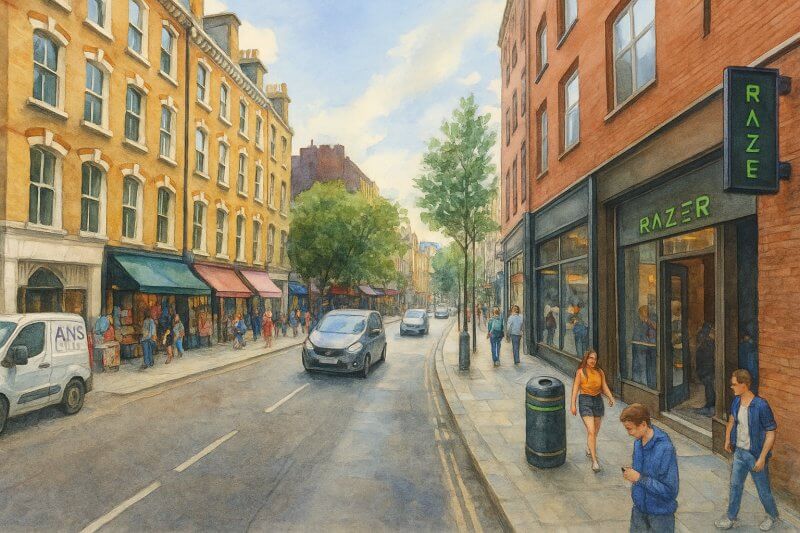
Painting of West End (View full-size image here)
List of Places in London, Map of Places in London
Want to share your London travel experiences or get tips from fellow travellers?
Join the London Travel Tips Facebook GroupMore information for visiting London
Here are some related articles to help you get to know London better.- Cost of Living in London: Discover the true cost of living in London, including housing, transport, groceries, and more - plus tips for budgeting in one of the world's most expensive cities.
- Driving in London: Planning to drive in London? Learn about roads, car rentals, parking, tolls, and key tips for tourists and visitors from outside the capital.
- Driving Tips for Visiting London: Thinking of driving to London? Discover the best times to travel, congestion tips, parking apps, breakdown help, and petrol advice for a smoother journey.
- Evolution of London's Streets: Discover the fascinating history of how London's streets developed from ancient footpaths to today's complex network of roads across the capital.
- History of Immigration to London: Discover the rich history of immigration to London, from Huguenots to Bangladeshis, and how diverse communities have shaped the city's vibrant identity.
- How Big Is London Compared to Other World Cities?
- How London's Streets Measure Up: A Global Comparison of Road Widths
- How Streets of London are Named: Discover how London streets get their names, who decides them, and how historic, political, and public influences shape street naming in the capital.
- How the Grosvenor Family Came to Own Much of Mayfair, Belgravia and Pimlico: Explore how the Grosvenor family came to own much of Mayfair, Belgravia, and Pimlico, and learn about their historical connection (or lack thereof) with the British royal family and government.
- Living and working in London
- London's Quiet Collapse: How Living Standards Fell as Costs Skyrockted (1975-2025): Explore how London residents endured rising costs and falling living standards from 1975 to 2025 - from rocketing rents to wage stagnation and inflation.
- Marvel of the London Underground: Discover the history, challenges, and triumphs of the London Underground - the world's first underground railway and a vital transport lifeline for the UK capital since 1863.
- Moving to London: Expat Tips for Settling in Westminster: Essential advice for expats moving to London's Westminster: neighborhood insights, cost of living, transportation, housing, healthcare, schools, and tips to help you feel at home in the heart of the city.
- Places in London that aren't pronounced the way they're spelled
- Shopping in London: Discover London's diverse shopping scene
- Taking the bus in London: This is your complete guide to taking the bus when in London.
- The Anglican Faith: A Visitor's Guide to the Church of England: Learn about the Anglican faith and its deep ties to London's landmarks like Westminster Abbey and St Paul's Cathedral.
- Top 10 London Streets Every Visitor Must See: Discover London through its most iconic thoroughfares - 10 streets every visitor must experience. From historic Abbey Road to vibrant Camden High Street, explore culture, shopping, and hidden gems.
- Why are most roads in Central London so narrow? Learn why there are so few multi-lane roads and elevated highways in the heart of the city.
 Latest Pages & Updates
Buy Me A Coffee
If you enjoy the information I provide and want to support the work I do, please buy me a coffee! I appreciate it immensely, thank you so much!
