
Shaftesbury Avenue: London's Theatreland Boulevard
Introduction
Shaftesbury Avenue is one of the most iconic streets in central London, celebrated for its dazzling theatres, historic architecture, and its central role in the West End's bustling arts scene. Located in the City of Westminster and stretching into the London Borough of Camden, this street is a must-visit for theatre lovers, architecture buffs, and anyone wanting to experience the energy of central London.
Where is Shaftesbury Avnue?
Shaftesbury Avenue runs through the heart of London's West End, beginning at Piccadilly Circus and continuing northeast until it meets New Oxford Street near Tottenham Court Road Station. The street acts as a dividing line between Soho to the north and Covent Garden and Chinatown to the south.
The street sits primarily within the City of Westminster, although a small stretch falls within the London Borough of Camden, especially towards its eastern end.
How long is Shaftesbury Avenue?
Shaftesbury Avenue measures approximately 0.6 miles (1 kilometre) in length, making it a walkable thoroughfare filled with landmarks, theatres, and restaurants packed into a short but culturally rich distance.
Map of Shaftesbury Avenue: London's Theatreland Boulevard
How long is Shaftesbury Avenue?
Shaftesbury Avenue measures approximately 0.6 miles (1 kilometre) in length, making it a walkable thoroughfare filled with landmarks, theatres, and restaurants packed into a short but culturally rich distance.
A brief history of Shaftesbury Avenue
Shaftesbury Avenue was created in the 1880s as part of a major Victorian-era initiative to relieve traffic congestion and improve access to the rapidly developing West End. Construction began in 1886 and was completed by 1887. The street was laid out by the Metropolitan Board of Works and became one of the first modern roadways intended to cut through an older and more cramped medieval street plan.
At the time, much of the surrounding area was made up of slums, and the avenue's creation was as much about social reform as it was about improving traffic. The road cut through densely populated housing areas and was intended to clear out poor-quality dwellings, improve sanitation, and open up space for development.
Why is it called Shaftesbury Avenue?
Shaftesbury Avenue was named in honour of Anthony Ashley Cooper, 7th Earl of Shaftesbury (1801-1885), a Victorian politician and philanthropist renowned for his work on social reforms. He championed better conditions for the working class, including factory reforms and child labour laws. Naming the avenue after him was a nod to both his influence and the street's purpose as a symbol of urban improvement and progress.
Streets connected to Shaftesbury Avenue
- Bloomsbury Street (at its eastern end)
- Cambridge Circus
- Charing Cross Road
- Dean Street
- Denman Street
- Dyott Street
- Frith Street
- Gerrard Place
- Great Windmill Street
- Greek Street
- Gower Street (indirectly via New Oxford Street)
- High Holborn
- Macclesfield Street
- Mercer Street
- New Oxford Street
- Piccadilly Circus (its starting point)
- Rupert Street
- St Giles High Street
- St Giles Passage
- Stacey Street
- Wardour Street
- West Street
Each of these connecting roads adds character to the surrounding area, offering everything from vibrant nightlife to quiet historic streets.
The Character of Shaftesbury Avenue
Shaftesbury Avenue is overwhelmingly commercial and cultural in nature, and it serves as the backbone of London's Theatreland. The street is lined with grand Edwardian and Victorian buildings, many of which house world-famous theatres. While some upper floors may contain office space or residential flats, the street is primarily about entertainment, shopping, dining, and tourism.
The vibrant mix of street performers, theatregoers, and visitors from around the globe make this one of London's most animated and cosmopolitan stretches.
Theatres and Notable Buildings
Some of the most celebrated theatres in London can be found on Shaftesbury Avenue, including:
- Lyric Theatre - Opened in 1888, currently hosting popular musicals.
- Apollo Theatre - Known for both classic and contemporary productions.
- Gielgud Theatre - Originally called the Hicks Theatre, it was renamed in honour of Sir John Gielgud.
- Sondheim Theatre (formerly the Queen's Theatre) - Home to the long-running Les Misérables.
- Palace Theatre - Just off Shaftesbury Avenue at Cambridge Circus, famous for hosting Harry Potter and the Cursed Child.
Other points of interest include:
- Chinatown Gate, accessible via Gerrard Street.
- Curzon Soho Cinema, a favourite for indie and foreign films.
- A variety of shops, pubs, and international restaurants, reflecting London's multicultural vibrancy.
Nearest London Underground Stations
Shaftesbury Avenue is well-served by multiple Tube stations:
- Piccadilly Circus (Bakerloo and Piccadilly lines) - Western end of the street.
- Leicester Square (Northern and Piccadilly lines) - Just a block south.
- Tottenham Court Road (Central, Northern, and Elizabeth lines) - Near the eastern end.
- Covent Garden (Piccadilly line) - A short walk southeast.
- Oxford Circus (Bakerloo, Central, and Victoria lines) - A few minutes northwest of the western end.
The street is also served by numerous bus routes and is within walking distance of many of London's top attractions.
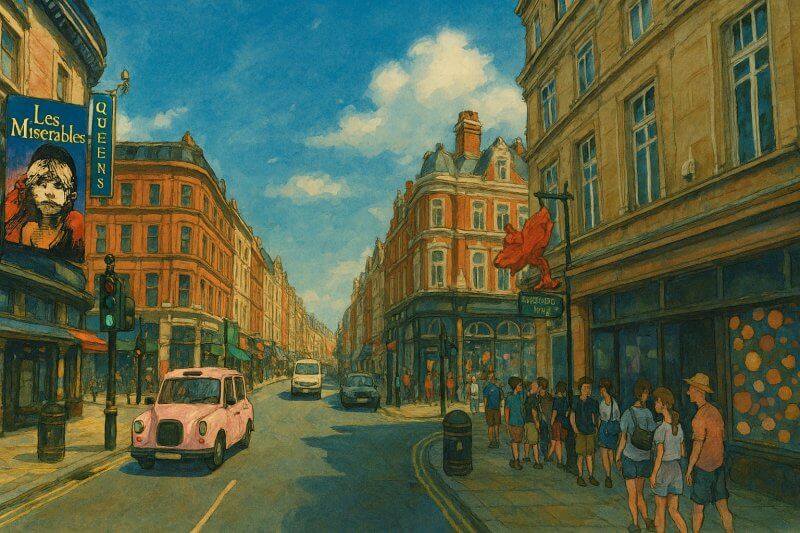
Painting of Shaftesbury Avenue: London's Theatreland Boulevard
Fun Fact
Did you know that Shaftesbury Avenue has appeared in numerous films, television shows, and video games? It's often used as a shorthand for the West End in international media. And, thanks to its strategic location, it's one of the streets featured in the UK version of Monopoly - a true testament to its fame and cultural relevance.
In Summary
Shaftesbury Avenue is more than just a road - it's the beating heart of London's theatre district, where art, history, and entertainment converge. Whether you're catching a world-class performance, exploring side streets filled with charm, or just soaking in the city's buzz, Shaftesbury Avenue offers a quintessential London experience.
Further Reading
Despite it being one of the major roads in London, Shaftesbury Avenue has only one lane of traffic in either direction. Find out why are most roads in Central London so narrow.Moving to London?
New to London and need a place to live? Read our Renting A Flat Guide. This guide covers everything you need to know about renting a flat in London, from viewing to signing.Streets of London
Come, let's explore and discover the streets of London together! Listed here afre the Streets of London that I have documented. Dive in and discover!Map of Streets in London
View all the streets that I have documented on Google Maps in this Map of Streets in London.Want to share your London travel experiences or get tips from fellow travellers?
Join the London Travel Tips Facebook GroupMore information for visiting London
Here are some related articles to help you get to know London better.- Cost of Living in London: Discover the true cost of living in London, including housing, transport, groceries, and more - plus tips for budgeting in one of the world's most expensive cities.
- Driving in London: Planning to drive in London? Learn about roads, car rentals, parking, tolls, and key tips for tourists and visitors from outside the capital.
- Driving Tips for Visiting London: Thinking of driving to London? Discover the best times to travel, congestion tips, parking apps, breakdown help, and petrol advice for a smoother journey.
- Evolution of London's Streets: Discover the fascinating history of how London's streets developed from ancient footpaths to today's complex network of roads across the capital.
- History of Immigration to London: Discover the rich history of immigration to London, from Huguenots to Bangladeshis, and how diverse communities have shaped the city's vibrant identity.
- How Big Is London Compared to Other World Cities?
- How London's Streets Measure Up: A Global Comparison of Road Widths
- How Streets of London are Named: Discover how London streets get their names, who decides them, and how historic, political, and public influences shape street naming in the capital.
- How the Grosvenor Family Came to Own Much of Mayfair, Belgravia and Pimlico: Explore how the Grosvenor family came to own much of Mayfair, Belgravia, and Pimlico, and learn about their historical connection (or lack thereof) with the British royal family and government.
- Living and working in London
- London's Quiet Collapse: How Living Standards Fell as Costs Skyrockted (1975-2025): Explore how London residents endured rising costs and falling living standards from 1975 to 2025 - from rocketing rents to wage stagnation and inflation.
- Marvel of the London Underground: Discover the history, challenges, and triumphs of the London Underground - the world's first underground railway and a vital transport lifeline for the UK capital since 1863.
- Moving to London: Expat Tips for Settling in Westminster: Essential advice for expats moving to London's Westminster: neighborhood insights, cost of living, transportation, housing, healthcare, schools, and tips to help you feel at home in the heart of the city.
- Places in London that aren't pronounced the way they're spelled
- Shopping in London: Discover London's diverse shopping scene
- Taking the bus in London: This is your complete guide to taking the bus when in London.
- The Anglican Faith: A Visitor's Guide to the Church of England: Learn about the Anglican faith and its deep ties to London's landmarks like Westminster Abbey and St Paul's Cathedral.
- Top 10 London Streets Every Visitor Must See: Discover London through its most iconic thoroughfares - 10 streets every visitor must experience. From historic Abbey Road to vibrant Camden High Street, explore culture, shopping, and hidden gems.
- Why are most roads in Central London so narrow? Learn why there are so few multi-lane roads and elevated highways in the heart of the city.
 Latest Pages & Updates
Buy Me A Coffee
If you enjoy the information I provide and want to support the work I do, please buy me a coffee! I appreciate it immensely, thank you so much!
