
Outram Travel Guide
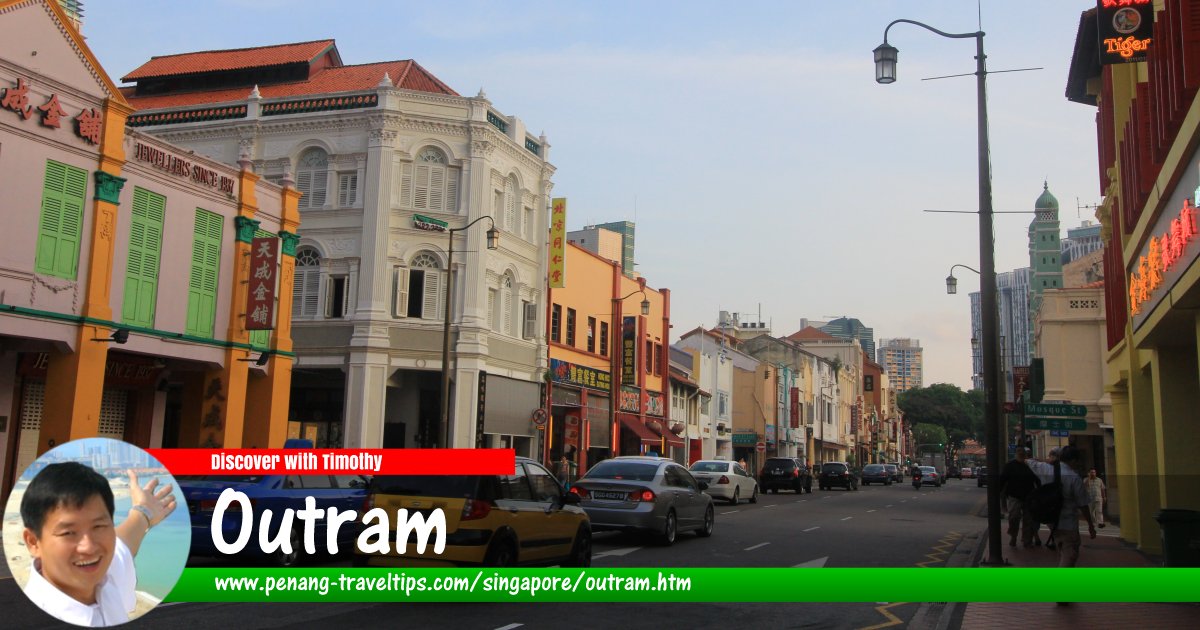 Outram, Singapore (8 July 2011)
The Outram Planning Area (Simplified Chinese: 欧南, Traditional Chinese: 歐南, Pinyin: Ōunán, Malay: Outram, Tamil: அவுட்ரம்) is a centrally located planning area in Singapore, covering about 1.37 square kilometres. Despite its compact size, Outram holds significant importance due to its cultural landmarks, bustling commercial hubs, and status as a healthcare centre. As of 2020, Outram had a resident population of approximately 18,6001, giving it one of the highest population densities in the Central Region.
History of Outram
The name “Outram” commemorates General Sir James Outram, a British officer who served in India during the 19th century. In the late 1800s, the area developed as part of colonial Singapore’s expansion beyond the Downtown Core. Outram quickly became associated with Chinatown, immigrant settlement, and public institutions, including hospitals and police headquarters. Its historical role as a site of social, medical, and cultural development has given Outram a unique identity in Singapore’s history.
Name and Pronunciation
The name “Outram” is pronounced /ˈaʊtrəm/ in English. In Mandarin Chinese, it is rendered as Ōunán (欧南 / 歐南). The Malay and Tamil names follow the English pronunciation. The district’s naming after a British general reflects Singapore’s colonial heritage.
Geography and Boundaries
Outram is situated in the Central Region, directly adjacent to the Downtown Core. It is bounded by the Rochor Planning Area to the northeast, Bukit Merah Planning Area to the west and south, and Newton Planning Area to the north. The Singapore River also lies close by, connecting Outram historically to trade and immigrant settlement.
Subzones of Outram
Transport and Accessibility
Outram is exceptionally well-served by public transport. Outram Park MRT Station is a major interchange linking the East West Line, North East Line, and Thomson-East Coast Line. In addition, Chinatown MRT Station serves the North East Line and Downtown Line. Several bus routes and major roads such as Eu Tong Sen Street, New Bridge Road, and Cantonment Road provide further connectivity.
Land Use and Development
Outram is a mixed-use area, balancing healthcare, cultural, residential, and commercial functions. It is home to Singapore General Hospital (SGH), which anchors the SGH Campus – a large healthcare precinct that also includes research institutes and specialist centres. Alongside this, Outram contains bustling Chinatown, with its heritage shophouses, temples, and markets, making it a popular cultural and tourist destination.
Residential Character
Housing in Outram is mainly made up of public HDB flats and private apartments. Due to its central location and proximity to Chinatown, property prices here are relatively high compared to island-wide averages. As of mid-2025, condominiums in Outram are valued between SGD 2,100–2,800 per square foot (22,604–30,139 per sq m)2. A typical 1,000 sq ft (93 sq m) apartment may cost between SGD 2.1 million and SGD 2.8 million, while rentals often range from SGD 4,500 to 7,000 per month, depending on size and amenities.
Commercial and Cultural Landmarks
Outram is closely associated with Chinatown, one of Singapore’s most vibrant historic districts. Key landmarks include:
- Buddha Tooth Relic Temple – a major Buddhist temple housing a sacred relic.
- Sri Mariamman Temple – Singapore’s oldest Hindu temple, established in 1827.
- Chinatown Heritage Centre – a museum preserving the stories of early Chinese immigrants.
- Maxwell Food Centre – one of Singapore’s most famous hawker centres, popular with locals and tourists alike.
The blend of religious, cultural, and gastronomic experiences makes Outram a microcosm of Singapore’s multicultural society.
Healthcare Hub
Outram is sometimes referred to as Singapore’s “medical city” due to the presence of Singapore General Hospital, the country’s oldest and largest hospital. The SGH Campus is undergoing redevelopment into a world-class medical and research hub by 2030, strengthening Outram’s role as a healthcare destination.
Where to Stay
Outram is one of the most convenient planning areas in Singapore for visitors who want to combine heritage, food and easy access to the rest of the city. The planning area encompasses much of Chinatown and includes the neighbourhoods around Pearl's Hill, People's Park and the Keong Saik Road area. There is a particularly good choice of hotels, from stylish boutique properties in conserved shophouses to larger full-service hotels.
One of the greatest advantages of staying in Outram is transport. Outram Park MRT Station is an interchange for the East West Line, North East Line and Thomson-East Coast Line. Chinatown MRT Station provides access to the North East and Downtown lines, while Tanjong Pagar and Telok Ayer stations are also within easy reach of parts of the planning area.
PARKROYAL COLLECTION Pickering is one of the area's most distinctive hotels. Located on Upper Pickering Street beside Chinatown, the hotel is particularly notable for its architecture and extensive greenery. It is also within easy walking distance of Chinatown's markets, temples, restaurants and heritage streets.
The Scarlet Singapore is a very different proposition. Housed in a row of conserved shophouses on Erskine Road, this boutique hotel places visitors directly within the historic Chinatown environment. It is particularly suitable for travellers who would rather stay in a characterful heritage building than in a conventional modern hotel.
Oasia Hotel Downtown, although just outside the formal Outram boundary in the Tanjong Pagar area, is a very practical nearby option. Its location makes it particularly useful for visitors who want easy access to Outram, Chinatown and the Central Business District, while also being close to Tanjong Pagar MRT Station.
Mondrian Singapore Duxton is another stylish nearby choice. Located around Duxton Hill, it puts visitors close to the restaurants, cafés and bars of the Duxton and Keong Saik neighbourhoods. It is particularly appealing to travellers interested in contemporary design and dining.
Furama City Centre, on Eu Tong Sen Street, is another practical option on the Chinatown side of Outram. Its location provides convenient access to Chinatown's shopping and food areas and is within walking distance of both Chinatown and Clarke Quay.
There are also numerous smaller boutique hotels and restored shophouse properties around Keong Saik Road, Teck Lim Road, Mosque Street, Temple Street and the Chinatown Historic District. These can be especially appealing to visitors who want to experience Singapore's historic urban environment rather than staying in a large modern hotel.
For first-time visitors, I would particularly recommend staying within walking distance of Chinatown MRT Station or Outram Park MRT Station. This gives you excellent access to the heritage attractions and food of the area while also making it easy to travel to Marina Bay, Orchard Road, Little India, Sentosa and other parts of Singapore.
Outram is also a good alternative to Orchard for visitors who want a more distinctly Singaporean atmosphere. Instead of being surrounded primarily by shopping malls, you will find conserved shophouses, temples, traditional food businesses, cafés, bars and residential neighbourhoods immediately outside the hotel door.
What to Eat
Food is one of Outram's greatest strengths. The planning area and its immediate surroundings contain some of Singapore's most famous hawker centres, traditional food streets, Chinese restaurants, cafés and modern restaurants.
The most important food destinations are Chinatown Complex Food Centre, Hong Lim Market & Food Centre and the streets around Keong Saik Road. Together they provide almost every kind of dining experience, from inexpensive hawker food costing only a few dollars to sophisticated restaurants in conserved shophouses.
Chinatown Complex Food Centre is particularly important. It is one of Singapore's largest hawker centres and contains a huge range of stalls selling local favourites such as chicken rice, noodles, roast meats, dumplings, porridge, desserts and traditional snacks.
Hong Lim Market & Food Centre, on the northern side of the planning area, is another excellent destination for serious food lovers. It has a particularly strong reputation for traditional Singaporean hawker food and is popular with office workers and local residents.
The Keong Saik Road and Teck Lim Road area offers a completely different dining experience. Historic shophouses now contain restaurants serving Italian, French, Japanese, modern Asian and other international cuisines. This makes the area especially interesting in the evening, when the streets become lively with diners.
Outram is also a good area for halal food. Malay and Muslim-owned establishments can be found around Chinatown and the surrounding central districts, while the nearby Tanjong Pagar and Telok Ayer areas provide additional halal restaurants. Visitors requiring halal-certified food should always check the current certification status of an individual establishment before dining.
For visitors who want a traditional Singaporean breakfast, there are numerous coffee shops and hawker stalls serving kaya toast, soft-boiled eggs, kopi and traditional noodles. For lunch, the hawker centres provide the widest choice at reasonable prices. In the evening, Keong Saik Road and the surrounding shophouse streets are particularly attractive for restaurant dining.
Because Outram is so close to the Downtown Core, visitors can also easily combine the area's food destinations with those of Tanjong Pagar, Telok Ayer and Chinatown. There is little reason to restrict yourself to one particular street when such a large concentration of food is within walking distance.
Where to Eat
Outram has so many eating options that it is more useful to approach the area according to the type of meal you want. The following are some particularly worthwhile choices.
- Chinatown Complex Food Centre – One of Singapore's largest and most famous hawker centres. It is the place to go for an enormous range of inexpensive local food, including rice dishes, noodles, roast meats, dumplings, porridge and traditional desserts.
- Hong Lim Market & Food Centre – A long-established hawker centre particularly popular for traditional Singaporean dishes. It is a good choice for visitors who want to eat where local residents and office workers eat rather than in a tourist-oriented restaurant.
- Chinatown Food Street – Smith Street has become one of the most recognisable food streets in Chinatown, with restaurants and food outlets serving Chinese and Singaporean dishes. It is particularly atmospheric in the evening.
- Chez Suzette – A French restaurant on Teck Lim Road, offering a more contemporary dining experience within the historic shophouse environment of Chinatown.
- Acqua e Farina – An Italian restaurant on Keong Saik Road specialising in pizza and pasta. It is a good option when you want a break from Singaporean and Chinese food.
- SteakGrill Steakhouse Chef's Table – A restaurant on Keong Saik Road offering steaks and Western dishes in a more intimate setting. It is suited to visitors looking for a substantial dinner rather than a quick hawker meal.
- Keong Saik Road restaurants – The entire stretch is worth exploring rather than choosing only one restaurant. The conserved shophouses contain a constantly changing collection of modern Asian, European, Japanese and other international restaurants.
- Teck Lim Road cafés and restaurants – The quieter street immediately beside Keong Saik Road has become another popular dining area, with cafés, restaurants and small independent food businesses occupying conserved shophouses.
- Nasi Lemak Ayam Taliwang – A halal option in the Chinatown area serving nasi lemak and Indonesian-influenced chicken dishes. It is particularly useful for Muslim visitors wanting an inexpensive halal meal.
- Chicky Fun – A halal chicken restaurant in the Chinatown area offering an inexpensive casual meal.
- Chinatown coffee shops – Traditional coffee shops around the older streets of Chinatown remain useful for inexpensive breakfasts, kopi, tea, toast and simple local meals.
For the classic Singapore hawker experience, I would put Chinatown Complex and Hong Lim Market & Food Centre at the top of the list. Both are considerably more representative of everyday Singaporean food culture than the more expensive restaurants found along the conserved shophouse streets.
Visitors who prefer a restaurant meal should explore Keong Saik Road and Teck Lim Road. These streets demonstrate how Singapore has transformed old shophouses into modern dining destinations while retaining much of their historic appearance.
For an evening meal, the combination of Chinatown, Keong Saik Road and Duxton Hill is particularly appealing. You can have dinner in a conserved shophouse, walk through the historic streets and then continue towards the bars and restaurants around Duxton.
Muslim visitors will find halal choices in and around Chinatown, although the selection is not as concentrated as in Kampong Glam or Little India. If halal certification is essential, check each establishment's current status before dining.
For visitors on a tight budget, Outram is one of the better places in central Singapore to eat inexpensively. A meal at a hawker centre can cost considerably less than dining at the restaurants in the surrounding conservation districts, while still providing some of the city's most memorable food.
Exploring Outram
Outram is one of the most rewarding planning areas in Singapore for visitors interested in history, architecture, food and the evolution of the city. The planning area contains a substantial part of the Chinatown Historic District, and its conserved shophouses provide a visual record of Singapore's development from a nineteenth-century port settlement into a modern global city.
The most obvious place to begin is Chinatown. The district contains some of Singapore's most recognisable historic streets, including South Bridge Road, Temple Street, Pagoda Street, Smith Street and Mosque Street.
Sri Mariamman Temple, Singapore's oldest Hindu temple, is one of the district's most important landmarks. Its elaborate entrance tower is an especially striking sight amid the surrounding conserved shophouses.
Nearby, the Buddha Tooth Relic Temple and Museum is another major Chinatown landmark. Its large Tang-inspired design makes it one of the most visually distinctive buildings in the district and it is an important Buddhist place of worship.
The coexistence of Hindu, Buddhist, Muslim and Chinese religious landmarks in such a compact area is one of Chinatown's most interesting characteristics. Visitors can encounter several different religious traditions within a relatively short walk.
Chinatown Complex is equally important as a place of everyday life. Beyond the food centre, the complex contains shops and other businesses, providing a useful contrast to the more visitor-oriented streets around Pagoda Street.
People's Park Complex is another landmark worth seeing. Its distinctive modernist architecture has made it one of Singapore's best-known buildings and provides a striking contrast to the conserved shophouses around Chinatown.
To the west, Keong Saik Road provides one of the most interesting transitions in the planning area. Once associated with brothels and a very different nightlife economy, the street has been transformed into a fashionable dining and hospitality district while many of its historic shophouses have survived.
Teck Lim Road and Duxton Hill continue this transition. Visitors can walk through the area and see conserved nineteenth- and early twentieth-century buildings now occupied by restaurants, cafés, hotels, offices and other businesses.
Ann Siang Hill and Club Street, immediately east of the Chinatown Historic District, extend this heritage-and-nightlife experience towards the Downtown Core. They are particularly lively in the evenings and contain numerous restaurants, bars and cafés.
At the northern edge of the planning area, Pearl's Hill provides a welcome change of pace. The hill is one of the area's important green spaces and offers visitors an opportunity to escape the busy streets of Chinatown for a short while.
The presence of Singapore General Hospital is another defining feature of Outram. The hospital and its associated medical institutions occupy a substantial part of the planning area and have played an important role in Singapore's medical history.
Outram is also closely associated with Singapore's public-health history. The medical district developed over many decades, and the proximity of the hospital complex to Chinatown, Pearl's Hill and the older residential districts makes Outram an interesting place to understand how healthcare and urban development evolved together.
For visitors interested in Singapore's history, I recommend taking a walking route that begins around Outram Park MRT Station, continues through the hospital and Pearl's Hill area, and then heads towards Keong Saik Road and Chinatown.
Another excellent route begins at Chinatown MRT Station and takes you through People's Park, Chinatown Complex, South Bridge Road, Temple Street, Pagoda Street and Smith Street before continuing towards Keong Saik Road.
Allow plenty of time for photographs. Outram's conserved shophouses are particularly attractive because they occur in long continuous stretches, allowing visitors to see how an entire historic streetscape can survive rather than merely one isolated heritage building.
Transport is one of Outram's major advantages. Outram Park MRT Station is one of Singapore's important interchange stations, linking the East West, North East and Thomson-East Coast lines. This makes the planning area an excellent base for visitors who want to explore different parts of Singapore.
From Outram, it is easy to travel to Orchard Road, Marina Bay, Little India, the eastern suburbs and the airport. Chinatown MRT Station adds the Downtown Line and provides another convenient connection to the city.
Outram is also within walking distance of the Downtown Core and Tanjong Pagar. This makes it possible to combine a heritage morning in Chinatown with an afternoon around Marina Bay or the Central Business District without spending much time travelling.
One of the best things about Outram is that the transition between old and new Singapore is visible almost everywhere. A conserved shophouse can stand beside a modern apartment tower; a traditional temple can sit opposite a contemporary restaurant; and a century-old food business can operate only a few streets away from the financial district.
That mixture is what makes Outram such an interesting place to stay. Visitors do not have to choose between historic Singapore and modern Singapore. Both are immediately outside the hotel door.
For a first visit, I would recommend allowing at least one full day to explore the area. Spend the morning walking through Chinatown and its temples, have lunch at Chinatown Complex or Hong Lim Market, explore the conserved streets around Keong Saik and Teck Lim Road in the afternoon, and then return in the evening when the restaurants and bars begin to come alive.
If you have more time, add Pearl's Hill and the surrounding heritage streets to the itinerary. Visitors interested in food can easily devote an entire additional day to exploring the hawker centres and restaurants of Chinatown, Keong Saik Road, Tanjong Pagar and the neighbouring Downtown Core.
Outram is therefore one of the strongest choices in Singapore for travellers who want heritage, food, nightlife, accommodation and transport convenience in one compact area. It may not have the polished appearance of Orchard or the futuristic skyline of Marina Bay, but for understanding the layers of Singapore's history while enjoying some of the city's best food, it is hard to beat.
Accommodation and Food References
- Urban Redevelopment Authority – Outram Urban Design Guidelines
- Urban Redevelopment Authority – Conservation Guidelines
- PARKROYAL COLLECTION Pickering Singapore – Official Website
- The Scarlet Singapore – Official Website
- Oasia Hotel Downtown – Official Website
- Mondrian Singapore Duxton – Official Website
- Furama City Centre – Official Website
- Singapore Tourism Board – Chinatown
- National Heritage Board – Chinatown Heritage Centre
- National Heritage Board – Sri Mariamman Temple
- National Parks Board – Pearl's Hill City Park
- National Environment Agency – Hawker Centres
Fun Facts
Chinatown in Outram is one of the few places in Singapore where four major religious institutions – a Buddhist temple, a Hindu temple, a mosque, and a Christian church – are located within walking distance of each other, symbolising Singapore’s religious harmony. Outram is also one of the smallest planning areas in land size but among the richest in cultural and historical significance.
Map of Outram, Singapore
MRT Stations in Outram, Singapore
- Chinatown MRT Station (GPS: 1.28399, 103.84317)

- Maxwell MRT Station (GPS: 1.28055, 103.84366)

- Outram Park MRT Station (GPS: 1.28153, 103.83914)

- Telok Ayer MRT Station (GPS: 1.28216, 103.84852)

Sights in Outram
- Airview Building (GPS: 1.27902, 103.84504)

- Buddha Tooth Relic Temple (GPS: 1.28149, 103.84428)

- Chinatown Heritage Centre (GPS: 1.2835, 103.84439)

- Chinatown Point (GPS: 1.28528, 103.84497)

- Copthorne King's Hotel (GPS: 1.28828, 103.83661)

- Dorsett Singapore (GPS: 1.27987, 103.84023)

- Far East Square (GPS: 1.28326, 103.84837)

- Fuk Tak Chi Museum (GPS: 1.28291, 103.84873)

- Hong Lim Complex (GPS: 1.28467, 103.84565)

- Jamae Mosque (GPS: 1.28325, 103.84541)

- Maxwell House (GPS: 1.279, 103.84584)

- Murray Terrace (GPS: 1.279, 103.84584)

- Pearl's Hill City Park (GPS: 1.28464, 103.8399)

- People's Park Centre (GPS: 1.28575, 103.84389)

- People's Park Complex (GPS: 1.28446, 103.8427)

- Sri Mariamman Temple (GPS: 1.28274, 103.84512)

- The Scarlet (GPS: 1.28071, 103.84538)

Streets in Outram
- Amoy Street
- Ann Siang Hill
- Ann Siang Road
- Banda Street
- Boon Tat Street
- Cantonment Road
- Central Expressway
- China Street
- Club Street
- Cook Street
- Craig Road
- Cross Street
- Duxton Hill
- Duxton Road
- Erskine Road
- Eu Tong Sen Street
- Keong Saik Road
- Kreta Ayer Road
- Maxwell Road
- Mccallum Street
- Mosque Street
- Neil Road
- New Bridge Road
- Outram Road
- Pagoda Street
- Pearl's Hill Road
- Pearl's Hill Terrace
- Sago Lane
- Sago Street
- Smith Street
- South Bridge Road
- Spring Street
- Stanley Street
- Tanjong Pagar Road
- Telok Ayer Street
- Temple Street
- Tras Street
- Trengganu Street
- Wallich Street
- Upper Cross Street
- Yan Kit Road
Quick Facts
- Total Area: 1.37 sq km
- Population: ~18,600 (2020)
- Postal Districts: Districts 2 and 3
- Main MRT: Outram Park (East West, North East, Thomson-East Coast Lines)
- Key Feature: Singapore General Hospital Campus
- Major Landmark: Chinatown
- Known For: Heritage shophouses, temples, food centres
References
- Singapore Department of Statistics – Population Data
- Urban Redevelopment Authority – Planning Areas
- NLB Infopedia – Outram
Page Details
This page was created on 8 September 2025. Hi, my name is Timothy and created it from my research, for my own entertainment, knowledge and to satisfy my curiosity. I am providing the information to you in good faith and hope it is useful. I try to get the details as accurate as possible. I also try to update the page whenever I stumble on new details. So this and all my other pages are perpetual work in progress. If you discover any error, please politely inform me, pointing out where the error lies, and I will correct it as soon as possible. Your helpfulness will keep this page accurate, relevant and helpful to those who need the information.My videos of Singapore
Want to share your Singapore travel experiences or get tips from fellow travellers?
Join the Singapore Travel Tips Facebook GroupMore information for visiting and living in Singapore
Here are some related articles to help you get to know Singapore better.- Cost of Living in Different Singapore Neighbourhoods (2025 Guide)
- EZ-Link Card
- Owning a Car in Singapore
- Singapore MRT Map & Guide 2025
- Singapore Postal Districts and Postcodes
- Singapore Tourist Pass
- Taking the Bus in Singapore: A Visitor's Guide
- Understanding CCR, RCR and OCR in Singapore real estate
 Latest Pages & Updates
Buy Me A Coffee
If you enjoy the information I provide and want to support the work I do, please buy me a coffee! I appreciate it immensely, thank you so much!
