
Singapore Travel Guide
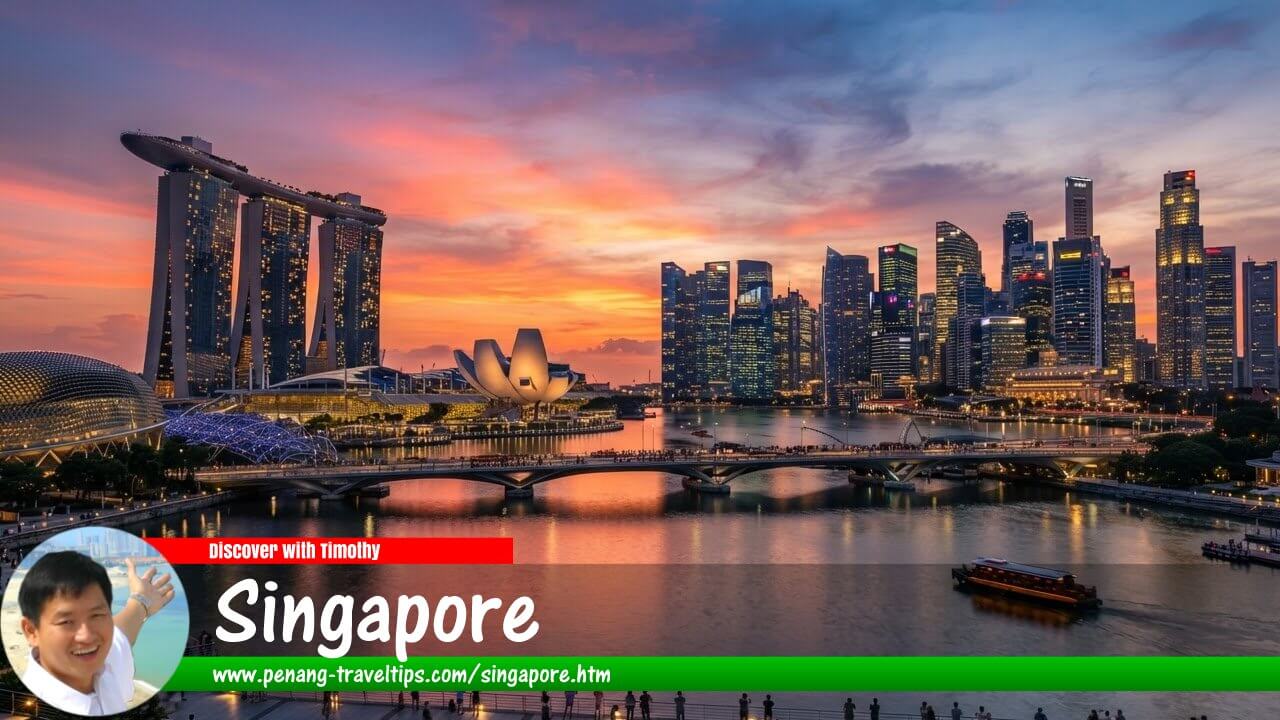
Singapore Travel Guide (AI image created on 9 August 2026)
Also available: Panduan Melawat Singapura
Singapore (Simplified Chinese: 新加坡; Traditional Chinese: 新加坡; Pinyin: Xīnjiāpō; Malay: Singapura; Malay Jawi: سيڠاڤورا; Tamil: சிங்கப்பூர்) is a sovereign city-state and island country in Southeast Asia:contentReference[oaicite:0]{index=0}. It lies at the southern tip of the Malay Peninsula and has developed from a 19th-century trading post into a modern metropolis. Singapore’s economy is highly developed and trade-driven, making it one of the world’s highest-income countries:contentReference[oaicite:1]{index=1}. It has a multicultural population (about 6.04 million in 2024) and four official languages (English, Malay, Mandarin, and Tamil):contentReference[oaicite:2]{index=2}:contentReference[oaicite:3]{index=3}.
Quick Facts
- Area: approximately 736.3 km² (284.3 sq mi)
- Population: around 6.04 million (2024 est.)
- Independence: 9 August 1965 (from Malaysia)
- Government: Unitary parliamentary republic (President as head of state; Prime Minister as head of government).
- Official Languages: English, Malay, Chinese (Mandarin), and Tamil
- Currency: Singapore Dollar (SGD).
- GDP per capita: among the highest in the world
- Major port: the busiest port in Southeast Asia, owing to its strategic location on the Strait of Malacca
- Climate: Equatorial (tropical rainforest) – uniformly warm and humid year-round.
Map of the Planning Areas of Singapore
Map of the Roads in Singapore | List of Streets in Singapore
Map of Singapore Postal Districts
Map of Mass Rapid Transit Stations in Singapore
History of Singapore
Singapore’s history spans centuries of trade and empire. It was known by names like Temasek and Singapura in early times, serving as a regional trading port. In 1819 Sir Stamford Raffles established a British trading post on the island, and Singapore soon became a crucial entrepôt of the British Empire. The island was occupied by Japan during World War II (1942–45) and returned to British rule afterward. Post-war Singapore gained self-governance, joined Malaysia in 1963, and then became fully independent on 9 August 1965. Under leaders like Lee Kuan Yew, it then transformed rapidly into a modern, developed nation with a free-market economy.
My videos of Singapore
Geography of Singapore
Singapore is located in maritime Southeast Asia, at the southern end of the Malay Peninsula. It comprises the main Singapore Island and about 60 smaller islets (including Sentosa, Pulau Ubin, Jurong Island, Pulau Tekong, etc.). The total land area is roughly 736 km² (much of which is reclaimed land), and the terrain is generally flat, with the highest point being Bukit Timah Hill at 164 m. Singapore’s climate is tropical rainforest: the weather is warm and wet year-round, with little temperature variation.
Demographics of Singapore
As of 2024 the population of Singapore is about 6.04 million. Of these, roughly 3.64 million are citizens and 0.54 million are permanent residents; the remaining one-third are foreign workers and dependents. The population is multi-ethnic: Chinese (~75%), Malay (~15%), Indian (~7.5%), and others. English is the main language of administration and business, but Malay, Mandarin Chinese, and Tamil are also official languages. Singapore’s diverse culture reflects its mix of ethnic Chinese, Malay, Indian, and other communities.
Economy of Singapore
Singapore has a highly developed, open-market economy. It is a leading global financial center and trading hub. Financial services, high-tech manufacturing (electronics, pharmaceuticals), and petroleum refining are major sectors. For example, Singapore is one of the world’s top exporters of refined oil. Its port is one of the busiest globally, serving as the largest port in Southeast Asia. The country’s GDP per capita is among the highest in the world. Tourism, biotech research, and logistics are also important contributors to the economy.
Getting to Singapore
Singapore is easily reached by air, land, or sea. Singapore Changi Airport is the main international gateway and a major transit hub. In 2024 Changi handled about 67.7 million passengers, making it one of the world’s busiest international airports. Many airlines from around the world fly to Singapore. By land, Singapore is connected to Malaysia via the Johor–Singapore Causeway (to Johor Bahru) and the Tuas Second Link. Major highways (e.g. East Coast Parkway, Pan Island Expressway, Kallang-Paya Lebar Expressway) link these crossings to the city. There are also ferry services to nearby Indonesian islands (like Batam and Bintan) and Malaysia’s coastal towns.
Immigration requirements for Singapore
Visitors to Singapore must generally have a passport valid for at least 6 months. Citizens of many countries (including the US, EU, Australia, Japan, etc.) can enter visa-free for short stays, whereas nationals from other countries must apply for an entry visa beforehand. All arrivals (except direct transit) must submit an SG Arrival Card online within three days before entry. There is no mandatory visa-on-arrival for most tourists, but some nationals need to obtain a visa. Long-term visitors may require additional passes or work permits. Overstaying or violating visa terms is an offense in Singapore.
Public Transport in Singapore
Singapore has an extensive public transport system. The Mass Rapid Transit (MRT) network has six lines linking most parts of the island. In total the MRT covers around 241 km, with hundreds of stations. For example, the Thomson-East Coast Line runs from Woodlands in the north through central Singapore, stopping at stations like Orchard MRT Station in the shopping district. In addition, there are three Light Rail Transit (LRT) lines serving residential towns, and an extensive bus network with over 300 routes. Taxis are readily available, relatively affordable, and app-based ride-hailing is common. The road network includes 3,356 km of roads and over 160 km of expressways. Singapore imposes congestion charges (ERP) and high vehicle taxes to manage traffic.
Major Tourist Attractions of Singapore
- Marina Bay Sands and the Bay area: An iconic resort complex (opened 2010) with three towers topped by a rooftop SkyPark and infinity pool. It dominates the skyline and is a symbol of modern Singapore. Nearby attractions include the ArtScience Museum and the Merlion Park on the waterfront.
- Gardens by the Bay: A futuristic nature park famous for its “Supertree Grove” (tall steel trees with hanging plants) and two cooled conservatories (Flower Dome and Cloud Forest). It showcases thousands of plant species and sustainable design. Since opening in 2012, it has welcomed tens of millions of visitors.
- Sentosa Island: A resort island just off Singapore’s south coast. Key attractions include Universal Studios Singapore (theme park), Adventure Cove Waterpark, and the S.E.A. Aquarium (one of the world’s largest aquariums). Resorts World Sentosa contains casinos, hotels, and entertainment.
- Singapore Botanic Gardens: A large tropical garden in the city centre, designated a UNESCO World Heritage Site. It features the National Orchid Garden, lakes, and rainforest groves, illustrating the evolution of a colonial garden (established 1859) into a modern botanical research centre.
- Singapore Flyer: A 165-metre tall observation wheel (opened 2008) providing panoramic views of the city and Marina Bay. It held the record as the world’s tallest Ferris wheel upon completion.
- Merlion Park: Waterfront park featuring the Merlion statue – a mythical creature with a lion’s head and fish’s body, serving as a mascot for Singapore. The Merlion spits water into the bay and is a popular photo spot.
- Jewel Changi Airport: A multi-level nature-themed complex at Changi Airport (opened 2019), known for the HSBC Rain Vortex – the world’s tallest indoor waterfall. It also has indoor gardens (Forest Valley), canopy walks, shops, restaurants, and a hotel. Jewel attracts huge crowds with its architecture and entertainment offerings.
- Chinatown, Little India, and Kampong Glam: Cultural quarters where visitors can explore traditional architecture, temples, mosques, markets, and food reflecting Singapore’s diverse heritage. Notable sites include the Buddha Tooth Relic Temple in Chinatown, Sri Mariamman Temple, the Sultan Mosque in Kampong Glam, and colorful shophouses along streets like Orchard Road.
Sights in Singapore by category
- Apartments in Singapore
- Art Galleries in Singapore
- Bridges in Singapore
- Buddhist Temples in Singapore
- Bus Interchanges in Singapore
- Canals in Singapore
- Cemeteries and Columbariums in Singapore
- Chinese Temples in Singapore
- Churches in Singapore
- Commercial Properties in Singapore
- Condominiums in Singapore
- Dams and Barrages in Singapore
- Department Stores in Singapore
- Expressways in Singapore
- Ferry Terminals in Singapore
- Government Buildings in Singapore
- Hawker Centres in Singapore
- Hawker Stalls in Singapore
- High-Rise Buildings in Singapore
- Highways in Singapore
- Hindu Temples in Singapore
- Historic Buildings in Singapore
- Hospitals in Singapore
- Hotels in Singapore
- Islands in Singapore
- Laksa in Singapore
- LRT Lines in Singapore
- LRT Stations in Singapore
- Modern Architecture in Singapore
- Monuments in Singapore
- Mosques in Singapore
- MRT Lines in Singapore
- MRT Stations in Singapore
- Museums in Singapore
- Muslim Shrines in Singapore
- Organisations in Singapore
- Parks in Singapore
- Places in Singapore
- Planning Areas in Singapore
- Properties in Singapore
- Quays in Singapore
- Reservoirs in Singapore
- Residential Properties in Singapore
- Restaurants in Singapore
- Rivers in Singapore
- Shopping Malls in Singapore
- Skyscrapers in Singapore
- Street Art in Singapore
- Streets in Singapore
- Subzones in Singapore
- Synagogues in Singapore
- Train Stations in Singapore
- Vehicular Tunnels in Singapore
- Waterways in Singapore
References
- Geography of Singapore - Wikipedia
- Demographics of Singapore - Wikipedia
- History of Singapore - Wikipedia
- Singapore - Britannica
- CityChangers.org: Singapore’s Gardens by the Bay
- Marina Bay Sands hits 500m visitors - iGaming Business
- Resorts World Sentosa - Wikipedia
- Singapore Botanic Gardens - UNESCO World Heritage Centre
- Singapore Flyer - Wikipedia
- Jewel Changi Airport - Wikipedia
- Reuters: Singapore says visitor arrivals rise 21% in 2024
- ASEAN Briefing: Sector insights – Singapore
- Singapore - Wikipedia
- ICA – Entering Singapore (Immigration & Checkpoints Authority)
Page Details
This page was created on 17 September 2025. Hi, my name is Timothy and created it from my research, for my own entertainment, knowledge and to satisfy my curiosity. I am providing the information to you in good faith and hope it is useful. I try to get the details as accurate as possible. I also try to update the page whenever I stumble on new details. So this and all my other pages are perpetual work in progress. If you discover any error, please politely inform me, pointing out where the error lies, and I will correct it as soon as possible. Your helpfulness will keep this page accurate, relevant and helpful to those who need the information.Buy Me A Coffee
If you enjoy the information I provide and want to support the work I do, please buy me a coffee! I appreciate it immensely, thank you so much!
