
Taking the Bus in Singapore: A Visitor's Guide
Singapore is renowned for its world-class public transport system, and buses form an essential part of that network. With air-conditioned fleets, extensive coverage, and seamless integration with the MRT, Singapore's buses are among the most efficient in the world. Overseen by the Land Transport Authority (LTA) and operated by several companies (SBS Transit, SMRT, etc.) under a government contracting model, the system is reliable, safe, and convenient for both residents and visitors. For travelers, taking the bus in Singapore is an affordable and comfortable way to explore the city beyond the MRT lines1.
Introduction to Taking the Bus in Singapore
Singapore's bus system complements its MRT (Mass Rapid Transit) network by serving areas not directly accessible by train. More than 300 routes crisscross the island, reaching residential estates, shopping centers, industrial hubs, tourist attractions, and even the airport. Buses run daily from early morning to midnight, with selected NightRider and Night Owl services operating on weekends for late-night travelers. For visitors who prefer to see the city at street level, buses provide a scenic and practical way to get around2.
Bus Color and Livery
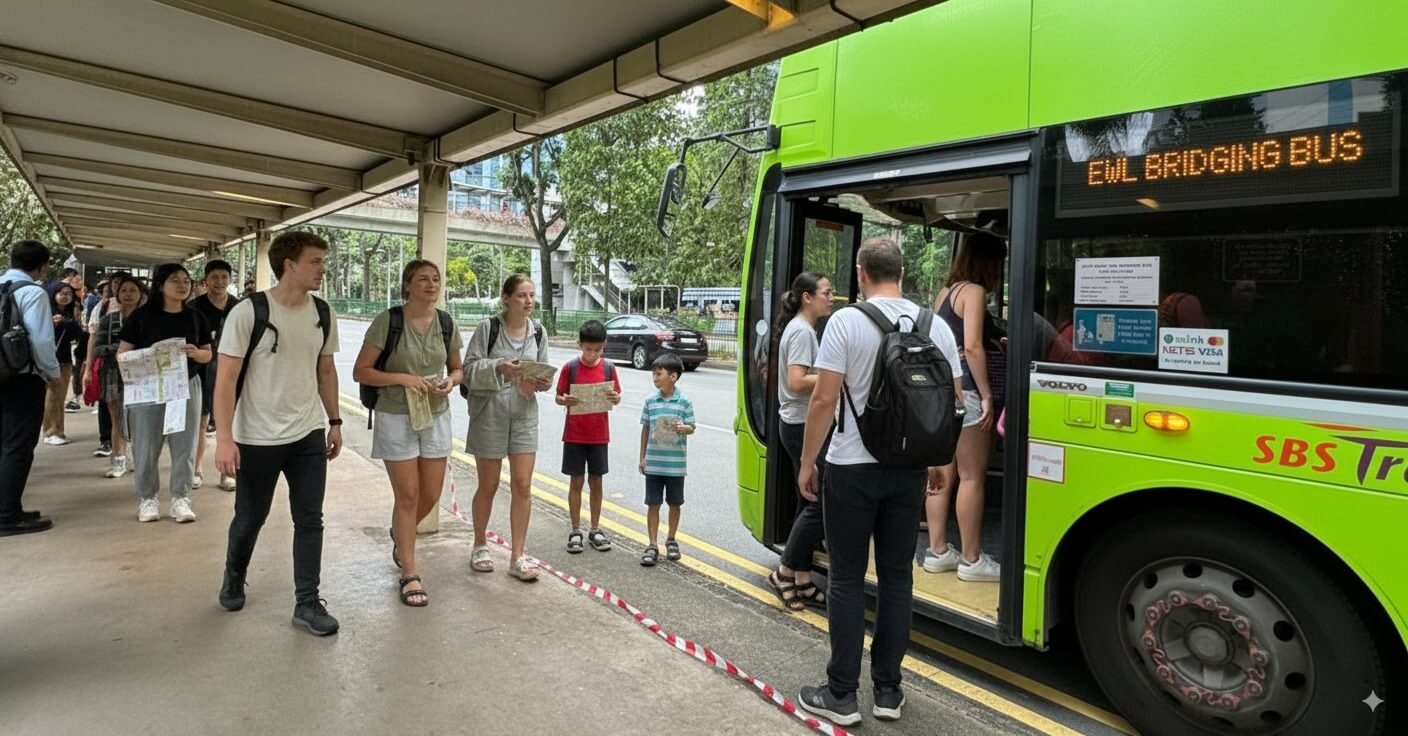
Unlike in many cities where buses are run by a single operator, Singapore's buses are operated by several companies, including SBS Transit, SMRT Buses, Go-Ahead Singapore, and Tower Transit. Under LTA's standardization, most buses now carry a uniform lush green livery, symbolizing Singapore's “Garden City” identity. This makes buses instantly recognizable across the island, regardless of operator.
The "uniform lush green livery" applies primarily to newly purchased buses from certain contracts (e.g., the Bus Contracting Model introduced from 2016 onwards), while older buses are gradully being replaced, some still retain operator-specific colours. So, the green livery is meant to standardize the appearance but is not absolute. You will still see buses, especially the older ones, sporting colours representing their respective operators such as SBS Transit's red/white livery3.
SMRT Buses' operations were taken over by a new entity called Asia Mobility Pte Ltd. However, they still largely operate under the SMRT brand for now, and the buses still have the same liveries.
Bus Routes in Singapore
The bus network covers virtually every corner of Singapore, with routes categorized as trunk, feeder, express, and night services. Examples of useful routes for visitors include:
- 36/36A: Connects Changi Airport with the city, stopping at Marine Parade, Suntec City, and Orchard Road.
- 7: From Bedok to Clementi via Orchard Road, serving many shopping districts.
- 124: Passes through Chinatown, City Hall, and Marina Bay areas.
- 190: Links Choa Chu Kang with the city center, including Orchard Road.
- NightRider (NR) & Night Owl: Late-night services on weekends connecting the city's nightlife districts with housing estates.
Most buses operate from major interchanges such as Bedok, Tampines, Toa Payoh, and Woodlands, and connect smoothly with MRT stations. Route maps and arrival timings are available on apps like MyTransport.SG or SG Buses4.
Fares and How to Pay
Singapore uses a distance-based fare system. This means passengers pay according to how far they travel, regardless of transfers between buses and MRT within a 1½-hour window. A typical short bus ride costs about SGD 0.95 to SGD 1.50 with an EZ-Link or contactless bank card, while longer trips may cost around SGD 2.00. Seniors, students, and children enjoy concessionary fares. For tourists, the Singapore Tourist Pass offers unlimited rides on buses and trains for one to three days5.
Payment Methods: Cashless System
All public buses in Singapore operate on a cashless payment system. Passengers can use:
- EZ-Link or NETS FlashPay cards: Reloadable stored-value cards commonly used by locals.
- Contactless bank cards: Credit or debit cards with the contactless symbol (Visa, Mastercard, AMEX).
- Mobile wallets: Apple Pay, Google Pay, or Samsung Pay linked to a contactless card.
Simply tap your card or device on the reader when boarding and again when alighting. Cash payment is no longer accepted on regular public buses6.
Bus Stops in Singapore
Bus stops are located all over Singapore, often within walking distance of residential blocks, offices, or malls. Each bus stop is marked with a unique code and name, making it easy to identify. In central areas, electronic boards display real-time arrival information. Outside the city center, apps such as MyTransport.SG provide accurate predictions of bus arrivals. Interchanges at MRT stations also serve as major bus hubs, making transfers seamless7.
What to Expect When Taking the Bus
Taking the bus in Singapore is generally efficient, safe, and comfortable. However, visitors should keep in mind the following:
- Affordability: Buses are cheaper than taxis and ride-hailing services, and fares are integrated with MRT journeys.
- Air-conditioning: All buses are air-conditioned, providing relief from Singapore's humid weather.
- Punctuality: Buses are usually reliable, though delays can occur during peak-hour traffic.
- Accessibility: Most buses are wheelchair- and stroller-friendly, with low floors and ramps.
- Local Experience: Buses are used by people from all walks of life, giving travelers a glimpse of daily Singaporean life.
For those who want to explore beyond the MRT lines, buses provide a scenic way to discover Singapore's neighborhoods and attractions at a low cost8.
Quick Facts
Service Name: Public buses under the Land Transport Authority (operated by SBS Transit, SMRT, Go-Ahead, Tower Transit)
Livery: Standard lush green buses, with some older operator-specific colors
Main Hubs: Major interchanges at Bedok, Tampines, Toa Payoh, Woodlands, and Changi Airport
Routes: Over 300 routes, including trunk, feeder, express, and night services
Example Routes: 36 (Airport to City), 7 (Orchard Road), 124 (Chinatown & Marina Bay), 190 (Orchard Road), NightRider services
Fares: Distance-based, typically SGD 0.95–2.00 with cards; tourist passes available
Payment: Cashless only (EZ-Link, NETS FlashPay, contactless bank cards, mobile wallets)
Stops: Widespread across the island, each with a unique code and real-time info available via apps
Experience: Affordable, reliable, air-conditioned, and accessible; occasional traffic delays during rush hours
 Taking the bus in Singapore (27 August 2025 AI Generated)
Related Articles
- Taking the Bus in Kuala Lumpur
- Taking the Bus in Kuala Lumpur
- Taking the Bus in Penang
- Taking the Bus in Malacca
References
- Land Transport Authority (LTA) Singapore
- TransitLink – Singapore Bus and MRT Information
- SBS Transit – Official Site
- SMRT Buses – Official Site
- Ministry of Transport Singapore
- Visit Singapore – Official Tourism Website
- TimeOut Singapore – Getting Around
- Lonely Planet – Singapore Travel Guide
Page Details
This page was created on 27 August 2025. Hi, my name is Timothy and created it from my research, for my own entertainment, knowledge and to satisfy my curiosity. I am providing the information to you in good faith and hope it is useful. I try to get the details as accurate as possible. I also try to update the page whenever I stumble on new details. So this and all my other pages are perpetual work in progress. If you discover any error, please politely inform me, pointing out where the error lies, and I will correct it as soon as possible. Your helpfulness will keep this page accurate, relevant and helpful to those who need the information.My videos of Singapore
Want to share your Singapore travel experiences or get tips from fellow travellers?
Join the Singapore Travel Tips Facebook GroupMore information for visiting and living in Singapore
Here are some related articles to help you get to know Singapore better.- Cost of Living in Different Singapore Neighbourhoods (2025 Guide)
- EZ-Link Card
- Owning a Car in Singapore
- Singapore MRT Map & Guide 2025
- Singapore Postal Districts and Postcodes
- Singapore Tourist Pass
- Taking the Bus in Singapore: A Visitor's Guide
- Understanding CCR, RCR and OCR in Singapore real estate
 Latest Pages & Updates
Buy Me A Coffee
If you enjoy the information I provide and want to support the work I do, please buy me a coffee! I appreciate it immensely, thank you so much!
