
Condominiums in Singapore
Condominiums in Singapore represent one of the most desirable forms of residential living, offering privacy, modern facilities, and a lifestyle-oriented environment. They appeal to a wide range of residents—locals, permanent residents, and foreigners alike—due to their blend of comfort, security, and community amenities. The condominium market in Singapore is diverse, featuring different categories such as private condominiums, executive condominiums (ECs), and serviced residences, each catering to distinct buyer profiles and lifestyle preferences.
Quick Facts
- Condominiums are private residential developments featuring shared facilities like pools, gyms, and security.
- There are two main types: Private Condominiums and Executive Condominiums (ECs).
- Serviced Residences provide short- to medium-term accommodation with hotel-style services.
- Foreigners can purchase private condominiums and serviced residences, but not executive condominiums that are still under HDB restrictions.
- Condominiums are typically 99-year leasehold, though some are freehold.
Overview of the Condominium Market in Singapore
Singapore’s condominium market offers a broad spectrum of choices—from luxurious high-rise developments in the city centre to suburban family-oriented projects. Condominiums are considered part of the private property sector, meaning they are built and managed by private developers rather than the government’s Housing and Development Board (HDB).
These developments typically feature communal amenities such as swimming pools, gyms, tennis courts, clubhouses, and 24-hour security. Residents also benefit from landscaped gardens and car parks, with maintenance fees paid monthly to a Management Corporation Strata Title (MCST) responsible for the upkeep of shared areas.
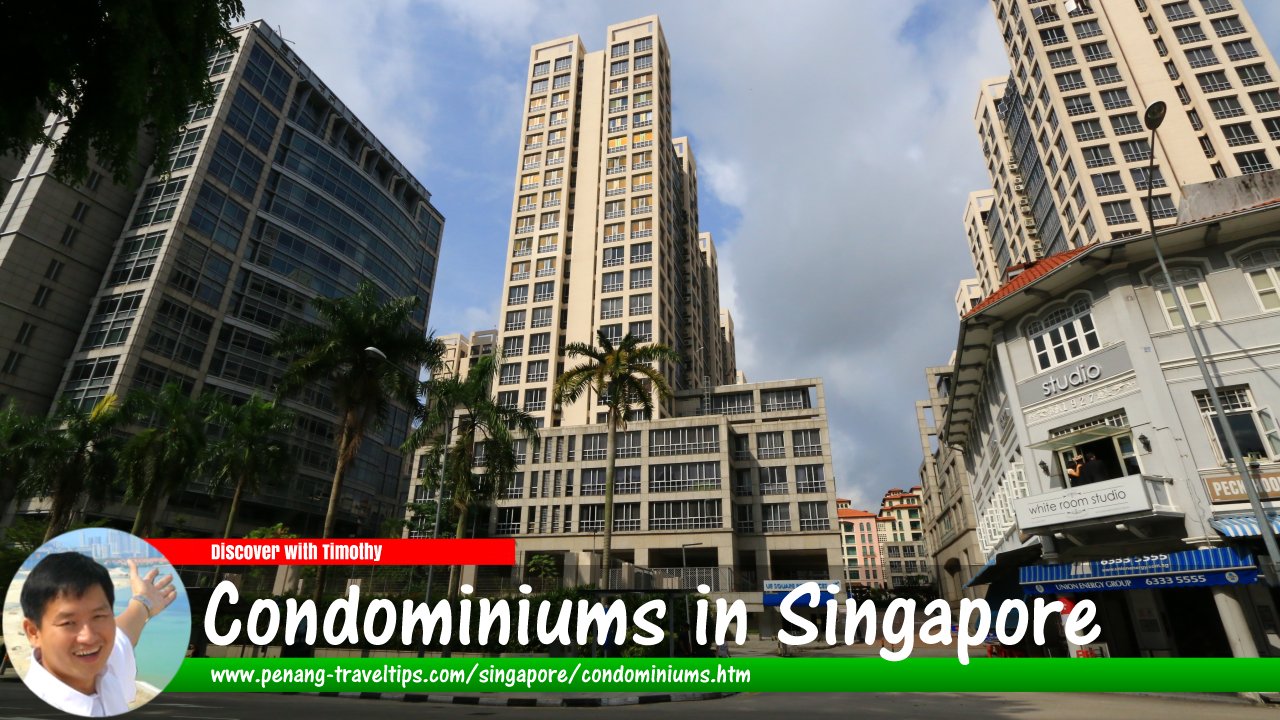 Condominiums in Singapore (30 July 2017)
Types of Condominiums in Singapore
1. Private Condominiums
Private condominiums are fully private residential properties with no government subsidies or ownership restrictions. Both Singaporeans and foreigners can purchase them freely, subject to applicable taxes such as the Additional Buyer’s Stamp Duty (ABSD). These developments are often found in both central and suburban areas, offering a range of sizes—from studio apartments to penthouses and multi-bedroom family units.
Private condominiums are typically built by major developers and come with premium facilities and finishes. Prices vary widely depending on location, size, and brand reputation. Districts such as Orchard, Marina Bay, Bukit Timah, and Sentosa Cove feature some of Singapore’s most prestigious condominiums, while suburban areas like Tampines, Punggol, and Woodlands offer more affordable yet comfortable alternatives.
For more detailed information, see our page on Private Condominiums in Singapore.
2. Executive Condominiums (ECs)
Executive Condominiums (ECs) are a unique hybrid housing type, combining features of both public and private housing. Developed and sold by private developers, ECs are initially subject to HDB regulations and eligibility requirements during their first 10 years. Only Singapore citizens and certain permanent resident households may purchase new ECs directly from developers.
After 10 years, ECs are fully privatised, allowing them to be sold to foreigners on the open market like private condominiums. ECs typically offer similar facilities—such as pools, gyms, and function rooms—but at a lower entry price compared to private condominiums.
For a complete explanation, visit our page on Executive Condominiums in Singapore.
3. Serviced Residences
Serviced residences (or serviced apartments) cater primarily to expatriates, corporate clients, and long-stay visitors who prefer a hotel-like living arrangement with the comforts of home. Managed by hospitality operators, these residences come fully furnished and include housekeeping, concierge, and utility services.
Unlike condominiums, serviced residences are typically rented rather than owned. However, some luxury serviced apartments may be available for purchase by foreigners under specific strata-title arrangements. They are ideal for individuals relocating temporarily for work, business, or education, and are commonly found in city locations such as Orchard, Marina Bay, and Novena.
Ownership Rules and Eligibility
Ownership rules for condominiums vary depending on the property type:
- Private Condominiums: Available for purchase by Singapore citizens, permanent residents, and foreigners.
- Executive Condominiums (ECs): Available only to eligible Singapore citizen households during their initial 5–10 years, then open to PRs and foreigners thereafter.
- Serviced Residences: Usually for rent, with limited ownership opportunities for institutional or approved foreign buyers.
Foreigners are not subject to special restrictions for buying condominium units, as these properties are classified as non-landed residential property. However, additional taxes such as the Additional Buyer’s Stamp Duty (ABSD) apply to foreign purchasers.
Tenure and Lease Types
Most condominiums in Singapore are sold under 99-year leasehold titles, though a significant number of projects, especially in older or premium areas, are freehold or 999-year leasehold. Freehold condominiums are highly sought after for their lasting ownership and investment value, though they tend to be priced higher than leasehold properties.
Facilities and Maintenance
Condominium living offers residents access to exclusive facilities that enhance quality of life. Common amenities include:
- Swimming pools and jacuzzis
- Fitness centres and tennis courts
- BBQ pits and function rooms
- Playgrounds and landscaped gardens
- 24-hour security and concierge services
Residents pay a monthly maintenance fee to the Management Corporation Strata Title (MCST), which covers upkeep of shared facilities, cleaning, landscaping, and security. Fees vary based on unit size and the level of amenities offered, typically ranging from S$250 to S$800 per month.
Buying a Condominium in Singapore
The process of buying a condominium depends on whether it’s a new launch or a resale unit. Generally, buyers should:
- Engage a licensed real estate agent or contact the developer directly.
- Pay an option fee (usually 1% of the purchase price) for a resale unit or a booking fee (typically 5%) for new launches.
- Sign the Option to Purchase (OTP) or Sale and Purchase Agreement (S&P).
- Engage a conveyancing lawyer to handle legal matters.
- Pay the Buyer’s Stamp Duty (BSD) and, if applicable, the Additional Buyer’s Stamp Duty (ABSD).
- Complete financing arrangements through a bank loan or CPF funds.
For step-by-step guidance, refer to our detailed page on How to Buy Property in Singapore as a Foreigner.
Serviced Residences vs. Condominiums
While both serviced residences and condominiums provide premium accommodation, the key difference lies in ownership and duration. Serviced residences are mainly for short- or medium-term stays, fully furnished with hotel-style services. Condominiums, on the other hand, are owned homes offering greater privacy and long-term investment potential.
Many serviced residences are part of international chains such as Ascott, Fraser Suites, and Oakwood, catering to professionals seeking temporary housing without the need for a lease commitment or property maintenance.
Investment Appeal of Condominiums
Condominiums are a preferred investment option in Singapore due to their rental yield potential and capital appreciation. Locations near MRT stations, business hubs, and educational institutions tend to attract strong rental demand from expatriates and professionals. Investors should, however, consider factors such as property taxes, maintenance fees, and financing limits imposed by the Total Debt Servicing Ratio (TDSR).
Conclusion
Condominiums in Singapore offer a balance of modern amenities, convenience, and exclusivity. With choices ranging from Executive Condominiums to Private Condominiums and Serviced Residences, residents and investors can find a property that suits their lifestyle and financial goals. Understanding the distinctions between these types—especially in terms of eligibility, ownership, and purpose—ensures that both locals and foreigners can make informed property decisions in Singapore’s dynamic real estate market.
Related Pages
- Private Condominiums in Singapore
- Executive Condominiums in Singapore
- How to Buy Property in Singapore as a Foreigner
- Residential Properties in Singapore
Map of Condominiums in Singapore
List of Condominiums by Singapore
- 1 Draycott Park (GPS: 1.31011, 103.83075)

- 1 Moulmein Rise (GPS: 1.31918, 103.84717)

- 2 Mount Elizabeth Link (GPS: 1.30573, 103.83672)

- 10 Shelford Rd (GPS: 1.31918, 103.84717)

- 10 Tanglin (GPS: 1.30654, 103.82628)

- 76 Shenton (GPS: 1.27343, 103.84555)

- Affinity at Serangoon (GPS: 1.36624, 103.8734)

- Alessandrea (GPS: 1.29058, 103.82246)

- Alex Residences (GPS: 1.29047, 103.81894)

- Alexis (GPS: 1.29131, 103.8074)

- Alsworth Park (GPS: 1.3202, 103.78069)

- Altez (GPS: 1.27444, 103.8443)

- Altura (GPS: 1.35929, 103.74217)

- Amaranda Gardens (GPS: 1.3496, 103.86653)

- Amaryllis Ville (GPS: 1.31492, 103.84192)

- Amber 45 (GPS: 1.31492, 103.84192)

- Amber House (GPS: 1.30155, 103.90041)

- Amber Point (GPS: 1.29922, 103.8986)

- Amber Residences (GPS: 1.30102, 103.90066)

- Amber Skye (GPS: 1.29958, 103.89806)

- AMO Residence (GPS: 1.29131, 103.8074)

- Aquarius By The Park (GPS: 1.33842, 103.9351)

- Arc At Tampines (GPS: 1.35035, 103.92853)

- Archipelago (GPS: 1.33832, 103.91955)

- Ardmore Park (GPS: 1.31003, 103.82918)

- Bendemeer Light (GPS: 1.31526, 103.86062)

- Cairnhill Crest (GPS: 1.30546, 103.83842)

- Cairnhill Plaza (GPS: 1.30633, 103.83686)

- Cantonment Towers (GPS: 1.27508, 103.84041)

- Canninghill Piers (GPS: 1.29156, 103.84463)

- Central Meadow (GPS: 1.31233, 103.88816)

- City Gate (GPS: 1.3023, 103.86239)

- City Loft (GPS: 1.31496, 103.85656)

- Citylights Condominium (GPS: 1.30849, 103.86329)

- 76 Shenton (GPS: 1.27343, 103.84555)
- Dakota Crescent (GPS: 1.29949, 103.85827)

- DUO Singapore (GPS: 1.29949, 103.85827)
- EON Shenton (GPS: 1.27397, 103.84617)

- Hullet Rise (GPS: 1.30325, 103.83834)

- Jaya Tower (GPS: 1.32032, 103.82399)

- Kerrisdale (GPS: 1.31308, 103.85832)

- Leonie Parcview (GPS: 1.29895, 103.83422)

- Lumiere, Mistri Road (GPS: 1.27431, 103.84607)

- Martin No 38 (GPS: 1.29225, 103.83803)

- North Park Residences (GPS: 1.31308, 103.85832)

- Nouvel 18 (GPS: 1.31086, 103.82774)

- One Balmoral (GPS: 1.31359, 103.82992)

- OUE Twin Peaks (GPS: 1.29943, 103.83327)

- Pan Pacific Serviced Suites Orchard (GPS: 1.30089, 103.8379)

- Park 1 Suites (GPS: 1.314, 103.88944)
- Pinnacle @ Duxton (GPS: 1.27616, 103.84124)

- Primedge (GPS: 1.31263, 103.88809)

- Richmond Park (GPS: 1.30505, 103.83638)

- River Place (GPS: 1.28974, 103.84088)

- RiverGate (GPS: 1.29188, 103.83697)

- Riverside 48 (GPS: 1.29108, 103.83977)

- Robertson Walk (GPS: 1.29201, 103.8414)

- Robinson Suites (GPS: 1.28096, 103.84983)
- Skysuites @ Anson (GPS: 1.27453, 103.84474)

- Southbank (GPS: 1.30638, 103.86423)

- Spottiswoode 18 (GPS: 1.27545, 103.83758)

- Spottiswoode Suites (GPS: 1.27601, 103.83745)

- Suites at Orchard (GPS: 1.31383, 103.88783)

- Sunflower Lodge (GPS: 1.31383, 103.88783)

- Sunflower View (GPS: 1.31308, 103.88833)

- Tiara (GPS: 1.30525, 103.83742)

- Terra Hill (GPS: 1.27817, 103.79346)

- The Bencoolen (GPS: 1.30187, 103.85321)

- The Citron Residences (GPS: 1.3124, 103.85738)

- The Clift (GPS: 1.2795, 103.84733)

- The Draycott (GPS: 1.31173, 103.83114)

- The Equatorial (GPS: 1.32027, 103.82485)

- The &Eeacute;tage (GPS: 1.31374, 103.88786)

- The Estuary (GPS: 1.41053, 103.83199)

- The Inspira (GPS: 1.2918, 103.83873)

- The Legacy (GPS: 1.30659, 103.83859)

- The Light @ Cairnhill (GPS: 1.30659, 103.83859)

- The Orange Grove (GPS: 1.31402, 103.82604)

- The Quayside (GPS: 1.29002, 103.83916)

- The Regency at Tiong Bahru (GPS: 1.28218, 103.83015)

- The Trillium (GPS: 1.29476, 103.83273)

- The Water Edge (GPS: 1.31379, 103.88874)

- Thomson Euro-Asia (GPS: 1.31804, 103.84468)

- Tiara (GPS: 1.29505, 103.83117)

- UE Square (GPS: 1.29291, 103.84306)

- Urban Suites (GPS: 1.30345, 103.83845)

- V On Shenton (GPS: 1.27763, 103.84944)

- Watermark @ Robertson Quay (GPS: 1.27763, 103.84944)

- White House Residences (GPS: 1.31779, 103.82525)

References
- Urban Redevelopment Authority (URA)
- Housing and Development Board (HDB)
- Ministry of National Development (MND)
- Council for Estate Agencies (CEA)
Page Details
This page was created on 7 October 2025. Hi, my name is Timothy and created it from my research, for my own entertainment, knowledge and to satisfy my curiosity. I am providing the information to you in good faith and hope it is useful. I try to get the details as accurate as possible. I also try to update the page whenever I stumble on new details. So this and all my other pages are perpetual work in progress. If you discover any error, please politely inform me, pointing out where the error lies, and I will correct it as soon as possible. Your helpfulness will keep this page accurate, relevant and helpful to those who need the information.My videos of Singapore
Want to share your Singapore travel experiences or get tips from fellow travellers?
Join the Singapore Travel Tips Facebook GroupMore information for visiting and living in Singapore
Here are some related articles to help you get to know Singapore better.- Cost of Living in Different Singapore Neighbourhoods (2025 Guide)
- EZ-Link Card
- Owning a Car in Singapore
- Singapore MRT Map & Guide 2025
- Singapore Postal Districts and Postcodes
- Singapore Tourist Pass
- Taking the Bus in Singapore: A Visitor's Guide
- Understanding CCR, RCR and OCR in Singapore real estate
 Latest Pages & Updates
Buy Me A Coffee
If you enjoy the information I provide and want to support the work I do, please buy me a coffee! I appreciate it immensely, thank you so much!
