
Hyde Park Corner, London
Hyde Park Corner is one of the most famous and busiest road junctions in central London, situated at the southeastern corner of Hyde Park in the City of Westminster. It marks a prominent gateway between Mayfair, Knightsbridge, and St James's, and serves as a vital traffic interchange that links multiple important routes in London.
Pronunciation and Name
The name Hyde Park Corner derives from its position on the corner of Hyde Park. The name has been in use since the early 18th century. It is pronounced “Hyde Park Corner”, phonetically rendered as /haɪd pɑːk ˈkɔːnə/
 .
.
Location and Surroundings
Hyde Park Corner sits at the crossroads of several major roads:
- Piccadilly (to the east)
- Knightsbridge (street) (to the west)
- Park Lane (to the north)
- Grosvenor Place and Constitution Hill (to the south)
This square acts as a transition point between the West End and the affluent residential neighbourhoods of Knightsbridge and Mayfair.
Layout and Road Details
Hyde Park Corner is a large gyratory system, consisting of a circular roundabout that channels multi-directional traffic. The one-way system circles the Wellington Arch, and connects with various radial routes. Traffic flows clockwise around the central island.
Although not a single road, the area collectively known as Hyde Park Corner includes short stretches of Park Lane, Piccadilly, Grosvenor Place, Constitution Hill, and Knightsbridge. The length of the actual roadways forming the junction varies, but the roundabout itself spans approximately 350 metres (1,150 feet) in circumference.
History of Hyde Park Corner
Originally a toll gate and entrance to Hyde Park, Hyde Park Corner emerged as a major junction in the 18th century. The construction of the Wellington Arch in the 1820s, followed by the expansion of surrounding roads in the 19th century, cemented its importance. In 1962, the roundabout system was introduced to better handle the growing traffic loads. The site has long been associated with ceremonial processions and military parades, as it lies close to Buckingham Palace.
Character and Atmosphere
Today, Hyde Park Corner is both a functional urban junction and a place of reflection, surrounded by monuments and lush greenery. Despite the heavy traffic, pedestrians can access all parts of the area via subways and crossings. The central island, dominated by the Wellington Arch, provides a moment of respite amid the bustle of the city. The surrounding buildings — including luxury hotels and embassies — reflect the opulence of Westminster.
Monuments and Points of Interest
Hyde Park Corner is home to several significant monuments:
- Wellington Arch – A triumphal arch built in 1825, topped by the largest bronze sculpture in Europe.
- Duke of Wellington Statue – A memorial to Arthur Wellesley, 1st Duke of Wellington.
- Australian War Memorial – A tribute to Australian forces who served alongside Britain.
- New Zealand War Memorial – Commemorating New Zealand’s military contributions.
- Royal Artillery Memorial – One of London’s most striking war memorials, designed by Charles Jagger.
Real Estate Overview
The surrounding areas command some of the highest property prices in Greater London. As of early 2025, residential properties near Hyde Park Corner average around £2,400 per square foot (approximately £25,800 per sq metre). Apartments with views of Hyde Park can exceed 2,000 sq ft (186 sq m) and often fetch prices upwards of £5 million, rivaling prime addresses in the City of London.
Transport Connections
The area is well-served by public transport. Hyde Park Corner Station, located directly underneath the junction, is on the Piccadilly Line of the London Underground.
Piccadilly Line Details:
- Preceding station: Green Park Station
- Following station: Knightsbridge
The nearest additional stations include:
- Green Park Station – served by the Jubilee Line, Piccadilly Line, and Victoria Line
- Piccadilly Circus Station – served by the Bakerloo Line and Piccadilly Line
Numerous bus routes stop at Hyde Park Corner, including night buses. Bus stops can be found on Grosvenor Place and Piccadilly, with direct connections to Oxford Street, Victoria, and the City.
Distance from Charing Cross
By road, Hyde Park Corner lies about 1.2 miles (1.9 kilometres) west of Charing Cross, traditionally regarded as the centre of London.
Fun Fact
Wellington Arch was originally intended as a grand entrance to Buckingham Palace but was relocated in 1882. Today, the arch houses a museum inside — few visitors realise they can actually go up and enjoy panoramic views over Hyde Park and the surrounding city.
Quick Facts
- Location: Southeastern corner of Hyde Park, City of Westminster
- Pronunciation: /haɪd pɑːk ˈkɔːnə/
- Main Roads: Piccadilly, Knightsbridge, Park Lane, Grosvenor Place, Constitution Hill
- Traffic: One-way roundabout system
- Nearest Underground Station: Hyde Park Corner (Piccadilly Line)
- Nearby Sights: Wellington Arch, Australian and New Zealand War Memorials, Royal Artillery Memorial
- Real Estate Prices (2025): £2,400 per sq ft (£25,800/sq m) on average
- Distance from Charing Cross: Approx. 1.2 miles (1.9 km) by road
- Nearby Bus Stops: On Grosvenor Place and Piccadilly
References
- British History Online – Hyde Park Corner
- London.gov.uk – Hyde Park Corner factsheet
- Rightmove – Knightsbridge and Hyde Park property listings (2025)
Map of Hyde Park Corner, London
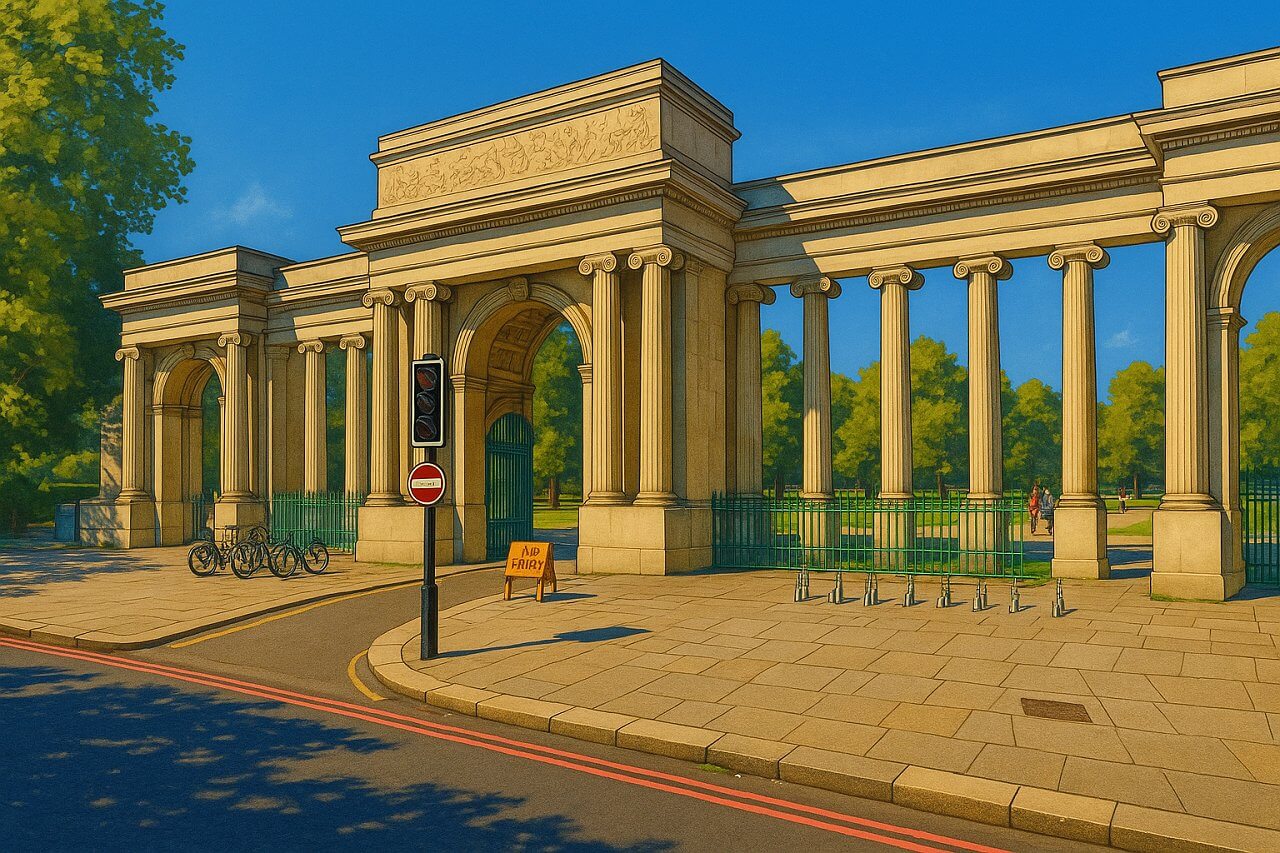
Painting of Hyde Park Corner, London (View image in full size)

Page Details
This page was created on 29 May 2025. Hi, my name is Timothy and created it from my research, for my own entertainment, knowledge and to satisfy my curiosity. I am providing the information to you in good faith and hope it is useful. I try to get the details as accurate as possible. I also try to update the page whenever I stumble on new details. So this and all my other pages are perpetual work in progress. If you discover any error, please politely inform me, pointing out where the error lies, and I will correct it as soon as possible. Your helpfulness will keep this page accurate, relevant and helpful to those who need the information.List of Places in London, Map of Places in London
Want to share your London travel experiences or get tips from fellow travellers?
Join the London Travel Tips Facebook GroupMore information for visiting London
Here are some related articles to help you get to know London better.- Cost of Living in London: Discover the true cost of living in London, including housing, transport, groceries, and more - plus tips for budgeting in one of the world's most expensive cities.
- Driving in London: Planning to drive in London? Learn about roads, car rentals, parking, tolls, and key tips for tourists and visitors from outside the capital.
- Driving Tips for Visiting London: Thinking of driving to London? Discover the best times to travel, congestion tips, parking apps, breakdown help, and petrol advice for a smoother journey.
- Evolution of London's Streets: Discover the fascinating history of how London's streets developed from ancient footpaths to today's complex network of roads across the capital.
- History of Immigration to London: Discover the rich history of immigration to London, from Huguenots to Bangladeshis, and how diverse communities have shaped the city's vibrant identity.
- How Big Is London Compared to Other World Cities?
- How London's Streets Measure Up: A Global Comparison of Road Widths
- How Streets of London are Named: Discover how London streets get their names, who decides them, and how historic, political, and public influences shape street naming in the capital.
- How the Grosvenor Family Came to Own Much of Mayfair, Belgravia and Pimlico: Explore how the Grosvenor family came to own much of Mayfair, Belgravia, and Pimlico, and learn about their historical connection (or lack thereof) with the British royal family and government.
- Living and working in London
- London's Quiet Collapse: How Living Standards Fell as Costs Skyrockted (1975-2025): Explore how London residents endured rising costs and falling living standards from 1975 to 2025 - from rocketing rents to wage stagnation and inflation.
- Marvel of the London Underground: Discover the history, challenges, and triumphs of the London Underground - the world's first underground railway and a vital transport lifeline for the UK capital since 1863.
- Moving to London: Expat Tips for Settling in Westminster: Essential advice for expats moving to London's Westminster: neighborhood insights, cost of living, transportation, housing, healthcare, schools, and tips to help you feel at home in the heart of the city.
- Places in London that aren't pronounced the way they're spelled
- Shopping in London: Discover London's diverse shopping scene
- Taking the bus in London: This is your complete guide to taking the bus when in London.
- The Anglican Faith: A Visitor's Guide to the Church of England: Learn about the Anglican faith and its deep ties to London's landmarks like Westminster Abbey and St Paul's Cathedral.
- Top 10 London Streets Every Visitor Must See: Discover London through its most iconic thoroughfares - 10 streets every visitor must experience. From historic Abbey Road to vibrant Camden High Street, explore culture, shopping, and hidden gems.
- Why are most roads in Central London so narrow? Learn why there are so few multi-lane roads and elevated highways in the heart of the city.
 Latest Pages & Updates
Buy Me A Coffee
If you enjoy the information I provide and want to support the work I do, please buy me a coffee! I appreciate it immensely, thank you so much!
