
Jalan Masjid Kapitan Keling (Pitt Street)
 Go Back - HOME | Latest PENANG | Travel Tips | Penang Hokkien : Dictionary | YouTube | Facebook | Contact Me
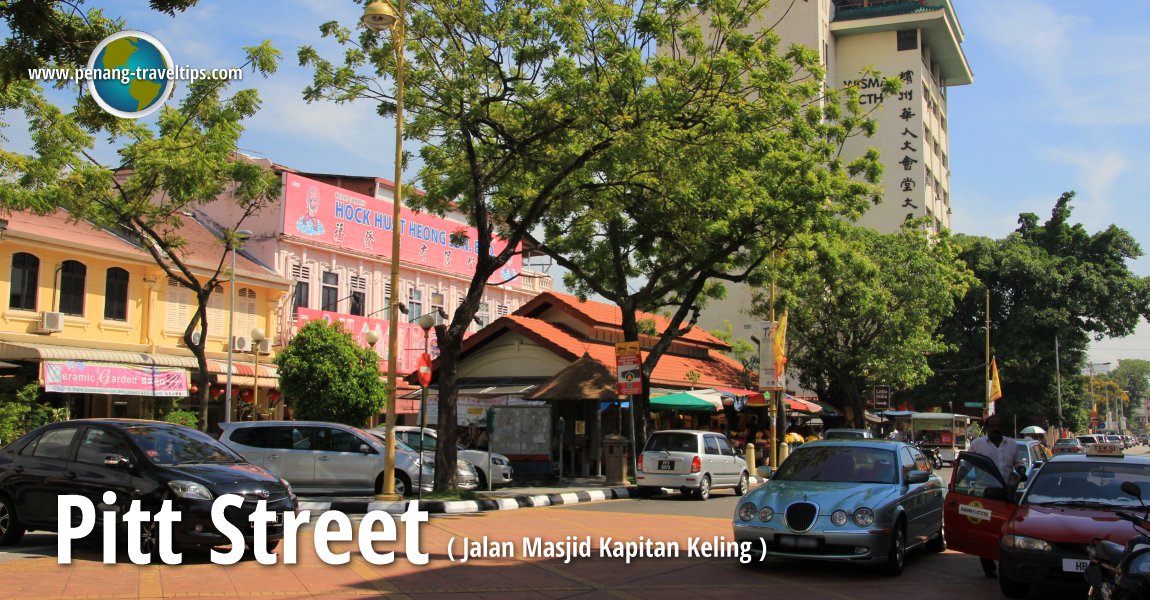 Pitt Street, George Town, Penang (15 September 2012)
B. Melayu
Pitt Street (Malay: Jalan Masjid Kapitan Keling) is one of the four major streets in the Original Grid of George Town laid out by Captain Francis Light when he established his trading settlement.
It is said that the choice of name for this street came as an afterthought. After naming the first street of his settlement after himself, the town after the British monarch King George III, the island after the future King George IV, Light realised that he may have offended the prime minister for not naming anything after him. Hence, he decided to name Pitt Street after the then prime minister, William Pitt the Younger.
 Map of Jalan Masjid Kapitan Keling (Pitt Street), Penang
Accommodation on Pitt Street
The following is a list of accommodation that you can find on Pitt Street. The ones which you can book online via Agoda includes a "check rate" link.- Broadway Budget Hotel (GPS: 5.41789, 100.33867)

- Red Inn Court (GPS: 5.41797, 100.33877)

- Silver Shine Homestay Guesthouse (GPS: 5.41874, 100.33921)

- The Boutique Residence Hotel (GPS: 5.41575, 100.33729)

Street Art on Pitt Street
- "Bullock Cart Wheel" Sculpture (GPS: 5.41831, 100.33889)

- "Tok Tok Mee" Sculpture (GPS: 5.41831, 100.33889)

 Sights along Pitt Street
- 104 & 106 Pitt Street (GPS: 5.41622, 100.33724)

- Bank Negara Malaysia Building (GPS: 5.42046, 100.34026)

- Kapitan Keling Mosque (GPS: 5.41666, 100.33758)


- Kuan Im Teng (GPS: 5.41849, 100.33871)

- Penang Chinese Town Hall (GPS: 5.41887, 100.33885)

- Mahamariamman Temple (GPS: 5.41728, 100.3382)

- St George's Anglican Church (GPS: 5.41971, 100.3391)

- Supreme Court Building (GPS: 5.42066, 100.33983)

- The Star Pitt Street (GPS: 5.41873, 100.33931)
Eateries and Food Stalls on Pitt Street

Businesses along Pitt Street
- AKS Abdul Kassim Gems & Jewellers
- Best Mart Forex (money changer)
- Eu Yan Sang (Chinese medical hall) (GPS: 5.41729, 100.33786)

- Faongg Sdn Bhd (pu-erh tea dealer)
- Gerak Budaya Bookshop
- Habib Jewels
- Haji A. Othman Piliai & Sons (second-hand furniture, antiques)
- Hock Huat Heong (Chinese prayer items)
- Indian Florists
- International Mega Forex (money changer)
- Kheng Sheng Goldsmith & Jewellery
- Kok Seng Antique
- Mohamed Ismail Sdn Bhd (jeweller)
- Nasrat Jewellery Centre
- Oren Sport Concept Store
- Pitt & Chulia Junction Indian Barber
- Pitt Street Indian Barber
- S. Abdul Kassim Gems
- SNOB Hair Dressing
- Tai Loong Jewellers
- Tan Coin Trading
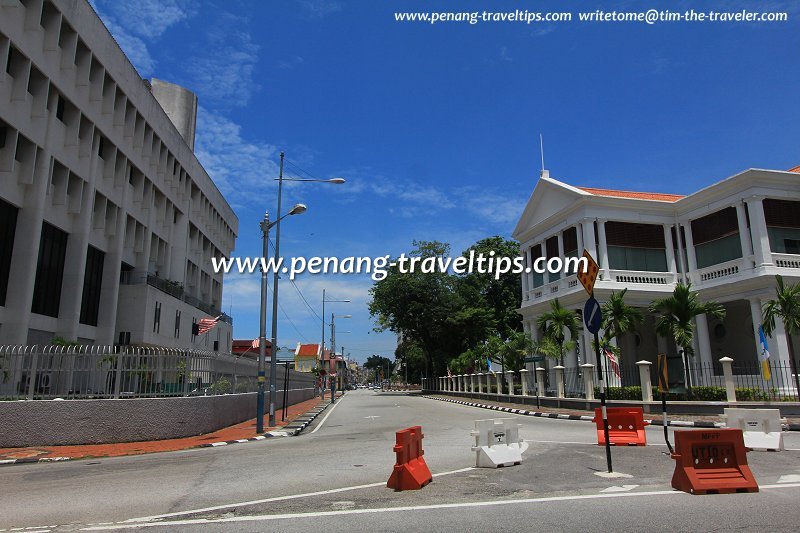 The junction of Pitt Street with Light Street (21 August 2011)
About Pitt Street
Pitt Street was already shown in the earliest existing map of George Town, the Popham map of 1798. During Light's time, Pitt Street was at the very edge of his town, which was bordered by Light Street, Beach Street and subsequently Chulia Street. Today the street, named Jalan Masjid Kapitan Keling after the Indian Muslim mosque along it, is one of the major streets within the George Town World Heritage Site core zone.Pitt Street provides a cross section view of the cosmopolitan nature of George Town. At its outermost section, or rather easternmost, Pitt Street wears a European character. This was where the earliest British officers had their homes, centred upon their house of worship, the St George's Anglican Church.
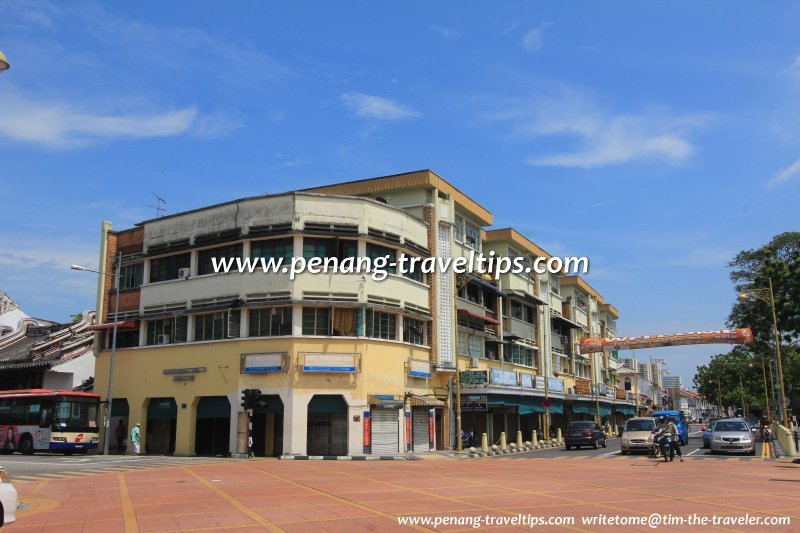 Pitt Street and Chulia Street junction (22 July 2012)
By the middle part of the 18th century, as the Europeans moved into the suburbs (to North Beach and then later on to Western Road), the properties along the coast were bought over by wealthy Chinese tycoons. People like Koh Seang Tat, Foo Tye Sin and Goh Ban Bee ownest the choicest lots.
As you leave the European section of Pitt Street, you enter the working-class Chinese precinct. This is anchored by the Kuan Im Teng Temple, which once had an uninterrupted view of the sea down China Street, which was a predominantly Chinese enclave.
You will notice that the space after the Kuan Yin Temple broadens. In the old days, there used to be a police station here, on the site where today you can see kiosks selling flowers. For that reason, this section of Pitt Street was known as Tua33 Ba3lai4
 in Penang Hokkien, meaning "big police station".
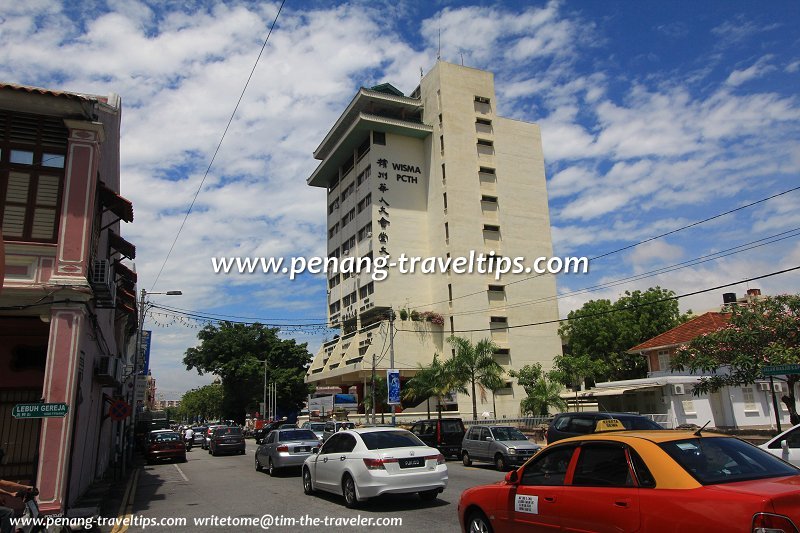 Stretch of Pitt Street near the Penang Chinese Town Hall (21 April 2012)
Continuing down Pitt Street, we come upon the rear entrance of the Sri Mariamman Temple, an indication that we are skirting the predominantly Hindu part of Light's town. The next junction is with Chulia Street, a thoroughfare populated mostly by communities from the Indian subcontinent. In the old days, the junction was known as Simpang Lelong in Malay, or Elam Muchanti ஏலம் முச்சந்த்தி
in Tamil, both of which meaning "auctioneer's junction." That's because auctions used to be carried out under the Neem trees, many of which are still standing today.Upon crossing Chulia Street, the character of Pitt Street changes again. On the left side are rows of Muslim jewellery shops, while on the right is their main place of worship, the Kapitan Keling Mosque. This is the Indian Muslim part of town. The numerous Muslim eateries are located here. A largely forgotten piece of Muslim heritage is the Madrasah Hamid Arabi, an old Muslim religious school.
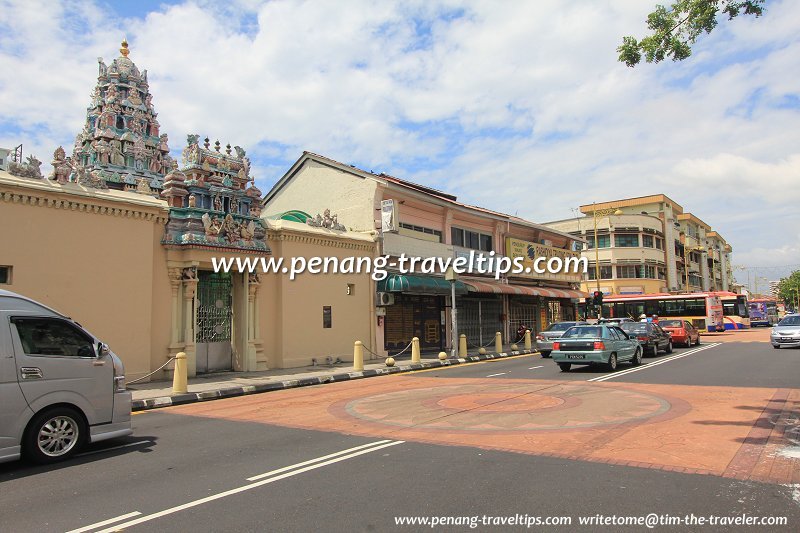 Giant koolam design on Pitt Street in front of the Arumigu Maha Mariamman Temple (21 April 2012)
The right side of Pitt Street, at the junction with Buckingham Street and Kampung Kolam, was once known as Tua33 Chooi1 Ti2 大水池
in Hokkien, meaning "big water tank". This refers to the water tank used by the Muslims of the community for ablution.The section of Pitt Street between Kampung Kolam and Armenian Street used to be known as Ya3 Kha1 攑跤
, meaning "under the coconut tree", which is self explanatory. You can well imagine the rural nature of Pitt Street back then.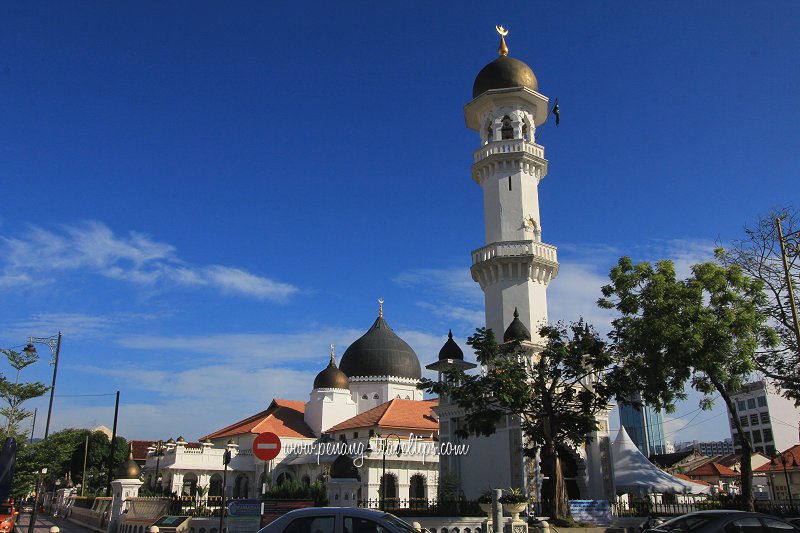 Kapitan Keling Mosque, the grandest landmark along Pitt Street (30 June 2014)
The junction of Armenian Street signals another character change for Pitt Street. This is where Pitt Street ends, and the street following is Cannon Street, named to commemorate the cannons fired during the Penang Riots of 1867.
The only thing Armenian about Armenian Street today is its name. Of course there once were Armenians in George Town, but they have long packed up and left. The appearance of town here is decidedly Chinese, although in the old days, there used to be Malay and Sumatran kampungs in the vicinity. Remnants of this can be seen in the Acheen Street Mosque.
Resurfacing of Pitt Street
A few years ago Pitt Street was surfaced with granite tiles in an attempt to create the appearance of cobblestones. The result drew widespread complaints from users, leading the municipal council to hold a survey, which showed that the public overwhelmingly supported the re-tarring of the street.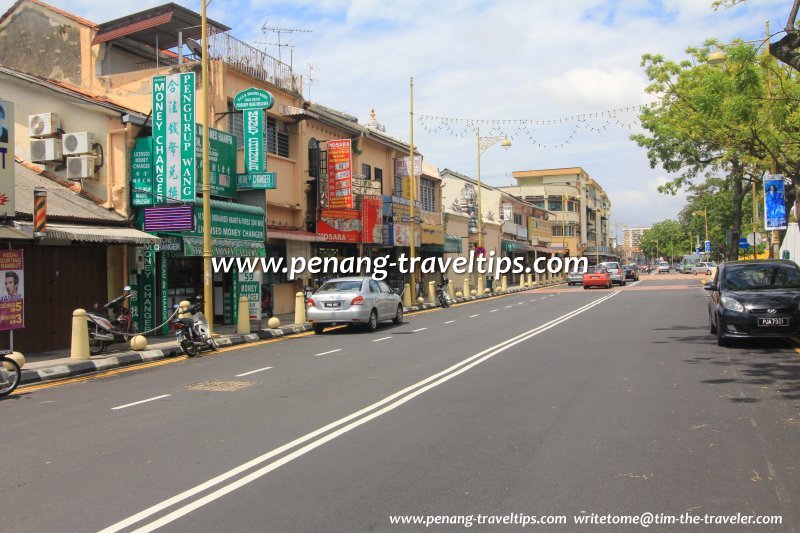 Newly resurfaced Pitt Street after the unpopular tiles were removed (21 April 2012)
Property Numbering
Starting from Light Street and heading towards Cannon Street, properties on the left side of Pitt Street carry odd-number addresses while those on the right side carry even-number addresses.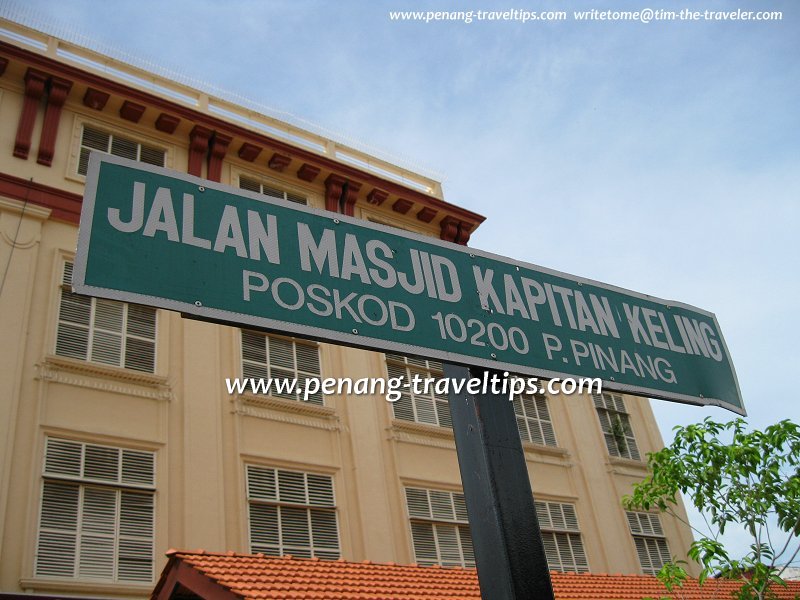 Jalan Masjid Kapitan Keling road sign (12 November 2008)
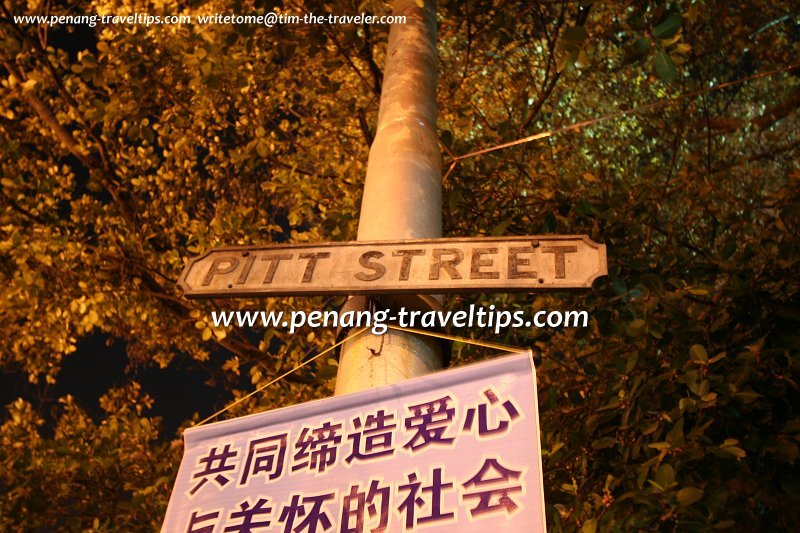 Old Pitt Street road sign (9 February 2009)
Properties on Pitt Street
In this section is a selection of photographs showing the properties lining Pitt Street.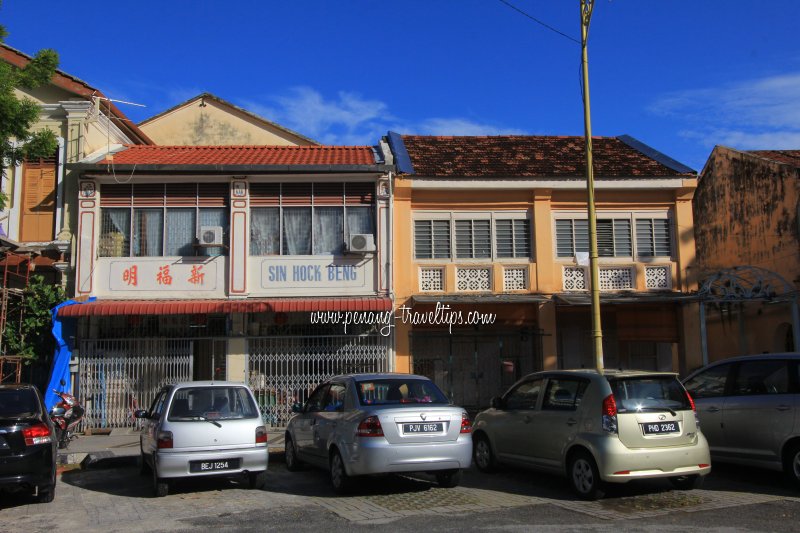 Pitt Street Shophouses: from right to left, their numbers are 156, 156A, 160 and 162 (30 June 2014)
156, 156A, 160 and 162 is an ensemble of four adjoining shophouse. I am not sure where is No. 158, that instead there is 156A. Anyway, these are all built at the turn of the 20th century.2
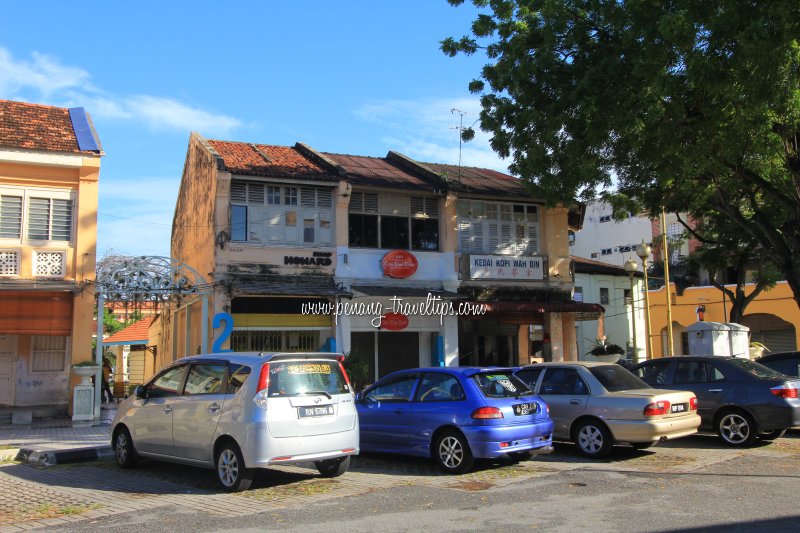 Pitt Street Shophouses: from right to left, their numbers are 156, 156A, 160 and 162 (30 June 2014)
This cluster of three shophouses are numbered, from right to left, 150, 152 and 154. They presently house Kedai Kopi Wah Bin, Kafe Chin Chai Chiak and Galeri Shop Howard.
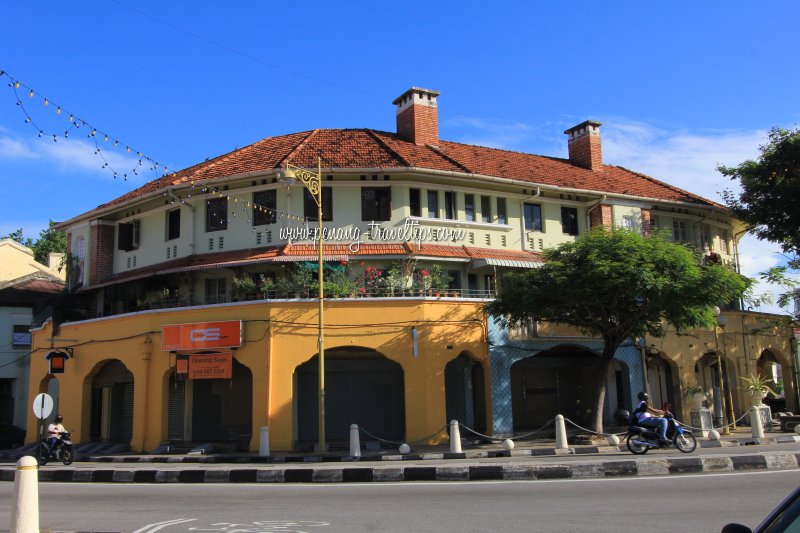 104 & 106 Pitt Street, Penang (30 June 2014)
104 & 106 Pitt Street is the building that wraps around the curve of Pitt Street until Buckingham Street.
Getting there
Rapid Penang Bus 10, 103, 301 and 401 pass through Pitt Street.Street Art
There are two steel-rod sculptures on Pitt Street. The "Bullock Cart Wheel" Sculpture is on the wall near the junction near Bishop Street while the "Tok Tok Mee" Sculpture is at the junction with China Street.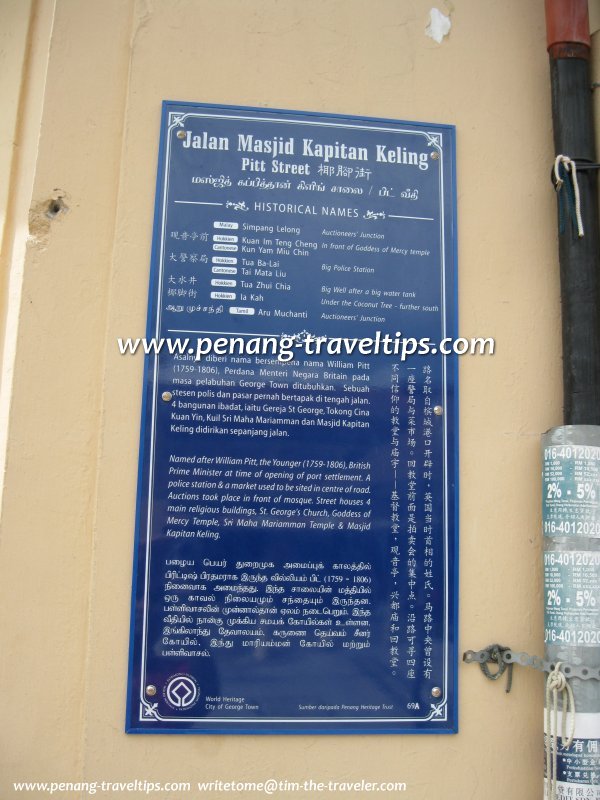
Pitt Street plaque (12 November 2008)
Updates on Pitt Street
30 April, 2014: It was reported in The Star that Arts-Ed and ThinkCity are working on a project entitled Journey of Harmony - Understanding Communities and Its Values which is meant to create greater awareness of the cultural and religious elements of Pitt Street. Residents, worshippers at the various religious sites and tourists are surveyed for their views, and the resulting information will be presented to the public.References
1. Khoo Salma Nasution, The Chulia in Penang (Areca Books, 2014, p.14)2. Heritage Buildings of Penang Island (MPPP, 1994, p.240)
Acknowledgement
1. Penang Travel Tips thanks Mr Nelamegam Malairaja for information on Simpang Lelong.List of Streets in Penang and Streets in Malaysia
Want to share your Penang travel experiences or get tips from fellow travellers?
Join the Penang Travel Tips Facebook GroupUseful guides for visiting Penang

