
Lebuh Light (Light Street), George Town
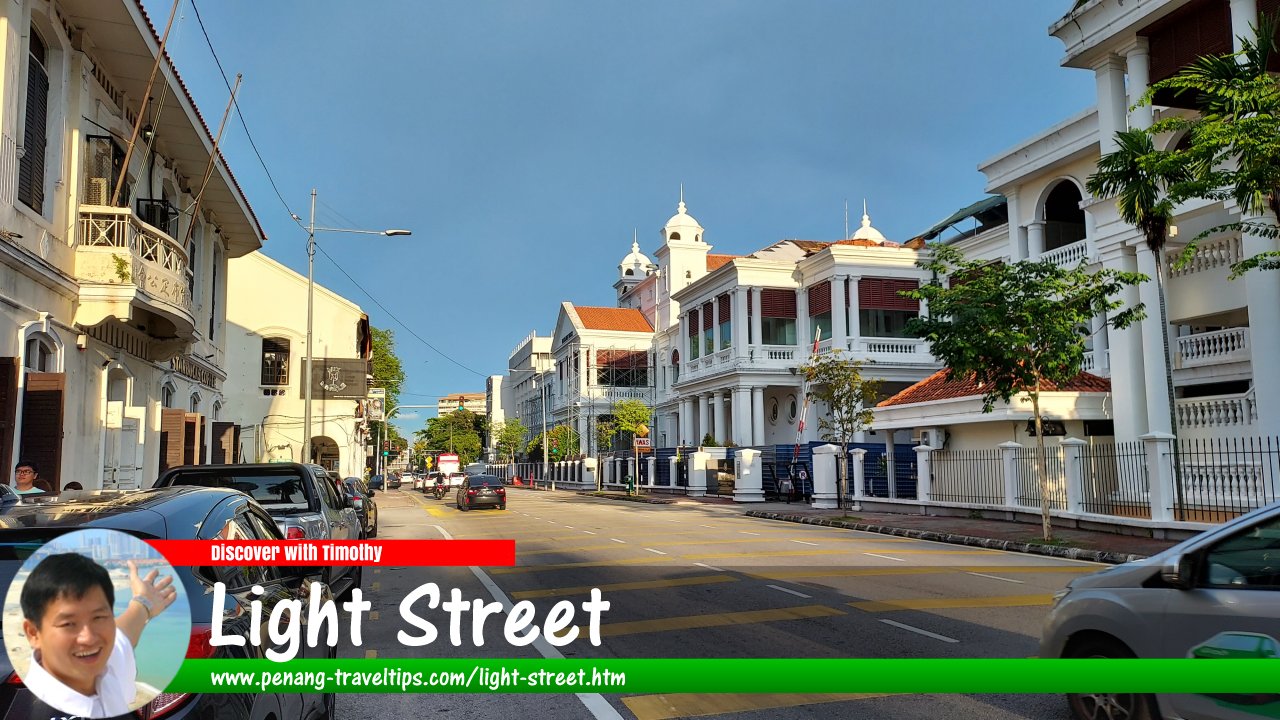 Light Street (Lebuh Light), George Town, Penang (20 May 2023)
Also available: Lebuh Light and Lebuh Light (乔治市)
Lebuh Light is a historic street in George Town, Penang, Malaysia, and is generally regarded as the first street laid out in the settlement founded by Captain Francis Light in 1786. Formerly known in English as Light Street, it runs through the civic heart of George Town and forms part of the city's UNESCO World Heritage Site. The street and its immediate surroundings contain some of Penang's most important colonial-era buildings, including Fort Cornwallis, the Penang State Legislative Assembly Building, City Hall, the Town Hall and the former Supreme Court complex. Its location beside the Esplanade also gives Lebuh Light an important place in the history and urban landscape of George Town.1
My videos on Lebuh Light
History of Lebuh Light
The history of Lebuh Light is closely intertwined with the foundation and early development of George Town. On 11 August 1786, Captain Francis Light took formal possession of Penang Island on behalf of the British East India Company and established a settlement on the island's north-eastern tip. The new settlement was subsequently named George Town in honour of King George III.2
The area selected for the new settlement was not an uninhabited wilderness, despite some traditional accounts describing it in those terms. Communities already lived in various parts of Penang Island, including settlements along the Sungai Pinang and at places such as Batu Uban and Tanjong Tokong. Nevertheless, the north-eastern cape selected for George Town contained extensive areas of vegetation and wetlands that had to be cleared and developed before the new town could take shape.
Among the earliest roads laid out in George Town was the road that became Light Street. It ran along the southern side of what is now the Esplanade, linking the early settlement around Fort Cornwallis with the developing town. The road was named after Francis Light, who was then the Superintendent of the settlement. Other early streets, including Beach Street, Chulia Street and Pitt Street, were subsequently laid out to form the basic framework of the new town.3
The first street layout established the nucleus from which George Town expanded. The early roads were laid out in a broadly regular pattern, allowing the new settlement to be divided into plots and facilitating the development of commercial, residential and administrative areas. As George Town grew into an important entrepôt, the area around Light Street became particularly attractive to European officials and merchants.
Francis Light's Well
One of the surviving reminders of the earliest settlement is Captain Francis Light's Well, located within the grounds of what is now Convent Light Street (now no longer running). The well is traditionally associated with Francis Light and the early European settlement. According to Penang's official tourism directory, Light built a road running from a newly constructed pier to his home, and the road became known as Light Street. His residence stood within the compound of the present-day Convent Light Street school.4
The association between the street and Light's residence is significant because it illustrates how the earliest civic and residential development of George Town was concentrated around the new settlement's north-eastern waterfront. What began as a small colonial trading post gradually developed into a major port city, and Light Street remained close to the centre of its political and administrative life.
From residential street to civic centre
During the early decades of George Town, Light Street was associated with European residences and government functions. As the settlement expanded and Penang became increasingly important within the British colonial administration, substantial government and judicial buildings appeared around the street and the adjacent Esplanade.
The area eventually developed into the civic core of George Town. Fort Cornwallis occupied the eastern end of the early settlement, while government buildings and other institutions were established around the Esplanade. The resulting concentration of administrative buildings gave the area a character quite different from the commercial streets farther south and west in the old town.
In the 19th century, the social character of the street also changed. Properties that had originally been associated with Europeans were increasingly acquired by wealthy local Chinese merchants and businessmen. The presence of prominent Chinese-owned residences and institutions alongside British administrative buildings illustrates the multicultural character that developed in George Town as its port expanded and attracted merchants and settlers from across Asia and beyond.
By the late 19th and early 20th centuries, the area around Light Street had become one of the most impressive civic ensembles in British Malaya. The Town Hall and later the Municipal Offices, now known as City Hall, faced the Esplanade, while the State Assembly Building and judicial buildings stood nearby. The concentration of these institutions helped establish the area as the political and administrative heart of Penang.
 Map of Light Street, Penang
Hotels on Light Street
Historic Buildings on/near Light Street
- Chinese Chamber of Commerce (GPS: 5.42012, 100.34168)

- Foo Tye Sin Mansion (GPS: 5.41975, 100.34209)

- Fort Cornwallis (GPS: 5.4203, 100.34384)

- Francis Light's Well (GPS: 5.42257, 100.33918)

- Government House (GPS: 5.42273, 100.3389)

- House of Yeap Chor Ee (GPS: 5.41982, 100.3418)

Fields on Light Street
- Padang Kota Lama (GPS: 5.42072, 100.34221)

Schools on Light Street
- Convent Light Street (GPS: 5.42146, 100.33856)

Auditoriums on Light Street
- Dewan Sri Pinang (GPS: 5.4213, 100.34045)

Monuments on Light Street
- Logan Memorial (GPS: 5.42107, 100.33984)

- Queen Victoria Memorial Clocktower (GPS: 5.41944, 100.34426)

Fountains on Light Street
- Municipal Fountain (GPS: 5.42076, 100.34098)

- Pinang Fountain (GPS: 5.41912, 100.34408)

Commercial Buildings on Light Street
- Wisma Great Eastern (GPS: 5.42005, 100.34091)

- Wisma Pelaut (GPS: 5.41956, 100.34252)

Government Buildings on Light Street
- Bank Negara Malaysia Building (GPS: 5.42052, 100.34044)

- Immigration Department (GPS: 5.41902, 100.34367)

- Penang Supreme Court (GPS: 5.42076, 100.3398)

- State Assembly Building (GPS: 5.41936, 100.34312)

Geography of Lebuh Light
Lebuh Light lies in the north-eastern part of George Town on Penang Island. It occupies a strategic position between the historic town centre and the waterfront, running broadly from the vicinity of Lebuh Farquhar in the west to the Lebuh Light roundabout (now expunged) in the east. At the eastern end, the road connects with the network around Beach Street, King Edward Place and Jalan Tun Syed Sheh Barakbah.
The street is relatively short, but its position is considerably more important than its length might suggest. Its northern side is dominated by the Esplanade and the historic civic buildings around it, while the southern side contains a mixture of institutional, commercial and heritage properties. The street therefore forms an important edge between the historic urban core and the open waterfront landscape.
Today, Lebuh Light lies wholly within the George Town UNESCO World Heritage Site. UNESCO identifies Lebuh Light as one of the important streets within the World Heritage site's Core Zone, which covers 109.38 hectares and contains more than 1,700 historic buildings. The street forms one of the perpendicular streets connecting the principal north-south and east-west streets of the historic city.5
The relationship between the street and the Esplanade is particularly significant. The Esplanade is a large open field facing the sea, bordered by Fort Cornwallis to the east and the Town Hall and City Hall to the west, with the State Legislative Assembly Building and other historic buildings along its southern edge. This arrangement creates one of George Town's most recognisable civic landscapes.6
The changing waterfront
The eastern part of the historic settlement originally had a much closer relationship with the sea than it does today. Land reclamation over the course of George Town's development altered the shoreline and expanded the town's waterfront. The original jetty and pier associated with the earliest settlement were eventually replaced by a more extensive port environment, while later reclamation created additional land around the eastern side of the city.
This gradual transformation explains why the present-day relationship between Lebuh Light, Beach Street, King Edward Place and the waterfront differs from the landscape experienced by the earliest inhabitants of George Town. The street nevertheless remains a visible reminder of the original settlement and its early connection with the sea.
Sights Along and Near Lebuh Light
Although Lebuh Light is relatively short, it is surrounded by an unusually high concentration of historic attractions. A walk along the street and the adjoining Esplanade can therefore take visitors past buildings representing several different stages of George Town's development.
Fort Cornwallis
Fort Cornwallis stands at the eastern end of the historic precinct beside the Esplanade. It originated as a defensive fortification established soon after Francis Light's arrival and was initially constructed using local materials before being rebuilt in more substantial form. The present fort largely dates from the late 18th and early 19th centuries and remains one of the most prominent surviving colonial fortifications in Malaysia.
The fort is particularly important to the story of Lebuh Light because the road was laid out as part of the earliest settlement surrounding it. The fort, road, Esplanade and early government buildings together form a physical record of George Town's beginnings as a British trading settlement.
The Esplanade and Padang
The Esplanade, also known as Padang Kota Lama, is the broad open space immediately adjoining Lebuh Light. It has historically served as a parade ground, public gathering place and venue for civic events. Its open character contrasts strongly with the dense streets and shophouses found elsewhere in George Town.
The Esplanade is also important from an urban-design perspective. The arrangement of open space surrounded by major civic buildings reflects the planning traditions of British colonial towns. UNESCO has highlighted the significance of this civic ensemble, noting the arrangement of the Esplanade, Fort Cornwallis, Town Hall, City Hall and surrounding government buildings.6
City Hall
City Hall stands beside the Esplanade and is one of the most recognisable buildings in the historic civic precinct. Completed in 1903 as the Municipal Offices, the building provided additional accommodation for the municipal administration when the Town Hall could no longer meet the growing needs of the city. It later became known as City Hall following George Town's attainment of city status in 1957.7
Today, City Hall is associated with the Penang Island City Council and remains an important symbol of George Town's municipal history. Its Edwardian Baroque and Palladian architectural elements contribute strongly to the historic character of the Esplanade.
Town Hall
George Town Town Hall stands beside City Hall on the Esplanade. Completed in 1880, it predates City Hall and was the first municipal building constructed for the town. While City Hall eventually became the principal municipal office, the Town Hall developed a more social and ceremonial role.
The two buildings form an important architectural pair and help illustrate the expansion of George Town's municipal administration during the late 19th and early 20th centuries.
Penang State Legislative Assembly Building
The Penang State Legislative Assembly Building stands along the southern side of the Esplanade near Lebuh Light. The building has undergone several changes of function during its history. It was originally associated with the central police station of George Town before subsequently becoming the home of the Penang Legislative Assembly.
Its position beside the Esplanade is another reminder of the area's long-standing role as the centre of public administration in Penang. The building, together with City Hall, the Town Hall and the former judicial complex, forms part of the civic ensemble that gives this part of George Town its distinctive character.
Former Supreme Court and High Court Buildings
The Penang High Court complex is located near the western portion of Lebuh Light. The judiciary has had a presence in this part of George Town since the early colonial period. The Supreme Court was initially established within Fort Cornwallis in 1809 before being moved to a purpose-built building nearby the following year.1
The judicial buildings are significant not only for their architecture but also because they demonstrate how George Town's administrative functions became concentrated around the original settlement. Together with the government buildings and municipal offices, they transformed the area around Lebuh Light into the city's principal civic district.
Convent Light Street
Convent Light Street occupies an historic site associated with the early European settlement of George Town. The school traces its origins to the Sisters of the Infant Jesus, who arrived in Penang in the 19th century. The sisters acquired the site in 1859, which included an earlier Government House associated with the colonial administration.8
The school is particularly relevant to the history of Lebuh Light because of its connection with Francis Light's former residence and the surviving well associated with him. The site therefore preserves layers of Penang's history spanning the earliest settlement, colonial administration, Catholic missionary education and modern schooling.
Penang Chinese Chamber of Commerce
The Penang Chinese Chamber of Commerce is another notable heritage building in the vicinity of Lebuh Light. Its presence illustrates the growing economic influence of the Chinese business community in Penang during the colonial era. The building has been recognised as an important heritage structure within George Town's World Heritage area, and conservation work has contributed to preserving the historic character of the street.9
Queen Victoria Memorial Clock Tower
The Queen Victoria Memorial Clock Tower stands near the eastern end of the civic precinct, close to the junction of the historic waterfront roads. It was erected to commemorate Queen Victoria's Diamond Jubilee in 1897. The tower became one of the visual landmarks of the waterfront approach to George Town and remains an easily recognisable feature when approaching Lebuh Light from the eastern side.
Lebuh Light as a Heritage Street
The importance of Lebuh Light extends beyond the individual buildings found along it. The street forms part of a larger historic urban landscape in which roads, open spaces, government buildings, religious institutions and commercial properties developed together. This relationship is one reason why George Town's World Heritage designation focuses not merely on isolated monuments but on the character of the historic city as a whole.
George Town was inscribed together with Melaka on the UNESCO World Heritage List in 2008 as the Historic Cities of the Straits of Malacca. UNESCO describes the two cities as exceptional examples of multicultural trading towns in Southeast Asia, shaped by centuries of interaction between Malay, Chinese, Indian, Middle Eastern and European communities.10
Lebuh Light represents one particularly visible aspect of that history. Its earliest buildings and institutions reflect British colonial administration, while later buildings and properties demonstrate the participation of local Chinese and other communities in the economic and civic development of George Town. The result is not simply a colonial street, but part of a much broader multicultural urban landscape.
Conservation has consequently become an important part of the street's modern history. UNESCO notes that Lebuh Light has been among the public spaces in George Town to benefit from rehabilitation and conservation initiatives based on historical documentation and historic photographs. Such work seeks to retain the character of the street while allowing it to continue functioning as part of a living city.11
Visiting Lebuh Light
Lebuh Light is particularly rewarding to explore on foot because several major sights are concentrated within a relatively small area. A visitor can combine the street with Fort Cornwallis, the Esplanade, City Hall, the Town Hall, the State Legislative Assembly Building and other heritage attractions in the surrounding civic precinct.
The street also provides a useful starting point for exploring the wider historic core of George Town. From Lebuh Light, visitors can continue towards Lebuh Farquhar and the churches and institutions of the northern heritage district, or head southward towards the commercial and religious quarters around Lebuh Pantai, Lebuh Chulia, Lebuh Gereja and Jalan Masjid Kapitan Keling.
Because of its location within the World Heritage Site, Lebuh Light is best understood not simply as a road connecting two junctions, but as part of the historic framework from which George Town developed. Its short length belies its importance: the street encompasses the origins of the settlement, the development of colonial administration, the growth of municipal government, the emergence of a multicultural trading city and the continuing conservation of George Town's historic urban landscape.
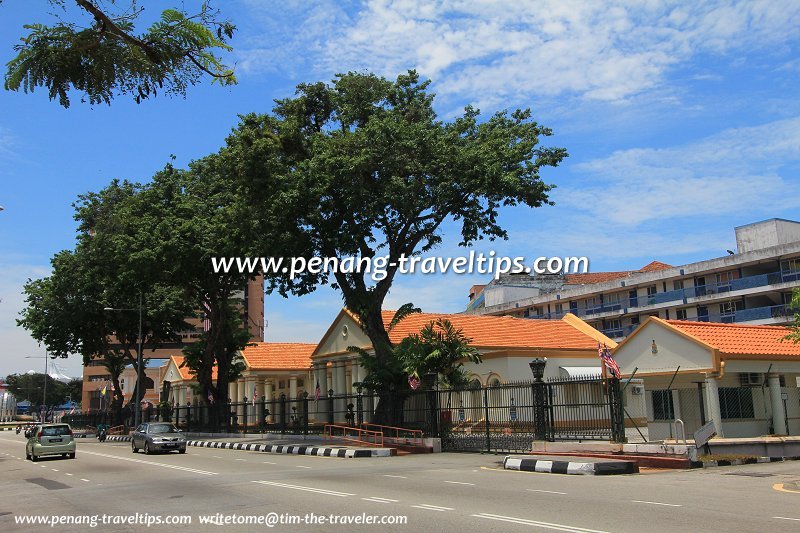
Light Street in front of the State Assembly Building (21 August 2011)
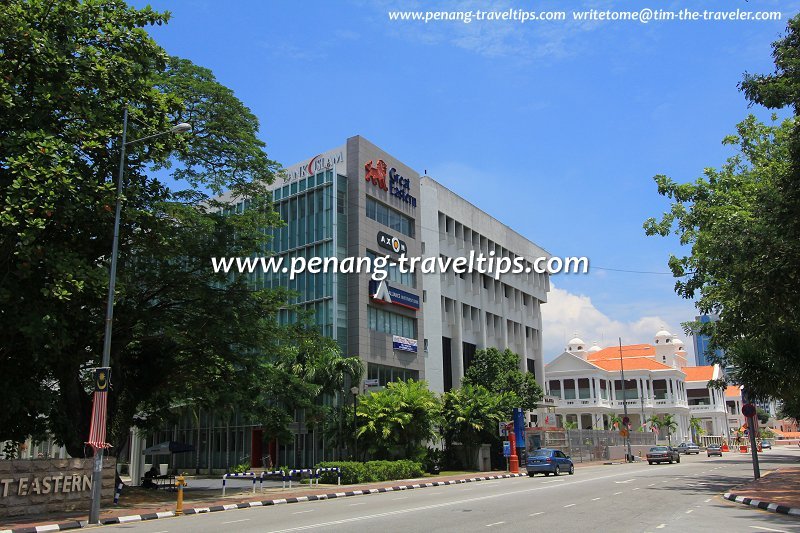
Light Street in front of Wisma Great Eastern (21 August 2011)
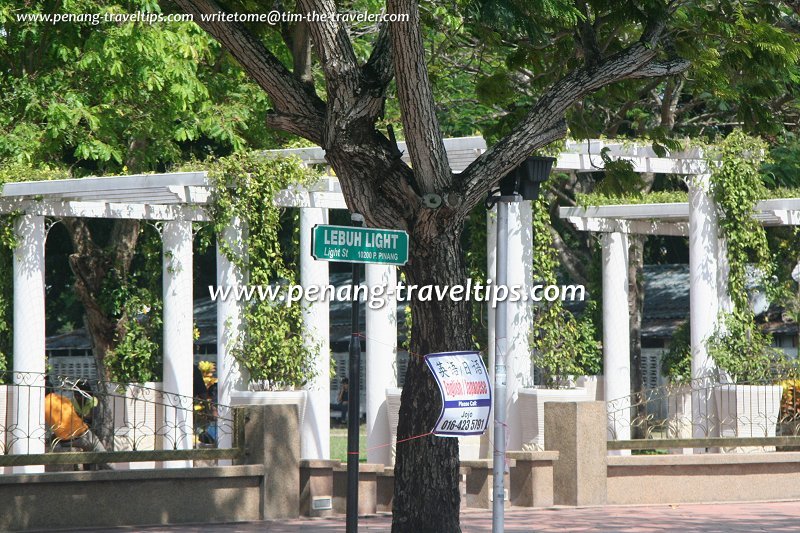
Lebuh Light road sign (30 November 2008)
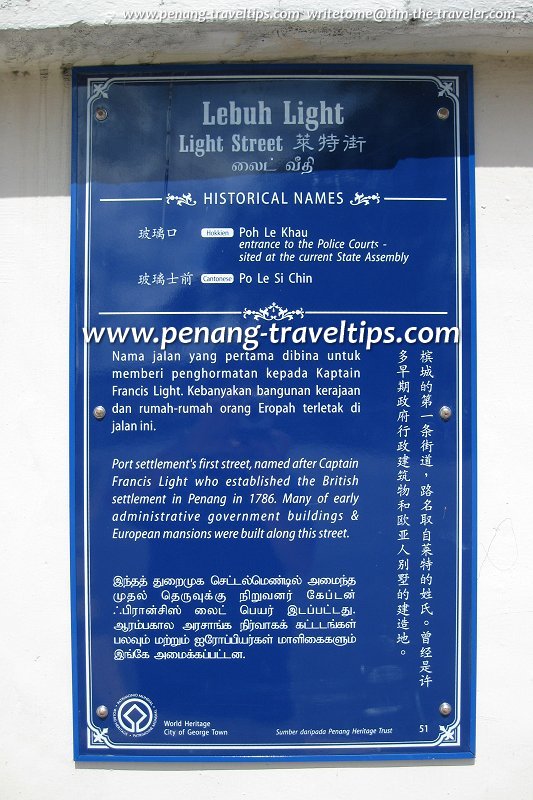
Light Street history plaque (30 November 2008)
References
- Penang Travel Tips, “Light Street (Lebuh Light), George Town”
- UNESCO World Heritage Centre, “Melaka and George Town, Historic Cities of the Straits of Malacca”
- Light Street, George Town — historical and geographical overview
- myPenang, “Captain Francis Light Well”
- UNESCO, Heritage Management Plan for the Historic City of George Town
- UNESCO World Heritage Centre, “The Padang Civic Ensemble”
- City Hall, George Town — history and architecture
- Convent Light Street — history of the school and site
- UNESCO, “From port city to World Heritage site: case study of George Town”
- UNESCO World Heritage Centre, Outstanding Universal Value of Melaka and George Town
- UNESCO, conservation and rehabilitation initiatives in George Town
Page Details
This page was created on 16 August 2026. Hi, my name is Timothy and created it from my research, for my own entertainment, knowledge and to satisfy my curiosity. I am providing the information to you in good faith and hope it is useful. I try to get the details as accurate as possible. I also try to update the page whenever I stumble on new details. So this and all my other pages are perpetual work in progress. If you discover any error, please politely inform me, pointing out where the error lies, and I will correct it as soon as possible. Your helpfulness will keep this page accurate, relevant and helpful to those who need the information.Want to share your Penang travel experiences or get tips from fellow travellers?
Join the Penang Travel Tips Facebook GroupUseful guides for visiting Penang
My Videos of Penang
 Latest Pages & Updates
Buy Me A Coffee
If you enjoy the information I provide and want to support the work I do, please buy me a coffee! I appreciate it immensely, thank you so much!
