
St James's London
St James's, London: History, Elegance and Royal Heritage in Westminster
St James's is a historic and prestigious district in the heart of the City of Westminster, central London. Nestled just west of Trafalgar Square and north of Buckingham Palace, St James's forms part of an illustrious neighbourhood bordered by:- Mayfair to the northwest
- Green Park and Buckingham Palace to the southwest
- Westminster proper (including Whitehall and Parliament) to the southeast
- Soho to the northeast
Size and Population
St James's is a relatively small area, covering roughly 0.25 square miles (0.65 square kilometres). Despite its compact size, it plays an outsized role in the culture and administration of the capital. The residential population is low - estimated at fewer than 1,000 permanent residents - owing to the area's dominance by commercial buildings, clubs, government offices, embassies, and royal parks. However, its daytime population surges with tourists, workers, and visitors.A Glimpse into the History of St James's
The origins of St James's stretch back to the medieval period, but the area as we know it today began to take shape in the 17th century. Before urban development, the land was primarily open fields and marshland situated on the edge of Westminster. Its transformation began with the establishment of St James's Palace by Henry VIII in the 1530s on the site of a former leper hospital dedicated to St James the Less (not to be confused with James the Apostle). The surrounding area, originally farmland and hunting grounds, gradually developed into an aristocratic residential quarter through the 17th and 18th centuries. By the 1660s, the Restoration period saw the development of St James's Square, which became one of London's most fashionable addresses. Over time, it evolved into a hub for exclusive gentlemen's clubs, elegant shops, and royal establishments.How St James's Got Its Name
The name St James's comes from the 12th-century Hospital of St James, a leper hospice dedicated to St James the Less, one of the twelve apostles. Unlike the Camino de Santiago pilgrimage route in Spain, St James's was never a major pilgrimage destination, but its name reflects a biblical association and the Christian charitable tradition of caring for the sick.Main Roads in St James's
St James's is defined by a number of grand and historic streets that still retain their charm and importance today:- Pall Mall - home to many gentlemen's clubs and formerly a royal road.
- St James's Street - a key thoroughfare running south from Piccadilly to St James's Palace.
- Piccadilly - forming the northern boundary of St James's.
- Jermyn Street - renowned for bespoke shirtmakers and high-end menswear tailors.
- King Street - connecting St James's Square with St James's Street.
Map of St James's, London
Streets of St James's, London
- Apple Tree Yard
- Bury Street
- Carlton Gardens
- Carlton House Terrace
- Catherine Wheel Yard
- Charles II Street
- Cleveland Row
- Duke of York Street
- Duke Street St James's
- Jermyn Street
- King Street
- Little St James's Street
- Man In Moon Passage
- Marlborough Road
- Mason's Yard
- Ormond Yard
- Pall Mall
- Park Place
- Piccadilly
- Piccadilly Circus
- Piccadilly Place
- Regent Street St James's
- Russell Court
- Ryder Street
- St James's Place
- St James's Square
- St James's Street
- The Mall
- Waterloo Place
Shopping in St James's
The Character of St James's
St James's is a district that exudes elegance, prestige, and tradition. It is:- Commercial - home to exclusive offices, auction houses, and art galleries.
- Retail-focused - especially high-end menswear, art, and fine wine.
- Institutional - with many clubs, royal residences, and cultural institutions.
- Semi-residential - but with very limited housing stock.
Major Sights and Attractions in St James's
St James's is rich in heritage and attractions, many of which are iconic London landmarks. Highlights include:- St James's Palace - a working royal residence and the formal home of several royal family members.
- St James's Park - one of the loveliest Royal Parks, with views of Buckingham Palace and waterfowl-rich lakes.
- The Mall - the ceremonial road leading to Buckingham Palace, used for royal processions and parades.
- Spencer House - an 18th-century aristocratic mansion open to the public on Sundays.
- St James's Square - a peaceful garden square surrounded by historic buildings.
- The Royal Academy of Arts - located just outside St James's, on Piccadilly, but integral to the cultural fabric of the area.
- Jermyn Street - perfect for shopping aficionados, with tailors and perfumers dating back centuries.
Nearest London Underground Stations
St James's is well-served by several London Underground stations:- Green Park Station - serving the Jubilee, Piccadilly, and Victoria lines.
- Piccadilly Circus Station - on the Piccadilly and Bakerloo lines.
- Charing Cross Station - on the Northern and Bakerloo lines (a short walk away).
- St James's Park Station - on the District and Circle lines, though technically closer to Westminster.
Fun Fact: The Origins of Gentlemen's Clubs
St James's is famously home to many of London's oldest and most exclusive gentlemen's clubs. These private members' clubs, such as White's, Boodle's, and the Reform Club, have their roots in the 18th and 19th centuries and were founded as places where aristocratic men could gather to socialise, drink, and discuss politics in privacy. Even today, many of these clubs maintain their traditions and strict dress codes.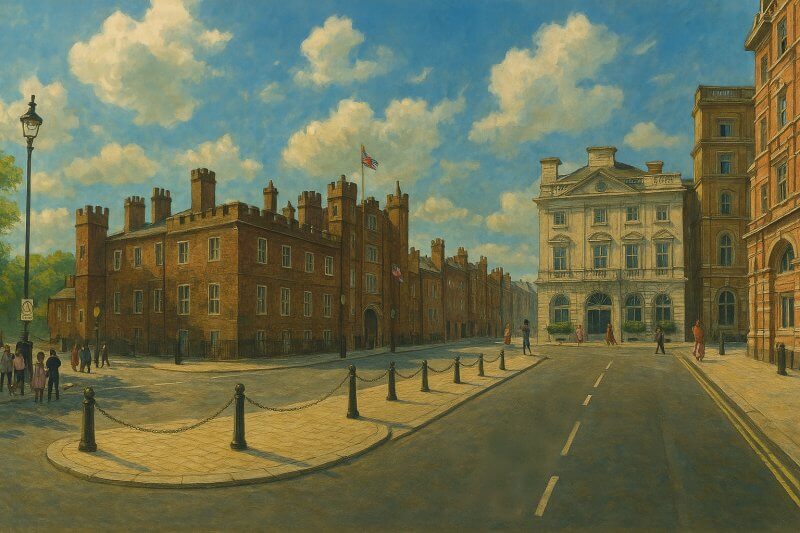
Painting of St James's
List of Places in London, Map of Places in London
Want to share your London travel experiences or get tips from fellow travellers?
Join the London Travel Tips Facebook GroupMore information for visiting London
Here are some related articles to help you get to know London better.- Cost of Living in London: Discover the true cost of living in London, including housing, transport, groceries, and more - plus tips for budgeting in one of the world's most expensive cities.
- Driving in London: Planning to drive in London? Learn about roads, car rentals, parking, tolls, and key tips for tourists and visitors from outside the capital.
- Driving Tips for Visiting London: Thinking of driving to London? Discover the best times to travel, congestion tips, parking apps, breakdown help, and petrol advice for a smoother journey.
- Evolution of London's Streets: Discover the fascinating history of how London's streets developed from ancient footpaths to today's complex network of roads across the capital.
- History of Immigration to London: Discover the rich history of immigration to London, from Huguenots to Bangladeshis, and how diverse communities have shaped the city's vibrant identity.
- How Big Is London Compared to Other World Cities?
- How London's Streets Measure Up: A Global Comparison of Road Widths
- How Streets of London are Named: Discover how London streets get their names, who decides them, and how historic, political, and public influences shape street naming in the capital.
- How the Grosvenor Family Came to Own Much of Mayfair, Belgravia and Pimlico: Explore how the Grosvenor family came to own much of Mayfair, Belgravia, and Pimlico, and learn about their historical connection (or lack thereof) with the British royal family and government.
- Living and working in London
- London's Quiet Collapse: How Living Standards Fell as Costs Skyrockted (1975-2025): Explore how London residents endured rising costs and falling living standards from 1975 to 2025 - from rocketing rents to wage stagnation and inflation.
- Marvel of the London Underground: Discover the history, challenges, and triumphs of the London Underground - the world's first underground railway and a vital transport lifeline for the UK capital since 1863.
- Moving to London: Expat Tips for Settling in Westminster: Essential advice for expats moving to London's Westminster: neighborhood insights, cost of living, transportation, housing, healthcare, schools, and tips to help you feel at home in the heart of the city.
- Places in London that aren't pronounced the way they're spelled
- Shopping in London: Discover London's diverse shopping scene
- Taking the bus in London: This is your complete guide to taking the bus when in London.
- The Anglican Faith: A Visitor's Guide to the Church of England: Learn about the Anglican faith and its deep ties to London's landmarks like Westminster Abbey and St Paul's Cathedral.
- Top 10 London Streets Every Visitor Must See: Discover London through its most iconic thoroughfares - 10 streets every visitor must experience. From historic Abbey Road to vibrant Camden High Street, explore culture, shopping, and hidden gems.
- Why are most roads in Central London so narrow? Learn why there are so few multi-lane roads and elevated highways in the heart of the city.
 Latest Pages & Updates
Buy Me A Coffee
If you enjoy the information I provide and want to support the work I do, please buy me a coffee! I appreciate it immensely, thank you so much!
