
Marylebone Road, London
Marylebone Road is a major arterial road in Marylebone, within the City of Westminster. Stretching from the Marylebone Flyover in the west to Euston Road in the east, this broad and busy thoroughfare serves as a crucial link in central London's inner ring road system. It accommodates heavy volumes of traffic daily and is flanked by a variety of landmarks, educational institutions, transport hubs and cultural destinations.
Overview and Streetscape
Marylebone Road spans approximately 1.3 miles (2.1 km), forming a key part of the A501 route. To the west, it begins at the junction with Harrow Road at the Marylebone Flyover. From there, it proceeds eastward, becoming Euston Road at the junction with Great Portland Street.
The road is lined with a mixture of architectural styles—Victorian facades, modern office blocks, and preserved Georgian buildings—testifying to the area's evolution over centuries. Despite being dominated by traffic, broad pavements, trees, and nearby green spaces like Regent's Park provide visual relief and a pedestrian-friendly atmosphere in some areas.
Connecting Streets
- Albany Street
- Allsop Place
- Baker Street
- Balcombe Street
- Chiltern Street
- Cosway Street
- Devonshire Place
- Enford Street
- Euston Road
- Glentworth Street
- Gloucester Place
- Great Central Street
- Harewood Avenue
- Harley Street
- Harrow Road
- Knox Street
- Lisson Grove
- Luxborough Street
- Mac Farren Place
- Marylebone Flyover
- Marylebone High Street
- Nottingham Place
- Old Marylebone Road
- Park Crescent
- Park Crescent Mews West
- Park Square East
- Park Square West
- Seymour Place
- Ulster Place
- Upper Montagu Street
- Wyndham Street
- York Gate
Historical Background
Marylebone Road was constructed in the 18th century as part of the New Road, one of London's first bypasses. It was designed to divert cattle and commercial traffic away from the crowded West End streets on their way to Smithfield Market. The original route was later divided into Marylebone Road, Euston Road, and Pentonville Road.
The road got its present name in the mid-19th century from the district of Marylebone through which it passes. The name Marylebone is commonly pronounced /'mɑːrlɪbən/ or /ˈmærɪləbəʊn/, with the International Phonetic Alphabet being /ˈmɑːrlɪbəʊn/. The name derives from “St Mary at the Bourne”, referring to a church by the River Tyburn, which once flowed nearby.
Key Landmarks and Attractions
Marylebone Road is home to several prominent attractions:
- Madame Tussauds – This world-famous wax museum draws thousands of visitors each week.
- Royal Academy of Music – A prestigious institution offering classical music education.
- Sherlock Holmes Museum – Located on nearby Baker Street, it celebrates the life of the fictional detective.
- The Landmark London – A grand Victorian-era hotel known for its impressive glass atrium.
Other nearby destinations include Regent's Park, Baker Street Station, and the green expanses of Regent's Park.
Transport Links
Marylebone Road is exceptionally well connected by public transport. Major London Underground stations serving the road include:
- Baker Street Station – Served by the Bakerloo, Circle, Hammersmith & City, Jubilee, and Metropolitan lines.
- Regent's Park Station – Served by the Bakerloo line.
- Edgware Road Station – Served by the Bakerloo, Circle, District, and Hammersmith & City lines.
Numerous bus routes serve Marylebone Road, with stops spaced along its length, providing links across central and north London. Common routes include the 18, 27, 30, 74, 205, and 453.
Real Estate and Living
Due to its central location and excellent transport links, property along and near Marylebone Road commands high prices. As of August 2025, two-bedroom flats in the area typically range between £1.3 million to £2.2 million, depending on condition, floor space, and proximity to amenities. These properties average about 900–1,200 sq ft (84–111 sq m).
Rental prices are also premium, with a two-bedroom flat costing between £4,200 and £6,000 per month. Despite the road's heavy traffic, residential developments located just off the main thoroughfare offer quieter accommodation with excellent access to local shops, cafes, and parks. Compared to the London average, Marylebone Road is on the higher end of the pricing spectrum, comparable to other central zones like Kensington and Soho.
Neighbouring Streets and Districts
Marylebone Road is bordered by several important cross streets and neighbouring areas:
- Gloucester Place and Baker Street – Running north-south and connecting to Oxford Street.
- Albany Street – Leading north toward Camden Town.
- Great Portland Street – Transition point to Euston Road.
It defines the southern boundary of London Borough of Camden and the northern limits of the City of Westminster, making it a significant administrative marker as well as a traffic artery.
Fun Fact
One of Marylebone Road's claims to fame is its role in the classic Monopoly board game. It is one of the red properties, grouped with Bow Street and Marlborough Street. This quirky cultural reference means the road is instantly recognisable to people far beyond London.
Quick Facts
- Length: Approx. 1.3 miles (2.1 km)
- Connects: Harrow Road (west) to Euston Road (east)
- Located in: London Borough of Camden and City of Westminster
- Nearest Underground Stations: Baker Street, Regent's Park, Edgware Road
- Main Tube Lines: Bakerloo, Circle, Hammersmith & City, Metropolitan, Jubilee
- Nearby Attractions: Madame Tussauds, Sherlock Holmes Museum, Royal Academy of Music
- Pronunciation: /ˈmɑːrlɪbəʊn/ (“MAR-li-bone”)
- Average 2-bed Property: £1.3M–£2.2M, 900–1,200 sq ft (84–111 sq m)
- Rent (2-bed flat): £4,200–£6,000 per month (as of August 2025)
- Fun Fact: Featured as a red property in the UK version of Monopoly
Map of Marylebone Road, London
Painting of Marylebone Road
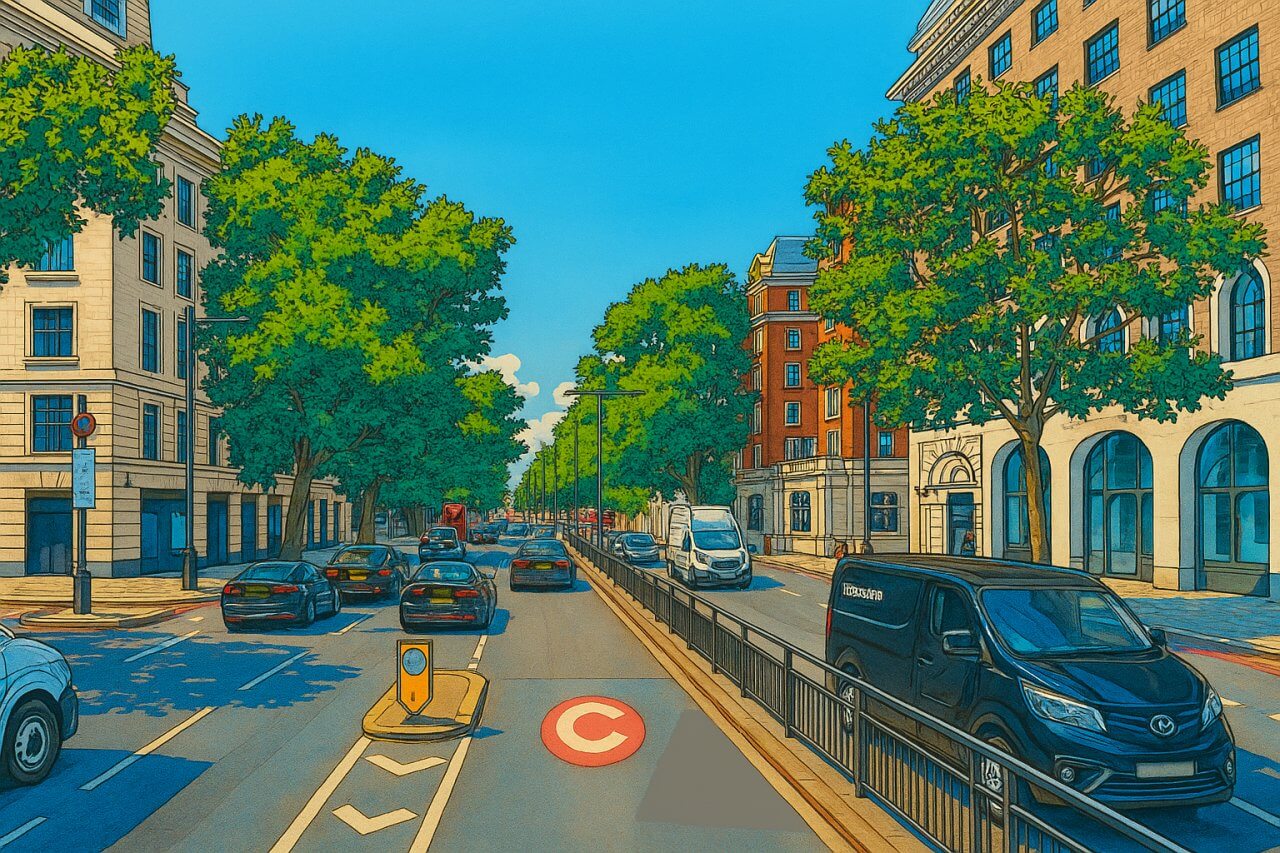 Painting of Marylebone Road
Page Details
This page was created on 4 August 2025. Hi, my name is Timothy and created it from my research, for my own entertainment, knowledge and to satisfy my curiosity. I am providing the information to you in good faith and hope it is useful. I try to get the details as accurate as possible. I also try to update the page whenever I stumble on new details. So this and all my other pages are perpetual work in progress. If you discover any error, please politely inform me, pointing out where the error lies, and I will correct it as soon as possible. Your helpfulness will keep this page accurate, relevant and helpful to those who need the information.Moving to London?
New to London and need a place to live? Read our Renting A Flat Guide. This guide covers everything you need to know about renting a flat in London, from viewing to signing.Streets of London
Come, let's explore and discover the streets of London together! Listed here afre the Streets of London that I have documented. Dive in and discover!Map of Streets in London
View all the streets that I have documented on Google Maps in this Map of Streets in London.Want to share your London travel experiences or get tips from fellow travellers?
Join the London Travel Tips Facebook GroupMore information for visiting London
Here are some related articles to help you get to know London better.- Cost of Living in London: Discover the true cost of living in London, including housing, transport, groceries, and more - plus tips for budgeting in one of the world's most expensive cities.
- Driving in London: Planning to drive in London? Learn about roads, car rentals, parking, tolls, and key tips for tourists and visitors from outside the capital.
- Driving Tips for Visiting London: Thinking of driving to London? Discover the best times to travel, congestion tips, parking apps, breakdown help, and petrol advice for a smoother journey.
- Evolution of London's Streets: Discover the fascinating history of how London's streets developed from ancient footpaths to today's complex network of roads across the capital.
- History of Immigration to London: Discover the rich history of immigration to London, from Huguenots to Bangladeshis, and how diverse communities have shaped the city's vibrant identity.
- How Big Is London Compared to Other World Cities?
- How London's Streets Measure Up: A Global Comparison of Road Widths
- How Streets of London are Named: Discover how London streets get their names, who decides them, and how historic, political, and public influences shape street naming in the capital.
- How the Grosvenor Family Came to Own Much of Mayfair, Belgravia and Pimlico: Explore how the Grosvenor family came to own much of Mayfair, Belgravia, and Pimlico, and learn about their historical connection (or lack thereof) with the British royal family and government.
- Living and working in London
- London's Quiet Collapse: How Living Standards Fell as Costs Skyrockted (1975-2025): Explore how London residents endured rising costs and falling living standards from 1975 to 2025 - from rocketing rents to wage stagnation and inflation.
- Marvel of the London Underground: Discover the history, challenges, and triumphs of the London Underground - the world's first underground railway and a vital transport lifeline for the UK capital since 1863.
- Moving to London: Expat Tips for Settling in Westminster: Essential advice for expats moving to London's Westminster: neighborhood insights, cost of living, transportation, housing, healthcare, schools, and tips to help you feel at home in the heart of the city.
- Places in London that aren't pronounced the way they're spelled
- Shopping in London: Discover London's diverse shopping scene
- Taking the bus in London: This is your complete guide to taking the bus when in London.
- The Anglican Faith: A Visitor's Guide to the Church of England: Learn about the Anglican faith and its deep ties to London's landmarks like Westminster Abbey and St Paul's Cathedral.
- Top 10 London Streets Every Visitor Must See: Discover London through its most iconic thoroughfares - 10 streets every visitor must experience. From historic Abbey Road to vibrant Camden High Street, explore culture, shopping, and hidden gems.
- Why are most roads in Central London so narrow? Learn why there are so few multi-lane roads and elevated highways in the heart of the city.
 Latest Pages & Updates
Buy Me A Coffee
If you enjoy the information I provide and want to support the work I do, please buy me a coffee! I appreciate it immensely, thank you so much!
