
Landed Homes in Singapore
Landed homes in Singapore represent the pinnacle of residential living—spacious, prestigious, and highly sought-after. Unlike condominiums and HDB flats, landed properties give owners full ownership of both the land and the building standing on it. These homes are typically located in low-rise, exclusive neighbourhoods and are considered symbols of wealth and status. However, owning landed property in Singapore comes with strict regulations, especially for foreigners, and it is important to understand the eligibility criteria, costs, and responsibilities before making a purchase.
Quick Facts
- Landed homes are properties where the owner holds title to both the land and the building.
- Categories include detached houses (bungalows), semi-detached houses, and terrace houses.
- Located mainly in landed housing estates such as Bukit Timah, Seletar, and Serangoon Gardens.
- Foreigners generally need government approval to buy landed properties under the Residential Property Act.
- Singapore citizens face no restrictions on landed home ownership.
- Freehold and 999-year leasehold landed properties are the most desirable for long-term ownership.
- Higher property taxes, maintenance costs, and acquisition duties apply compared to other property types.
What Are Landed Homes?
Landed homes are residential properties built on individual land plots, where the owner owns the land itself rather than just the building. They offer significantly more privacy and space compared to strata-titled developments like condominiums. Landed homes typically include gardens, driveways, and private outdoor areas, making them especially appealing to families and high-net-worth individuals seeking exclusivity and comfort.
Types of Landed Homes in Singapore
There are several main categories of landed homes in Singapore, as defined by the Urban Redevelopment Authority (URA):
- Detached Houses (Bungalows): Standalone houses surrounded by land on all sides. They offer the highest level of privacy and are often found in Good Class Bungalow Areas (GCBAs).
- Semi-Detached Houses: Two houses sharing a common wall. These offer a balance of space and cost, commonly found in suburban estates.
- Terrace Houses: A row of adjoining houses that share walls with neighbours on both sides (except for corner units). They are the most affordable type of landed property.
- Cluster Houses: A hybrid form combining features of landed homes and condominiums—owners hold strata titles but share common facilities like pools and gyms.
Where Landed Homes Are Found
Landed housing is limited in Singapore due to the country's compact land area. As a result, landed estates are primarily concentrated in specific zones designated by the URA. Prominent landed housing districts include:
- Bukit Timah and Holland (prime central districts)
- Serangoon Gardens and Braddell Heights (central-northeast)
- Seletar Hills and Yio Chu Kang (northeast)
- Upper Thomson, Bukit Panjang, and Hillview (northwest)
- East Coast and Katong (east)
- Sentosa Cove (special waterfront enclave open to approved foreign buyers)
Ownership Eligibility
Singapore Citizens
Singapore citizens face no restrictions on buying landed properties. They can own any type of landed home, including Good Class Bungalows, subject to market availability and financial capability.
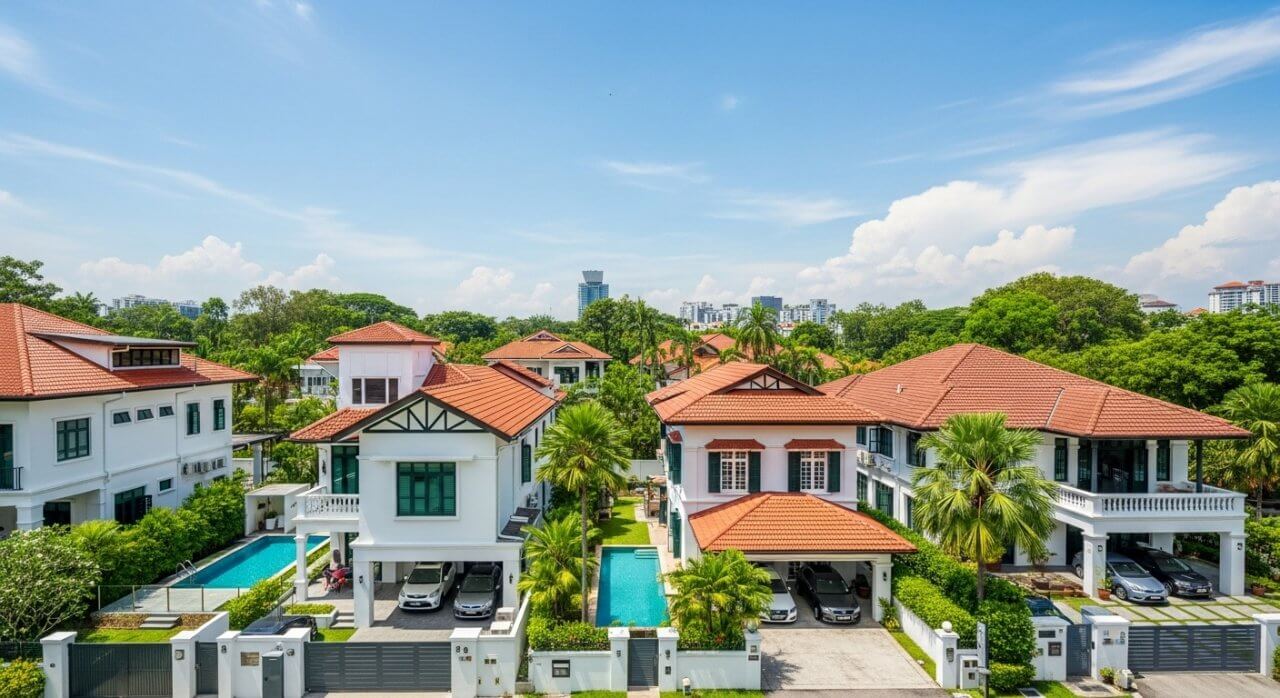 Landed homes in Singapore (7 October 2025 AI Generated)
Permanent Residents (PRs)
PRs must seek approval from the Singapore Land Authority (SLA) under the Residential Property Act before buying landed property. Approval is considered on a case-by-case basis, typically granted to long-term PRs who have made significant economic contributions to Singapore. Even with approval, PRs are limited to purchasing landed homes on the mainland—not on Sentosa Cove.
Foreigners
Foreigners are generally not allowed to purchase landed property in Singapore without prior government approval. Under the Residential Property Act, foreign individuals and entities (including companies) must apply to the Minister for Law through the SLA. Approval is rarely granted unless the applicant has exceptional economic or professional standing and intends to make Singapore their permanent home.
However, foreigners are allowed to purchase landed properties located on Sentosa Cove—a luxury waterfront residential enclave—subject to approval. This is the only area in Singapore where foreigners can own landed homes.
Tenure Types
Landed properties in Singapore may come with different land tenures, affecting both value and ownership rights:
- Freehold: The most desirable, offering perpetual ownership with no lease expiry.
- 999-Year Leasehold: Considered nearly equivalent to freehold due to its long duration.
- 99-Year Leasehold: More affordable but with diminishing value as the lease runs down.
Most newly launched landed homes are on 99-year leasehold plots, as freehold land is limited and rarely released by the government.
Buying a Landed Home in Singapore
The process of purchasing a landed home is similar to that of other private residential properties but with added considerations due to regulatory approvals. Below is a simplified overview:
- Determine Eligibility: Check if approval is required from the SLA (for PRs and foreigners).
- Secure Financing: Obtain an in-principle approval for a home loan from a bank.
- Select Property: Engage a licensed real estate agent familiar with landed housing transactions.
- Option to Purchase (OTP): Pay 1% of the purchase price to secure the property, followed by 4% upon exercising the option.
- Legal Completion: Conveyancing lawyers handle transfer of title, financing, and stamp duties.
Taxes and Fees
Owning landed property in Singapore involves several taxes and fees that buyers must budget for:
- Buyer's Stamp Duty (BSD): A progressive tax applied to all property purchases.
- Additional Buyer's Stamp Duty (ABSD): Varies by citizenship; as of 2025, foreigners pay 60% ABSD on their first property.
- Property Tax: Annual tax based on the annual value (AV) of the home, with higher rates for investment properties.
- Legal Fees: Typically 0.3%–0.6% of the property's value for conveyancing services.
- Maintenance Costs: Owners are responsible for all upkeep, unlike condominiums where the MCST manages common areas.
Good Class Bungalows (GCBs)
Good Class Bungalows (GCBs) are the most prestigious category of landed property in Singapore. They are typically located in 39 designated areas, such as Nassim Road, Holland Park, and Chatsworth. GCBs must occupy a minimum land size of 1,400 square metres and adhere to strict planning guidelines to maintain exclusivity and low density. Only Singapore citizens can purchase GCBs, and they represent the pinnacle of luxury housing in the country.
Cluster Landed Housing
Cluster housing developments combine the features of landed homes with condominium-style amenities. These developments are strata-titled, meaning that while individual units are privately owned, common facilities such as pools, gardens, and security services are shared among residents. Both citizens and foreigners can purchase cluster homes, making them a viable alternative for those seeking the landed lifestyle with lower maintenance burdens.
Resale and Rental Market
The landed property market is relatively illiquid compared to condominiums due to higher price points and limited supply. Nonetheless, landed homes are in strong demand among affluent locals and foreign investors with approval. Rental yields tend to be lower (2–3%) but are compensated by long-term capital appreciation. Prime districts and freehold properties often experience the strongest price stability.
Advantages of Landed Properties
- Full Ownership: Owners control both the land and the structure.
- Privacy and Space: Large plots, gardens, and private amenities offer unmatched comfort.
- Long-Term Value: Land is scarce, making landed properties excellent stores of wealth.
- Customization: Owners can renovate, rebuild, or expand within planning guidelines.
- Prestige: Landed homes represent status and exclusivity in Singapore's property hierarchy.
Challenges and Considerations
- High Entry Cost: Prices often start from several million dollars, even for smaller terrace houses.
- Approval Restrictions: Foreigners and PRs face regulatory hurdles.
- Maintenance Responsibilities: All upkeep, repairs, and renovations are borne by the owner.
- Market Volatility: Luxury segments can fluctuate with economic conditions and policy changes.
- Limited Supply: URA zoning tightly restricts new landed housing developments.
Foreign Ownership at Sentosa Cove
Sentosa Cove is the only enclave in Singapore where foreigners may purchase landed homes with government approval. Located on Sentosa Island, this exclusive community features bungalows and villas with private berths for yachts, waterfront views, and resort-style facilities. However, prices are high, and approval is still required, ensuring that ownership remains limited to a select few.
Conclusion
Landed homes in Singapore are the most coveted form of residential real estate, offering unmatched privacy, exclusivity, and investment value. While locals enjoy relatively unrestricted access, foreigners face significant barriers under the Residential Property Act. Nevertheless, for those who qualify, owning a landed home in Singapore is both a lifestyle statement and a secure long-term investment in one of Asia's most stable property markets.
References
- Urban Redevelopment Authority (URA)
- Singapore Land Authority (SLA)
- Inland Revenue Authority of Singapore (IRAS)
- Monetary Authority of Singapore (MAS)
Page Details
This page was created on 7 October 2025. Hi, my name is Timothy and created it from my research, for my own entertainment, knowledge and to satisfy my curiosity. I am providing the information to you in good faith and hope it is useful. I try to get the details as accurate as possible. I also try to update the page whenever I stumble on new details. So this and all my other pages are perpetual work in progress. If you discover any error, please politely inform me, pointing out where the error lies, and I will correct it as soon as possible. Your helpfulness will keep this page accurate, relevant and helpful to those who need the information.Articles related to Residential Properties in Singapore
- Get a list of condominiums in Singapore
- Find out about Property Taxes and Stamp Duties in Singapore
- What is Buyer's Stamp Duty (BSD)
- What is Additional Buyer's Stamp Duty (ABSD)
- What is Seller's Stamp Duty (SSD)
- What is CCR, RCR and OCR
- What are HDB Flats
- What are Executive Condominiums
- What are Private Condominiums
- What are Landed Homes
- Understand Singapore's Ethnic Integration Policy
- Understanding Postal Districts and Postcodes
- What to expect from Real Estate Agents in Singapore
My videos of Singapore
Want to share your Singapore travel experiences or get tips from fellow travellers?
Join the Singapore Travel Tips Facebook GroupMore information for visiting and living in Singapore
Here are some related articles to help you get to know Singapore better.- Cost of Living in Different Singapore Neighbourhoods (2025 Guide)
- EZ-Link Card
- Owning a Car in Singapore
- Singapore MRT Map & Guide 2025
- Singapore Postal Districts and Postcodes
- Singapore Tourist Pass
- Taking the Bus in Singapore: A Visitor's Guide
- Understanding CCR, RCR and OCR in Singapore real estate
 Latest Pages & Updates
Buy Me A Coffee
If you enjoy the information I provide and want to support the work I do, please buy me a coffee! I appreciate it immensely, thank you so much!
