
HDB Flats in Singapore
HDB flats are the cornerstone of public housing in Singapore, providing affordable and well-managed homes for the majority of its residents. Managed by the Housing and Development Board (HDB), these flats have played a central role in shaping the nation's urban landscape since the 1960s. For both locals and foreigners, understanding how HDB flats function—who can buy, who can rent, and what rules apply—is crucial to navigating Singapore's unique property market.
Quick Facts
- HDB stands for Housing and Development Board, the statutory board that oversees Singapore's public housing.
- Over 80% of Singapore's resident population live in HDB flats.
- Only Singapore citizens and certain permanent residents (PRs) can buy HDB flats directly from HDB.
- Foreigners cannot buy HDB flats but can rent them with some restrictions.
- Flats are typically on 99-year leasehold tenure.
- Resale and upgrading rules apply to maintain housing affordability and community balance.
What Are HDB Flats?
HDB flats are residential units built and managed by Singapore's Housing and Development Board. They are typically found in planned townships that include amenities such as markets, schools, parks, and public transport links. HDB flats are not just homes—they are part of a carefully curated social framework designed to promote integration and accessibility.
Types of HDB Flats
HDB offers a range of flat types to suit various household sizes and income levels. These range from compact 1-room and 2-room units to larger Executive Apartments and Maisonettes. Most flats are designed to balance affordability with liveability, often featuring modern layouts and access to nearby facilities.
Flat types include:
- 1-room and 2-room Flexi Flats: Typically for singles or elderly citizens.
- 3-room Flats: Affordable options for smaller families.
- 4-room and 5-room Flats: The most common types for families, offering greater space and comfort.
- Executive Apartments and Maisonettes: Larger flats with additional rooms or multi-storey layouts.
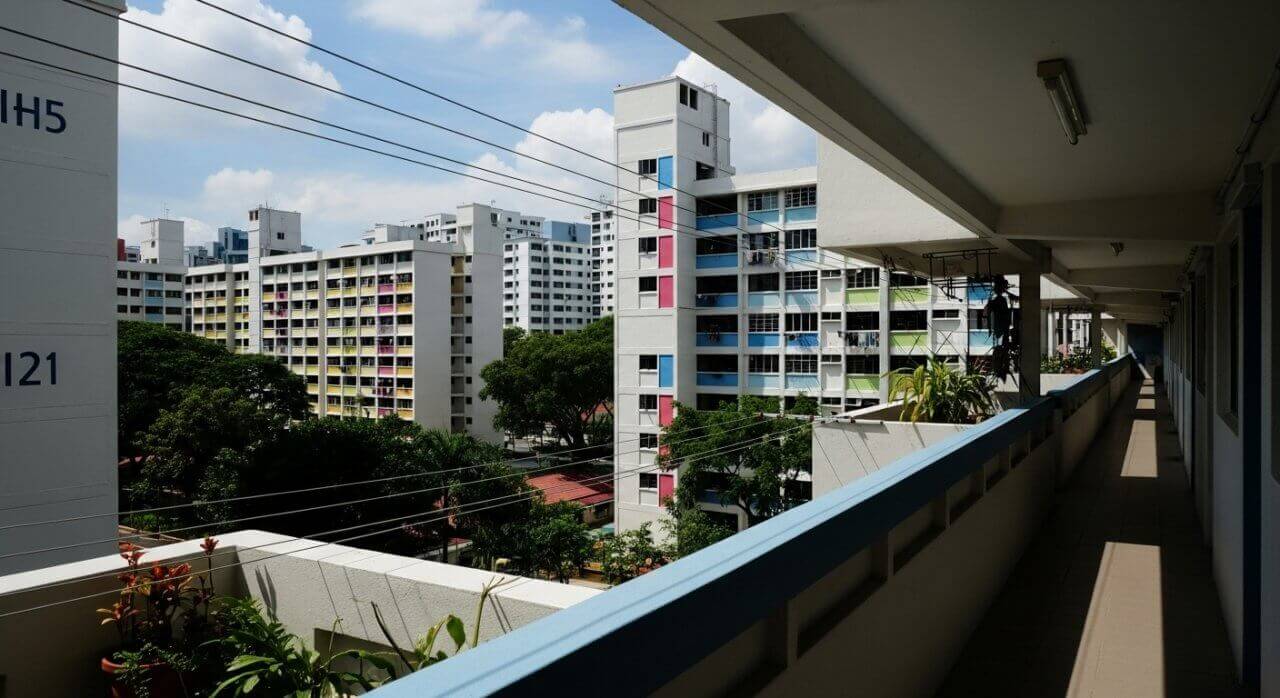 HDB Flats in Singapore (7 October 2025 AI Generated)
Eligibility to Buy HDB Flats
Only certain groups can buy HDB flats directly from the government or through resale. Generally, buyers must form a valid “family nucleus,” such as a married couple or parent-child pair. The eligibility differs between new flats (sold by HDB) and resale flats (sold by existing owners).
Singapore Citizens
Singapore citizens enjoy the most access to HDB housing. They can buy both new and resale flats, provided they meet income ceilings, citizenship, and household structure requirements. Citizens can also apply for generous government grants to reduce purchase costs.
Permanent Residents (PRs)
Singapore PRs can buy only resale HDB flats, and only as a couple where both partners are PRs. They are not eligible for most government housing grants and must fulfill a minimum occupation period (MOP) before renting or reselling the flat.
Foreigners
Foreigners are not allowed to buy HDB flats, whether new or resale. However, they may rent entire flats or individual rooms, provided the unit owner has fulfilled the MOP and obtained approval from HDB. Foreigners working or studying in Singapore often rent HDB flats for affordable and convenient housing.
Buying Process for Eligible Buyers
Buying an HDB flat typically involves several key steps:
- Determine eligibility based on citizenship, income, and household status.
- Apply for a flat through an HDB sales launch (for new flats) or search the resale market.
- Obtain a HDB Loan Eligibility (HLE) letter or arrange bank financing.
- Submit the application and pay an option fee or down payment.
- Complete the flat purchase and sign lease documents through HDB.
The process for resale flats includes additional checks such as ethnic integration policy (EIP) and Singapore Permanent Resident (SPR) quotas to ensure balanced community distribution.
Financing and Grants
Eligible Singapore citizens may finance their HDB flat through either a HDB Concessionary Loan or a bank loan. The HDB loan offers stable interest rates pegged to CPF rates, while bank loans vary based on market conditions. Buyers may also use their Central Provident Fund (CPF) savings for down payments and monthly installments.
Various grants are available, such as the Enhanced CPF Housing Grant, Family Grant, and Proximity Housing Grant, to make HDB ownership more accessible to first-time buyers and families living near their parents.
Resale HDB Market
The resale market is open to both Singapore citizens and PRs. Prices depend on location, flat size, remaining lease, and demand. Resale transactions are conducted via the HDB resale portal, which streamlines the process. A resale levy may apply to those who previously owned subsidized flats and are buying another from HDB.
Renting HDB Flats
Foreigners, PRs, and even citizens may rent HDB flats, subject to HDB's rules. Only flats that have fulfilled the Minimum Occupation Period (MOP)—usually five years—may be rented out in full. Flat owners must register the tenancy with HDB and ensure tenants hold valid passes to stay in Singapore.
HDB rentals are generally more affordable compared to private condominiums, making them popular among expatriates, foreign students, and workers who seek long-term accommodation without ownership.
Lease Tenure and Lease Decay
Most HDB flats come with a 99-year leasehold tenure. Over time, as the lease shortens, the property's value may decline—a process known as lease decay. The government has introduced schemes like the Voluntary Early Redevelopment Scheme (VERS) and the Selective En bloc Redevelopment Scheme (SERS) to manage aging estates and renew housing stock.
Living in an HDB Flat
HDB estates are designed as self-contained communities, featuring hawker centres, schools, parks, and medical clinics. The government invests continuously in upgrading programmes such as the Home Improvement Programme (HIP) and the Neighbourhood Renewal Programme (NRP) to enhance liveability. This focus on community development makes HDB towns vibrant, inclusive, and sustainable.
HDB Flats vs. Private Condominiums
While HDB flats are public housing, private condominiums offer ownership to both locals and foreigners, subject to different pricing and regulation. HDB flats are typically more affordable and subject to resale and rental restrictions, while condominiums offer more flexibility and facilities. Many Singaporeans eventually “upgrade” from HDB flats to condominiums as their income grows.
Conclusion
HDB flats in Singapore embody the nation's success in providing affordable, quality housing for its people. While they are primarily for citizens and PRs, foreigners can still experience life in these communities through rentals. Understanding the ownership rules, financial requirements, and social principles behind HDB housing is key to appreciating why this model is admired worldwide for its effectiveness and inclusivity.
References
- Housing and Development Board (Official Website)
- Central Provident Fund Board
- Urban Redevelopment Authority (URA)
Page Details
This page was created on 7 October 2025. Hi, my name is Timothy and created it from my research, for my own entertainment, knowledge and to satisfy my curiosity. I am providing the information to you in good faith and hope it is useful. I try to get the details as accurate as possible. I also try to update the page whenever I stumble on new details. So this and all my other pages are perpetual work in progress. If you discover any error, please politely inform me, pointing out where the error lies, and I will correct it as soon as possible. Your helpfulness will keep this page accurate, relevant and helpful to those who need the information.Articles related to Residential Properties in Singapore
- Get a list of condominiums in Singapore
- Find out about Property Taxes and Stamp Duties in Singapore
- What is Buyer's Stamp Duty (BSD)
- What is Additional Buyer's Stamp Duty (ABSD)
- What is Seller's Stamp Duty (SSD)
- What is CCR, RCR and OCR
- What are HDB Flats
- What are Executive Condominiums
- What are Private Condominiums
- What are Landed Homes
- Understand Singapore's Ethnic Integration Policy
- Understanding Postal Districts and Postcodes
- What to expect from Real Estate Agents in Singapore
My videos of Singapore
Want to share your Singapore travel experiences or get tips from fellow travellers?
Join the Singapore Travel Tips Facebook GroupMore information for visiting and living in Singapore
Here are some related articles to help you get to know Singapore better.- Cost of Living in Different Singapore Neighbourhoods (2025 Guide)
- EZ-Link Card
- Owning a Car in Singapore
- Singapore MRT Map & Guide 2025
- Singapore Postal Districts and Postcodes
- Singapore Tourist Pass
- Taking the Bus in Singapore: A Visitor's Guide
- Understanding CCR, RCR and OCR in Singapore real estate
 Latest Pages & Updates
Buy Me A Coffee
If you enjoy the information I provide and want to support the work I do, please buy me a coffee! I appreciate it immensely, thank you so much!
