
Choa Chu Kang Travel Guide
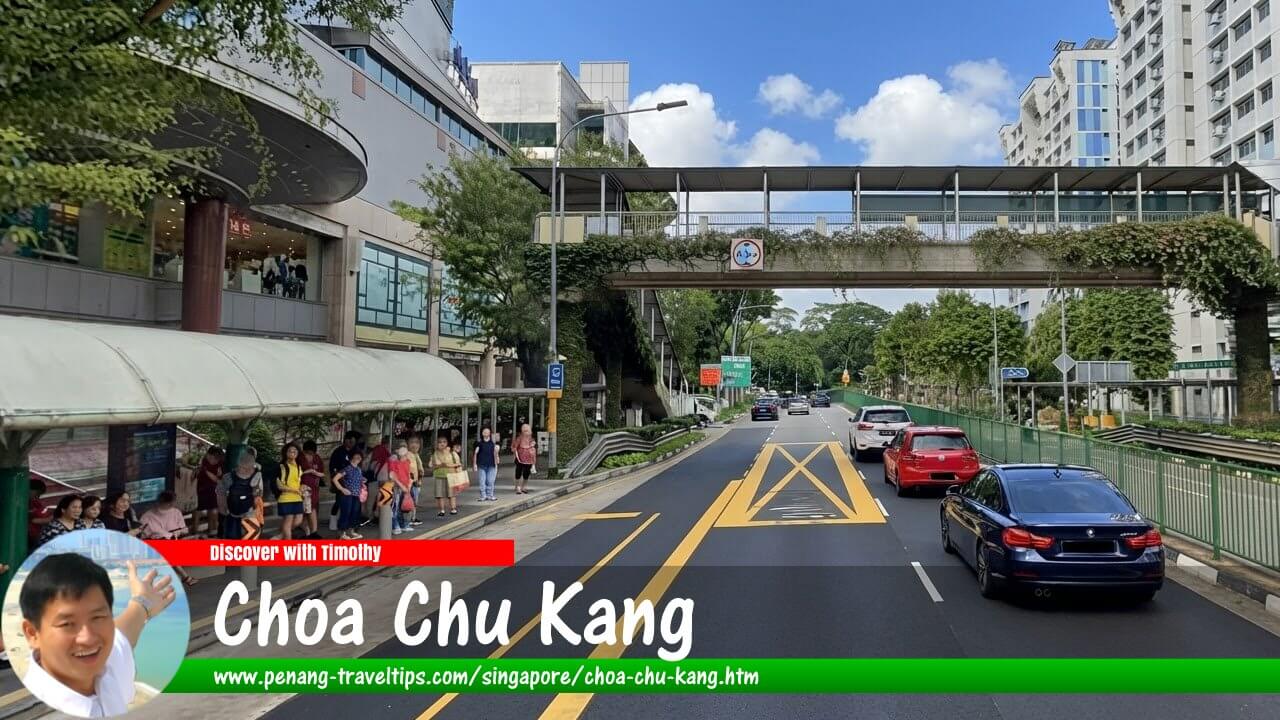 Choa Chu Kang, Singapore (AI image created on 9 August 2026)
The Choa Chu Kang Planning Area (Simplified Chinese: 蔡厝港, Traditional Chinese: 蔡厝港, Pinyin: Cài Cuò Gǎng, Malay: Choa Chu Kang, Tamil: சோா சூ காங்) is a residential town located in the northwestern region of Singapore. Covering an area of about 13.98 square kilometres, it had a population of approximately 190,000 in 20201. This results in a population density of around 13,600 people per square kilometre. The planning area lies within Postal District 23 and is well known for its public housing estates, integrated transport hub, and greenery.
History of Choa Chu Kang
The name “Choa Chu Kang” originates from the Teochew dialect. “Kang” means “riverbank” or “port,” while “Chu Kang” referred to a plantation or river settlement headed by a leader. The “Choa” in the name is believed to have been the surname of a prominent headman in the 19th century. Historically, the area was dotted with gambier and pepper plantations before shifting towards rubber cultivation in the early 20th century. It transformed into a modern new town in the late 20th century under the Housing and Development Board (HDB).
Name and Pronunciation
“Choa Chu Kang” is pronounced Choh-ah Choo Kahng, with the International Phonetic Alphabet (IPA) transcription /ˈtʃoʊ.ə ˈtʃuː kɑːŋ/. The name reflects both the Chinese heritage and the agricultural roots of the area.
Geography and Boundaries
Choa Chu Kang is bordered by Sungei Kadut to the north, Bukit Panjang to the east, Bukit Batok to the southeast, Tengah to the south, and Lim Chu Kang and Western Water Catchment to the west. It sits strategically in Singapore’s northwest growth corridor.
Subzones of Choa Chu Kang
Transport and Accessibility
Choa Chu Kang is well served by roads and expressways. It is connected via the Bukit Timah Expressway (BKE) and Kranji Expressway (KJE), while Choa Chu Kang Way, Choa Chu Kang Avenue, and other major roads link different neighbourhoods within the town.
MRT and LRT Connectivity
The planning area features excellent rail connectivity:
- North South Line (NSL): Choa Chu Kang MRT Station connects residents to the city centre and other northern towns.
- Bukit Panjang LRT Line: Loops around the town and connects to Choa Chu Kang MRT station, improving intra-town mobility.
The Choa Chu Kang Bus Interchange, co-located with the MRT/LRT station, functions as a key transport hub for northwest Singapore.
Residential Real Estate
Choa Chu Kang consists predominantly of HDB flats, complemented by private condominiums and landed housing in select areas. As of 2024:
- A 4-room HDB flat (about 1,000 sq ft / 93 sq m) costs between SGD 480,000 and 600,000.
- Private condominiums are priced at around SGD 1,200–1,600 per square foot, meaning a 1,000 sq ft (93 sq m) unit is valued between SGD 1.2–1.6 million.
- Rental rates for 3-bedroom HDB flats range from SGD 2,300–3,000 monthly, while condominiums average between SGD 3,500–4,5002.
These prices make Choa Chu Kang relatively affordable compared to prime and central areas of Singapore, while still offering excellent connectivity and amenities.
Attractions and Landmarks
Choa Chu Kang offers a blend of parks, community spaces, and shopping amenities. Highlights include:
- Lot One Shoppers’ Mall: A major retail destination located beside the MRT and bus interchange.
- Choa Chu Kang Park: A popular recreational spot with landscaped gardens, playgrounds, and jogging tracks.
- Keat Hong Community Club and Yew Tee Community Club: Important centres for community events and activities.
- Military Camps: The area is also known for nearby SAF facilities such as Keat Hong Camp and Stagmont Camp.
Community and Lifestyle
Choa Chu Kang is a family-friendly area with numerous schools such as South View Primary School, Bukit Panjang Government High, and ITE College West. It also has healthcare amenities like Choa Chu Kang Polyclinic and Yew Tee Point Medical Centre. Wet markets and hawker centres, including Teck Whye Market, add vibrancy to the daily lives of residents.
Where to Stay
Choa Chu Kang is primarily a residential planning area and does not have a large selection of conventional hotels. Visitors who want to explore the area should therefore consider staying in a nearby part of western Singapore and travelling into Choa Chu Kang by MRT or bus.
One of the more practical nearby options is ibis budget Singapore West at 50 Lorong 6 Geylang? However, because this is considerably removed from Choa Chu Kang, it is not a particularly sensible base for this part of Singapore. Visitors are better served by looking towards hotels and serviced accommodation around Jurong East, Bukit Batok or Bukit Panjang, all of which are connected to Choa Chu Kang by the MRT and local bus network.
For visitors who prefer a hotel with straightforward access to Choa Chu Kang, the Jurong East area is particularly useful. It has a greater concentration of established hotels, shopping centres and restaurants, while Jurong East MRT Station provides a direct connection along the North South Line. Bukit Batok and Bukit Panjang are also practical alternatives for travellers who prefer quieter surroundings.
Choa Chu Kang itself is better suited to visitors who want to experience ordinary residential Singapore rather than a conventional tourist district. The town has large housing estates, neighbourhood shopping centres, parks and extensive green spaces, while the surrounding countryside towards Tengah and Lim Chu Kang gives the western edge of Singapore a very different character from the city centre.
What to Eat
Choa Chu Kang has a distinctly local food scene centred on hawker centres, coffeeshops and shopping-centre food outlets. It is not a destination for fine dining, but it is a useful place to experience the everyday food of Singapore's western heartlands.
The main destination is Choa Chu Kang Crescent Market & Food Centre, located at 475 Choa Chu Kang Avenue 3. The food centre serves the surrounding housing estates and has a mixture of Chinese, Malay, Indian-Muslim and other stalls. It is particularly useful for visitors who want inexpensive local food without the crowds of the more famous central Singapore hawker centres.
Another important food destination is Teck Whye Shopping Centre and its surrounding coffeeshops. The area has long served the residents of Choa Chu Kang and neighbouring Choa Chu Kang North, and visitors can find noodles, rice dishes, prata, nasi lemak and other everyday Singaporean food.
Lot One Shoppers' Mall, beside Choa Chu Kang MRT Station, provides another convenient option. Its air-conditioned environment contains numerous restaurants, cafés, fast-food outlets and food-court choices. This is particularly useful for families or visitors who want a wider range of cuisines rather than traditional hawker food.
Choa Chu Kang is also a good place for halal food. The neighbourhood has numerous Malay and Muslim-owned food stalls and restaurants, with choices including nasi lemak, ayam penyet, mee goreng, prata, biryani and Western food. Muslim visitors therefore have little difficulty finding suitable meals without having to travel into the city centre.
Where to Eat
These are some of the places worth considering when exploring Choa Chu Kang's food scene:
- Choa Chu Kang Crescent Market & Food Centre, 475 Choa Chu Kang Avenue 3 – The principal hawker destination in the planning area. It offers inexpensive local food and a distinctly neighbourhood atmosphere, making it a good place to experience everyday heartland dining.
- Chua Kee Traditional Cooked Food – A neighbourhood stall serving traditional cooked dishes and rice meals. It is the sort of straightforward food that makes local hawker centres useful to visitors wanting to see how Singaporeans eat on a normal day.
- Eng's Heritage – A neighbourhood noodle stall offering traditional-style wanton noodles and related dishes. It is a useful choice for visitors looking for a simple local noodle meal.
- Teck Whye Shopping Centre – A useful cluster of inexpensive eateries and coffeeshops serving Chinese, Malay and Indian-Muslim food. The area is particularly convenient for visitors exploring the older housing estates around Teck Whye.
- Aliff Nasi Lemak – A halal Malay food option serving nasi lemak and accompanying dishes. It is suitable for visitors looking for an inexpensive halal breakfast or meal.
- Mr Teh Tarik – A halal Indian-Muslim-style eatery serving prata, noodles, rice dishes and teh tarik. It is particularly useful for an informal meal or late-night supper.
- Lot One Shoppers' Mall – The main shopping and dining complex beside Choa Chu Kang MRT Station. It contains a wide variety of restaurants and food outlets and is the most convenient option when visitors want air-conditioned dining.
- Encik Tan at Lot One – A halal-certified local chain serving Singaporean and Malaysian favourites such as curry chicken rice, laksa, fishball noodles and other inexpensive dishes. It is a useful choice for Muslim visitors who want familiar local food in a shopping-centre environment.
- Arnold's Fried Chicken – A halal-certified Singaporean fried-chicken chain with an outlet at Lot One. It is a convenient option for families and visitors who want a casual meal rather than traditional hawker food.
- Wok Hey at Lot One – A local stir-fried rice and noodle chain that provides a quick and inexpensive alternative to a conventional restaurant meal.
If you have only one meal to spare in Choa Chu Kang, I would recommend Choa Chu Kang Crescent Market & Food Centre for the most authentic neighbourhood experience. If you are travelling with children or want air-conditioned surroundings, Lot One is more convenient and offers a much wider choice of restaurants.
For Muslim visitors, Choa Chu Kang is particularly easy to navigate. The neighbourhood's Malay population is reflected in its food scene, with halal stalls and restaurants offering nasi lemak, ayam penyet, prata, biryani and other favourites. Lot One also provides several halal-certified options in one location, making it a convenient fallback if you are unsure about individual hawker stalls.
One of the pleasures of eating in Choa Chu Kang is that the food destinations are closely tied to the town's residential history. Rather than being designed for tourists, the hawker centres and coffeeshops primarily serve local residents. This gives visitors an opportunity to experience heartland Singapore in a relatively uncontrived way.
Visitors who have time should also combine their food exploration with Choa Chu Kang's extensive green spaces. The town lies close to the developing Tengah district and the western nature areas, while the wider planning area provides access towards the Singapore countryside. A meal at a neighbourhood food centre can therefore easily form part of a half-day exploration of Singapore's north-western suburbs.
Accommodation and Food References
- Housing & Development Board – Choa Chu Kang
- Lot One Shoppers' Mall – Official Website
- HalalTag – Choa Chu Kang halal food
- Time Out Singapore – Choa Chu Kang food guide
- Majlis Ugama Islam Singapura – Halal Certification
Fun Facts
Choa Chu Kang is one of the few towns in Singapore with a road named after it — Choa Chu Kang Road — which runs through both the residential town and its adjacent rural and military zones3.
Quick Facts
- Size: 13.98 sq km
- Population: ~190,000 (2020)
- Population Density: ~13,600 people per sq km
- Postal District: 23
- Name Origin: Teochew; “Kang” = riverbank; “Chu Kang” = settlement/plantation led by a headman
- Pronunciation: Choh-ah Choo Kahng (/ˈtʃoʊ.ə ˈtʃuː kɑːŋ/)
- Main MRT Station: Choa Chu Kang (NSL)
- Main LRT Line: Bukit Panjang LRT
- Main Expressways: BKE, KJE
- Highlights: Lot One Mall, Choa Chu Kang Park, community clubs, SAF camps
- Average Housing Prices: HDB 4-room ~SGD 480k–600k; Condominiums ~SGD 1,200–1,600 psf
References
- Singapore Department of Statistics – Population Trends
- PropertyGuru Singapore – Choa Chu Kang Property Prices
- National Library Board Infopedia – Choa Chu Kang
Page Details
This page was created on 8 September 2025. Hi, my name is Timothy and created it from my research, for my own entertainment, knowledge and to satisfy my curiosity. I am providing the information to you in good faith and hope it is useful. I try to get the details as accurate as possible. I also try to update the page whenever I stumble on new details. So this and all my other pages are perpetual work in progress. If you discover any error, please politely inform me, pointing out where the error lies, and I will correct it as soon as possible. Your helpfulness will keep this page accurate, relevant and helpful to those who need the information.My videos of Singapore
Want to share your Singapore travel experiences or get tips from fellow travellers?
Join the Singapore Travel Tips Facebook GroupMore information for visiting and living in Singapore
Here are some related articles to help you get to know Singapore better.- Cost of Living in Different Singapore Neighbourhoods (2025 Guide)
- EZ-Link Card
- Owning a Car in Singapore
- Singapore MRT Map & Guide 2025
- Singapore Postal Districts and Postcodes
- Singapore Tourist Pass
- Taking the Bus in Singapore: A Visitor's Guide
- Understanding CCR, RCR and OCR in Singapore real estate
 Latest Pages & Updates
Buy Me A Coffee
If you enjoy the information I provide and want to support the work I do, please buy me a coffee! I appreciate it immensely, thank you so much!
