
Bedok Travel Guide
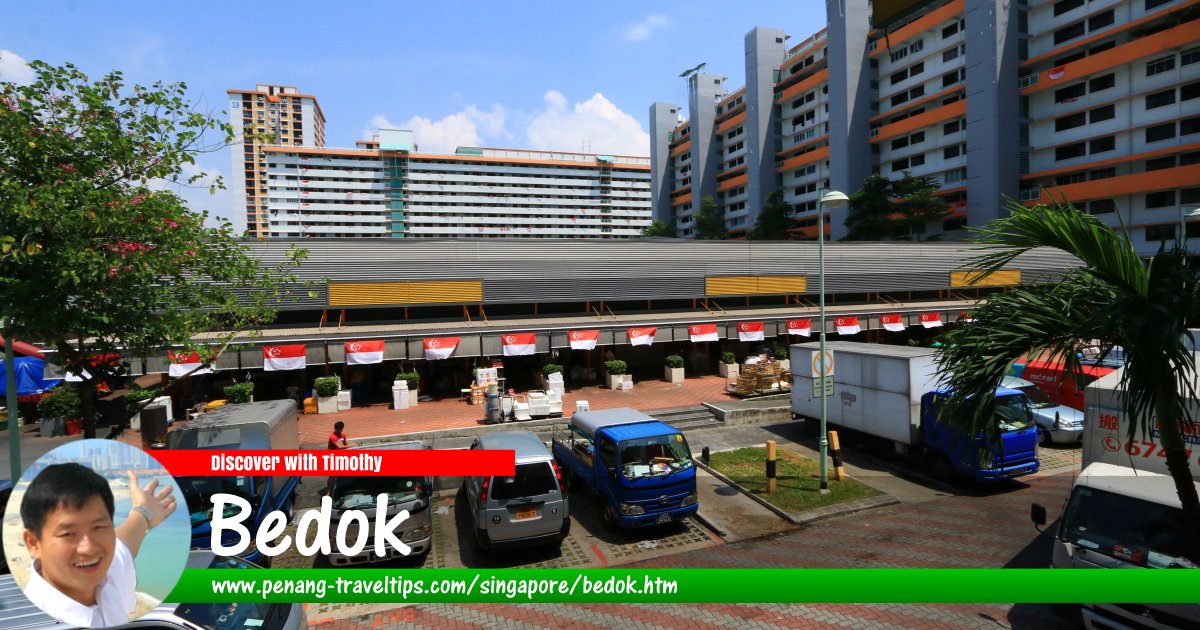 16 Bedok South Road signage (29 July 2006)
The Bedok Planning Area (Simplified Chinese: 勿洛, Traditional Chinese: 勿洛, Pinyin: Wù Luò, Malay: Bedok, Tamil: பெடோக்) is the largest residential town in eastern Singapore, covering a total land area of 21.69 square kilometres. With a population of approximately 278,330 as of 2020, it is also one of the most densely populated planning areas, with a density of about 12,800 persons per square kilometre1. Bedok falls within Postal District 16, which also covers areas like Upper East Coast, Tanah Merah, and Bayshore.
History of Bedok
The history of Bedok dates back to pre-colonial Singapore. The earliest mention of “Bedok” appeared in the 1604 map by Malay-Portuguese cartographer Manuel Godinho de Erédia, where the coastal area was marked as “Sune Bodo.” In Malay, “Bedok” may derive from the word bedoh, a type of drum used in mosques to signal prayer times2. Another explanation is that it refers to the Malay word bedok meaning “cooked rice.” In the 1960s and 1970s, Bedok was mainly agricultural land with fishing villages and coconut plantations. Modern development began in 1979 when the Housing and Development Board (HDB) launched Bedok New Town, which has since grown into Singapore’s most populous residential town.
Name and Pronunciation
“Bedok” is pronounced as Beh-dok in English, with the International Phonetic Alphabet (IPA) pronunciation /bəˈdɒk/. The name retains its Malay origins and remains one of the few Singapore place names unchanged from pre-colonial times.
Geography and Boundaries
Bedok is situated in the East Region of Singapore, with several adjoining planning areas: Marine Parade to the west, Geylang and Paya Lebar to the northwest, Tampines to the north, and the Singapore Straits to the south. Its coastal frontage gives residents direct access to East Coast Park and coastal amenities.
Subzones of Bedok
Transport and Accessibility
Bedok is highly accessible by road and rail. The East Coast Parkway (ECP) runs along its southern edge, linking it to the Downtown Core and Changi Airport. Other key roads include Changi Road, East Coast Road, and Jalan Eunos, which connect Bedok to neighbouring towns.
MRT Connectivity
Bedok is well served by MRT lines:
- East West Line (EWL): Bedok, Tanah Merah, and Kembangan stations.
- Downtown Line (DTL): Bedok Reservoir, Bedok North, and Kaki Bukit stations.
- Future stations on the Thomson-East Coast Line (TEL) such as Bayshore, Bedok South, and Sungei Bedok will further enhance connectivity3.
Residential Real Estate
Bedok offers a diverse housing landscape, ranging from affordable HDB flats to luxury condominiums along the East Coast. As of 2024:
- A 4-room HDB flat (about 1,000 sq ft / 93 sq m) typically costs SGD 600,000–750,000.
- Condominiums near East Coast Park, such as Bayshore and Laguna Park, average around SGD 1,700–2,300 per square foot, making a 1,200 sq ft (111 sq m) unit cost between SGD 2.0–2.7 million.
- Rental rates for a 3-bedroom HDB flat average SGD 2,800–3,500 per month, while private condos of similar size rent for SGD 4,000–5,2004.
Compared to central planning areas like Rochor and Novena, Bedok remains relatively more affordable while still offering coastal living and abundant amenities.
Interesting Sights and Attractions
Bedok is rich in recreational and lifestyle attractions. Some highlights include:
- East Coast Park: Singapore’s largest park, ideal for cycling, picnics, and water sports.
- Bedok Reservoir Park: Popular for jogging, kayaking, and dragon boat races.
- Bedok Town Centre: Home to Bedok Mall, Bedok Interchange Hawker Centre, and Heartbeat@Bedok, a large integrated community and sports complex.
- Siglap: A food haven known for its cafés, eateries, and late-night dining spots.
- Tanah Merah Coast: A scenic waterfront area with golf clubs and leisure facilities.
Community and Lifestyle
Bedok has a strong community identity, with numerous schools, sports facilities, and healthcare centres. Schools such as Temasek Junior College, Bedok Green Secondary, and Anglican High School are located here. The area is also home to diverse food choices, from famous hawker centres like Fengshan Market (“Bedok 85”) to modern cafés and international dining options. Its blend of coastal living, parks, and amenities makes it highly attractive to families and retirees alike.
Where to Stay
Bedok is a large residential planning area, but it is not primarily a hotel district. Nevertheless, visitors who want to stay in the eastern part of Singapore have several accommodation choices in and around Bedok. Staying here can be particularly convenient for travellers who prefer a quieter, more residential setting while still having good access to the city centre, Changi Airport and the eastern coast.
One of the most convenient choices within the planning area is Hotel 81 Bedok, located along Bedok Road. It provides straightforward, budget-oriented accommodation close to Bedok's shopping and dining facilities, and is particularly suitable for visitors who expect to spend much of their time exploring the eastern side of Singapore. Several other budget hotels can also be found in the surrounding districts, including nearby Geylang and Joo Chiat.
For visitors wanting something more comfortable, the wider Bedok area is within easy reach of hotels around Changi Business Park, East Coast and Katong. These locations can be attractive alternatives because they combine accommodation with restaurants, shopping and recreational facilities. The eastern location also means that Changi Airport is considerably more convenient than it would be from central Singapore.
Bedok is therefore best considered a residential base rather than a hotel destination. Its main advantage is the opportunity to stay close to ordinary Singaporean neighbourhoods, markets and hawker centres while remaining well connected by MRT and bus.
What to Eat
Bedok is one of the better places in Singapore for visitors who want to explore local hawker food. The planning area has several established food centres, neighbourhood markets and coffeeshops, giving visitors a wide choice of inexpensive Singaporean dishes. There is no single dish that defines Bedok, but the area is particularly good for chicken rice, laksa, mee pok, wanton noodles, fish soup, nasi lemak, roti prata, Malay rice dishes and traditional desserts.
One of the most famous food destinations is Bedok 85 Fengshan Centre, commonly known simply as Bedok 85. The centre is especially well known for its barbecued stingray, satay, bak chor mee, chicken wings and other local favourites. It is an excellent destination in the evening, when the food centre takes on a lively neighbourhood atmosphere1.
Bedok Interchange Hawker Centre is another useful stop, particularly for visitors arriving by MRT or bus. The food centre is located in the heart of Bedok Town Centre and offers a broad selection of traditional hawker dishes. It is convenient for breakfast and lunch and provides a good introduction to the everyday food culture of the eastern suburbs2.
Visitors should also consider Bedok Food City and the neighbourhood coffeeshops scattered around Bedok North and Bedok South. These less tourist-oriented establishments are where visitors can discover the everyday meals eaten by local residents, often at considerably lower prices than restaurants in central Singapore.
Bedok also has a particularly strong selection of Malay and Muslim food. Visitors looking for halal fare can choose from nasi padang, nasi lemak, mee rebus, mee siam, Malay rice dishes and Muslim Indian favourites. This makes Bedok an especially useful destination for Muslim travellers who want to experience Singapore's local food culture without having to search exclusively in the traditional Malay enclaves.
Where to Eat
These are some of the places worth considering when exploring Bedok's food scene:
- Bedok 85 Fengshan Centre – One of the best-known hawker destinations in eastern Singapore. It is particularly popular for barbecued stingray, satay, chicken wings and bak chor mee. The centre is at its liveliest in the evening and is worth visiting specifically for the atmosphere as well as the food1.
- Bedok Interchange Hawker Centre – A convenient choice in the centre of Bedok, with a broad range of inexpensive local dishes. It is especially useful for visitors who want to combine a meal with shopping around Bedok Town Centre2.
- Fei Fei Wanton Mee – A long-established name associated with the Bedok area, serving traditional wanton noodles. It is a good choice for visitors wanting to try one of Singapore's classic noodle dishes.
- Bedok Chwee Kueh – A local favourite for chwee kueh, the steamed rice cakes traditionally served with preserved radish. This simple breakfast or snack is particularly representative of Singapore's hawker culture.
- Song Zhou Fish Ball Bak Chor Mee – A popular choice for visitors looking for noodles with fish balls and minced meat. Bak chor mee is one of the classic Singaporean noodle dishes and makes an inexpensive meal.
- Spize Bedok – A popular halal establishment offering a broad menu of Asian, Western and fusion dishes. It is useful for groups in which diners want more variety than a traditional hawker centre can provide3.
- Selera Rasa Nasi Lemak – A halal option for visitors wanting to try Singapore-style nasi lemak. The combination of fragrant coconut rice with fried chicken, ikan bilis, egg, sambal and other accompaniments makes it a satisfying introduction to one of the region's most popular dishes.
- Bedok South Road and Bedok North neighbourhood coffeeshops – These are worth exploring for visitors who prefer discovering food away from the better-known tourist recommendations. They commonly offer Chinese, Malay and Indian Muslim dishes under one roof.
For visitors with only one meal available in Bedok, Bedok 85 Fengshan Centre in the evening is probably the most distinctive choice. It offers the combination of local food, crowds and neighbourhood atmosphere that makes a Singapore hawker centre memorable. For breakfast or lunch, Bedok Interchange Hawker Centre is more convenient and offers a wider variety of traditional dishes.
Bedok's food scene is also particularly useful for travellers who want to eat well without spending heavily. Unlike some of Singapore's more famous dining districts, much of Bedok's food culture remains firmly rooted in the neighbourhood. A visitor who spends a day exploring its markets, food centres and residential streets can therefore experience a very different side of Singapore from the one found around Marina Bay or Orchard Road.
Accommodation and Food References
- Singapore Tourism Board – Bedok food and neighbourhood information
- National Environment Agency – Hawker Centres
- Spize – Official Website
- Hotel 81 – Hotel 81 Bedok
- MICHELIN Guide Singapore – Bedok dining listings
Fun Facts
One fun fact is that Bedok has the highest number of hawker centres in Singapore, reflecting its reputation as a food paradise5. Another interesting point is that Bedok New Town was once the largest housing project ever undertaken by HDB when it was first developed in 1979.
Quick Facts
- Size: 21.69 sq km
- Population: ~278,330 (2020)
- Population Density: ~12,800 people per sq km
- Postal District: 16
- Established: Bedok New Town developed in 1979
- Name Origin: Malay word “bedok,” meaning drum or cooked rice
- Pronunciation: Beh-dok (/bəˈdɒk/)
- Main MRT Stations: Bedok, Tanah Merah, Kembangan (EWL); Bedok North, Bedok Reservoir, Kaki Bukit (DTL); Bayshore, Bedok South, Sungei Bedok (TEL, future)
- Main Expressways: East Coast Parkway (ECP)
- Highlights: East Coast Park, Bedok Reservoir, Bedok Mall, Fengshan Market
- Average Housing Prices: HDB 4-room ~SGD 600k–750k; Condominiums ~SGD 1,700–2,300 psf
Map of Bedok, Singapore
MRT stations in Bedok
- Bayshore MRT Station (GPS: 1.31359, 103.94085)

- Bedok MRT Station (GPS: 1.33977, 103.93393)

- Bedok South MRT Station (GPS: 1.31741, 103.94844)

- Bedok North MRT Station (GPS: 1.3348, 103.91785)

- Bedok Reservoir MRT Station (GPS: 1.33652, 103.93287)

- Kaki Bukit MRT Station (GPS: 1.32045, 103.93555)

- Marine Terrace MRT Station (GPS: 1.30958, 103.92896)

- Siglap MRT Station (GPS: 1.30958, 103.92896)
- Sungei Bedok MRT Station (GPS: 1.32087, 103.95817)

Apartments, Condominiums and HDB Flats in Bedok
- Aquarius By The Park (GPS: 1.33842, 103.9351)

- Archipelago (GPS: 1.33832, 103.91955)

Markets, Hawker Centres and Food Courts in Bedok
- Blk 16 Bedok South Road Market & Hawker Centre (GPS: 1.32045, 103.93555)

Sights in Bedok
- Bedok Reservoir Park (GPS: 1.33977, 103.93393)

References
- Singapore Department of Statistics – Population Trends
- National Library Board Infopedia – Bedok
- Land Transport Authority – Rail Expansion Plans
- PropertyGuru Singapore – Bedok Property Prices
- National Heritage Board – Hawker Culture
Page Details
This page was created on 6 September 2025. Hi, my name is Timothy and created it from my research, for my own entertainment, knowledge and to satisfy my curiosity. I am providing the information to you in good faith and hope it is useful. I try to get the details as accurate as possible. I also try to update the page whenever I stumble on new details. So this and all my other pages are perpetual work in progress. If you discover any error, please politely inform me, pointing out where the error lies, and I will correct it as soon as possible. Your helpfulness will keep this page accurate, relevant and helpful to those who need the information.My videos of Singapore
Want to share your Singapore travel experiences or get tips from fellow travellers?
Join the Singapore Travel Tips Facebook GroupMore information for visiting and living in Singapore
Here are some related articles to help you get to know Singapore better.- Cost of Living in Different Singapore Neighbourhoods (2025 Guide)
- EZ-Link Card
- Owning a Car in Singapore
- Singapore MRT Map & Guide 2025
- Singapore Postal Districts and Postcodes
- Singapore Tourist Pass
- Taking the Bus in Singapore: A Visitor's Guide
- Understanding CCR, RCR and OCR in Singapore real estate
 Latest Pages & Updates
Buy Me A Coffee
If you enjoy the information I provide and want to support the work I do, please buy me a coffee! I appreciate it immensely, thank you so much!
