

Lebuh Chulia, George Town
 Go Back - Latest PENANG Sights/Streets/New Properties > Malaysia > World | Hokkien : Lessons : Dictionary | YouTube | Facebook | About Me : Contact Me
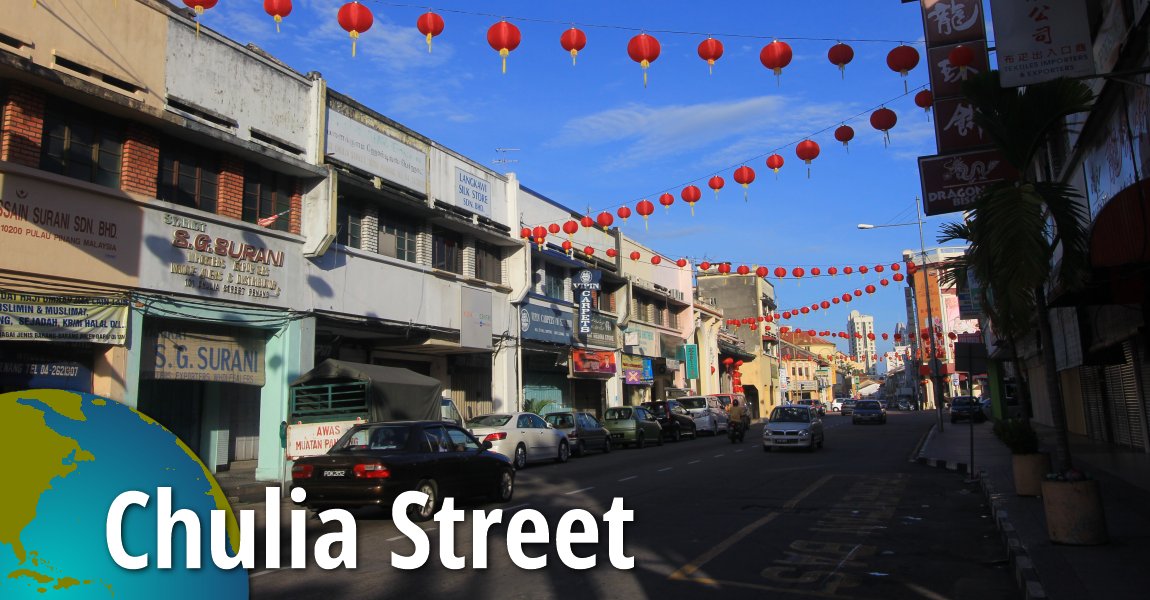 Chulia Street, George Town, festooned with Chinese lanterns (5 February 2013)
Lebuh Chulia, formerly Chulia Street, is one of the major roads in George Town, Penang. Due to its length, part of it is within the core zone of the George Town UNESCO World Heritage Site, until the junctions of Carnavon Street and Love Lane, while the rest is within the buffer zone.
Where to stay along Lebuh Chulia
Of the many hotels along Lebuh Chulia, the one I have stayed before and experienced the hospitality is Yeng Keng Hotel. I have no problem in suggesting it to anybody. Just take a look at the hotel to see if it suits you. Map of Lebuh Chulia, Penang
What to eat on Lebuh Chulia
- Lebuh Chulia Famous Cha Siew Rice at Wai Kei Cafe on Lebuh Chulia, Penang, was recommended by Evevy Ang on 16 September, 2019
- Grilled Hainan Chicken Rice, recommended by Ooichinchye Chinchye (23 August 2019)
Members' dining experience on Lebuh Chulia
- Shu Jun posted about dining at Yeap Noodles on Lebuh Chulia on 16 September, 2019.
 Coffee Shops, restaurants, bistros and bars along Lebuh Chulia
- Betel Nut Tree Cafe (GPS: 5.41827, 100.33616)

- Coffee, Tea or Me (GPS: 5.41861, 100.33611)

- Eating House Cafe (Chinese coffee shop) (GPS: 5.41883, 100.33556)

- Hong Kong Bar (GPS: 5.41845, 100.33575)

- Kedai Kopi Lam Ah (GPS: 5.41543, 100.3394)

- Kedai Kopi Pak Hock (Chinese coffee shop) (GPS: 5.41871, 100.33526)

- Kedai Kopi Sai Lam (GPS: 5.41822, 100.33641)

- Reggae Club (night club) (GPS: 5.41836, 100.33596)

- Reggae Mansion (night club) (GPS: 5.41845, 100.3356)

- Restoran Kapitan (nasi kandar)
- Restoran Kassim Mustafa (nasi kandar) (GPS: 5.41582, 100.33932)

- Restoran Khaleel (nasi kandar)
- Restoran Nasi Kandar Bathusa (GPS: 5.41844, 100.3364)

- Restoran Ros Mutiara (nasi kandar)
- Sin Kuan Hwa Coffee Shop (Chinese coffee shop)
- Thew Chik Cafe (Chinese coffee shop) (GPS: 5.41886, 100.33546)

- Trois Canon Cafe
- Wai Kei Cafe (GPS: 5.41891, 100.33526)

- Yeng Keng Café & Bar (GPS: 5.41911, 100.33486)

Accommodation on Lebuh Chulia
- 322 Chulia Hostel

- Banana Boutique Hotel
 (GPS: 5.41962, 100.33371)
- Banana New Guesthouse
- Chulia Heritage Hotel

- Chuliaracks
 )
) - Chulia Court The Tavern
 (GPS: 5.4183, 100.33609)
- Chulia Heritage Hotel (GPS: 5.41923, 100.33466)

- Chulia Mansion (GPS: 41882, 100.33483)

- Crystal Guesthouse (GPS: 5.4183, 100.3366)

- D Mo Inn
- Day & Night Guesthouse
- Grand Swiss Hotel
- Hotel Hong Ping (GPS: 5.41787, 100.33684)

- KK Budget Hotel
- Siok Hostel (GPS: 5.41996, 100.33293)

- Time Capsule Hotel
- Trekker Inn & Cafe
- Yeng Keng Hotel (GPS: 5.41908, 100.33499)

Sights along Lebuh Chulia
- Anjuman Himayathul Islam (GPS: 5.41952, 100.33305)

- Cheapside (GPS: 5.41805, 100.3365)

- Kapitan Keling Mosque (GPS: 5.41722, 100.33718)

- Masjid Alimsah Waley (GPS: 5.41889, 100.33464)

- Nagore Shrine (GPS: 5.41625, 100.33882)

- Nam Hooi Wooi Koon (GPS: 5.41925, 100.33364)

- Ng Fook Thong (GPS: 5.41876, 100.33497)

- Noordin Family Tomb (GPS: 5.41723, 100.33752)

- Phun Yue Association (GPS: 5.41879, 100.33589)

- Teochew Ancestral Temple (GPS: 5.41669, 100.33814)

Street Art on Lebuh Chulia
- Urban Xchange street art
- "The Main Street" Sculpture by Lefty
- "Rotan" Sculpture by Mun Kian
Businesses along Lebuh Chulia
- 7-Eleven
- Asas Dunia Berhad
- Banana Travel & Tours
- Bombay Textiles
- China Handicraft Co.
- Ching Yau (textile)
- Chop Cheng Hai
- Chung Hin Pawn Shop
- Cin Cin Enterprise (fashion accessories)
- CTC Trading (furniture)
- Dynamic Glass & Frame Centre
- EJ Motiwalla (precision instruments)
- Eu Yan Sang (GPS: 5.41731, 100.33782)

- Fazal Mohammed Brother (textile)
- G & C Laundry Service
- Guan Huat Locks & Keys (locksmith)
- Guang Jie Glass & Aluminium
- Jafex Travel & Ticketing
- Kedai Ubat Zhong Yen Trading
- Keow Seong & Co.
- Lean Giap Trading Co. (antiques and curios)
- Lee Soo Kee Rattan
- Likely Enterprise (clothing wholesaler)
- M.A. Tours & Travel
- Medina Store
- Ong Cheng Hock Hardware
- Oriental Arts & Antiques
- Pasaraya Golden Store
- Pearl Frame Maker
- Pitt & Chulia Junction Indian Barber
- Pok Oy Thong Medical Hall (GPS: 5.4184, 100.33588)

- Progressing Frame & Co.
- Rafiq Jewels
- Rahimas Forex (money changer)
- Sengley Glass Merchant
- Shadani Mesra (money changer)
- Tek Wee Machinery
- Thean Guan Hardware
- Vincent Hair Dressing Salon
- Vipin Carpets
- Wee Ling Sdn Bhd (Dragon Ball Biscuit)
- Wing Hup Frame Maker
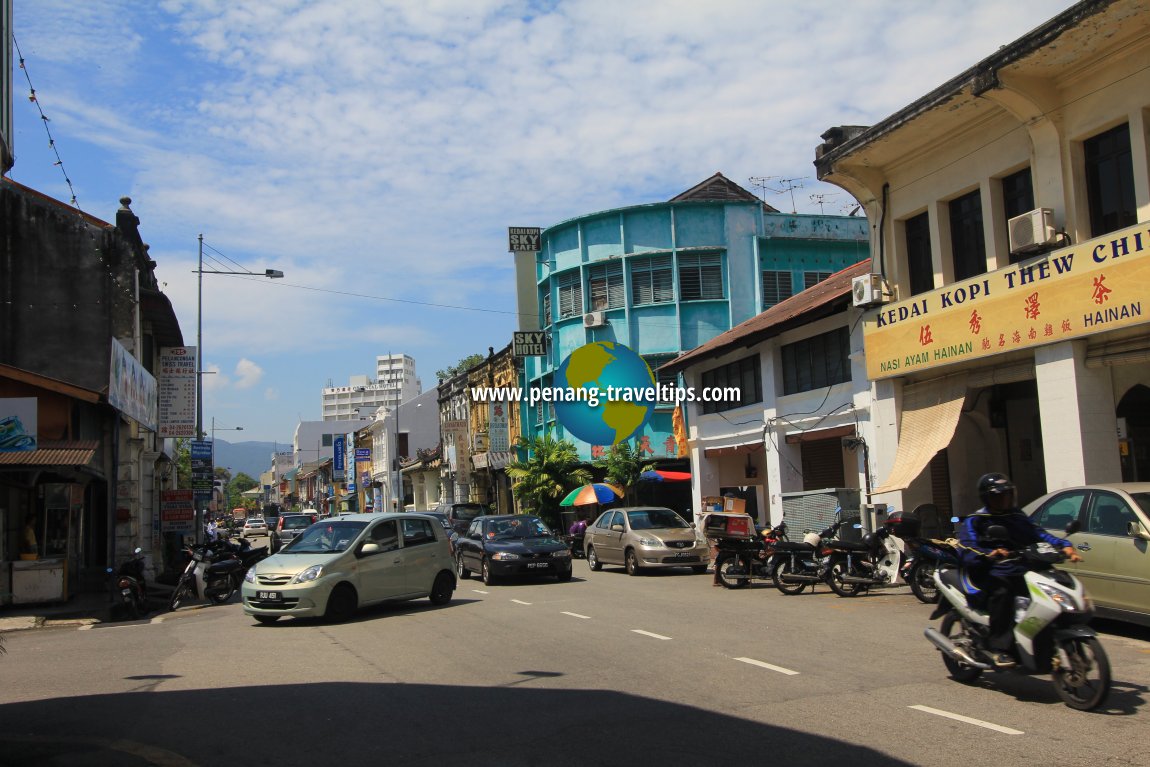 Lebuh Chulia, at the junction with Rope Walk (25 January 2013)
Lebuh Chulia Today
Today, Lebuh Chulia is the epicentre of budget accommodation in George Town. (To view list of accommodation on Lebuh Chulia, scroll this page to here.) If you are a budget traveller, you will find most of the amenities you need along Lebuh Chulia as well as in neighbouring Love Lane and Leith Street. There are numerous budget guesthouses here, as well as cafes, restaurants, cybercafes, laundrettes, travel agencies that cater to the needs of travellers. Many of the travel agencies along Lebuh Chulia specialize in arranging visa runs for travellers planning extended stays in Penang.The character of Lebuh Chulia has evolved through the 20th century. It only morphed into the backpacker haven towards the mid 20th century. For much of the 1980s and 90s, Lebuh Chulia was the destination of budget travelers. However, since the inscription of George Town as a World Heritage Site, some of the budget establishment began to gentrify, many reinventing themselves into upscale boutique hotels. Only time will tell how far the change will take.
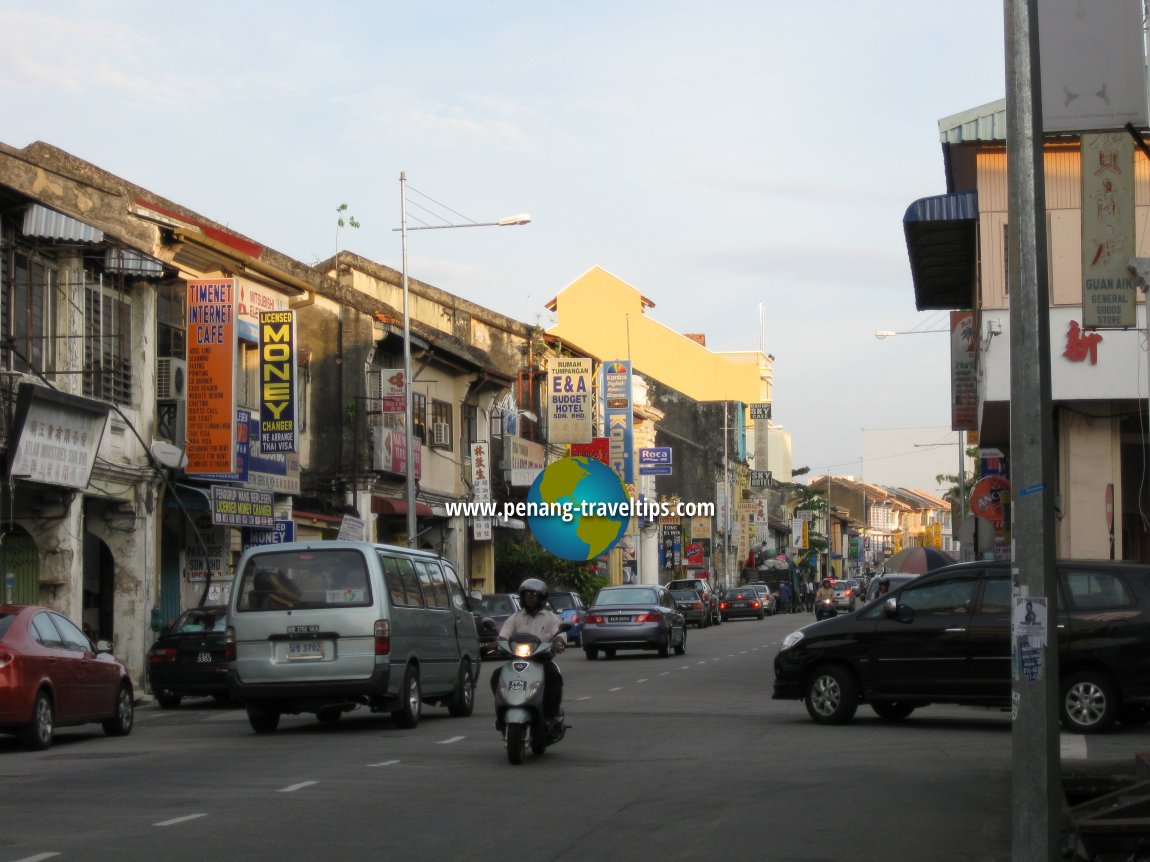 Lebuh Chulia is today lined with businesses catering to budget travellers (17 December 2008)
History of Lebuh Chulia
Lebuh Chulia is one of the oldest streets in George Town. It was laid out during the time of Captain Francis Light, and is one of the four main streets of his newly developed settlement, along with Light Street, Beach Street and Pitt Street. In its earliest incarnation, it was known as Malabar Street, after the Malabari Indians. By 1798, it had already acquired the name Lebuh Chulia, or rather, Chulier Street, as it was then written. Until 1803, Chulier Street reached only till Love Lane.When it was extended, the section beyond Love Lane was then known as Chulier Road. Today the whole stretch is called Lebuh Chulia, or Lebuh Chulia. This name is derived from the old Chola kingdom, and like Malabar, refers to the early Indians that settled there.
Another name that appears regularly in the Lebuh Chulia area is Keling, most obviously at Kapitan Keling Mosque. The name "keling" also refers to South Indian, and to be specific, was derived from the ancient south Indian kingdom of Kalinga.
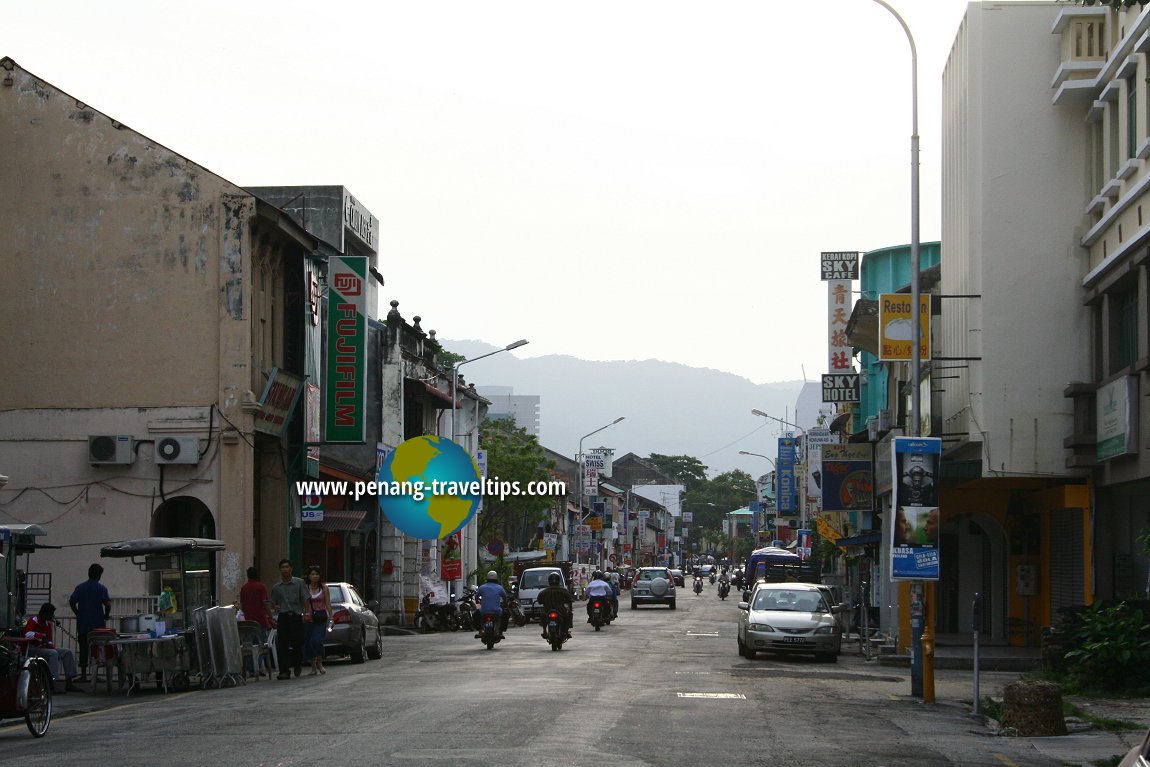 Lebuh Chulia in the evening (28 June 2006)
Among the Hokkien, south Indians are generally called kelinga. Due to the lack of historical appreciation, the term kelinga however, has since been regarded as offensive by the Indians, as it later became associated with South Indian convicts brought into George Town. To the Hokkiens, however, kelinga remains a commonly used word to refer to south Indians. Its use pre-dates the arrival of the first convicts, as the Kalinga has traded with the Malay peninsula for centuries, and contact with the Hokkien living along the coast of the Malay peninsula pre-dates the founding of Penang. The use of Kelinga in Hokkien is not in any way derogatory, as it is based on the historical reference to the Kalinga kingdom.
Like most of the streets that run east-west in George Town, Lebuh Chulia was extended in the third quarter of the 19th century following extensive land reclamation. The resulting extension is called Lebuh Chulia Ghaut. Until then, there was a pier where Lebuh Chulia ended.
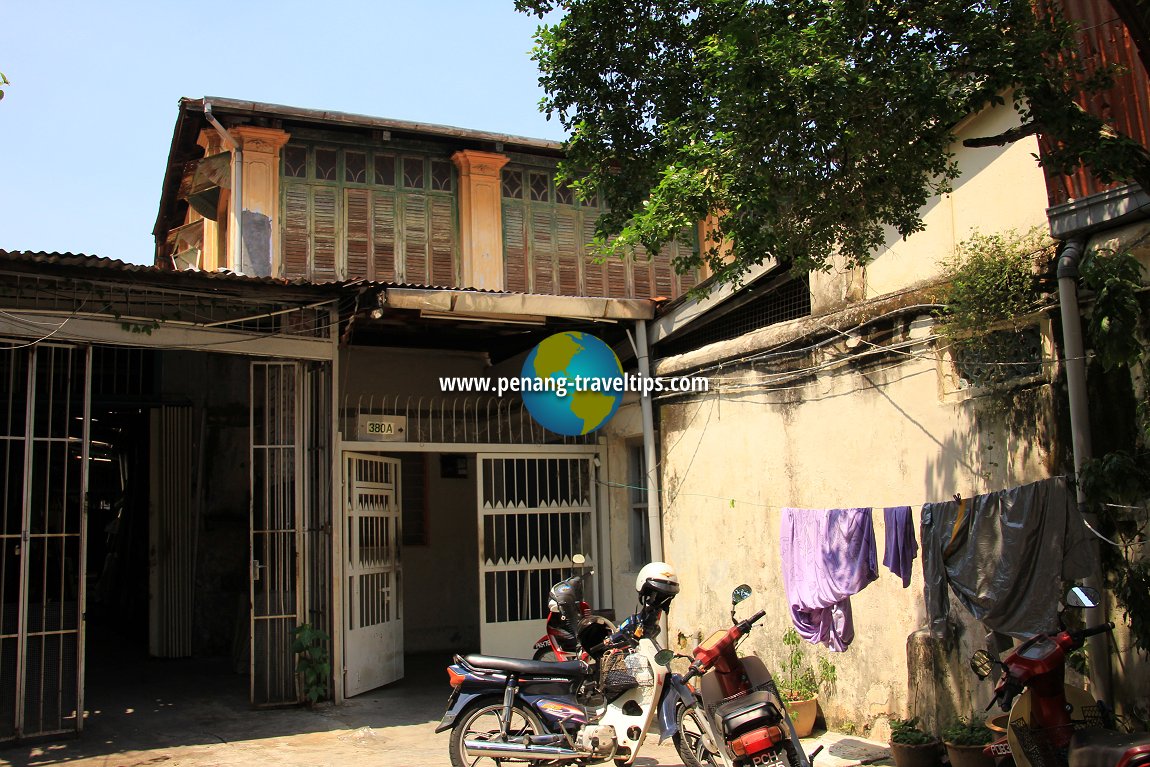 Anglo-Indian architecture, Lebuh Chulia (30 August 2012)
For much of the 19th century, Lebuh Chulia was occupied by Indians, Muslims as well as Hindus. The Indian Muslims contributed to the character of Lebuh Chulia. Among the sights attributed to them, apart from the Kapitan Keling Mosque, includes the Nagore Durgha Shrine and the Noordin Family Tomb. The tomb is one of many properties owned by the wealthy Noordin family that settled in George Town since the early 19th century. Masjid Alimsah Waley is another mosque started by the Indian Muslims.
The Chinese, especially the Cantonese, began moving into Lebuh Chulia towards the end of the 19th century where there was a decline in the number of Indian Muslims in Lebuh Chulia as well as within George Town. Their presence is reflected in the number of Cantonese district associations along the road, namely the Ng Fook Thong and Nam Hooi Wooi Koon.
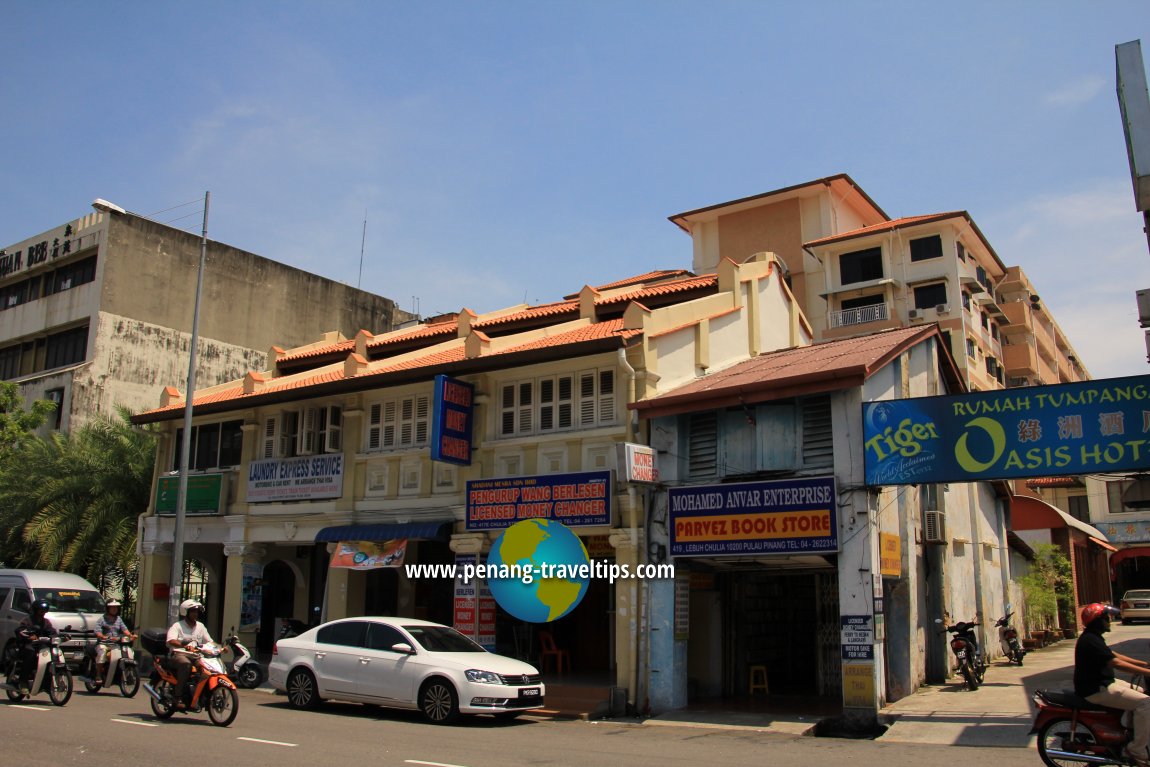 Shophouses on Lebuh Chulia, Penang (30 August 2012)
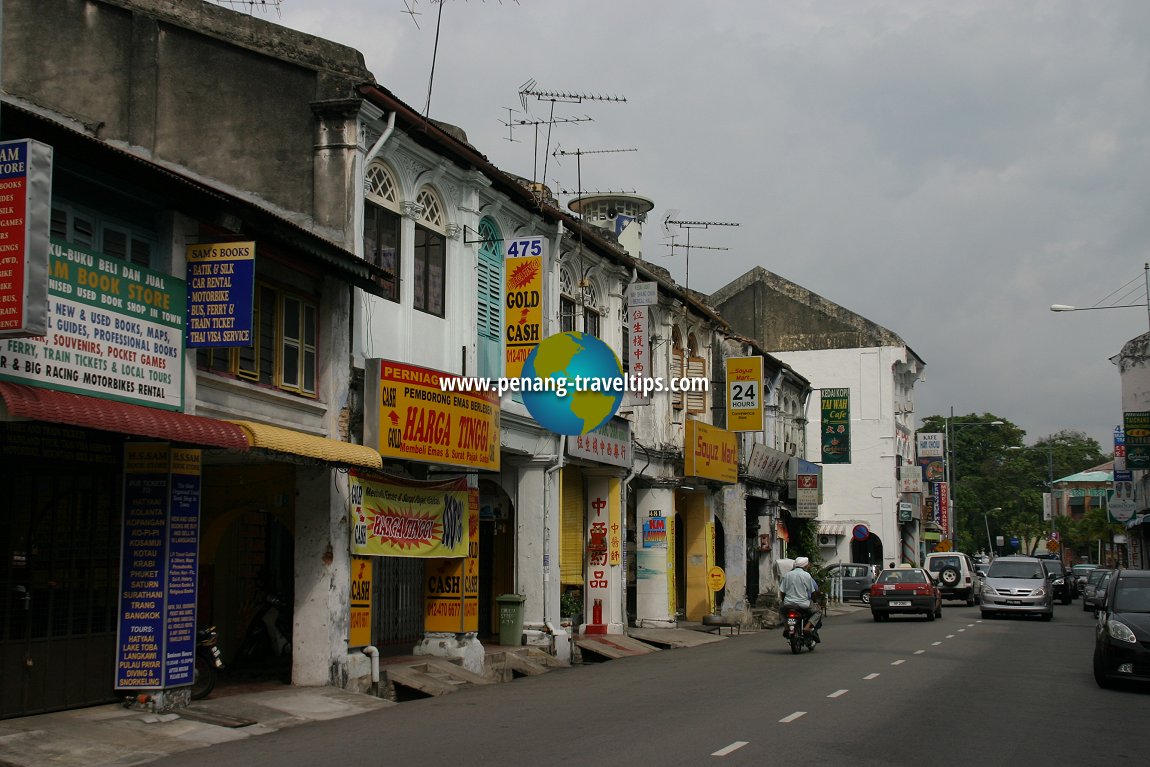 Lebuh Chulia, George Town, Penang (6 May 2008)
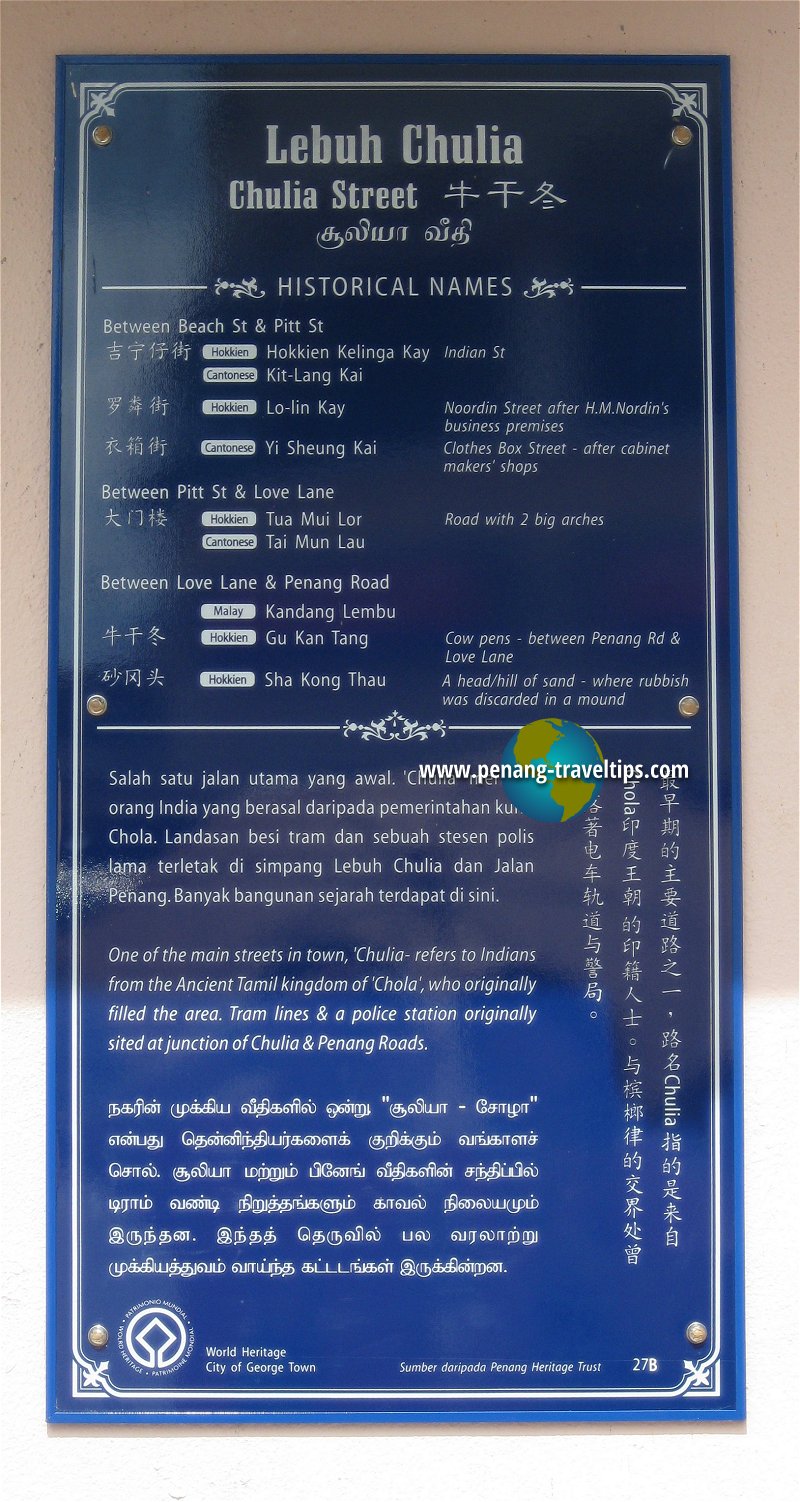 Lebuh Chulia plaque (12 November 2008)
In Other Words ...
Lebuh Chulia was known in Penang Hokkien as Ke1ling2na1 Kay1 , meaning "South Indian Street" (in reference to the predominantly South Indian character of that stretch), between Beach Street and Pitt Street, Tua33 Mui3 Lau2 大門樓 between Pitt Street and Love Lane (in reference to an archway that was once standing in the area), and as Gu3 Gan3 Tang1 牛干冬 , meaning cow pens (from "kandang lembu"), between Love Lane and Penang Road.
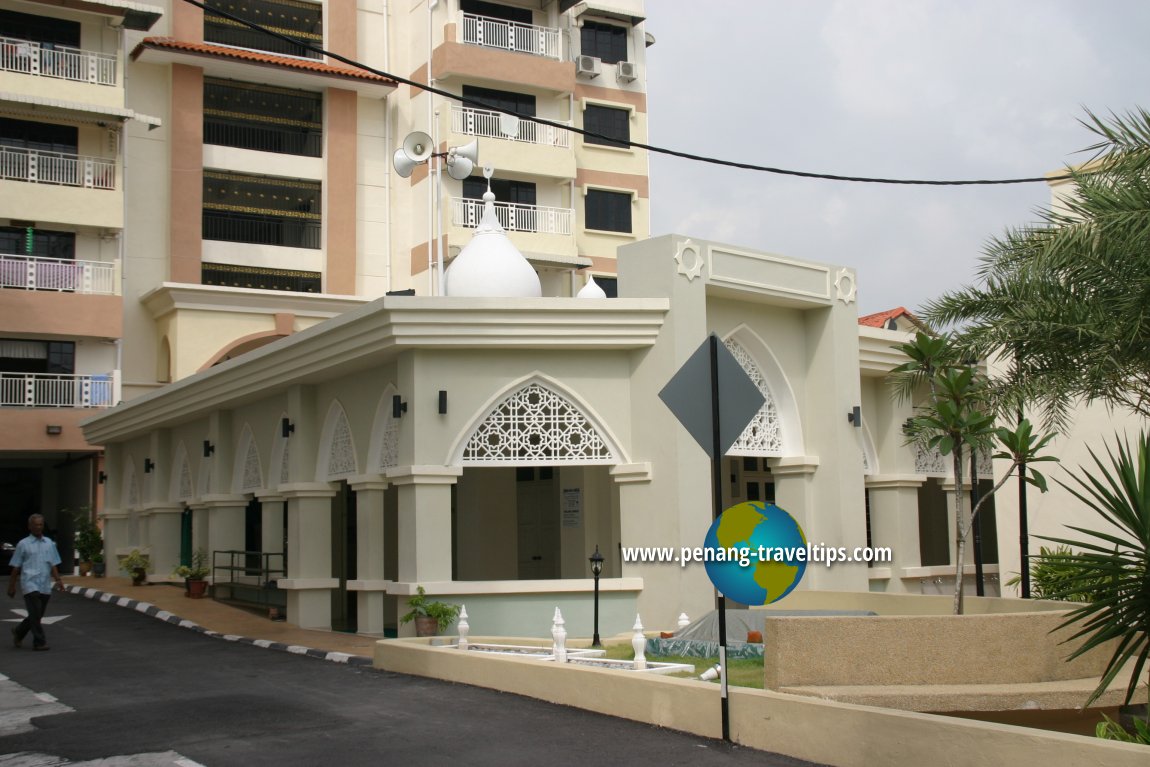 The Masjid Alimsah Waley is a reminder of a time when Lebuh Chulia was predominantly Indian (6 May 2008)
Property Numbering
Starting from Beach Street, the buildings on Lebuh Chulia carry odd-number addresses if they are on the left side of the street, and even-number addresses if they are on the right.Getting there
Rapid Penang Bus 11, 101, 104, 201, 202, 203, 204, 301 and 302 pass through Lebuh Chulia.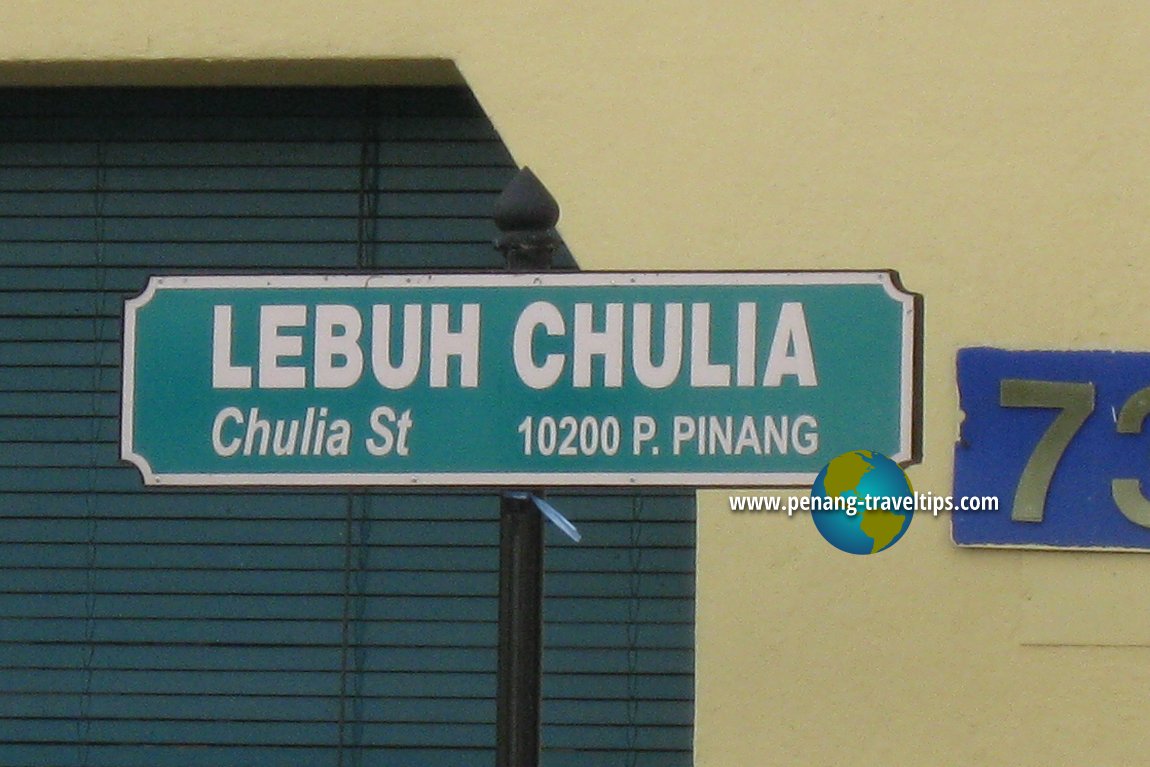 Lebuh Chulia road sign with English subtitle (12 November 2008)
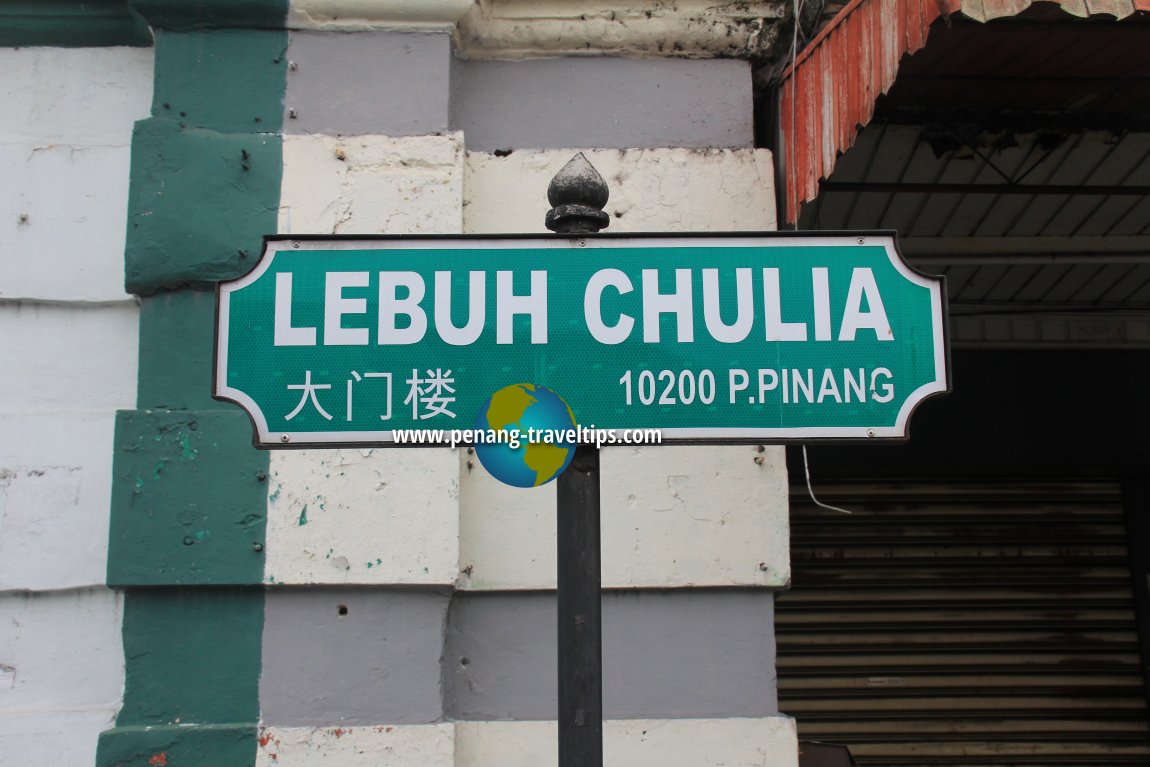 Lebuh Chulia roadsign with Chinese subtitle (30 June 2012)
List of Streets in Penang and Streets in Malaysia
Buy, rent or sell properties in Penang
Do you have a property for sale or to rent out? Are you looking to buy or rent a property? Get in touch with me. WhatsApp me (Timothy Tye) at 012 429 9844, and I will assign one of my property agents to serve you. I will choose the agent for you, according to your property needs. So when you message me, provide me some details of what you need, whether to sell, to buy, to rent or to rent out, and what type of property, is it condo, apartment, house, shop, office or land.Adakah anda mempunyai hartanah untuk dijual atau disewakan? Adakah anda ingin membeli atau menyewa hartanah? Hubungi saya. WhatsApp saya (Timothy Tye) di 012 429 9844, dan saya akan menugaskan salah seorang ejen hartanah saya untuk berkhidmat kepada anda. Saya akan pilih ejen untuk anda, mengikut keperluan hartanah anda. Oleh itu, apabila anda menghantar mesej kepada saya, berikan saya beberapa butiran tentang apa yang anda perlukan, sama ada untuk menjual, untuk membeli, untuk disewakan atau untuk disewakan, dan jenis hartanah apakah itu kondo, pangsapuri, rumah, kedai, pejabat atau tanah.
您有待出售或出租的房产吗? 您想购买或租赁房产吗? 与我联系。 WhatsApp 我 (Timothy Tye) 012 429 9844,我将指派一名房地产经纪人为您服务。 我会根据您的房产需求,为您选择代理。 因此,当您给我发消息时,请向我提供一些您需要的详细信息,无论是出售、购买、出租还是出租,以及房产类型,是公寓、公寓、房屋、商店、办公室还是土地。
New Properties in Penang
Looking to buy property in Penang? Get the e-brochures right here without having to visit or contact individual developers.- Anggun Residences E-Brochure, Batu Kawan
- Aston Acacia E-Brochure, Bukit Mertajam
- Beacon Executive Suites E-Brochure, George Town
- Beverly Heights @ Bukit Gambir E-Brochure, Gelugor
- BM Highland E-Brochure, Bukit Mertajam
- Cypress Villa E-Brochure, Sungai Ara
- D'Zone Condominium E-Brochure, Teluk Kumbar
- Elements Garden E-Brochure, Butterworth
- Ferringhi Residence 2 E-Brochure, Batu Ferringhi
- GEM Residences E-Brochure, Prai
- Golden Triangle 2 E-Brochure, Sungai Ara/Relau
- Grace Residence E-Brochure, Jelutong
- Granito @ Permai E-Brochure, Tanjong Bungah
- Green City Residence E-Brochure, Jelutong
- Havana Beach Residences E-Brochure, Bayan Lepas
- Imperial Residences E-Brochure, Sungai Ara/Relau
- Imperial Grande E-Brochure, Sungai Ara/Relau
- Lucerne Residence E-Brochure, Bayan Lepas
- Mezzo @ The Light City E-Brochure, Gelugor
- Middleton E-Brochure, Gelugor
- Orchard Villa 3 E-Brochure, Simpang Ampat
- Primero Heights E-Brochure, Permatang Pauh
- Queens Waterfront Q2 E-Brochure, Bayan Lepas
- Royale Heights @ Tambun Royale City E-Brochure, Simpang Ampat
- Royale Infinity @ Tambun Royale City E-Brochure, Simpang Ampat
- Rubica @ Harbour Place E-Brochure, Butterworth
- Sensasi Commercial Suites E-Brochure, Batu Kawan
- Setia Sky Ville E-Brochure, Jelutong
- Setia Sky Vista E-Brochure, Sungai Ara/Relau
- Setia V Residence E-Brochure, Gurney Drive
- Sinaran Residence E-Brochure, Batu Kawan
- Sky @ TriPark E-Brochure, Bukit Mertajam
- Skyridge Garden E-Brochure, Tanjong Tokong
- Starhill Luxury Residences E-Brochure, Gelugor
- Straits Residences E-Brochure, Tanjong Tokong
- Taman Nuri Emas E-Brochure, Nibong Tebal
- The Light Collection IV E-Brochure, Gelugor
- The Loft @ Southbay E-Brochure, Batu Maung
- The Terraces Condominium E-Brochure, Bukit Jambul
- Trehaus Condo Villas E-Brochure, Bukit Jambul
- Triuni Residences E-Brochure, Batu Uban
- Urban Suites E-Brochure, Tanjong Tokong
- Valencia Residence E-Brochure, Bayan Lepas
- Vertu Resort E-Brochure, Batu Kawan
- Vivo Executive Apartment E-Brochure, Batu Kawan
- Viluxe E-Brochure, Batu Kawan
- Waterside Residence E-Brochure, Gelugor
Latest updates on Penang Travel Tips
Discover with Timothy YouTube Channel
PG Food Channel
Learn Penang Hokkien YouTube Channel
SojiMart Videos
Share your travels and/or ask a travel-related question
Join the Penang Travel Tips Facebook Group to share photos, tips and anything related to your travels, or ask travel-related questions.
Map of Roads in Penang
Looking for information on Penang? Use this Map of Roads in Penang to zoom in on information about Penang, brought to you road by road. Discover with Timothy
Let me take you to explore and discover Penang through my series of walking tours on YouTube. You may use these videos as your virtual tour guide. At the beginning of each video, I provide the starting point coordinates which you may key into your GPS, Google Maps or Waze, to be navigated to where I start the walk, and use the video as your virtual tour guide.Disclaimer
Please use the information on this page as guidance only. The author endeavours to update the information on this page from time to time, but regrets any inaccuracies if there be any.Latest from Discover with Timothy: Gurney Bay - what to see and do there
About this website

Hello and thanks for reading this page. My name is Timothy and my hobby is in describing places so that I can share the information with the general public. My website has become the go to site for a lot of people including students, teachers, journalists, etc. whenever they seek information on places, particularly those in Malaysia and Singapore. I have been doing this since 5 January 2003, for over twenty years already. You can read about me at Discover Timothy. By now I have compiled information on thousands of places, mostly in Peninsular Malaysia and Singapore, and I continue to add more almost every day. My goal is to describe every street in every town in Malaysia and Singapore.
Robbie's Roadmap
- Episode 1: Robbie's Journey to Financial Freedom
- Episode 2: Lost in America
- Episode 3: The Value of Money
- Episode 4: The Mentor
- Episode 5: The Thing that Makes Money
- Episode 6: The walk with a Billionaire
- Episode 7: The Financial Freedom Awakening
- Episode 8: Meet Mr Washington
- Episode 9: The Pizzeria Incident
Copyright © 2003-2024 Timothy Tye. All Rights Reserved.