
State Route P119, Seberang Perai
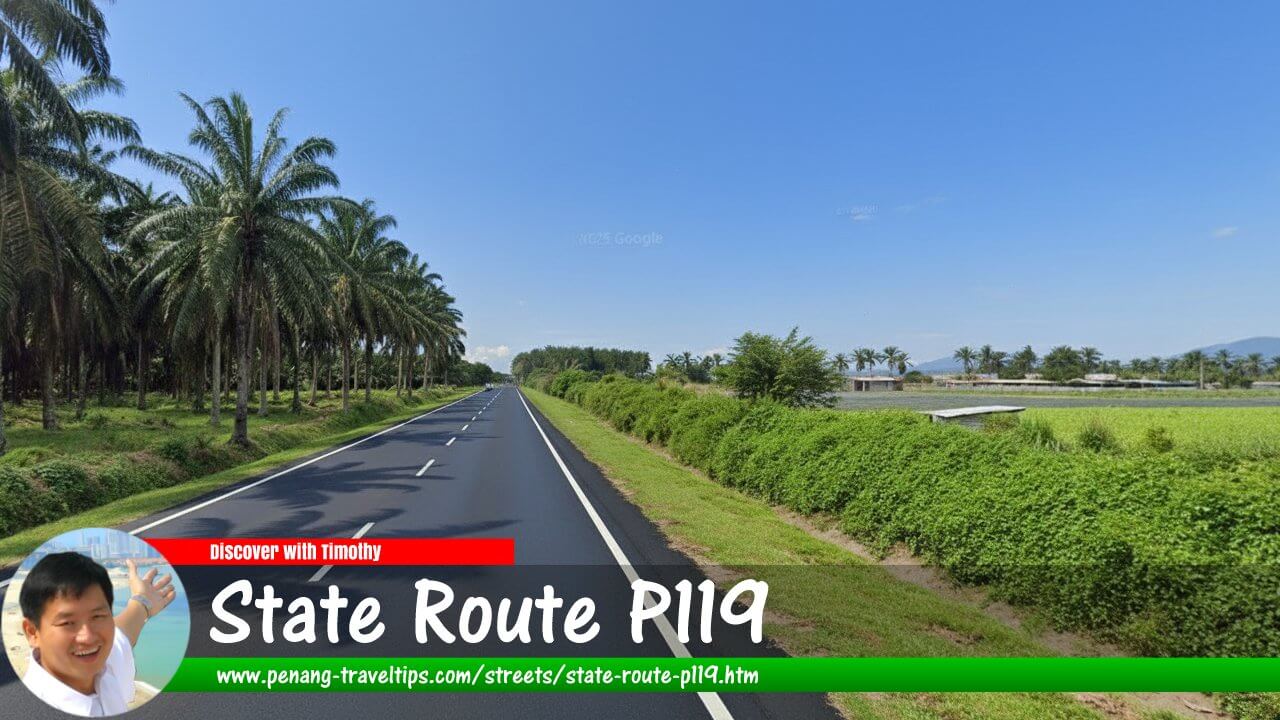 State Route P119, Seberang Perai (AI-edited photograph on 4 January 2026)
State Route P119 is a significant rural connector road in Seberang Perai, Penang, providing north–south connectivity across a broad stretch of mainland communities. With an approximate total length of 16.2 kilometres, the route links Jalan Pongsu Seribu in the north to Kubang Ulu in the south. Along its course, different segments of P119 are known by local names, reflecting the areas they serve and the historical development of the road.1
Quick Facts
- Route number: State Route P119
- Location: Seberang Perai, Penang
- Approximate length: 16.2 km
- Road type: Rural state connector
- North terminus: Jalan Pongsu Seribu
- South terminus: Kubang Ulu
- Local road names: Jalan Gelugor, Jalan Ara Kuda
Introduction to State Route P119
State Route P119 forms part of Penang’s state road network, designed to connect rural settlements with each other and with larger collector roads. Unlike federal highways, state routes such as P119 emphasise local accessibility rather than high-speed, long-distance travel.2
Its relatively long length for a rural connector highlights its importance in linking multiple communities, agricultural areas, and small town centres across northern and central Seberang Perai.2
Geographical Setting
P119 traverses a landscape that is predominantly rural, characterised by kampung settlements, farmland, and low-density residential areas. The road passes through zones that have retained strong agricultural and village identities, even as nearby areas experience gradual suburban growth.3
This geographical context shapes the road’s design and usage, with an emphasis on moderate speeds, frequent access points, and integration with surrounding land uses.3
Northern Terminus at Jalan Pongsu Seribu
At its northern end, State Route P119 begins at Jalan Pongsu Seribu. This junction acts as an entry point into the route from surrounding villages and nearby road corridors, enabling movement towards Tasek Gelugor and further south.4
The northern segment plays a key role in connecting local residents to educational, commercial, and community facilities within the broader Kepala Batas and Tasek Gelugor areas.4
Jalan Gelugor Segment
The stretch of P119 between Jalan Pongsu Seribu and Tasek Gelugor is commonly known as Jalan Gelugor. This name reflects the communities it serves and is widely used by local residents for orientation and daily navigation.1
Along this segment, the road supports mixed uses, including residential access, small roadside businesses, and agricultural transport. It functions as a vital everyday route rather than a through corridor for distant travel.5
Central Alignment and Connectivity
As P119 continues southward beyond Tasek Gelugor, it maintains a generally linear alignment shaped by historical land divisions and settlement patterns. The road connects several minor junctions and local access roads, reinforcing its role as a connector rather than a destination in itself.5
This central portion of the route provides continuity across districts, enabling movement between rural areas that might otherwise require lengthy detours via larger arterial roads.5
Jalan Ara Kuda Segment
From the Ara Kuda area towards Kubang Ulu, State Route P119 is locally known as Jalan Ara Kuda. This name reflects the identity of the communities in the southern part of the route and distinguishes this stretch from its northern sections.1
The Jalan Ara Kuda segment continues to serve primarily local traffic, supporting village connectivity and access to nearby agricultural and residential zones.6
Southern Terminus at Kubang Ulu
The southern end of P119 lies at Kubang Ulu, where the route integrates with other local roads serving the surrounding rural hinterland. This terminus marks the completion of the road’s north–south function within Seberang Perai.4
Through this connection, residents gain access to neighbouring districts while maintaining strong internal connectivity within their own communities.4
Role in the State Road Network
Within Penang’s road hierarchy, P119 acts as a secondary connector that complements federal and major state roads. Its purpose is not to replace high-capacity highways but to ensure that rural areas remain linked to the broader transport system.2
The route’s length and continuity make it particularly important for distributing traffic across multiple settlements without overloading primary roads.2
Traffic Characteristics and Usage
Traffic on State Route P119 is largely composed of motorcycles, private cars, and light commercial vehicles. These reflect the everyday travel needs of residents, farmers, and small-scale traders who rely on the road for short to medium-distance trips.6
Peak usage typically coincides with school and work commuting hours, while heavier vehicles are more common during agricultural harvesting and distribution periods.6
Community and Social Importance
Beyond transportation, P119 serves as a social spine for many of the communities it passes through. Roads in rural Seberang Perai often double as informal public spaces, where daily interactions strengthen community ties.3
The use of different local names along its length underscores the close relationship between the road and the identities of the settlements it serves.3
Maintenance and Development
As a state-maintained route, P119 is subject to ongoing maintenance aimed at preserving road surface quality, drainage, and safety. Improvements are typically incremental, ensuring the road remains functional without disrupting its rural character.7
This approach supports long-term sustainability while accommodating gradual changes in traffic demand and land use.7
Conclusion
State Route P119 stands as an essential rural connector within Seberang Perai, linking Jalan Pongsu Seribu to Kubang Ulu across a diverse landscape of villages and farmland. Known locally as Jalan Gelugor and Jalan Ara Kuda along different stretches, the road reflects both functional necessity and local identity.1
Through its length, continuity, and community focus, P119 continues to play a quiet yet indispensable role in supporting mobility, economic activity, and social cohesion across Penang’s mainland.1
State Route P119 on the Map of Roads in Penang
References
- State Roads in Penang – Wikipedia
- Roads in Malaysia – Wikipedia
- Seberang Perai – Wikipedia
- Penang State Government
- Public Works Department of Malaysia
- Malaysia Open Data Portal
- Penang Public Works Department
Page Details
This page was created on 4 January 2026. Hi, my name is Timothy and created it from my research, for my own entertainment, knowledge and to satisfy my curiosity. I am providing the information to you in good faith and hope it is useful. I try to get the details as accurate as possible. I also try to update the page whenever I stumble on new details. So this and all my other pages are perpetual work in progress. If you discover any error, please politely inform me, pointing out where the error lies, and I will correct it as soon as possible. Your helpfulness will keep this page accurate, relevant and helpful to those who need the information.Want to share your Penang travel experiences or get tips from fellow travellers?
Join the Penang Travel Tips Facebook GroupUseful guides for visiting Penang
My Videos of Penang
 Latest Pages & Updates
Buy Me A Coffee
If you enjoy the information I provide and want to support the work I do, please buy me a coffee! I appreciate it immensely, thank you so much!
