
Jalan Gelugor, Tasek Gelugor
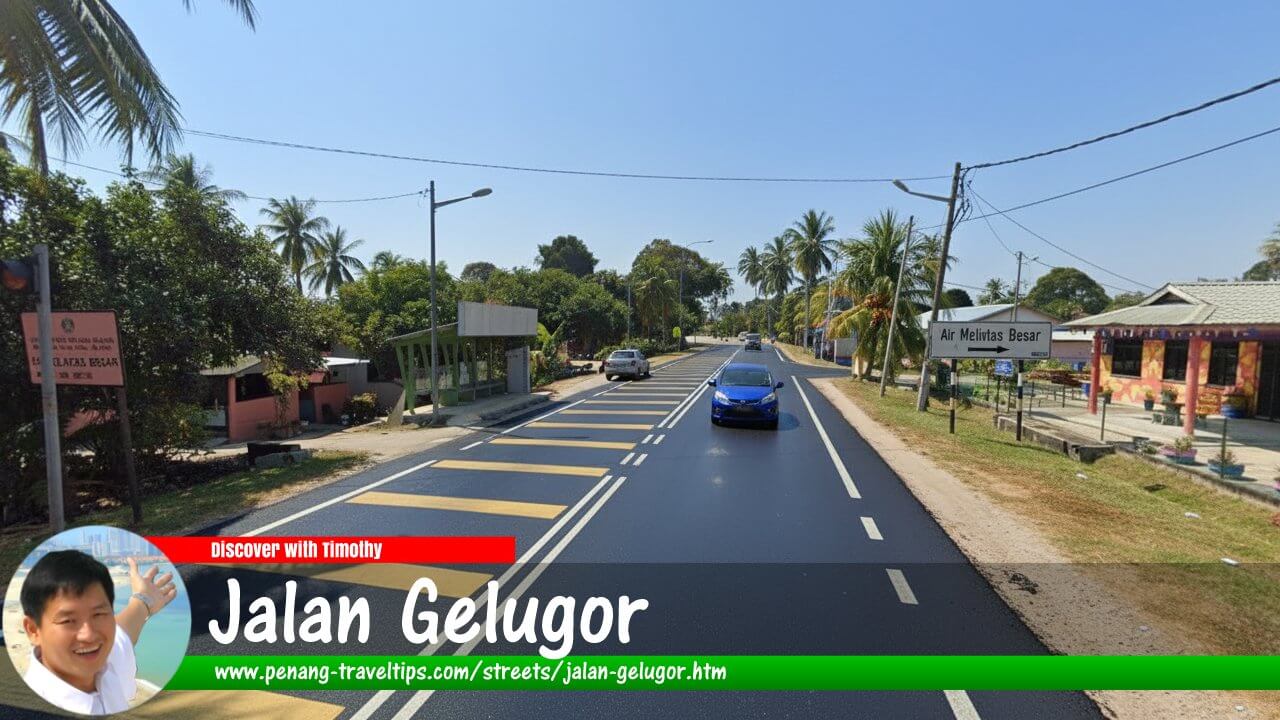 Jalan Gelugor, Tasek Gelugor (AI-edited photograph on 2 January 2026)
Jalan Gelugor is an important rural road located in Tasek Gelugor, Seberang Perai Utara, Penang. Forming part of State Route P119, the road stretches for approximately 5.37 kilometres, linking Jalan Pongsu Seribu in the west to Jalan Tasek Gelugor in the east. Although not a major arterial road, Jalan Gelugor plays a significant role in connecting villages, agricultural areas, and secondary roads across the northern mainland of Penang.1
Quick Facts
- Road name: Jalan Gelugor
- Location: Tasek Gelugor, Seberang Perai Utara, Penang
- Route designation: State Route P119
- Total length: Approximately 5.37 km
- Western terminus: Jalan Pongsu Seribu
- Eastern terminus: Jalan Tasek Gelugor
- Road type: Rural connector road
- Primary surroundings: Villages and agricultural land
Geographical Setting
Jalan Gelugor is situated within the broader Tasek Gelugor area, a district known for its predominantly rural landscape. The road passes through flat lowland terrain typical of northern Seberang Perai, where irrigation canals and paddy fields shape both land use and settlement patterns.2
This geographical context has influenced the alignment of Jalan Gelugor, which follows a relatively straight path between villages while avoiding waterways and cultivated fields. The surrounding scenery reflects the agricultural heritage of the area, with stretches of greenery dominating much of the roadside view.2
Route Alignment and Connectivity
From its western end, Jalan Gelugor begins at its junction with Jalan Pongsu Seribu, another important rural road serving the surrounding villages. This junction acts as a local distribution point, allowing traffic to flow between multiple settlements and road corridors within Tasek Gelugor.3
Travelling eastwards, the road continues through a mix of kampung housing clusters and agricultural plots before reaching its named eastern terminus at Jalan Tasek Gelugor. Beyond this junction, the route number P119 continues east and then south as an unnamed road, maintaining its function as a state route despite the absence of a local street name.3
Role within State Route P119
As part of State Route P119, Jalan Gelugor contributes to the wider state road network that supports local and regional mobility. State routes such as P119 are designed to link rural communities to larger roads, enabling access to services, markets, and nearby towns without relying solely on federal highways.1
The continuation of P119 beyond Jalan Tasek Gelugor, even without a formal road name, highlights the functional importance of the route as a continuous corridor rather than a single named street.1
Physical Characteristics
Jalan Gelugor is typically a two-lane undivided road with a single carriageway in each direction. The road surface is paved and suitable for motorcycles, private cars, and light commercial vehicles that form the bulk of traffic in rural Penang.4
Road shoulders are generally narrow, with open drains running alongside many sections. Vegetation, including roadside trees and shrubs, provides shade and reinforces the road’s rural character, though it also requires regular maintenance to ensure visibility and safety.4
Land Use and Surroundings
The land surrounding Jalan Gelugor is dominated by agricultural use, particularly paddy cultivation. These fields form the backbone of the local economy and influence daily traffic patterns along the road.2
In addition to farmland, the road passes through several village areas where traditional houses, small shops, and community facilities are clustered. For these communities, Jalan Gelugor serves as the primary access route to schools, places of worship, and nearby service centres.2
Traffic Patterns
Traffic volumes on Jalan Gelugor are generally low to moderate, reflecting its rural setting. Motorcycles are the most common vehicles, followed by passenger cars used by residents for commuting and daily errands.3
During peak agricultural periods, small lorries and farm vehicles are frequently seen transporting produce and equipment. These seasonal variations underscore the close link between the road and the surrounding agricultural activities.3
Social and Economic Importance
Despite its modest scale, Jalan Gelugor plays a vital role in sustaining rural life in Tasek Gelugor. By providing reliable connectivity between villages and linking to other state roads, it supports access to employment, education, and healthcare.1
The road also facilitates the movement of agricultural goods, enabling farmers to transport their harvests efficiently to collection points and markets beyond the immediate area.1
Historical Development
Jalan Gelugor likely developed from earlier village paths that connected farming communities across the Tasek Gelugor area. Over time, these informal routes were upgraded and incorporated into the state road system as part of broader rural infrastructure development.4
The road’s current alignment reflects historical settlement patterns, preserving traditional connections while accommodating modern transport needs.4
Future Outlook
Looking ahead, Jalan Gelugor is expected to remain a rural connector rather than undergoing major widening or realignment. Future improvements are likely to focus on maintenance, drainage upgrades, and incremental safety enhancements to support local traffic.4
As Tasek Gelugor continues to balance agricultural traditions with gradual development, Jalan Gelugor will remain an essential link within the local transport network.4
Jalan Gelugor on the Map of Roads in Penang
References
- Roads in Penang – Wikipedia
- Tasek Gelugor – Wikipedia
- Transportation in Penang – Wikipedia
- Public Works Department of Malaysia
Page Details
This page was created on 2 January 2026. Hi, my name is Timothy and created it from my research, for my own entertainment, knowledge and to satisfy my curiosity. I am providing the information to you in good faith and hope it is useful. I try to get the details as accurate as possible. I also try to update the page whenever I stumble on new details. So this and all my other pages are perpetual work in progress. If you discover any error, please politely inform me, pointing out where the error lies, and I will correct it as soon as possible. Your helpfulness will keep this page accurate, relevant and helpful to those who need the information.Want to share your Penang travel experiences or get tips from fellow travellers?
Join the Penang Travel Tips Facebook GroupUseful guides for visiting Penang
My Videos of Penang
 Latest Pages & Updates
Buy Me A Coffee
If you enjoy the information I provide and want to support the work I do, please buy me a coffee! I appreciate it immensely, thank you so much!
