
Kepala Batas
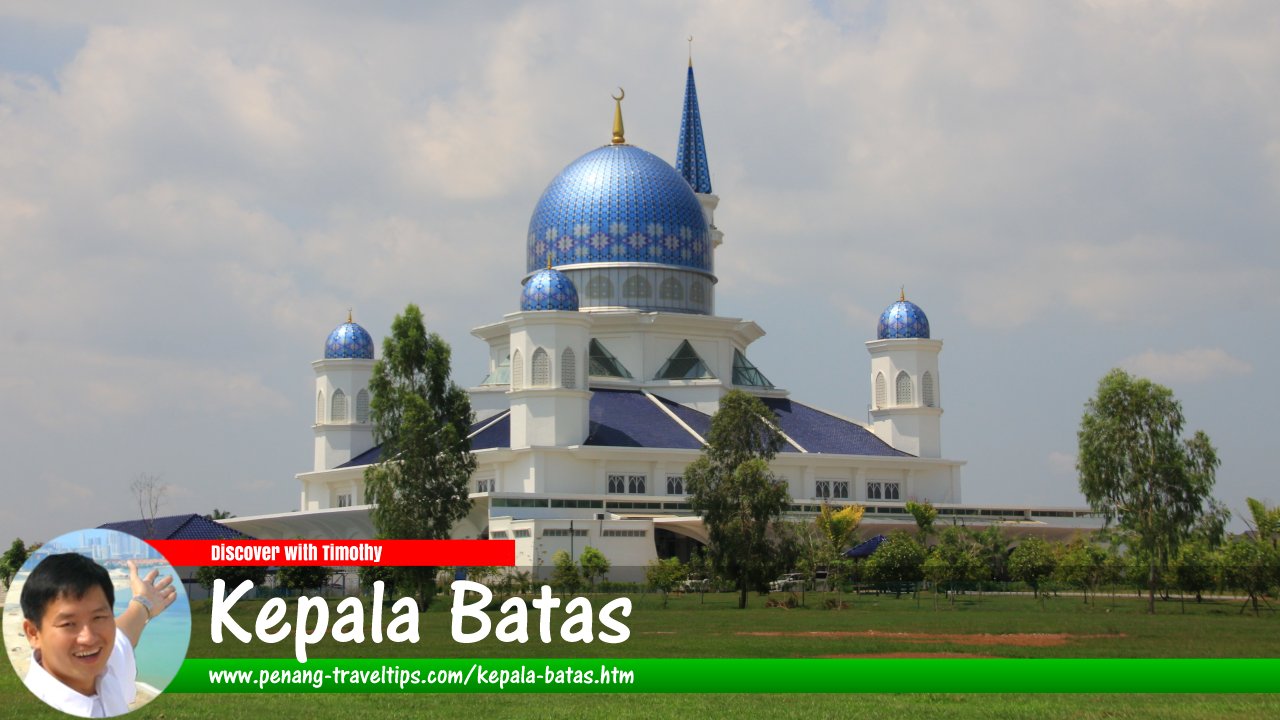 Kepala Batas (22 July 2015)
Kepala Batas is a well-known town located in the northern part of Seberang Perai, Penang, Malaysia. Often described as a bridge between tradition and modernity, Kepala Batas combines rural landscapes, historic villages, and religious institutions with steadily expanding residential and commercial developments. The town plays an important role as a local administrative, educational, and cultural centre for the surrounding northern Seberang Perai communities1.
Quick Facts
Location: Northern Seberang Perai, Penang, Malaysia
District: Seberang Perai Utara
Administrative Authority: Seberang Perai City Council (MBSP)
Character: Semi-rural town with growing suburban development
Known for: Islamic education, traditional villages, local food, and political history
Accessibility: Connected by federal and state roads to Butterworth, Bertam, and Penaga
Geographical Setting
Kepala Batas is situated in the northern portion of Seberang Perai Utara, bordered by agricultural land, kampung settlements, and newer townships such as Bertam. The geography of the area is predominantly flat, making it suitable for paddy fields, vegetable farms, and small-scale plantations that have long supported the local economy2.
Several minor rivers and drainage canals traverse the region, playing an important role in irrigation and flood management. Although Kepala Batas does not sit directly on the coastline, it benefits from proximity to coastal areas such as Penaga and Teluk Air Tawar, which influence local climate and economic activities. The tropical climate brings consistent rainfall and warm temperatures throughout the year, supporting agriculture and greenery.
Jalan Tun Hamdan Sheikh Tahir, formerly known as Jalan Kubang Menderung, is the main road through Kepala Batas. It runs east-west, connecting the Federal Route 1 to the west with the North-South Expressway Northern Route. The other main road in town was named Jalan Datuk Haji Ahmad Badawi.
To serve as catalyst for development in Seberang Perai Utara, the plantation land of Bertam Estate was earmarked for redevelopment. The land is now progressively cleared to make way for the new township of Bertam, which will have various modern amenities.
Location of Kepala Batas
Measured from the intersection of Jalan Datuk Haji Ahmad Badawi (P203) with Jalan Padang Kelab/Jalan Tun Hamdan Sheikh Tahir (P123) (GPS: 5.516832, 100.430067), Kepala Batas is 21.6 km to Penang Sentral, 22.9 km to the Penang Bridge, 43.4 km to the Second Penang Bridge and 40.7 km to the Penang International Airport.
Historical Background
The history of Kepala Batas is closely linked to the development of Malay settlements in northern Seberang Perai during the 19th century. The name “Kepala Batas” is believed to refer to the head or starting point of a boundary, possibly marking the edge of early agricultural land divisions or administrative limits3.
During the British colonial period, the area remained largely rural, with economic activities centred on rice cultivation and small trading hubs. Unlike George Town on Penang Island, Kepala Batas developed at a slower pace, preserving many aspects of traditional village life. Mosques, religious schools, and family-owned farms became defining features of the town.
Role in Modern Penang
In the post-independence era, Kepala Batas gained wider recognition due to its association with national political leadership, particularly as the hometown and parliamentary constituency of Malaysia’s fifth Prime Minister, Tun Abdullah Ahmad Badawi. This connection brought increased attention and infrastructure investment to the area4.
Today, Kepala Batas functions as a sub-regional centre within Seberang Perai Utara. Government offices, educational institutions, health facilities, and commercial areas serve not only town residents but also neighbouring rural communities. Despite ongoing development, the town retains a distinctly local identity rooted in community ties and religious life.
Education and Religious Institutions
Kepala Batas is widely recognised as an important hub for Islamic education in northern Penang. The presence of respected religious schools and pondok institutions has shaped the town’s intellectual and spiritual landscape for decades. Students from different parts of Malaysia have historically travelled to Kepala Batas to pursue religious studies5.
In addition to religious institutions, the town is served by public schools, secondary schools, and vocational centres. These educational facilities support the local population and contribute to gradual socio-economic mobility, especially among younger generations.
Economy and Local Livelihoods
The traditional economy of Kepala Batas has long been based on agriculture, particularly rice farming. While large-scale agriculture has declined over time, many families continue to engage in smallholdings, food production, and related activities. Local markets and roadside stalls remain an important part of daily economic life.
In recent years, commercial growth has increased with the development of shoplots, retail centres, and service-based businesses. The nearby Bertam area, including Bertam Perdana and Bertam Vision City, has further expanded employment opportunities for Kepala Batas residents, reducing the need to commute to Butterworth or George Town6.
Transport and Accessibility
Kepala Batas is well connected by a network of federal and state roads, providing access to Butterworth, Sungai Dua, Penaga, and other parts of northern Seberang Perai. The North–South Expressway can be reached within a short drive, making long-distance travel convenient.
Public transport options include buses and informal transport services, although private vehicles remain the primary mode of transportation. Ongoing infrastructure improvements continue to enhance connectivity and support residential and commercial expansion.
Culture, Food, and Daily Life
Daily life in Kepala Batas reflects a blend of rural traditions and modern routines. Community events, mosque activities, and family gatherings remain central to social life. The town is especially known for its local Malay cuisine, including traditional breakfast dishes, kuih-muih, and hawker-style meals sold at morning and evening markets.
Festive seasons such as Hari Raya Aidilfitri and Maulidur Rasul are widely observed, with communal prayers and open houses strengthening neighbourhood bonds. These cultural practices continue to define the character of Kepala Batas, even as new residential developments introduce more diverse lifestyles.
Urban Development and Future Outlook
Urbanisation in Kepala Batas has accelerated over the past two decades, driven by population growth and spillover development from Butterworth and central Seberang Perai. New housing estates, educational campuses, and commercial areas are gradually transforming the town’s physical landscape.
Despite these changes, planning authorities and local communities place emphasis on balancing growth with heritage preservation. Maintaining green spaces, mosques, and traditional villages remains a priority, ensuring that Kepala Batas continues to reflect its historical roots while adapting to modern needs7.
Significance within Seberang Perai
Kepala Batas holds a unique position within Seberang Perai as a town that embodies continuity and change. Its role as a cultural, educational, and administrative centre complements the more industrialised areas of southern Seberang Perai. For many residents, it represents a place where community values remain strong amid ongoing development.
As Seberang Perai continues to evolve as a city-region, Kepala Batas is expected to remain an important northern anchor, offering a distinctive blend of heritage, faith, and modern suburban living.
 Map of Kepala Batas
.Sights in and around Kepala Batas
- Bertam House (GPS: 5.51782, 100.43649)

- Bumbung Lima Pillbox (GPS: 5.56225, 100.42786)

- Kepala Batas Gateway Arch (GPS: 5.51726, 100.43735)

- Kraftangan Malaysia Pulau Pinang (GPS: 5.51649, 100.44676)

- Merdeka Bridge (GPS: 5.56376, 100.42806)

- Pantai Kamloon (GPS: 5.56404, 100.44477)

- Penang Golf Resort (GPS: 5.52068, 100.44682)

- Penang Technology Park (GPS: 5.52747, 100.48798)

- Restoran Ikan Bakar Din (GPS: 5.51584, 100.4224)

- Vision Park (GPS: 5.51946, 100.46216)

Banks in Kepala Batas
- Affin Bank (GPS: 5.516578, 100.421659)
- Agro Bank (GPS: 5.517210, 100.430616)
- Bank Islam (GPS: 5.517230, 100.431872)
- Bank Simpanan Nasional (GPS: 5.517923, 100.438324)
- CIMB Bank (GPS: 5.515958, 100.430435)
- Hong Leong Bank (GPS: 5.517218, 100.431085)
- Public Bank (GPS: 5.517226, 100.431268)
.Chinese Temples in Kepala Batas
- Tau Bo Keong Temple (GPS: 5.50967, 100.43267)

.Coffee Shops and hawker centres in Kepala Batas
- Bandar Putra Bertam Hawker Centre (GPS: 5.51861, 100.4809)

Commercial Development in Kepala Batas
- Bertam Perdana (GPS: 5.51669, 100.44718)

Government Buildings in Kepala Batas
- Bertam Fire & Rescue Department Air Base (GPS: 5.54938, 100.4855)

- Engineering Office, Public Works Department, JKR (GPS: 5.51306, 100.43862)

- Kepala Batas Post Office (GPS: 5.51664, 100.43064)

- Millennium Hall (GPS: 5.51442, 100.43763)

- National Registration Department, Bertam Branch (GPS: 5.51272, 100.43627)

- Penang Library, Bertam Branch (GPS: 5.51321, 100.43763)

- Seberang Perai Utara Land Office (GPS: 5.51451, 100.43598)

- Wisma Persekutuan, Seberang Perai Utara (GPS: 5.51218, 100.43611)

Hindu Temples in Kepala Batas
- Sri Maha Mariamman Temple (GPS: 5.51694, 100.42943)

Housing Estates and townships in Kepala Batas
- Bertam Lakeside (GPS: 5.52598, 100.46835)

- Bertam Lakeview (GPS: 5.51932, 100.4589)

- Bertam Resort (GPS: 5.52052, 100.45308)

- Casa Innova (GPS: 5.51752, 100.47415)

- Crescent Dew (GPS: 5.51798, 100.45599)

- Mekarsari (GPS: 5.53035, 100.49318)

- Setia Fontaines (GPS: 5.5124, 100.48211)

- Taman Aman Putera (GPS: 5.5184, 100.4245)

- Taman Bertam Indah (GPS: 5.51824, 100.43729)

- Taman Bertam Perdana (GPS: 5.53227, 100.46701)

- Taman Bertam Perdana 2 (GPS: 5.5233, 100.4675)

- Taman Bertam Permai (GPS: 5.53599, 100.43667)

- Taman Haji Abdullah Fahim (GPS: 5.50569, 100.42714)

- Taman Sepakat (GPS: 5.51633, 100.42143)

- Taman Seri Indah (GPS: 5.5021, 100.4297)

- Taman Seri Serdang (GPS: 5.50507, 100.43482)

Hospitals and public clinics in Kepala Batas
- Hospital Kepala Batas (GPS: 5.51155, 100.43735)
- Klinik Desa Lahar Kepar (GPS: 5.53824, 100.41666)

- Klinik Kesihatan Kepala Batas (GPS: 5.51617, 100.4329)

Hotels in Kepala Batas
- Hotel Seri Malaysia (GPS: 5.51558, 100.43153)

Mosques in Kepala Batas
- Masjid Abdullah Fahim (GPS: 5.52052, 100.46396)

- Masjid Al-Jamiul Badawi (GPS: 5.51491, 100.42549)

- Masjid At-Taqwa (GPS: 5.52124, 100.43563)

- Masjid Jamek Al-Hidayah (GPS: 5.54885, 100.47977)

- Masjid Jamek Permatang Buloh (GPS: 5.48465, 100.42563)

- Masjid Kampung Banggol (GPS: 5.48505, 100.45024)

Petrol Stations in Kepala Batas
- BHPetrol Penaga (GPS: 5.51203, 100.40361)

- Caltex Kepala Batas (GPS: 5.522088, 100.426644)

- Petron Kepala Batas (GPS: 5.52123, 100.42635)

- Petronas Bertam Perdana (GPS: 5.51751, 100.44962)

- Petronas Kepala Batas (GPS: 5.51548, 100.41874)

- Shell Kepala Batas (GPS: 5.51732, 100.43235)

Roads in Kepala Batas
- Jalan Butterworth
- Jalan Datuk Haji Ahmad Badawi
- Jalan Kedah
- Jalan Lahar Yooi
- Jalan Pajak Song
- Jalan Paya Keladi
- Jalan Permatang Bogak
- Jalan Permatang Kuang
- Jalan Permatang Sireh
- Jalan Pongsu Seribu
- Jalan Tun Hamdan Sheikh Tahir
Schools in Kepala Batas
- Sekolah Jenis Kebangsaan (Cina) Pei Yu (GPS: 5.51481, 100.42987)

- Sekolah Jenis Kebangsaan (Cina) Chin Hwa (GPS: 5.5499, 100.50967)

- Sekolah Jenis Kebangsaan (Cina) Sin Chung (GPS: 5.51364, 100.40349)

- Sekolah Jenis Kebangsaan (Tamil) Palaniandy (GPS: 5.5207, 100.42658)

- Sekolah Kebangsaan Bertam Indah (GPS: 5.5242, 100.43548)

- Sekolah Kebangsaan Bertam Perdana (GPS: 5.53158, 100.46832)

- Sekolah Kebangsaan Hashim Awang (GPS: 5.51653, 100.42831)

- Sekolah Kebangsaan Kepala Batas (GPS: 5.50236, 100.43652)

- Sekolah Kebangsaan Lahar Kepar (GPS: 5.53814, 100.41682)

- Sekolah Kebangsaan Paya Keladi (GPS: 5.53846, 100.4457)

- Sekolah Kebangsaan Permatang Bertam (GPS: 5.51058, 100.42486)

- Sekolah Menengah Kebangsaan Bertam Indah (GPS: 5.52311, 100.43546)

- Sekolah Menengah Kebangsaan Bertam Perdana (GPS: 5.53178, 100.46713)

- Sekolah Menengah Kebangsaan Datuk Haji Abdul Kadir (GPS: 5.51469, 100.43017)

- Sekolah Menengah Kebangsaan Dato Kailan (GPS: 5.53922, 100.46784)

- Sekolah Menengah Kebangsaan Kepala Batas (GPS: 5.50184, 100.43656)

- Sekolah Menengah Sains Kepala Batas (GPS: 5.51878, 100.46786)

Shopping centres and hypermarkets in Kepala Batas
- Mydin Bertam Mall (GPS: 5.51876, 100.47768)

- Sunshine Bertam Shopping Mall (GPS: 5.51634, 100.44974)

- Tesco Bertam (GPS: 5.51658, 100.4432)

Supermarkets in Kepala Batas
- Longwan Kepala Batas (GPS: 5.52093, 100.42672)
Townships in Kepala Batas
- Bandar Putra Bertam (GPS: 5.51939, 100.4759)

Universities and colleges in Kepala Batas
- Animal Research Centre, USM (GPS: 5.52758, 100.47684)

- Kolej Kejururawatan Bertam (GPS: 5.5185, 100.46301)

- UiTM Bertam (GPS: 5.52965, 100.47556)

Villages in Kepala Batas
- Bumbung Lima (GPS: 5.55601, 100.4416)

- Lahar Tiang (GPS: 5.5483, 100.48027)

- Pajak Song (GPS: 5.500556, 100.426105)

- Permatang Buluh (GPS: 5.55601, 100.4416)

- Permatang Tinggi (GPS: 5.54243, 100.43406)

- Pinang Tunggal (GPS: 5.55279, 100.50266)

- Tanjung Rambai (GPS: 5.48549, 100.42613)

- Titi Mukim (GPS: 5.49918, 100.38714)

Wet Markets and Night Markets in Kepala Batas
- Pasar Awam Kepala Batas (GPS: 5.51563, 100.41673)

- Pasar Malam Kepala Batas (GPS: 5.51575, 100.42481)

References
- Seberang Perai City Council (MBSP) – Official Information
- Penang Institute – Regional Geography and Development
- Official Portal of the Penang State Government
- Prime Minister’s Office Malaysia – Historical Leaders
- Department of Islamic Development Malaysia (JAKIM)
- Economic Planning Unit Malaysia
- Federal Department of Town and Country Planning Malaysia
Page Details
This page was created on 1 January 2026.Want to share your Penang travel experiences or get tips from fellow travellers?
Join the Penang Travel Tips Facebook GroupUseful guides for visiting Penang
My Videos of Penang
 Latest Pages & Updates
Buy Me A Coffee
If you enjoy the information I provide and want to support the work I do, please buy me a coffee! I appreciate it immensely, thank you so much!
