
Stamford Road, Singapore
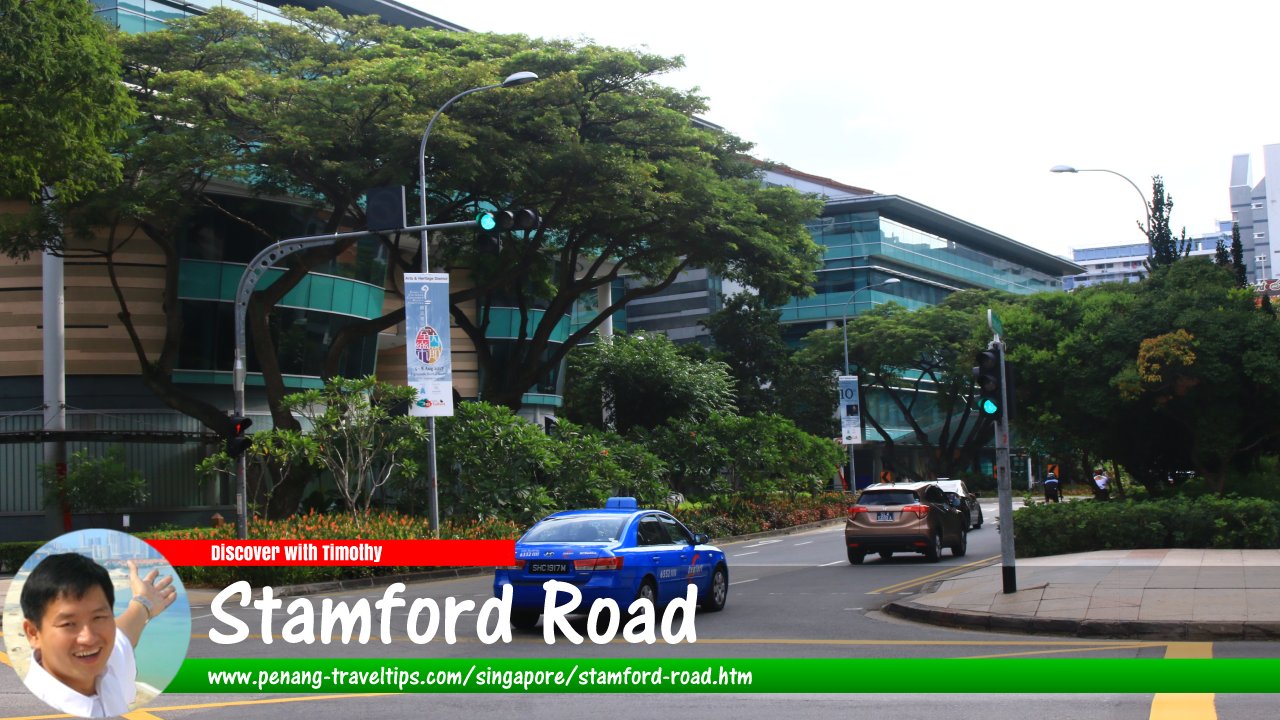 Stamford Road, Singapore (30 July 2017)
Stamford Road is one of the most historically significant roads in Singapore, stretching approximately 1 kilometre across the Downtown Core and Museum Planning Areas. Named after Sir Stamford Raffles, the founder of modern Singapore, the road has played a central role in the nation's development since the earliest years of British colonial rule. Today it connects the Civic District with the Orchard Road area, passing many of Singapore's best-known landmarks, government buildings, cultural institutions and commercial developments. Few roads in Singapore have witnessed as many defining moments in the nation's history as Stamford Road.
Beginning at the junction with Nicoll Highway and Raffles Avenue, Stamford Road runs westwards as a one-way road before ending at the junction of Orchard Road, Bencoolen Street and Fort Canning Road. Along the way it passes the Padang, St Andrew's Cathedral, the former Capitol Building, Stamford House, the National Museum precinct and numerous other historic sites. Although only a kilometre long, Stamford Road offers a journey through more than two centuries of Singapore's past, making it one of the country's most important heritage streets.1
Quick Facts
- Road Name: Stamford Road
- Length: Approximately 1 kilometre
- Planning Areas: Downtown Core and Museum
- Postal District: 2
- Road Type: Major one-way arterial road
- Direction: East to west
- Named After: Sir Stamford Raffles
- Former Name: Hospital Road
- Historic Hokkien Name: Lau Cui Kay (漏水街), meaning "Water Dripping Street"
- Nearest MRT Station: City Hall MRT Station (EW13 / NS25)
History
Long before modern Singapore emerged as a global city, the area occupied by Stamford Road formed part of the low-lying coastal plain immediately north of the Singapore River. Much of the land consisted of swamps, freshwater streams and gently rising ground leading towards Fort Canning Hill. When Sir Stamford Raffles established the British trading settlement in 1819, this area quickly became an important part of his vision for the new town.
The earliest alignment of today's Stamford Road appeared during the first decades of British rule. At the time it was known as Hospital Road because it led to Singapore's first military hospital, which stood on the slopes of Fort Canning Hill. The hospital served British troops stationed in the colony and became one of the settlement's earliest public institutions.2
As Singapore expanded throughout the nineteenth century, Hospital Road evolved into one of the principal thoroughfares connecting the European Town with newer residential and commercial districts further inland. Government offices, churches, schools and hotels gradually appeared along its route, transforming the road into one of the civic centre's principal streets.
The surrounding landscape also underwent dramatic changes. Streams were canalised, marshland reclaimed and roads widened to accommodate increasing traffic. Stamford Canal, which ran alongside sections of the road, became an important drainage channel but was notorious for overflowing during heavy rain. This recurring problem gave rise to the road's well-known Hokkien nickname.
Throughout the colonial period Stamford Road remained at the heart of civic life. Public processions, military parades, religious ceremonies and national celebrations frequently passed along the road or took place at nearby landmarks such as the Padang. During the Japanese Occupation (1942–1945), many of the buildings lining Stamford Road were commandeered by the occupying authorities, while others suffered damage during the war.3
Following the Second World War, Stamford Road entered a new phase of development. Modern office towers, hotels and shopping complexes gradually replaced many earlier buildings, while others were carefully conserved. The construction of Raffles City during the 1980s fundamentally changed the eastern section of the road, creating one of Singapore's largest mixed-use developments while preserving nearby landmarks such as St Andrew's Cathedral.
Today, Stamford Road continues to evolve while retaining its historical importance. It forms one of the principal roads through Singapore's Civic District, where colonial architecture stands alongside contemporary developments. Museums, hotels, universities, churches, theatres and commercial buildings coexist within a remarkably compact stretch of road, making Stamford Road one of the country's finest illustrations of how Singapore balances heritage conservation with urban renewal.
Stamford Road | Singapore Street History
The Origin of the Name
Stamford Road is named after Sir Stamford Raffles (1781–1826), whose arrival in Singapore on 29 January 1819 marked the beginning of modern Singapore as a British trading settlement. Although historians continue to recognise the important roles played by Malay rulers, local communities and other administrators in Singapore's development, Raffles remains closely associated with the establishment of the free port that transformed the island into one of the world's leading trading centres.4
The road was not always known by its present name. During the settlement's earliest years it was called Hospital Road, reflecting the presence of the military hospital nearby. As Singapore grew, the importance of Raffles' legacy led to numerous landmarks being named in his honour, including Stamford Road, Raffles Place, Raffles Hotel, Raffles Institution and, much later, Raffles Avenue.
Among Chinese residents, however, Stamford Road became better known by a completely different name. In Hokkien it was called Lau1 Cui1 Kay1 (漏水街)  , literally meaning "Water Dripping Street". The nickname referred not to leaking buildings but to Stamford Canal, whose waters frequently overflowed during periods of heavy rain. Before modern drainage improvements, flooding was a common occurrence in this part of Singapore, and the colourful Hokkien name remained in popular use for many decades.5
Today, both the official English name and the historic Hokkien nickname survive as reminders of two different aspects of Singapore's past—one reflecting the colonial administration and the other preserving the memories of the local Chinese community who lived and worked around the area.
Map of Stamford Road, Singapore
Sights along Stamford Road
- Capitol Building (GPS: 1.29357, 103.8515)

- Esplanade Park (GPS: 1.29074, 103.85419)

- National Museum of Singapore (GPS: 1.29663, 103.84858)

- Padang (GPS: 1.29134, 103.8533)

- Raffles City (GPS: 1.29395, 103.85326)

- Singapore Management University (GPS: 1.29529, 103.85043)

- St Andrew's Cathedral (GPS: 1.29237, 103.85222)

- Stamford Court (GPS: 1.29448, 103.85012)

- The Capitol Kempinski Hotel Singapore (GPS: 1.29404, 103.8508)

- War Memorial Park (GPS: 1.2928, 103.85468)

A Walk Along Stamford Road
Although Stamford Road measures only about one kilometre in length, it passes through one of the richest concentrations of historic landmarks in Singapore. Travelling from east to west, the road offers a remarkable cross-section of the nation's architectural, political and cultural development. Every few hundred metres, another chapter of Singapore's history unfolds.
From Nicoll Highway to War Memorial Park
Stamford Road begins at its eastern end at the junction with Nicoll Highway and Raffles Avenue. This section marks the transition between the Marina Centre precinct and Singapore's historic Civic District. Unlike many older roads that have retained their original surroundings, the eastern approach to Stamford Road has been transformed by extensive land reclamation and urban redevelopment over the past five decades.
Shortly after leaving the junction, motorists and pedestrians pass the distinctive War Memorial Park on the right. Dominating the park are the four soaring concrete columns of the Civilian War Memorial, unveiled in 1967 to commemorate civilians who lost their lives during the Japanese Occupation. Commonly nicknamed "The Chopsticks" by Singaporeans because of its appearance, the monument remains one of the country's most recognisable memorials. Every year on Total Defence Day and Remembrance Day, ceremonies continue to be held here to honour those who suffered during the Second World War.6
The Padang and the Civic District
Opposite War Memorial Park lies the Padang, one of Singapore's most historically significant open spaces. Since the nineteenth century, this large field has served as the venue for military parades, sporting competitions, public celebrations and national ceremonies. Singapore's first National Day Parade was held here in 1966, and many important milestones in the nation's history have taken place on or around the Padang.
The Padang is framed by several National Monuments, including the former City Hall, the Old Supreme Court Building, Victoria Theatre and Victoria Concert Hall. Together they form the architectural heart of Singapore's Civic District. Although these buildings front neighbouring roads rather than Stamford Road itself, they contribute greatly to the character of the area and are within easy walking distance.
St Andrew's Cathedral and Raffles City
The next major intersection is with St Andrew's Road and Beach Road. On the left stands St Andrew's Cathedral, Singapore's largest Anglican cathedral and one of the country's most important ecclesiastical buildings. Designed by Colonel Ronald MacPherson in the Gothic Revival style and completed in 1861, the cathedral has served generations of worshippers and remains one of Singapore's National Monuments.7
Directly opposite is Raffles City, one of Singapore's landmark integrated developments. Completed in 1986 and designed by internationally renowned architect I. M. Pei, the complex comprises office towers, a shopping centre, hotels and convention facilities. Its construction transformed this section of Stamford Road into one of Singapore's busiest commercial precincts while maintaining visual prominence for nearby heritage buildings.
Capitol Singapore and North Bridge Road
Continuing westwards, Stamford Road reaches its intersection with North Bridge Road. This crossroads has long been an important gateway between the Civic District and the historic commercial quarters to the north.
On the left stands Capitol Singapore, centred around the beautifully restored Capitol Building and the former Capitol Theatre. Originally completed in the early twentieth century, the Capitol Theatre became one of Singapore's premier cinemas and entertainment venues for many decades. Following extensive conservation and redevelopment works, the complex today combines heritage architecture with luxury residences, hospitality and retail spaces.
The surrounding streets preserve much of the atmosphere of colonial Singapore, where government offices, theatres, hotels and commercial buildings developed side by side during the late nineteenth and early twentieth centuries.
Stamford House
Beyond North Bridge Road stands Stamford House, one of the finest surviving examples of late nineteenth-century commercial architecture along Stamford Road. Designed in the 1890s by architect Regent Alfred John Bidwell, the elegant building originally served as offices before being carefully conserved during redevelopment of the surrounding area. Today it forms part of the Capitol Singapore development, demonstrating Singapore's commitment to integrating historic buildings into modern urban projects.
Stamford House is particularly admired for its decorative façade, arched windows and distinctive colonial detailing. Rather than being demolished, it was painstakingly restored and incorporated into the larger mixed-use development, preserving an important piece of the streetscape for future generations.
Victoria Street and Hill Street
The next intersection brings Stamford Road to Victoria Street on the right and Hill Street on the left. This has long been one of the busiest junctions in central Singapore, linking several important government, educational and commercial districts.
Across the junction is Stamford Court, another restored heritage development that originally served as residential flats before later being converted into commercial premises. Its conservation complements nearby Stamford House and Capitol Singapore, creating an attractive cluster of historic buildings amidst the modern city.
The vicinity also provides easy access to the Singapore Management University campus, the National Library precinct, Bras Basah's arts and educational district, and numerous museums located within walking distance.
Queen Street to Orchard Road
West of Victoria Street, Stamford Road becomes noticeably greener as it approaches the Museum Planning Area. The road crosses Queen Street before continuing towards its final junction with Bencoolen Street, Fort Canning Road and Orchard Road.
This western section lies close to the National Museum of Singapore, Singapore Art Museum's former premises, the YMCA, educational institutions and Fort Canning Hill. Although many motorists simply pass through this stretch, it serves as an important gateway between the historic Civic District and Singapore's premier shopping belt.
At its western end, Stamford Road seamlessly merges into Orchard Road, one of the world's best-known shopping streets. This transition symbolises Singapore's evolution from a nineteenth-century colonial settlement into a modern global city. Within the space of a single kilometre, Stamford Road connects the nation's historic heart with one of its most dynamic commercial districts.
The Character of Stamford Road Today
Modern Stamford Road is a fascinating blend of old and new. Although it remains an important one-way arterial road carrying traffic between Marina Centre and Orchard Road, it is equally valued as one of Singapore's principal heritage streets. Along its relatively short length stand colonial monuments, religious buildings, museums, educational institutions, luxury hotels, office towers and shopping complexes, illustrating more than two centuries of urban development.
Unlike many major roads in the city centre that are lined almost entirely with commercial skyscrapers, Stamford Road retains an unusually varied streetscape. Mature rain trees provide welcome shade along sections of the road, while carefully preserved colonial architecture sits comfortably alongside contemporary developments. This harmonious coexistence reflects Singapore's long-standing policy of conserving historically significant buildings while allowing the city to continue growing.
The road also forms part of Singapore's Civic District, an area recognised for its concentration of national monuments and institutions that have played key roles in the country's political, cultural and educational history. Walking along Stamford Road is therefore much more than a journey through the city centre—it is a walk through Singapore's collective memory.
Historic Buildings and Landmarks
Few roads in Singapore can rival Stamford Road for the number and variety of nationally significant landmarks found along or immediately beside it. Many of these buildings have become enduring symbols of Singapore.
War Memorial Park
Located near the eastern end of Stamford Road, War Memorial Park commemorates civilians who lost their lives during the Japanese Occupation of Singapore between 1942 and 1945. The Civilian War Memorial, with its four towering concrete pillars, has become one of the country's most recognisable monuments. Besides its historical importance, the park offers a quiet green space amidst the surrounding office towers and busy roads.
The Padang
Running alongside part of Stamford Road is the Padang, a large open field that has served as Singapore's ceremonial ground since the nineteenth century. It has hosted military parades, cricket matches, football games, National Day celebrations, state events and countless public gatherings. Several milestones in Singapore's journey to nationhood took place here, making the Padang one of the country's most historically important public spaces.
St Andrew's Cathedral
One of Singapore's finest examples of Gothic Revival architecture, St Andrew's Cathedral has stood beside Stamford Road since 1861. Its gleaming white spire has long been a landmark for travellers entering the city and remains one of the most photographed churches in Singapore. The cathedral continues to function as an active place of worship while also attracting visitors interested in its architecture and history.
Capitol Singapore
The beautifully restored Capitol Singapore complex combines several historic buildings with modern retail, hospitality and residential developments. The former Capitol Theatre was once among Singapore's premier cinemas, while the Capitol Building itself housed offices and commercial premises for generations. Their careful restoration demonstrates how heritage conservation can successfully coexist with modern urban redevelopment.
Stamford House and Stamford Court
Two of the road's most distinctive heritage buildings are Stamford House and Stamford Court. Both date from the late nineteenth century and have survived dramatic changes to the surrounding cityscape. Their elegant façades, decorative plasterwork and colonial architectural details provide a glimpse into the appearance of Singapore's commercial district during the Victorian era.
National Museum Precinct
Near the western end of Stamford Road lies Singapore's museum district. The National Museum of Singapore, founded in 1887, is the nation's oldest museum and presents exhibitions tracing Singapore's history from its earliest settlements to the present day. Nearby cultural institutions, galleries and educational establishments reinforce Stamford Road's role as an important gateway to Singapore's arts and heritage precinct.
Nearby Streets
Stamford Road is connected to several major roads that have themselves played important roles in Singapore's development. Together they form one of the most historically significant road networks in the country.
- Nicoll Highway marks the eastern entrance to Stamford Road and provides connections to Marina Centre, Kallang and the East Coast.
- Raffles Avenue, constructed during the redevelopment of Marina Centre, commemorates Sir Stamford Raffles just as Stamford Road does, although it is a much newer road.
- St Andrew's Road provides access to the National Gallery Singapore, the Padang and several important government buildings.
- Beach Road historically linked the city with the eastern coastline and remains one of Singapore's oldest thoroughfares.
- North Bridge Road has served as a principal route through the city since the nineteenth century and connects the Civic District with Kampong Glam and the northern suburbs.
- Hill Street is home to several historic government buildings, including the colourful former Hill Street Police Station.
- Victoria Street links the Bras Basah district with Bugis, Lavender and Jalan Besar, making it one of Singapore's busiest north-south routes.
- Queen Street has long been associated with schools, churches and transport services and forms part of the Bras Basah educational district.
- Bencoolen Street leads towards Bugis, Rochor and Little India, while the junction with Orchard Road marks the western end of Stamford Road.
Places to Visit Along Stamford Road
Because of its location at the heart of the Civic District, Stamford Road serves as an excellent starting point for exploring central Singapore. Many of the city's best-known attractions are located within a comfortable walking distance.
- National Gallery Singapore occupies the beautifully restored former Supreme Court and City Hall buildings overlooking the Padang.
- Asian Civilisations Museum, located a short walk away beside the Singapore River, houses one of Asia's finest collections of regional art and artefacts.
- Fort Canning Park preserves the hill where Singapore's rulers once resided and later where the British built Fort Canning. Today it is one of the city's most important historical parks.
- National Museum of Singapore offers immersive exhibitions on Singapore's history and culture.
- CHIJMES, a beautifully restored former convent and girls' school, is now a popular dining and lifestyle destination.
- Raffles City Shopping Centre provides hundreds of retail outlets, restaurants and direct connections to City Hall MRT Station.
These attractions make Stamford Road popular not only with office workers and residents but also with tourists, photographers, students and heritage enthusiasts. It is entirely possible to spend a full day exploring the area on foot while encountering many of Singapore's most significant historic sites.
A Living Timeline of Singapore
Perhaps no other road in Singapore illustrates the nation's evolution as clearly as Stamford Road. Beginning near land reclaimed during the twentieth century and ending beside Fort Canning Hill, where Singapore's modern story began in 1819, the road passes landmarks representing nearly every stage of the country's development.
Colonial churches stand beside contemporary shopping centres. National monuments overlook busy intersections. Heritage buildings continue to serve modern purposes, while museums preserve the stories behind them. As a result, Stamford Road functions not merely as a transportation corridor but as a living timeline of Singapore itself.
Real Estate and Property Market
Unlike many roads elsewhere in Singapore, Stamford Road is not primarily a residential address. Instead, it is dominated by government institutions, hotels, museums, commercial developments, educational establishments and heritage buildings. Residential properties are relatively scarce, making homes with a Stamford Road address particularly distinctive.
The best-known residential development is Stamford Residences, which forms part of the Capitol Singapore integrated development. Completed in 2018, it occupies the upper floors above The Capitol Kempinski Hotel Singapore and offers luxury apartments in one of the country's most prestigious city-centre locations. As of mid-2026, apartments typically range from approximately 700 to 2,500 sq ft (65 to 232 sq m), with resale prices commonly ranging from around SGD 2.2 million for smaller units to well over SGD 8 million for larger premium residences, depending on size, floor level and outlook.8
Rental demand is similarly strong because of the road's proximity to the Central Business District, Marina Bay and numerous government offices. Monthly rents generally range between SGD 5,500 and SGD 14,000, although exceptional penthouses and larger residences command considerably higher rents.
The surrounding precinct also contains several luxury hotels, Grade A office towers and mixed-use developments. Commercial property values rank among the highest in Singapore, reflecting the prestige of the Civic District and its excellent transport connectivity. Compared with residential districts elsewhere on the island, Stamford Road offers a distinctly urban lifestyle where cultural attractions, shopping centres, hotels and workplaces are all within walking distance.
Transport and Accessibility
Despite its relatively short length, Stamford Road enjoys some of the best public transport connectivity in Singapore. The principal station serving the road is City Hall MRT Station (EW13/NS25), an interchange between the East-West Line and North-South Line. Located near the junction with North Bridge Road and St Andrew's Road, it provides direct rail connections to the Central Business District, Orchard, Jurong East, Changi Airport (via transfer), Woodlands and Marina South.
Depending on which section of Stamford Road visitors are heading to, several other MRT stations are also within comfortable walking distance. Bras Basah MRT Station (CC2) serves the Circle Line, while Bencoolen MRT Station (DT21) on the Downtown Line is close to the western end of the road. Dhoby Ghaut MRT Station (NS24/NE6/CC1), one of Singapore's busiest interchanges, is also nearby, providing convenient access to three MRT lines.
Numerous public bus services operate along Stamford Road itself and on adjoining roads such as North Bridge Road, Beach Road, Victoria Street and Bras Basah Road. Bus stops are conveniently located near War Memorial Park, St Andrew's Cathedral, Capitol Singapore, SMU, the National Museum precinct and the Orchard Road junction, making almost every section of the road easily accessible by public transport.
For motorists, Stamford Road provides direct access to Nicoll Highway, Orchard Road and the surrounding road network of the Civic District. Nearby expressways, including the Marina Coastal Expressway (MCE), East Coast Parkway (ECP) and Central Expressway (CTE), can all be reached within a short drive.
Fun Facts About Stamford Road
- It was originally called Hospital Road. The earliest name reflected the military hospital that once stood on nearby Fort Canning Hill before the road was renamed in honour of Sir Stamford Raffles.2
- It had a colourful Hokkien nickname. Chinese residents knew it as Lau Cui Kay (漏水街), meaning "Water Dripping Street", because Stamford Canal frequently overflowed after heavy rain.
- It passes an extraordinary concentration of National Monuments. Within a short walk of Stamford Road are St Andrew's Cathedral, the Padang, the former City Hall, the former Supreme Court, the Capitol Theatre and several other historically significant buildings.
- It has witnessed more than two centuries of Singapore's history. Since the early nineteenth century, Stamford Road has seen colonial expansion, royal visits, wartime occupation, independence celebrations and the transformation of Singapore into a global city.
- It is one of Singapore's most photographed streets. Countless postcards, travel guides, newspaper photographs and historical images have featured Stamford Road and the landmarks that line it.
- Several famous institutions bear the Stamford name. Besides Stamford Road itself, Sir Stamford Raffles is commemorated through Raffles Place, Raffles Hotel, Raffles Institution, Raffles Avenue and numerous other landmarks throughout Singapore.
Conclusion
Stamford Road is far more than a route connecting Marina Centre with Orchard Road. It is one of Singapore's defining historic streets, tracing the city's remarkable transformation from a small colonial trading settlement into one of the world's leading global cities. Along its one-kilometre length are monuments to government, religion, education, commerce, culture and national identity, each representing a different chapter of Singapore's story.
Whether admired for its elegant colonial architecture, visited for its museums and historic landmarks, or simply travelled as part of the daily commute, Stamford Road continues to occupy a unique place in Singapore's urban landscape. For residents, visitors and students of history alike, few roads offer such a rich and continuous narrative of the nation's past while remaining an essential part of its present.
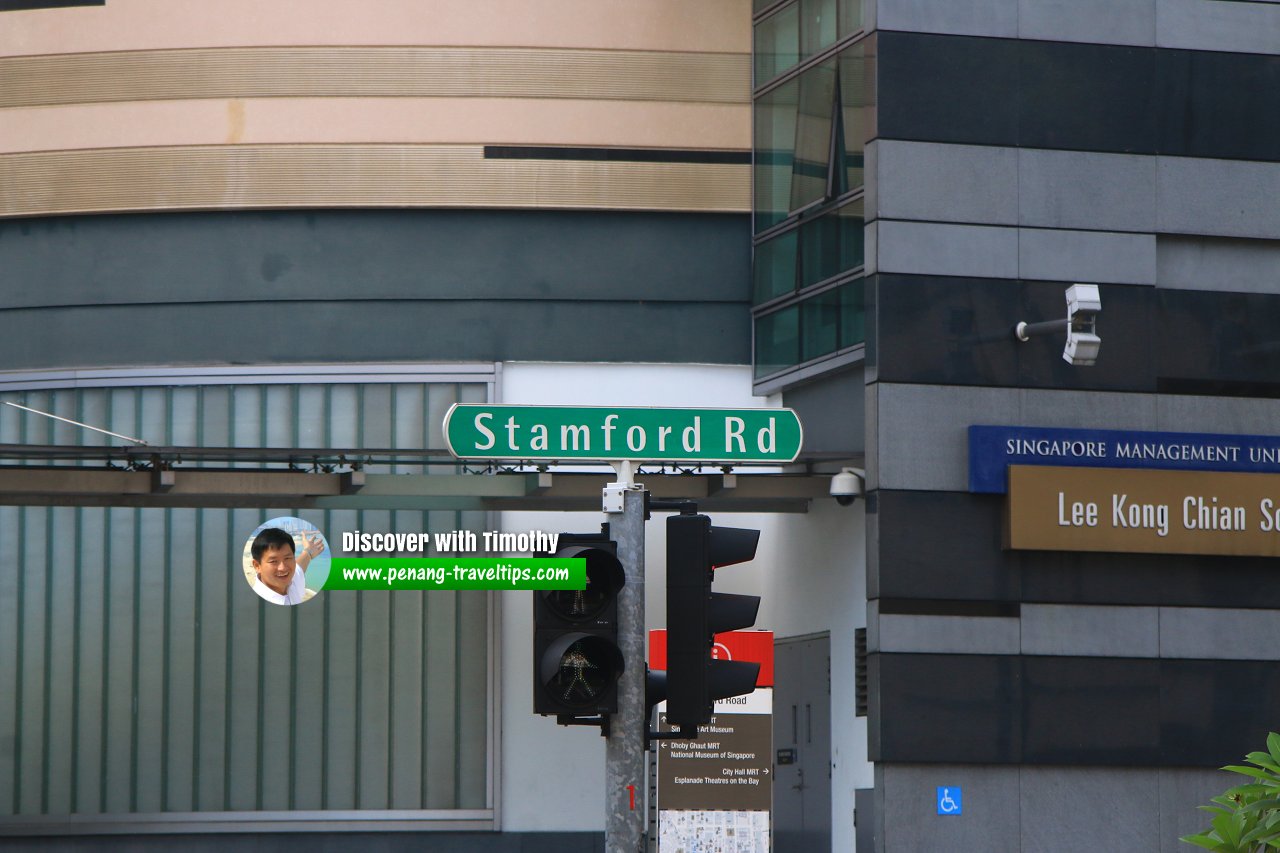 Stamford Road roadsign (30 July 2017)
References
- Singapore Land Authority – OneMap
- National Library Board Singapore Infopedia – Stamford Road and Early Singapore
- National Heritage Board – Singapore During the Japanese Occupation
- Savage, Victor R. & Yeoh, Brenda S.A. Singapore Street Names: A Study of Toponymics. Marshall Cavendish.
- Ng, Yew Peng. What's in the Name? How the Streets and Villages in Singapore Got Their Names. World Scientific.
- National Heritage Board – Civilian War Memorial
- St Andrew's Cathedral Singapore
- Urban Redevelopment Authority – Property Market Information
- PropertyGuru Singapore – Residential Market Listings (2026)
- Land Transport Authority – MRT and Bus Network
- National Gallery Singapore
- National Museum of Singapore
Page Details
This page was created on 11 July 2026. Hi, my name is Timothy and created it from my research, for my own entertainment, knowledge and to satisfy my curiosity. I am providing the information to you in good faith and hope it is useful. I try to get the details as accurate as possible. I also try to update the page whenever I stumble on new details. So this and all my other pages are perpetual work in progress. If you discover any error, please politely inform me, pointing out where the error lies, and I will correct it as soon as possible. Your helpfulness will keep this page accurate, relevant and helpful to those who need the information.Streets of Singapore Directory
My videos of Singapore
Want to share your Singapore travel experiences or get tips from fellow travellers?
Join the Singapore Travel Tips Facebook GroupMore information for visiting and living in Singapore
Here are some related articles to help you get to know Singapore better.- Cost of Living in Different Singapore Neighbourhoods (2025 Guide)
- EZ-Link Card
- Owning a Car in Singapore
- Singapore MRT Map & Guide 2025
- Singapore Postal Districts and Postcodes
- Singapore Tourist Pass
- Taking the Bus in Singapore: A Visitor's Guide
- Understanding CCR, RCR and OCR in Singapore real estate
 Latest Pages & Updates
Buy Me A Coffee
If you enjoy the information I provide and want to support the work I do, please buy me a coffee! I appreciate it immensely, thank you so much!
