
Museum Planning Area Travel Guide
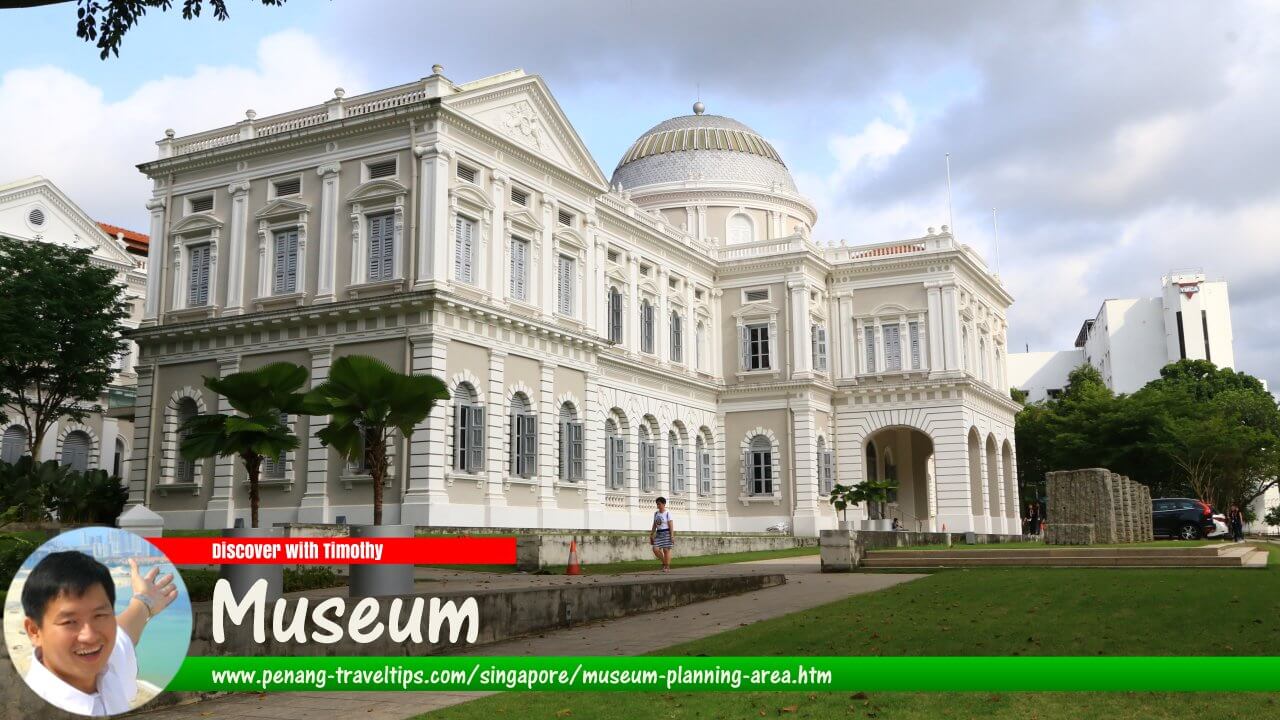 Museum Planning Area, Singapore (30 July 2017)
The Museum Planning Area (Simplified Chinese: 博物馆, Traditional Chinese: 博物館, Pinyin: Bówùguǎn, Malay: Kawasan Perancangan Muzium, Tamil: அருங்காட்சியகம் திட்டப்பகுதி) is a compact but culturally significant district in the Central Region of Singapore. Encompassing just 0.83 square kilometres, it is home to Singapore’s premier museums and heritage landmarks. As of 2020, the Museum Planning Area has a modest residential population of about 1,450 people1. It falls within Postal District 7 and serves as an essential gateway to the nation’s history, arts, and cultural identity.
History of the Museum Planning Area
The Museum Planning Area was formally designated in Singapore’s urban planning framework to preserve and enhance the cluster of national museums and heritage institutions in the Bras Basah–Bugis district. This zone has long been associated with colonial-era schools, churches, and government buildings. In the late 20th century, many of these historic structures were conserved and repurposed into museums and cultural venues. Today, the Museum Planning Area stands as a cultural precinct that attracts both locals and international visitors.
Name and Pronunciation
The name “Museum” reflects the area’s concentration of national museums and cultural landmarks. It is pronounced Myoo-zee-uhm, with the International Phonetic Alphabet (IPA) transcription /mjuːˈziːəm/.
Geography and Boundaries
The Museum Planning Area lies just outside the Downtown Core. It is bordered by the Rochor Planning Area to the northeast, Kallang Planning Area to the east, and Novena Planning Area further north. Major roads such as Stamford Road, Bras Basah Road, and Bencoolen Street frame the district. Its compact geography makes it a walkable area, with cultural attractions situated close to one another.
Subzones of the Museum Planning Area
The Museum Planning Area comprises three subzones namely Bras Basah, Dhoby Ghaut and Fort Canning.Transport and Accessibility
The Museum Planning Area is well connected by public transport. MRT stations nearby include:
- Bras Basah MRT Station (Circle Line)
- Bencoolen MRT Station (Downtown Line)
- Dhoby Ghaut MRT Station (North South Line, North East Line, Circle Line)
Bus services also connect the precinct to other cultural areas such as Bugis, Orchard, and City Hall.
Residential Real Estate
The Museum Planning Area is not primarily residential, but it does have some mixed-use developments. As of 2025, private condominiums in the vicinity command premium prices, averaging between SGD 2,300–2,800 per square foot2. A 1,000 sq ft (92.9 sq m) apartment could cost between SGD 2.3 million and SGD 2.8 million. Rental rates for similar properties are in the range of SGD 5,000–6,500 per month. Given its central location and proximity to arts and cultural attractions, residential demand here is driven mainly by professionals and expatriates.
Landmarks and Attractions
The Museum Planning Area is home to some of Singapore’s most iconic cultural and heritage institutions:
- National Museum of Singapore – The nation’s oldest museum, showcasing Singapore’s history from the 14th century to the present.
- Singapore Art Museum (SAM) – Dedicated to contemporary art, with international exhibitions and collections.
- Peranakan Museum – Celebrating Peranakan heritage, arts, and culture.
- Armenian Church – The oldest Christian church in Singapore, completed in 1835.
- Cathedral of the Good Shepherd – A national monument and seat of the Catholic Archdiocese of Singapore.
Community and Lifestyle
While its residential base is small, the Museum Planning Area thrives as a cultural and educational hub. Its heritage buildings, galleries, and event spaces attract students, artists, tourists, and history enthusiasts. Festivals and cultural events frequently take place in the district, strengthening its reputation as the heart of Singapore’s arts and heritage scene.
Where to Stay
The Museum Planning Area is an excellent place to stay for visitors interested in Singapore's museums, history, arts and central-city attractions. Unlike some of the more peripheral planning areas, Museum has several hotels within or immediately around its boundaries, particularly around Dhoby Ghaut and Fort Canning. Its central location also makes it possible to walk to Orchard Road, the Civic District and the Bras Basah arts and cultural precinct.
Hotel Fort Canning is one of the most distinctive choices. Set within the grounds of historic Fort Canning Park, the hotel gives visitors an unusually green and peaceful environment while remaining close to Dhoby Ghaut and the city centre. It is particularly suitable for visitors who want a hotel with a sense of place rather than a conventional high-rise city hotel.
YOTEL Singapore Orchard Road, although in the neighbouring Orchard Planning Area, is another practical option for visitors who want to explore Museum. It is close to Orchard Road and has convenient MRT connections, while Museum's Dhoby Ghaut attractions are only a short journey away.
Hotel Mi Rochor and hotels around Bencoolen provide further alternatives just beyond the planning area's eastern boundary. These are particularly useful for visitors who want to remain in the central area while looking for accommodation at a somewhat lower price than the major luxury hotels around Orchard Road.
Rendezvous Hotel Singapore, near Dhoby Ghaut, is another established hotel choice. Its location makes it particularly convenient for visitors who want to combine the Museum Planning Area with Orchard Road, Bras Basah, Bugis and the Civic District.
For visitors wanting a more luxurious experience, the hotels around Orchard Road and the Downtown Core provide many alternatives. However, staying around Dhoby Ghaut or Fort Canning has the advantage of placing you immediately beside many of the Museum Planning Area's principal attractions.
Transport is another major advantage. Dhoby Ghaut MRT Station is one of Singapore's most important interchange stations, serving the North South, North East and Circle lines. This makes Museum an especially convenient base for visitors who intend to explore different parts of Singapore rather than remaining in the city centre.
What to Eat
Food is one of the easiest things to find in and around Museum. The planning area contains restaurants, cafés and food outlets around Dhoby Ghaut, while Plaza Singapura provides a particularly large concentration of restaurants under one roof. URA's current guidelines specifically encourage food and beverage and other activity-generating uses along important pedestrian routes in the planning area.1
Plaza Singapura is particularly useful for visitors because it offers a mixture of Chinese, Japanese, Korean, Vietnamese, Thai, Western and Singaporean food. A recent food guide lists more than a dozen notable restaurants in the mall, including Tamoya Udon & Tempura, Co Chung Restaurant, Nanjing Impressions, Five Guys, Go-Ang Pratunam Chicken Rice and several other choices.2
The area is also suitable for visitors seeking halal food. There are halal and Muslim-friendly choices in the wider Dhoby Ghaut, Bencoolen and Bras Basah area, while a short walk or MRT journey towards Bugis and Kampong Glam opens up one of central Singapore's largest concentrations of halal Malay, Indonesian and Middle Eastern food.
For inexpensive food, it is worth moving slightly beyond the large shopping malls. Fortune Centre near Middle Road is particularly well known for its vegetarian restaurants and cafés. It is a useful alternative for visitors who want something different from the standard mall food court, and local diners continue to recommend it as a destination for vegetarian food.3
The neighbouring Bras Basah and Bugis area also provides a much wider selection of local food. Waterloo Centre, Queen Street and Albert Centre are all within easy walking distance or a short bus ride from Museum, making them useful alternatives when visitors want inexpensive everyday Singaporean food.
Where to Eat
These are some of the places worth considering when staying in or exploring the Museum Planning Area and its immediate surroundings:
- Nanjing Impressions at Plaza Singapura – A popular Chinese restaurant specialising in Nanjing cuisine. It is a good choice for visitors who want something more distinctive than generic mall Chinese food and has attracted a large number of customer reviews.4
- Co Chung Restaurant at Plaza Singapura – A Vietnamese restaurant that has developed a strong local following. It is particularly known for its pho and other Vietnamese dishes, and local diners have frequently recommended it when discussing where to eat at Plaza Singapura.5
- Tamoya Udon & Tempura at Plaza Singapura – A casual Japanese restaurant specialising in udon and tempura. It is a useful choice for a quick and relatively straightforward meal.
- Go-Ang Pratunam Chicken Rice at Plaza Singapura – A Thai-style chicken rice restaurant offering a variation on one of Singapore's favourite everyday dishes. It is particularly useful for visitors who want an inexpensive casual meal.
- Bizen Wagyu & Salad Bar at Plaza Singapura – A Japanese-style buffet and steakhouse offering beef, salads and other dishes. It is more substantial and expensive than the casual food outlets in the mall and is suitable for a leisurely meal.6
- Fortune Centre – Rather than recommending one particular restaurant, I would recommend exploring the building itself. It has become a well-known destination for vegetarian food, with several vegetarian and vegan restaurants and cafés in one compact location.3
- New Station Rice Bar – A casual local-style eatery in the Bras Basah area. It is useful for visitors looking for a straightforward rice meal rather than a formal restaurant.
- Waterloo Centre food outlets – The centre and surrounding streets provide several inexpensive food choices and are particularly useful for visitors exploring the temples, churches and cultural attractions around Waterloo Street.
- Albert Centre Market & Food Centre – Just beyond the Museum Planning Area in the neighbouring Rochor Planning Area, Albert Centre is a good place to look for inexpensive hawker food, including Malay and Muslim-owned stalls. It is a particularly useful nearby option for visitors seeking halal food.
- Chin Chin Eating House – A long-established chicken rice restaurant in the broader Bras Basah and Bugis area. It is worth considering for visitors who want a traditional Singaporean chicken rice meal.
- Entre-Nous Crêperie – A small French crêperie around the Bras Basah and Bugis area, offering savoury and sweet crêpes. It provides a pleasant alternative to the area's Asian restaurants.3
- Food outlets around Bencoolen – The Bencoolen area immediately east of Museum has numerous casual restaurants, cafés and food courts. It is particularly convenient for visitors staying near Fort Canning or Dhoby Ghaut who want something quick without travelling far.
If you have only one meal in the Museum Planning Area, I would suggest choosing according to the kind of experience you want. Co Chung is a good choice for Vietnamese food, Nanjing Impressions for Chinese cuisine, and Tamoya Udon & Tempura for a casual Japanese meal. If you want inexpensive local food, walk towards Waterloo Street, Albert Centre or the surrounding Bras Basah and Bugis streets.
For visitors who prefer vegetarian food, Fortune Centre deserves special mention. The building has become something of a vegetarian-food destination, and recent local recommendations continue to point visitors towards it when looking for vegetarian choices in central Singapore.3
For Muslim visitors, the Museum Planning Area itself has fewer concentrated halal choices than Kampong Glam, but that is not a serious disadvantage. Bugis and Kampong Glam are very close, and the Albert Centre and surrounding streets also provide halal Malay and Muslim-owned food options. This makes Museum a practical base even for visitors who specifically want halal food.
One further advantage of Museum is that you are never far from another dining district. If the food around Dhoby Ghaut does not appeal to you, Orchard Road is immediately to the west, Bras Basah and Bugis are just to the east, and the Downtown Core is within easy reach. You therefore have an enormous range of food within a relatively small area.
Making the Most of Your Stay
The Museum Planning Area is particularly well suited to visitors who enjoy combining museums, heritage, architecture, parks and food. Rather than treating the museums as isolated attractions, it is possible to walk between them while experiencing some of the oldest parts of central Singapore.
Begin at National Museum of Singapore, where you can explore the history of Singapore before walking towards Fort Canning. The hill provides a dramatic contrast to the surrounding city, with mature trees, archaeological remains and historic landmarks.
From Fort Canning, you can descend towards the Peranakan Museum and the Civic District. The museum occupies the former Tao Nan School building and provides an introduction to Peranakan culture and heritage. Nearby are the Singapore Art Museum, the former Saint Joseph's Institution and numerous other historic buildings.
Dhoby Ghaut itself is worth exploring as a transport and commercial centre. Plaza Singapura sits beside the MRT interchange and provides a convenient place to rest, eat and shop between cultural attractions.
The planning area also forms part of the wider Bras Basah.Bugis arts and cultural district. The district straddles the Museum and Rochor planning areas and contains numerous educational, arts, heritage and cultural institutions.7
One of the pleasures of the Museum Planning Area is that it is surprisingly green for somewhere so central. URA describes it as an institutional hub and the “green lung” of the Central Area, with Fort Canning Park forming an important component of that landscape.8
Fort Canning is especially enjoyable in the early morning or late afternoon. During the middle of the day, the combination of tropical heat and the hill's slopes can make walking more tiring, so visitors may prefer to visit the museums during the hotter hours and explore the park later.
Another attraction of the area is its concentration of historic buildings. The planning area contains numerous conserved structures and national monuments, making even an ordinary walk between attractions an opportunity to see Singapore's architectural history.
For visitors who enjoy theatre and live performance, the planning area and its immediate surroundings also provide access to venues such as Fort Canning Park and the Dhoby Ghaut cultural precinct. The area's combination of arts, education, heritage and entertainment is precisely why URA continues to envision Museum as an institutional and cultural hub.
There is also a strong connection with Orchard Road. Dhoby Ghaut effectively forms a gateway between the historic Civic District and Singapore's principal shopping boulevard. A visitor staying at Museum can therefore combine a morning of museums and heritage with an afternoon of shopping without needing to make a long journey.
In practical terms, Museum is one of the best central planning areas for visitors who want to explore Singapore on foot. Its attractions are close together, several MRT lines converge at Dhoby Ghaut, and neighbouring areas provide an enormous range of additional hotels, restaurants and cultural attractions.
For a full day, I would suggest starting at the National Museum, walking through Fort Canning Park, visiting the Peranakan Museum and other Civic District attractions, stopping for lunch around Dhoby Ghaut or Bras Basah, and then continuing towards Bugis or Orchard Road. In the evening, return to Fort Canning or Dhoby Ghaut for dinner and drinks.
The Museum Planning Area is therefore much more than a collection of museums. It is a compact cultural landscape where Singapore's history, greenery, architecture, education, entertainment and modern city life meet. Its excellent transport and large selection of nearby accommodation and food make it one of the most convenient central districts for visitors who want to discover the historical side of Singapore.
Accommodation and Food References
- Urban Redevelopment Authority – Museum Planning Area
- HungryGoWhere – Plaza Singapura Food Guide
- Reddit – Recent food recommendations around Bras Basah and Museum
- STAMPEDE – Nanjing Impressions
- Reddit – Local recommendations for Plaza Singapura restaurants
- Chope – Bizen Wagyu & Salad Bar
- Urban Redevelopment Authority – Rochor and Bras Basah.Bugis
- Urban Redevelopment Authority – Guidelines for Museum Planning Area
Fun Facts
The National Museum of Singapore first opened in 1887 as the Raffles Library and Museum3. Its neoclassical building remains a cultural icon of the city.
Map of the Museum Planning Area, Singapore
MRT Stations in the Museum Planning Area, Singapore
- Bras Basah MRT Station (GPS: 1.29757, 103.8505)

- Dhoby Ghaut MRT Station (GPS: 1.29859, 103.84599)

Sights in the Museum Planning Area, Singapore
- Armenian Church (GPS: 1.29314, 103.84933)

- Cathedral of the Good Shepherd (GPS: 1.2961, 103.8511)
- Central Fire Station (GPS: 1.2923, 103.84904)

- Church of the Sacred Heart (GPS: 1.296, 103.84361)

- Dhoby Ghaut Green (GPS: 1.29826, 103.84601)

- Istana Park (GPS: 1.29928, 103.84387)

- Lazada One (GPS: 1.29787, 103.85013)

- Orchard Road Presbyterian Church (GPS: 1.29789, 103.84753)
- Red Cross House (GPS: 1.29728, 103.84449)

- Rendezvous Hotel Singapore (GPS: 1.29851, 103.84931)

- School of the Arts Singapore - SOTA (GPS: 1.29936, 103.84862)

- The Cathay Cineplex (GPS: 1.29944, 103.84771)

- Singapore Shopping Centre (GPS: 1.29816, 103.84413)

- Sri Thendayuthapani Temple (GPS: 1.29431, 103.84305)

- Teochew Building (GPS: 1.29543, 103.84343)

- The MacDonald House (GPS: 1.29914, 103.84617)

- VisionCrest Commercial (GPS: 1.29902, 103.84262)

Streets in the Museum Planning Area, Singapore
- Armenian Street
- Bencoolen Street
- Bras Basah Road
- Central Expressway
- Fort Canning Link
- Fort Canning Tunnel
- Hill Street
- Loke Yew Street
- Orchard Road
- Penang Road
- Prinsep Street
- Queen Street
- River Valley Road
- Stamford Road
- Victoria Street
- Waterloo Street
Quick Facts
- Size: 0.83 sq km
- Population: ~1,450 (2020)
- Postal District: 7
- Name Origin: Derived from its concentration of museums and cultural landmarks
- Pronunciation: Myoo-zee-uhm (/mjuːˈziːəm/)
- Main Roads: Stamford Road, Bras Basah Road, Bencoolen Street
- Main MRT Stations: Bras Basah, Bencoolen, Dhoby Ghaut
- Key Landmarks: National Museum, Singapore Art Museum, Peranakan Museum, Armenian Church
References
- Singapore Department of Statistics – Population Data
- PropertyGuru – Central Area Property Prices
- NLB Infopedia – National Museum of Singapore
Page Details
This page was created on 8 September 2025. Hi, my name is Timothy and created it from my research, for my own entertainment, knowledge and to satisfy my curiosity. I am providing the information to you in good faith and hope it is useful. I try to get the details as accurate as possible. I also try to update the page whenever I stumble on new details. So this and all my other pages are perpetual work in progress. If you discover any error, please politely inform me, pointing out where the error lies, and I will correct it as soon as possible. Your helpfulness will keep this page accurate, relevant and helpful to those who need the information.My videos of Singapore
Want to share your Singapore travel experiences or get tips from fellow travellers?
Join the Singapore Travel Tips Facebook GroupMore information for visiting and living in Singapore
Here are some related articles to help you get to know Singapore better.- Cost of Living in Different Singapore Neighbourhoods (2025 Guide)
- EZ-Link Card
- Owning a Car in Singapore
- Singapore MRT Map & Guide 2025
- Singapore Postal Districts and Postcodes
- Singapore Tourist Pass
- Taking the Bus in Singapore: A Visitor's Guide
- Understanding CCR, RCR and OCR in Singapore real estate
 Latest Pages & Updates
Buy Me A Coffee
If you enjoy the information I provide and want to support the work I do, please buy me a coffee! I appreciate it immensely, thank you so much!
