
Pan Island Expressway (PIE), Singapore
The Pan Island Expressway (PIE) is the oldest and longest expressway in Singapore. Stretching across the island from east to west, it serves as a critical transport artery, linking major residential and industrial areas while facilitating rapid travel between the eastern, central, and western regions. Completed in phases beginning in the 1960s, the PIE has shaped the nation’s modern road network and continues to evolve with widening and upgrading projects.
Overview of the PIE
The Pan Island Expressway runs approximately 42.8 km across the island, making it the longest expressway in Singapore. Its eastern terminus lies in the Bedok Planning Area, near the junction with East Coast Parkway and Changi Road. From there, it extends westward, passing through central areas such as Toa Payoh, Novena, and Bishan, before finally reaching Tuas in the far west. The PIE connects seamlessly to other major expressways, including the Central Expressway (CTE), Ayer Rajah Expressway (AYE), and Tampines Expressway (TPE).
Carrying six to eight lanes of traffic in many sections, the PIE handles some of the heaviest daily traffic volumes in Singapore. It serves not only private cars but also a large share of logistics, goods transport, and public bus services.
Connecting Streets
- Adam Road
- Bendemeer Road
- Boon Lay Way
- Central Expressway
- East Coast Parkway
- Jalan Bahar
- Jalan Eunos
- Lorong 2 Toa Payoh
- MacPherson Road
- North-South Corridor
- Kallang Bahru
- Kallang-Paya Lebar Expressway
- Paya Lebar Road
- Serangoon Road
- Simei Avenue
- Thomson Road
- Upper Serangoon Road
- Whitley Road
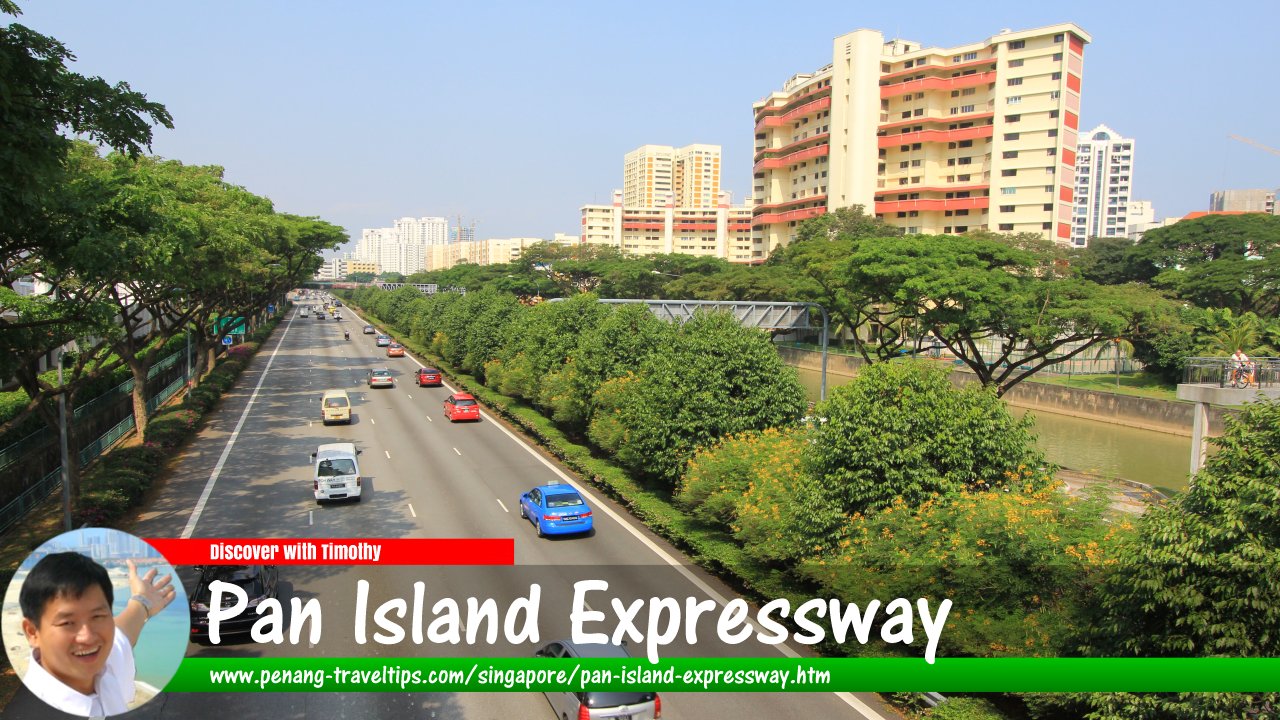 Pan Island Expressway, Singapore (11 July 2011)
History and Development
Construction of the PIE began in 1964, making it Singapore’s first expressway. The first section, linking Mount Pleasant to Paya Lebar, was opened in 19691. Over the following decades, the expressway was extended in stages both eastwards and westwards until it reached its full length by the 1980s.
The government undertook frequent upgrading works to expand the PIE from its original four lanes to today’s six or more lanes in many stretches. These upgrades were necessary to keep up with the island’s rapid urbanisation and vehicle growth. In recent years, improvements included reconfiguring exits and entrances for smoother traffic flow and integrating with newer expressways such as the North-South Corridor, currently under construction.
Name and Pronunciation
The name “Pan Island” reflects its role as a road that traverses the entire island from east to west. It is commonly abbreviated as PIE, pronounced as the English word /paɪ/ in the International Phonetic Alphabet (IPA). This simple pronunciation has made it one of the most recognisable expressway names among locals and visitors alike.
Character of the Expressway and Surroundings
Travelling on the PIE offers a cross-sectional view of Singapore’s diverse landscapes. In the east, motorists pass residential towns like Bedok and Tampines, with exits leading to commercial hubs and East Coast Road. In the central region, the expressway skirts the Central Water Catchment, where greenery flanks both sides. Moving westward, the PIE serves Yishun, Jurong, and Tuas, areas known for heavy industry and port facilities.
The expressway’s character is one of constant motion—fast-paced, heavily utilised, and central to daily life. For many commuters, the PIE symbolises the pulse of urban movement in Singapore.
Interesting Sights Along the PIE
While designed for speed and efficiency rather than leisure, the PIE runs close to several notable landmarks:
- MacRitchie Reservoir – Near the central stretches, providing lush greenery and a glimpse of Singapore’s oldest reservoir.
- Bishan-Ang Mo Kio Park – Accessible via nearby exits, one of the largest urban parks in the city.
- Jurong East commercial hub – A growing business and retail cluster in the west.
- East Coast Park – Easily reached from the PIE’s eastern end via the East Coast Parkway.
Real Estate Along the PIE
Properties near the PIE vary significantly depending on location. In the central regions, such as Toa Payoh and Novena, condominiums and HDB flats command higher values due to their proximity to the city. As of September 2025, resale HDB flats in Toa Payoh average around S$750,000 for a 4-room flat (approx. 1,000 sq ft / 93 sq m)2. Condominiums in nearby Bishan or Novena often fetch over S$1,800 per square foot (psf), meaning a 1,200 sq ft (111 sq m) unit may cost over S$2.1 million.
In contrast, homes in the western stretches, such as Jurong, are relatively more affordable, with condominiums averaging S$1,300 psf. Rental prices also reflect this, with typical 3-bedroom units near the PIE renting from S$3,500 to S$6,000 per month depending on proximity to the city.
Public Transport Connections
Although primarily serving vehicular traffic, the PIE is closely aligned with several MRT stations on major lines. These include:
- Braddell MRT Station and Toa Payoh MRT Station – both on the North South Line.
- Stations in Jurong East on the East West Line.
- Interchanges such as Bishan (Circle Line and North South Line).
Bus services also operate on parallel roads and across interchanges near the PIE, ensuring smooth connectivity between towns.
Fun Facts
One fun fact about the PIE is that, despite being the longest expressway in Singapore, it can be crossed from end to end in under an hour during light traffic. However, during peak hours, it is also one of the most congested routes, sometimes jokingly referred to by locals as the “Parking Island Expressway.”
Quick Facts
- Length: 42.8 km
- First section opened: 1969
- Eastern end: Bedok / East Coast Parkway
- Western end: Tuas
- Main connections: AYE, CTE, TPE, ECP
- Districts traversed: Multiple, including Toa Payoh, Bishan, Bedok, Novena, Jurong
- Nearest MRT lines: North South Line, East West Line, Circle Line
- Character: Oldest and longest expressway, heavy traffic artery
References
- National Library Board Singapore – Pan Island Expressway
- Singapore Real Estate Exchange (SRX) – Property Prices
Map of Pan Island Expressway, Singapore
Pan Island Expressway Singapore on Google Street View
Pan Island Expressway Singapore (Nov 2022)Page Details
This page was modified on 6 September 2025. Hi, my name is Timothy and created it from my research, for my own entertainment, knowledge and to satisfy my curiosity. I am providing the information to you in good faith and hope it is useful. I try to get the details as accurate as possible. I also try to update the page whenever I stumble on new details. So this and all my other pages are perpetual work in progress. If you discover any error, please politely inform me, pointing out where the error lies, and I will correct it as soon as possible. Your helpfulness will keep this page accurate, relevant and helpful to those who need the information.Streets of Singapore Directory
My videos of Singapore
Want to share your Singapore travel experiences or get tips from fellow travellers?
Join the Singapore Travel Tips Facebook GroupMore information for visiting and living in Singapore
Here are some related articles to help you get to know Singapore better.- Cost of Living in Different Singapore Neighbourhoods (2025 Guide)
- EZ-Link Card
- Owning a Car in Singapore
- Singapore MRT Map & Guide 2025
- Singapore Postal Districts and Postcodes
- Singapore Tourist Pass
- Taking the Bus in Singapore: A Visitor's Guide
- Understanding CCR, RCR and OCR in Singapore real estate
 Latest Pages & Updates
Buy Me A Coffee
If you enjoy the information I provide and want to support the work I do, please buy me a coffee! I appreciate it immensely, thank you so much!
