
Toa Payoh Travel Guide
The Toa Payoh Planning Area (Simplified Chinese: 大巴窑, Traditional Chinese: 大巴窯, Pinyin: Dàbāyáo, Malay: Toa Payoh, Tamil: தோ பாயோ) is a planning area and residential town located in the Central Region of Singapore. It is one of Singapore’s most historic housing estates, covering an area of about 8.17 square kilometres, and is home to a population of over 105,000 residents. Toa Payoh is notable as the first town developed entirely by the Housing & Development Board (HDB), making it a showcase of Singapore’s public housing efforts since the 1960s.
History of Toa Payoh
The name “Toa Payoh” comes from the Hokkien dialect, meaning “big swamp,” a reference to the area’s original swampy terrain. Before redevelopment, the area was a kampong with attap houses, pig farms, and vegetable plots. In 1964, Toa Payoh became the site of Singapore’s first large-scale public housing project by the newly formed HDB. The town was officially opened in 1968, and over the years, it became an important milestone in Singapore’s urbanisation story.
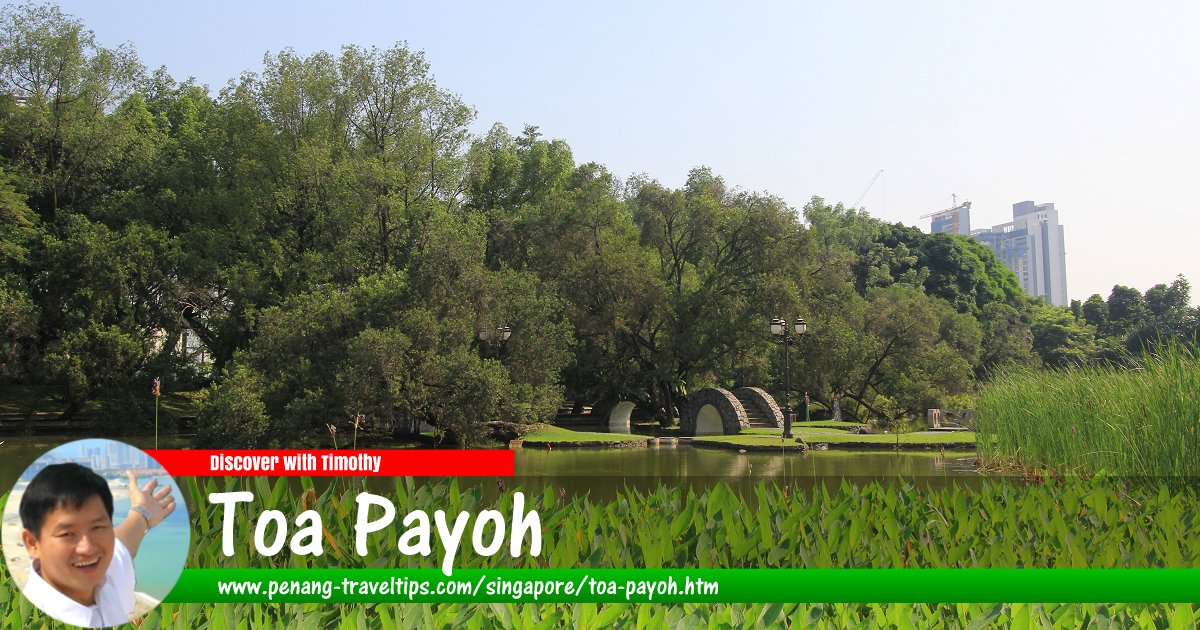 View of the Toa Payoh Town Park in Toa Payoh, Singapore (11 July 2011)
Toa Payoh is also historically significant for being the place where Queen Elizabeth II visited in 1972 and 2006 to view Singapore’s public housing success. The estate is often used to showcase Singapore’s housing policies to visiting dignitaries.
Geography and Boundaries
Toa Payoh is centrally located in Singapore, bordered by Bishan to the north, Novena and Kallang to the south, Geylang to the east, and Bukit Timah to the west. Its central position and strong transport links make it a highly accessible town, well connected to the rest of Singapore.
Subzones of Toa Payoh
- Bidadari
- Boon Teck
- Braddell
- Joo Seng
- Kim Keat
- Lorong 8 Toa Payoh
- Pei Chun
- Potong Pasir
- Sennett
- Toa Payoh Central
- Toa Payoh West
- Woodleigh
Residential Development
As the first HDB new town, Toa Payoh set the blueprint for subsequent towns in Singapore. The estate features a mix of older slab-blocks, point-blocks, and newer developments under the HDB’s upgrading programmes. Flats here range from 2-room units to executive flats. A typical 4-room flat (approx. 1,000 sq ft / 93 sq m) can cost between SGD 600,000 to 750,000 on the resale market, reflecting the town’s central location and mature estate status. Rentals are also popular due to its proximity to the city centre.
Town Centre and Amenities
The Toa Payoh Town Centre was Singapore’s first town centre designed as a commercial hub with shops, a library, bus interchange, and hawker centres. Today, it remains a bustling focal point for the community. Toa Payoh Central is well known for its wide range of eateries, shops, and essential services. Toa Payoh also hosts the HDB Hub, the headquarters of the Housing & Development Board.
Transport and Connectivity
Toa Payoh is served by Toa Payoh MRT Station (NS19) on the North South Line, with additional connectivity via Braddell (NS18) and Caldecott (TE9/CC17) stations nearby. Toa Payoh Bus Interchange links residents to other parts of the island. Major roads such as the Pan Island Expressway (PIE) and Braddell Road provide convenient access to the rest of Singapore.
Parks and Recreation
The town features several green spaces, the most notable being Toa Payoh Town Park, a tranquil garden with a pond, bridges, and walking trails. Other recreational facilities include sports complexes, playgrounds, and community clubs. Its proximity to MacRitchie Reservoir also offers residents easy access to nature trails and outdoor activities.
Education
Toa Payoh has a good mix of schools, including CHIJ Primary (Toa Payoh), Pei Chun Public School, Kheng Cheng School, and Beatty Secondary School. The area is also close to prestigious institutions such as Raffles Institution in Bishan and Catholic Junior College in Novena.
Fun Facts about Toa Payoh
- Toa Payoh was the first town developed by the HDB, starting in 1964.
- The name means “big swamp” in Hokkien, describing its original geography.
- Queen Elizabeth II visited Toa Payoh twice, in 1972 and 2006.
- Toa Payoh Town Park was once a popular spot for wedding photography in the 1970s and 1980s.
- The HDB Hub, Singapore’s central office for public housing, is located in Toa Payoh.
Map of Toa Payoh, Singapore
Subzones of Toa Payoh
- Bidadari
- Book Teck
- Joo Seng
- Kim Keat
- Lorong 8 Toa Payoh
- Pei Chun
- Potong Pasir
- Sennett
- Toa Payoh Central
- Toa Payoh West
- Woodleigh
MRT Stations in Toa Payoh, Singapore
- Bartley MRT Station (GPS: 1.34276, 103.87991; CC12)

- Caldecott MRT Station (GPS: 1.33137, 103.86917; CC17/TE19)

- Potong Pasir MRT Station (GPS: 1.33137, 103.86917; NE10)
- Toa Payoh MRT Station (GPS: 1.33776, 103.8394; NS19)

- Tai Seng MRT Station (GPS: 1.3354, 103.88817; CC11)

- Woodleigh MRT Station (GPS: 1.33938, 103.87075; NE11)

Hospitals in Toa Payoh
- Kwong Wai Shiu Hospital @ Potong Pasir (GPS: 1.33502, 103.8638) 51 Potong Pasir Ave 1, Singapore 358400; P: +65 6856 0000

Parks & Recreational Places in Toa Payoh
- Bidadari Park (GPS: 1.3404, 103.87374)

- Bidadari Park Greenway South (GPS: 1.33511, 103.87196)

- Carmichael Road Playground (GPS: 1.34259, 103.863)

- Chempaka Ave Playground (GPS: 1.33186, 103.87562)

- Mulberry Children Playground (GPS: 1.33286, 103.8784) 74 Belimbing Ave, Singapore 349951

- Potong Pasir Residents Garden (GPS: 1.33433, 103.86273) Singapore 350119

- Toa Payoh Swimming Complex temporarily closed (GPS: 1.33056, 103.85047) Lor 6 Toa Payoh, Singapore 319393

- Toa Payoh Town Park temporarily closed (GPS: 1.33066, 103.84795) Lor 6 Toa Payoh, Singapore 319393

Religious Buildings in Toa Payoh
- Masjid Alkaff Upper Serangoon (GPS: 1.33298, 103.87058) 66 Pheng Geck Ave, Singapore 348261; P: +65 6280 0300

- Sri Siva Durga Temple (GPS: 1.33182, 103.86662) 8 Potong Pasir Ave 2, Singapore 358362; P: +65 6284 1898

- Sri Vairavimada Kaliamman Temple (GPS: 1.33501, 103.85903) 2002 Lor 8, Singapore 319259; P: +65 6259 5238

Shopping malls in Toa Payoh
- Prime Supermarket (GPS: 1.33435, 103.87865) 1 Upper Aljunied Ln, #01-01, Singapore 360001; P: +65 6284 7681

- The Poiz Centre (GPS: 1.33865, 103.87176) 51 Upper Serangoon Rd, Singapore 347697; P: +65 8866 3773

- The Woodleigh Mall (GPS: 1.33865, 103.87176) 11 Bidadari Park Dr, Singapore 367803; P: +65 6320 0129

- Toa Payoh Hub (GPS: 1.33177, 103.84756) Lor 6 Toa Payoh, Singapore; P: +65 9382 2888

Schools in Toa Payoh
- Beatty Secondary School (GPS: 1.33339, 103.84257) 1 Toa Payoh N, Singapore 318990; P: +65 6256 9108

- Cedar Girls' Secondary School (GPS: 1.33339, 103.84257) 1 Cedar Ave, Singapore 349692; P: +65 6288 4909

- CHIJ Primary Toa Payoh (GPS: 1.33339, 103.84257) 628 Lor 1, Toa Payoh, Singapore 319765; P: +65 6353 2154

- Maris Stella High School (GPS: 1.34114, 103.87766) 25 Mount Vernon Rd, Singapore 368051; P: +65 6280 3880

- Marymount Convent School (GPS: 1.34061, 103.84001) 20 Marymount Rd, Singapore 297754; P: +65 6256 6701

- Raffles Girls' School (GPS: 1.34331, 103.84287) 2 Braddell Rise, Singapore 318871; P: +65 6737 1845

- Stamford American International School (GPS: 1.33738, 103.86897) 1 Woodleigh Ln, Singapore 357684; P: +65 6653 2949

- St Andrew's Junior School (GPS: 1.33098, 103.86527) 2 Francis Thomas Dr, Singapore 359337; P: +65 6288 4303

- St Andrew's Secondary School (GPS: 1.33133, 103.86601) 15 Francis Thomas Dr, Singapore 359342; P: +65 6285 1944
Quick Facts
- Total Area: ~8.17 sq km
- Region: Central Region
- Estimated Population: ~105,000
- Known for: First HDB town, HDB Hub, central location
- MRT: Toa Payoh (NS19), Braddell (NS18), Caldecott (TE9/CC17)
- Postal District: District 12
References
- Urban Redevelopment Authority – Toa Payoh
- Housing & Development Board – Toa Payoh
- Singapore Infopedia – Toa Payoh
Page Details
This page was created on 9 September 2025. Hi, my name is Timothy and created it from my research, for my own entertainment, knowledge and to satisfy my curiosity. I am providing the information to you in good faith and hope it is useful. I try to get the details as accurate as possible. I also try to update the page whenever I stumble on new details. So this and all my other pages are perpetual work in progress. If you discover any error, please politely inform me, pointing out where the error lies, and I will correct it as soon as possible. Your helpfulness will keep this page accurate, relevant and helpful to those who need the information.My videos of Singapore
Want to share your Singapore travel experiences or get tips from fellow travellers?
Join the Singapore Travel Tips Facebook GroupMore information for visiting and living in Singapore
Here are some related articles to help you get to know Singapore better.- Cost of Living in Different Singapore Neighbourhoods (2025 Guide)
- EZ-Link Card
- Owning a Car in Singapore
- Singapore MRT Map & Guide 2025
- Singapore Postal Districts and Postcodes
- Singapore Tourist Pass
- Taking the Bus in Singapore: A Visitor's Guide
- Understanding CCR, RCR and OCR in Singapore real estate
 Latest Pages & Updates
Buy Me A Coffee
If you enjoy the information I provide and want to support the work I do, please buy me a coffee! I appreciate it immensely, thank you so much!
