
Jurong East Travel Guide
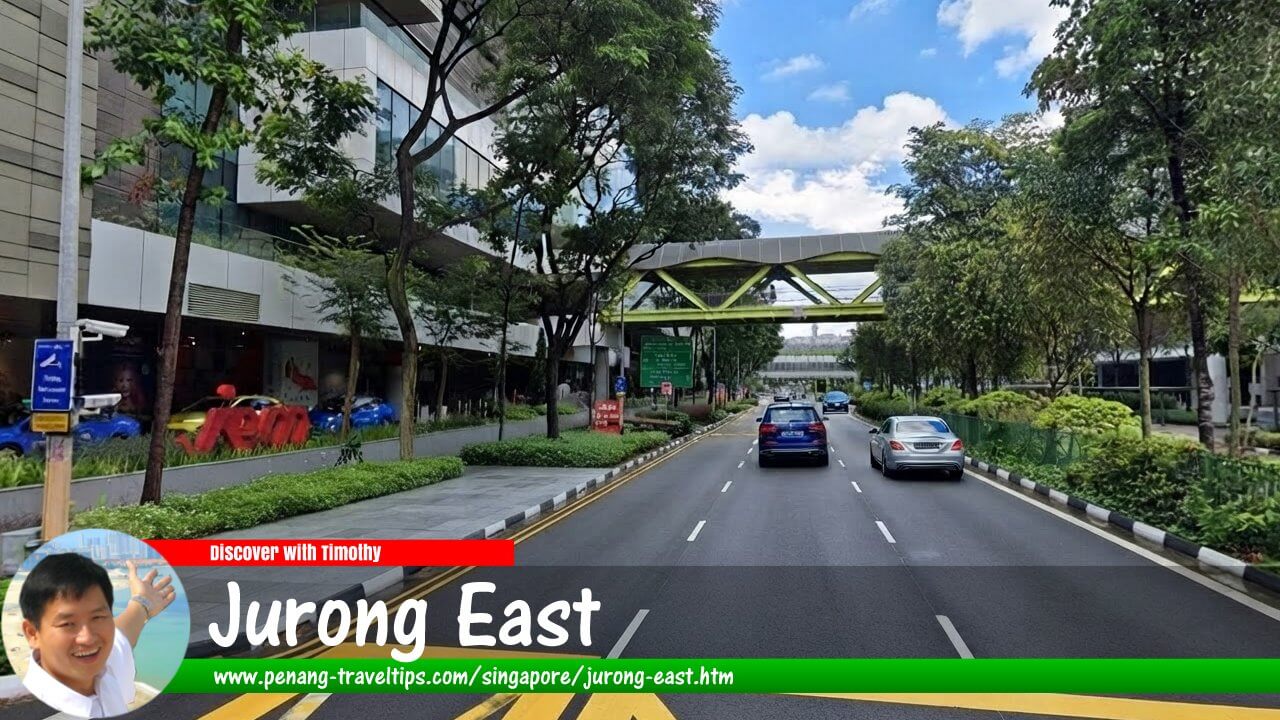 Jurong East, Singapore (AI image created on 9 August 2026)
The Jurong East Planning Area (Simplified Chinese: 裕廊东, Traditional Chinese: 裕廊東, Pinyin: Yù Láng Dōng, Malay: Jurong Timur, Tamil: ஜூரோங் கிழக்கு) is a major regional centre in the western part of Singapore. It covers an area of 17.83 square kilometres and is part of the West Region. As of 2020, the planning area had a population of about 84,9801. Jurong East is well known as a commercial and retail hub, home to several landmark malls, transport nodes, and business parks. It lies mainly within Postal District 22.
History of Jurong East
Jurong East was developed as part of the government’s plan in the 1960s to transform Jurong from swampland into an industrial powerhouse. While the western portion of Jurong focused on heavy industries, Jurong East was planned as the commercial and residential heart of the region. The town was built in phases from the 1970s onward, with public housing, community facilities, and transport links supporting the rapid growth of the industrial estate nearby.
Name and Pronunciation
“Jurong” is believed to originate from the Malay word “jerung,” meaning “shark.” Jurong East, therefore, refers to the eastern section of the Jurong region. It is pronounced Joo-rong Ee-st, with the International Phonetic Alphabet (IPA) transcription /ˈdʒuː.rɒŋ iːst/.
Geography and Boundaries
Jurong East is bordered by Bukit Batok Planning Area to the north, Clementi Planning Area to the east, Jurong West Planning Area to the west, and the Pandan Reservoir and Sungei Pandan to the south. Its central location in the western corridor makes it a hub for both commuters and businesses.
Subzones of Jurong East
- International Business Park
- Jurong Gateway
- Jurong Port
- Jurong River
- Lakeside (Business)
- Lakeside (Leisure)
- Penjuru Crescent
- Teban Gardens
- Toh Guan
- Yuhua East
- Yuhua West
Transport and Accessibility
Jurong East is one of the best-connected areas in western Singapore. It is served by the Pan Island Expressway (PIE) and the Ayer Rajah Expressway (AYE), linking it to central and southern Singapore.
MRT Connectivity
The town is anchored by Jurong East MRT interchange, one of the busiest in Singapore. It currently serves:
In the coming years, Jurong East will also be served by the Jurong Region Line (JRL) and the Cross Island Line (CRL), further strengthening its role as a western transport hub.
Residential Real Estate
Jurong East offers a wide range of housing, from HDB flats to private condominiums. As of 2025:
- HDB 4-room flats: SGD 550,000–700,000, depending on age and location.
- Private condominiums: SGD 1,400–1,800 per square foot.
- Monthly rental: HDB flats average SGD 2,400–3,000; condominiums SGD 3,300–4,5002.
Prices in Jurong East remain competitive compared to city-fringe areas, making it attractive for families and investors. With the upcoming Jurong Lake District development, property values are expected to rise.
Landmarks and Attractions
Jurong East is widely recognised as the commercial and leisure hub of western Singapore. Key landmarks include:
- Jurong Lake Gardens: Singapore’s national gardens in the heartlands, offering lush landscapes and lakeside walks.
- JEM, Westgate, IMM: A cluster of major malls providing extensive retail and dining options.
- Ng Teng Fong General Hospital and Jurong Community Hospital: Modern healthcare institutions serving the region.
- Singapore Science Centre and Snow City: Family-friendly attractions that have entertained generations.
- Jurong East Sports Complex: Featuring pools, stadium, and gyms for community recreation.
Community and Lifestyle
Jurong East offers a balance of work, leisure, and living. The town is a shopping paradise with three major malls connected directly to the MRT. It also has extensive parkland at Jurong Lake Gardens, providing a green escape for residents. The Jurong Lake District, envisioned as Singapore’s second CBD, will bring new offices, homes, and recreation spaces, further elevating the area’s importance.
Where to Stay
Jurong East is one of the better places to stay in western Singapore. Unlike many residential planning areas, it has several established hotels, and its position around the Jurong East MRT interchange makes it particularly convenient for visitors who want to explore both western Singapore and the city centre.
Gentle Treetops Executive Apartments is one of the accommodation choices in the wider Jurong East area for visitors who prefer an apartment-style stay. It is particularly suitable for longer stays and families who appreciate having more living space than a conventional hotel room.
IBIS Budget Singapore West, in the neighbouring West Coast area, is another practical choice for budget-conscious visitors. Although it is outside Jurong East itself, it is close enough to make a useful base for exploring Jurong East, Clementi and the western part of Singapore.
For visitors who want a proper full-service hotel, Park Hotel Alexandra is another nearby option. Located along Alexandra Road, it is somewhat farther from Jurong East but provides a higher level of hotel facilities and is well positioned for visitors who want to combine Jurong East with Alexandra, Queenstown and the city.
The strongest reason to stay in Jurong East is its transport connectivity. Jurong East MRT Station is an interchange between the North South Line and East West Line, while the adjoining Jurong East Bus Interchange provides numerous bus services. The area is also directly connected to major shopping centres, making it possible to eat, shop and travel without relying on taxis.
Jurong East is therefore particularly suitable for visitors who want to explore western Singapore, including Jurong West, Clementi, Bukit Batok, Tuas and the Jurong industrial districts. It is also a practical choice for visitors whose itinerary includes the Singapore Science Centre, Chinese Garden or other attractions in the west.
What to Eat
Jurong East has a surprisingly diverse food scene. The traditional neighbourhood hawker centres provide inexpensive local food, while the large shopping malls around the MRT station offer restaurants representing cuisines from across Asia and beyond.
The main shopping district consists of JCube's former site and the surrounding Jurong Gateway, with Jem, Westgate and IMM forming the principal commercial cluster. JCube closed permanently in 2023 for redevelopment, while the other three malls continue to provide a huge range of restaurants and cafés.
Westgate is particularly convenient because it is directly connected to Jurong East MRT Station and the bus interchange. Its restaurants range from casual Singaporean food to Japanese, Korean, Chinese, Western and fast-casual dining.
Jem provides another large selection of restaurants and cafés. It is particularly useful when visitors want air-conditioned dining or when travelling with children and family members who prefer familiar restaurant chains.
For traditional hawker food, Jurong East Street 52 Food Centre is a better choice. It is a neighbourhood food centre serving the surrounding residential estates and offers inexpensive Singaporean dishes including noodles, rice dishes, porridge, seafood and snacks.
Taman Jurong Market & Food Centre is another destination worth considering if you want a more traditional heartland experience. It is farther from Jurong East MRT Station but has a strong local following and a broad mixture of Chinese, Malay and Indian food.
Jurong East is also convenient for halal food. Shopping centres contain halal-certified chain restaurants, while Malay and Muslim-owned stalls can be found in the neighbourhood food centres. Visitors looking specifically for halal food can therefore eat comfortably in the area without having to travel into central Singapore.
One particularly useful halal destination is Encik Tan, which has outlets in the Jurong East shopping area. The chain serves Singaporean-style food such as curry chicken rice, laksa, fishball noodles and other local favourites and is halal-certified.
Where to Eat
These are some of the places worth considering when exploring Jurong East's food scene:
- Jurong East Street 52 Food Centre – A traditional neighbourhood hawker centre serving inexpensive local dishes. It is a good place to experience everyday food away from the major shopping malls.
- Taman Jurong Market & Food Centre – A large neighbourhood food centre with Chinese, Malay and Indian stalls. It is particularly useful for visitors wanting a traditional heartland hawker experience.
- Westgate – One of the most convenient places for restaurant dining in Jurong East because it is directly connected to the MRT station and bus interchange. It contains a wide mixture of restaurants and cafés.
- Jem – A large shopping centre with a substantial restaurant and café selection. It is particularly convenient for families and visitors wanting air-conditioned dining.
- IMM – The outlet mall next to Jurong East MRT Station has a broad range of restaurants and food outlets. It is particularly useful for visitors combining shopping with a meal.
- Encik Tan at Westgate – A halal-certified Singaporean food chain offering dishes such as laksa, curry chicken rice and fishball noodles. It is a convenient choice for Muslim visitors wanting familiar local food.
- The Dim Sum Place at Westgate – A halal-certified restaurant serving dim sum and other Chinese-style dishes. It is particularly useful for Muslim visitors wanting to try dim sum without having to leave Jurong East.
- Eng's Wantan Noodle – A Singaporean noodle institution with an outlet in the Jurong East area. The signature wanton noodles are served with char siew and dumplings and can be enjoyed as an inexpensive local meal.
- Imperial Treasure Fine Chinese Cuisine – An option for visitors looking for a more formal Chinese meal in the shopping-centre environment.
- Putien – A Singapore restaurant specialising in Fujian cuisine. It is a good choice for visitors wanting something different from the Cantonese and Sichuan restaurants commonly found in shopping centres.
- Monster Planet – A casual Japanese restaurant known for Japanese curry and large portions. It is particularly suitable for visitors travelling with teenagers or younger diners.
- Shi Li Fang – A casual hotpot restaurant providing an affordable alternative to the area's larger buffet restaurants.
If you have only one meal to spare in Jurong East, I would recommend visiting Jurong East Street 52 Food Centre if your priority is traditional Singaporean hawker food. If convenience is more important, the restaurants at Westgate and Jem are immediately accessible from the MRT station.
For Muslim visitors, Westgate is particularly convenient because several halal-certified restaurants are available within the shopping-centre environment. This makes it easy for groups with different dietary requirements to dine together without having to search through individual hawker stalls.
Jurong East is also a useful place to explore Singapore's shopping-centre food culture. The concentration of Jem, Westgate and IMM creates an enormous choice of restaurants within a small area. While this is less atmospheric than eating at a traditional hawker centre, it provides an excellent fallback during heavy rain or when travelling with children and elderly visitors.
For a more local experience, however, venture away from the MRT interchange towards the older residential estates. The neighbourhood coffeeshops and food centres provide a much better sense of how Jurong East residents eat on an ordinary day. This contrast between the modern Jurong Gateway commercial district and the older heartland estates is one of the area's most interesting characteristics.
Visitors who have several hours to spare can also combine their meal with the Singapore Science Centre, the Chinese Garden and Jurong Lake Gardens. This makes Jurong East particularly suitable for families: a morning of sightseeing can be followed by lunch at a hawker centre or shopping mall, with further activities available within the same western district.
Jurong East is therefore best regarded not simply as a residential town but as the commercial and transport centre of western Singapore. Its hotels, shopping malls, restaurants, food centres and excellent MRT connections make it one of the more convenient western bases for visitors.
Accommodation and Food References
- Jem – Official Website
- Westgate – Official Website
- IMM – Official Website
- HalalTag – Halal Food in Jurong East
- Time Out Singapore – Jurong East Food Guide
- Visit Singapore – Jurong Lake Gardens
Fun Facts
Jurong East’s Snow City is Singapore’s first permanent indoor snow centre, allowing residents to experience snow without leaving the tropics3.
Map of Jurong East, Singapore
What to eat in Jurong East
- Wanton Mee at Fei Fei Roasted Noodles, Yuhua Village Market and Food Centre, 254 Jurong East Street 24, 600254 Singapore (GPS: 1.343521, 103.737691), recommended by Gregory Leow on 29 August, 2019
MRT Stations in Jurong East
- Chinese Garden MRT Station (GPS: 1.34246, 103.7326)

- Jurong East MRT Station (GPS: 1.33317, 103.74233)

Sights in Jurong East
- Chinese Garden (GPS: 1.33898, 103.72975)

- JCube (GPS: 1.33331, 103.74019)

- Science Centre Singapore (GPS: 1.33279, 103.73574)

Quick Facts
- Size: 17.83 sq km
- Population: ~84,980 (2020)
- Postal District: 22
- Name Origin: From Malay “jerung” (shark)
- Pronunciation: Joo-rong Ee-st (/ˈdʒuː.rɒŋ iːst/)
- Main MRT: Jurong East (NSL, EWL, future JRL & CRL)
- Main Expressways: PIE, AYE
- Key Landmarks: Jurong Lake Gardens, Science Centre, JEM, Westgate, IMM
- Average Property Prices: HDB 4-room ~SGD 550k–700k; Condos ~SGD 1,400–1,800 psf
References
- Singapore Department of Statistics – Population Data
- PropertyGuru – Jurong East Property Market
- NLB Infopedia – Jurong
Page Details
This page was created on 8 September 2025. Hi, my name is Timothy and created it from my research, for my own entertainment, knowledge and to satisfy my curiosity. I am providing the information to you in good faith and hope it is useful. I try to get the details as accurate as possible. I also try to update the page whenever I stumble on new details. So this and all my other pages are perpetual work in progress. If you discover any error, please politely inform me, pointing out where the error lies, and I will correct it as soon as possible. Your helpfulness will keep this page accurate, relevant and helpful to those who need the information.My videos of Singapore
Want to share your Singapore travel experiences or get tips from fellow travellers?
Join the Singapore Travel Tips Facebook GroupMore information for visiting and living in Singapore
Here are some related articles to help you get to know Singapore better.- Cost of Living in Different Singapore Neighbourhoods (2025 Guide)
- EZ-Link Card
- Owning a Car in Singapore
- Singapore MRT Map & Guide 2025
- Singapore Postal Districts and Postcodes
- Singapore Tourist Pass
- Taking the Bus in Singapore: A Visitor's Guide
- Understanding CCR, RCR and OCR in Singapore real estate
 Latest Pages & Updates
Buy Me A Coffee
If you enjoy the information I provide and want to support the work I do, please buy me a coffee! I appreciate it immensely, thank you so much!
