
LRT Shah Alam Line
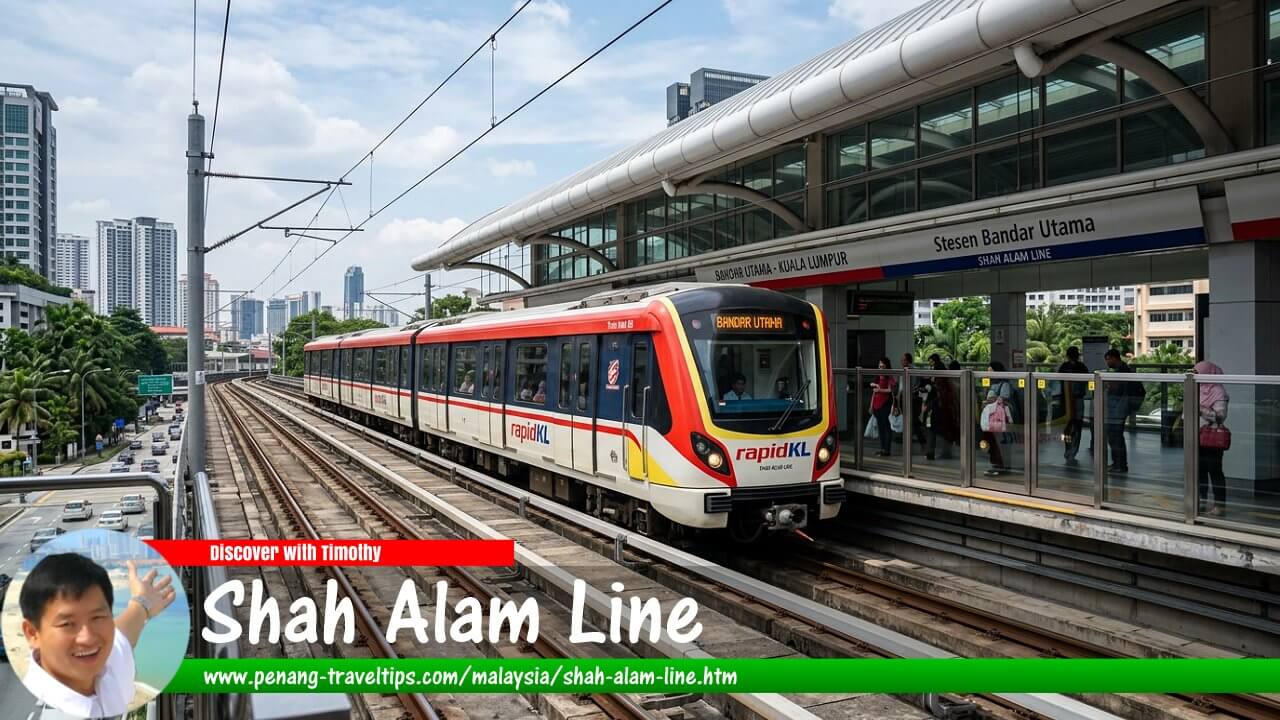 Train on the LRT Shah Alam Line (Picture edited with AI on 29 June 2026)
LRT Shah Alam Line, also officially known as the LRT3, is a modern light rail transit system serving the western and central parts of Selangor. The line connects Bandar Utama in Petaling Jaya with Johan Setia in Klang, providing an important east-west public transport corridor across the Klang Valley. Originally proposed to improve connectivity between rapidly growing residential, commercial and industrial areas, the project was announced by the Malaysian Government in 2015. Construction began shortly afterwards with an estimated cost of approximately RM16.63 billion before a major cost rationalisation exercise reduced the project value to around RM16.39 billion. The line is owned by Prasarana Malaysia Berhad and operated by Rapid Rail Sdn Bhd under the Rapid KL network. Although the line is widely known as the LRT Shah Alam Line, not every station is located within Shah Alam itself; instead, the railway passes through the cities of Petaling Jaya, Shah Alam and Klang, with all stations located within the state of Selangor.1
The Shah Alam Line began operations on 29 June 2026. For a period until 31 July, commuters get to ride the trains for free.
Quick Facts
- Official name: LRT Shah Alam Line (LRT3)
- Operator: Rapid Rail Sdn Bhd (Rapid KL)
- Owner: Prasarana Malaysia Berhad
- Location: Selangor, Malaysia
- Route: Bandar Utama – Johan Setia
- Total length: Approximately 37.8 km
- Number of stations: 25 stations
- Depot: Johan Setia
- System: Fully elevated light rail transit
- Track gauge: Standard gauge (1,435 mm)
- Electrification: 750 V DC third rail
- Rolling stock: Alstom Innovia Metro trainsets
- Maximum operating speed: Approximately 80 km/h
- Operational commencement: 2025
Introduction
The LRT Shah Alam Line was conceived to address the increasing transportation demands of Selangor's western growth corridor. Before the railway was built, many communities depended heavily on private vehicles and buses, resulting in significant congestion during peak periods. The new railway provides a faster and more reliable alternative while complementing existing rail systems in the Klang Valley. It also supports transit-oriented development around stations, encouraging higher-density residential and commercial projects close to public transport.2
Unlike the Kelana Jaya Line and Ampang Line, which primarily radiate from Kuala Lumpur, the LRT Shah Alam Line links major suburban centres directly with one another. The route serves established townships including Bandar Utama, Damansara, Glenmarie, Shah Alam, Bukit Raja and Klang. These areas are among the fastest-growing economic centres in Selangor and generate substantial commuter traffic every day.3
History
The idea of constructing a rail line linking Petaling Jaya, Shah Alam and Klang had been discussed for several years before the Federal Government officially announced the project in 2015. The railway formed part of the Greater Kuala Lumpur public transport master plan, which sought to improve mobility while reducing dependence on private vehicles.4
Following government approval, Prasarana Malaysia Berhad was appointed as the project owner, while Rapid Rail was designated as the future operator. Construction contracts were awarded to a consortium led by Malaysian engineering firms together with international technology partners responsible for signalling, rolling stock and systems integration.5
During 2018, the project underwent a comprehensive review aimed at reducing overall expenditure. Several stations were initially placed on hold, architectural features were simplified, and the project scope was revised to lower costs without compromising operational safety. Following another review, all originally planned stations were eventually reinstated, restoring the complete alignment.6
Construction progressed throughout the early 2020s despite delays caused by the COVID-19 pandemic and supply chain disruptions. Extensive viaduct construction, station installation, track laying and systems testing were completed before the line officially commenced passenger service in 2025. The opening represented one of Malaysia's largest rail infrastructure projects completed during the decade.7
Route Overview
The LRT Shah Alam Line extends approximately 37.8 kilometres from Bandar Utama in Petaling Jaya to Johan Setia in Klang. The entire railway is elevated, allowing trains to operate without interference from road traffic. Elevated construction also minimises land acquisition while maintaining consistent travel speeds throughout the route.8
The alignment follows several major highways and arterial roads, enabling convenient access to surrounding residential neighbourhoods, commercial centres, universities, industrial estates and hospitals. Numerous stations are integrated with bus services and park-and-ride facilities, making the railway accessible to commuters from surrounding districts.9
Map of Klang Valley Mass Transit Lines & Stations
Stations
The LRT Shah Alam Line consists of 25 stations:
- Bandar Utama (SA01)
- Kayu Ara (SA02)
- BU 11 (SA03)
- Tropicana (SA04)
- Damansara Idaman (SA05)
- Subang (SA06)
- Glenmarie 2 (SA07)
- Temasya (SA08) non-operational
- Kerjaya (SA09)
- Stadium Shah Alam (SA10)
Persiaran Hishamuddin(SA11)- Dato' Menteri (SA12)
- Raja Muda (SA13) non-operational
- UiTM Shah Alam (SA14)
- Seksyen 7 Shah Alam (SA15)
- Bukit Raja Selatan (SA16)
- Bandar Baru Klang (SA17)
- Pasar Klang (SA18)
- Jalan Meru (SA19)
- Jambatan Kota (SA20)
- Taman Selatan (SA21)
- Seri Andalas (SA22)
- Klang Jaya (SA23)
- Bandar Bukit Tinggi (SA24)
- Bandar Botanik (SA25)
- Johan Setia (SA26)
The stations have been designed with barrier-free access, elevators, escalators, tactile paving, CCTV surveillance and passenger information displays. Most stations also include bicycle facilities, drop-off areas and feeder bus connections.10
Interchange Stations
The LRT Shah Alam Line has several important interchange stations where passengers can transfer to other rail services:
- Bandar Utama – MRT Kajang Line.
- Damansara – MRT Putrajaya Line.
- Shah Alam – KTM Komuter Port Klang Line.
- Klang – KTM Komuter Port Klang Line.
These interchanges significantly expand travel options, enabling passengers to reach Kuala Lumpur, Putrajaya, Sungai Buloh, Kajang and Port Klang with fewer transfers than previously possible.11
Rolling Stock
The line uses fully automated driverless trains manufactured by Alstom. The trainsets are based on the Innovia Metro platform and are designed for high-frequency urban operations. Each train is air-conditioned and equipped with passenger information systems, wheelchair spaces, CCTV cameras and modern safety features. Driverless operation allows service frequency to be adjusted according to passenger demand while maintaining consistent reliability.12
Operations
Rapid Rail operates the LRT Shah Alam Line as part of the Rapid KL network. Ticketing is integrated with other Rapid KL rail services through the use of Touch 'n Go cards, concession cards and contactless payment options. This integrated fare system enables seamless transfers between LRT, MRT, Monorail, BRT and selected bus services.13
Trains generally operate from early morning until late at night, with shorter intervals during peak commuting hours. The automated signalling system enables efficient scheduling while maintaining high standards of operational safety and punctuality.14
Economic Importance
The LRT Shah Alam Line has become a major catalyst for economic development across western Selangor. Improved accessibility encourages investment around stations, stimulates retail activity and supports higher-density mixed-use developments. Businesses benefit from improved employee mobility, while residents gain easier access to employment centres throughout the Klang Valley.15
Transit-oriented development has become a significant planning objective around many stations. New residential projects, office buildings and commercial centres are increasingly being developed within walking distance of railway stations, reducing reliance on private cars while creating more sustainable urban communities.16
Benefits to Commuters
The railway offers numerous advantages compared with road transport. Travel times are generally more predictable because trains operate independently of road congestion. Commuters also benefit from integrated feeder buses, park-and-ride facilities and improved pedestrian connections around stations.17
The line improves accessibility to major educational institutions, shopping centres, hospitals, government offices and industrial areas. Students attending Universiti Teknologi MARA campuses, workers employed in Shah Alam's industrial estates and shoppers visiting Klang's commercial districts all benefit from enhanced public transport connectivity.18
Engineering Features
The LRT Shah Alam Line incorporates modern railway technologies including communications-based train control, platform safety systems, energy-efficient equipment and advanced maintenance facilities. The elevated viaducts were designed to minimise environmental impacts while accommodating existing roads and utilities beneath the alignment.19
The depot at Johan Setia houses maintenance workshops, train stabling tracks, operations control facilities and administrative offices. Routine maintenance ensures high levels of operational reliability and passenger safety throughout the railway's service life.20
Future Prospects
The LRT Shah Alam Line forms an important component of Malaysia's expanding urban rail network. As Selangor continues to grow, the line is expected to carry increasing numbers of passengers while encouraging greater use of public transport. Future improvements may include enhanced feeder bus services, better pedestrian connectivity and integration with additional transport projects planned for the Klang Valley.21
By linking major residential communities with employment centres, educational institutions and commercial districts, the LRT Shah Alam Line contributes to a more sustainable transportation system for Selangor. Its strategic alignment, modern infrastructure and integration with other rail services make it one of the most significant public transport investments undertaken in Malaysia during the twenty-first century.22
Map of Klang Valley's Mass Transit Lines
References
- Rapid KL – LRT Shah Alam Line
- Prasarana Malaysia Berhad
- Ministry of Transport Malaysia
- Land Public Transport Agency (APAD)
- MRT Corp Malaysia
- The Edge Malaysia – LRT3 Project
- New Straits Times
- Bernama
- The Star
- Alstom – Urban Rail Solutions
Page Details
This page was created on 29 June 2026. Hi, my name is Timothy and created it from my research, for my own entertainment, knowledge and to satisfy my curiosity. I am providing the information to you in good faith and hope it is useful. I try to get the details as accurate as possible. I also try to update the page whenever I stumble on new details. So this and all my other pages are perpetual work in progress. If you discover any error, please politely inform me, pointing out where the error lies, and I will correct it as soon as possible. Your helpfulness will keep this page accurate, relevant and helpful to those who need the information.Return to Kuala Lumpur MRT, Malaysia Rail Transportation Network
Rapid Transit Lines
 Latest updates on Penang Travel Tips
Buy Me A Coffee
If you enjoy the information I provide and want to support the work I do, please buy me a coffee! I appreciate it immensely, thank you so much!
