
Klang Valley
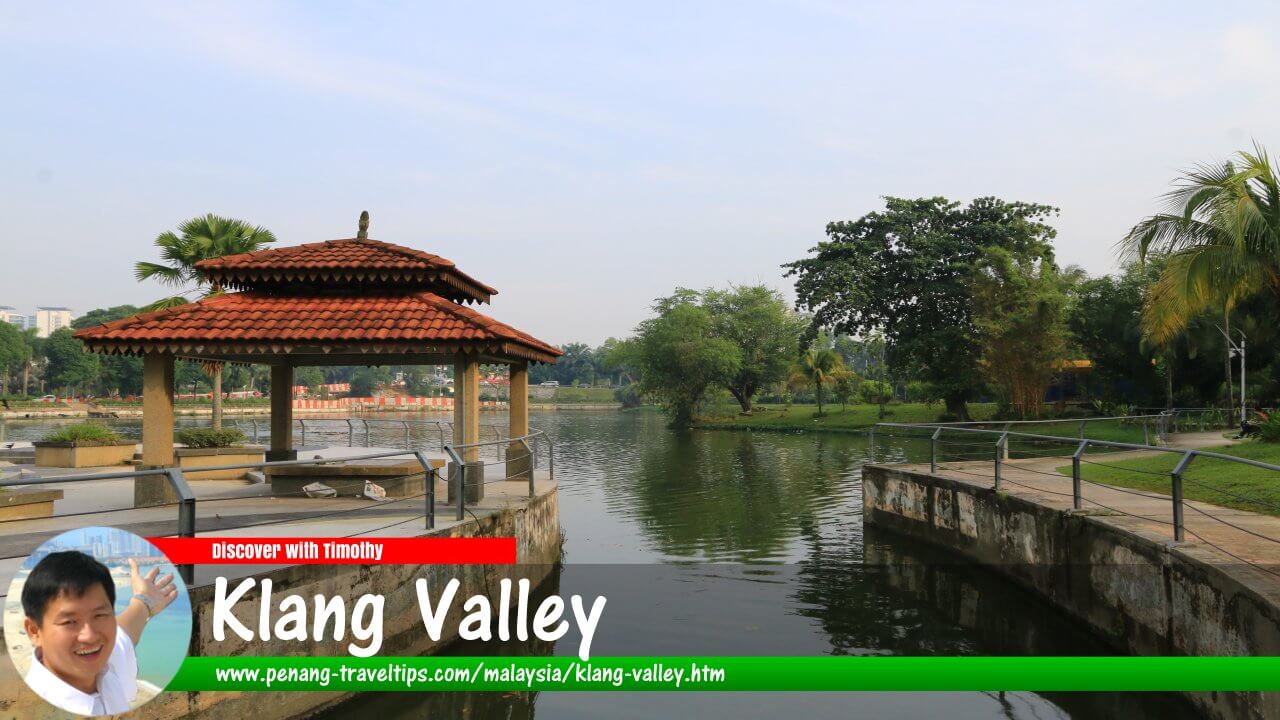 Taman Jaya Park in Petaling Jaya, in the Klang Valley (13 July 2016)
Klang Valley is the largest and most important urban agglomeration in Malaysia, encompassing Kuala Lumpur, much of Selangor, and the federal territories of Putrajaya and parts of surrounding areas. Named after the Klang River basin, the region serves as the country's principal economic, financial, administrative, transportation, and cultural hub. Home to millions of residents and a wide variety of industries, educational institutions, commercial centres, and residential communities, the Klang Valley has grown from a collection of towns and settlements into one of Southeast Asia's most dynamic metropolitan regions.1
Quick Facts
- Location: Central Peninsular Malaysia
- Main City: Kuala Lumpur
- States/Territories: Selangor, Kuala Lumpur, Putrajaya
- Named After: Klang River basin
- Estimated Population: More than 8 million people
- Economic Role: Malaysia's primary financial and commercial centre
- Key Industries: Finance, manufacturing, technology, logistics, education, tourism, and services
- Major Airports: Kuala Lumpur International Airport (KLIA) and Sultan Abdul Aziz Shah Airport
- Public Transport: MRT, LRT, Monorail, KTM Komuter, Rapid KL buses, and airport rail services
- Major Rivers: Klang River and Gombak River
Introduction to the Klang Valley
The Klang Valley is not a formally defined administrative unit but rather a metropolitan region that functions as a single economic and social area. At its core is Kuala Lumpur, Malaysia's capital city, surrounded by a network of municipalities, cities, and townships that have become increasingly interconnected through highways, rail systems, and commercial development. The region includes major urban centres such as Petaling Jaya, Shah Alam, Klang, Subang Jaya, Ampang Jaya, Kajang, Selayang, Puchong, Cyberjaya, and Putrajaya.2
Today, the Klang Valley serves as the heart of Malaysia's economy. Many of the country's largest corporations, financial institutions, government agencies, universities, hospitals, shopping centres, and industrial zones are located within the region. Its strategic location and modern infrastructure have made it attractive to both domestic and international investors.3
Origin of the Name
The term "Klang Valley" derives from the Klang River, one of the most significant rivers in western Peninsular Malaysia. The river originates in the highlands northeast of Kuala Lumpur and flows westward through the metropolitan area before emptying into the Strait of Malacca near the city of Klang. Historically, settlements, agriculture, and trade developed along the river and its tributaries, leading to the formation of communities that would eventually become major urban centres.4
As Kuala Lumpur expanded during the twentieth century, planners, economists, and government agencies increasingly used the term "Klang Valley" to describe the broader urban region connected by the Klang River basin. Over time, the name became synonymous with Malaysia's principal metropolitan area.5
Historical Development
Early Settlements
The history of the Klang Valley is closely linked to the development of tin mining in the nineteenth century. Before large-scale urbanisation, the area consisted primarily of forests, river settlements, and agricultural communities. The discovery of tin deposits in the Klang and Gombak river valleys attracted miners and traders from various parts of Asia.6
Kuala Lumpur emerged in the 1850s as a frontier trading post supporting mining activities. Its strategic location at the confluence of the Klang and Gombak rivers allowed it to become a major commercial centre. Meanwhile, Klang served as an important port and administrative centre for the state of Selangor.7
Colonial Era Expansion
Under British administration, roads, railways, public buildings, and civic institutions were developed throughout the region. Kuala Lumpur became the capital of Selangor in 1880 and later the capital of the Federated Malay States in 1896. These developments accelerated migration and economic growth across the valley.8
The completion of railway links between Kuala Lumpur, Klang, and other towns strengthened commercial activity and encouraged urban development beyond the city centre. Rubber plantations also became a major economic driver during this period.9
Post-Independence Growth
Following Malaysian independence in 1957, rapid industrialisation transformed the Klang Valley. New industrial estates, housing developments, and transportation infrastructure were constructed to accommodate population growth and economic expansion. Towns such as Petaling Jaya and Subang Jaya were planned to support the growing metropolitan population.10
From the 1980s onward, large-scale infrastructure projects, including expressways, rail transit systems, and new administrative centres, further integrated the region. The establishment of Putrajaya as Malaysia's federal administrative capital and Cyberjaya as a technology-focused city expanded the Klang Valley's influence beyond traditional urban boundaries.11
Geography and Size
The Klang Valley occupies a broad area in central Selangor and surrounding territories. While definitions vary depending on planning agencies and statistical studies, the metropolitan region generally covers more than 2,800 square kilometres. The area stretches from Klang on the west coast to Kajang and Semenyih in the east and southeast, encompassing numerous municipalities and townships.12
The valley is surrounded by hills and highlands, including the Titiwangsa Range to the east. Several rivers flow through the region, with the Klang River serving as the principal waterway. The generally flat terrain of much of the valley has facilitated urban development and transportation infrastructure.13
Population and Demographics
The Klang Valley is the most populous urban region in Malaysia, with an estimated population exceeding 8 million residents. This figure continues to grow due to natural population increase, migration from other parts of Malaysia, and international migration.14
The population is highly diverse and reflects Malaysia's multicultural society. Malays, Chinese, Indians, and numerous indigenous and international communities contribute to the region's social fabric. A wide range of languages, religions, traditions, and cuisines can be found throughout the metropolitan area.15
The Klang Valley also hosts a substantial expatriate population, attracted by employment opportunities, educational institutions, and modern urban amenities. This diversity has contributed to the cosmopolitan character of the region.16
Economic Importance
The Klang Valley is widely regarded as Malaysia's economic powerhouse. A significant proportion of the nation's gross domestic product is generated within the region. Major industries include finance, banking, manufacturing, logistics, information technology, healthcare, education, retail, tourism, and professional services.17
Kuala Lumpur serves as the country's financial centre, housing major banks, stock market institutions, corporate headquarters, and multinational companies. Industrial areas in Shah Alam, Klang, Subang Jaya, and other municipalities support manufacturing and logistics operations, while Cyberjaya has emerged as a centre for digital technology and innovation.18
The region's extensive infrastructure, skilled workforce, and strategic location have helped maintain its position as Malaysia's primary economic engine and a significant contributor to Southeast Asian commerce.19
Transportation and Connectivity
The Klang Valley possesses Malaysia's most comprehensive transportation network. A system of expressways connects major cities, towns, industrial areas, and residential communities throughout the metropolitan area. Key routes include the North–South Expressway, New Klang Valley Expressway, Federal Highway, and numerous urban expressways.20
Public transportation has expanded significantly since the late twentieth century. The region is served by MRT lines, LRT lines, the KL Monorail, KTM Komuter rail services, airport rail links, and extensive bus networks. These services help connect residential suburbs with employment centres, educational institutions, and commercial districts.21
Kuala Lumpur International Airport, located south of the metropolitan core, serves as Malaysia's primary international gateway. The airport connects the Klang Valley to destinations across Asia, Europe, the Middle East, Oceania, and beyond.22
Culture and Lifestyle
The Klang Valley is one of the most culturally vibrant regions in Malaysia. Residents enjoy access to museums, galleries, theatres, music venues, festivals, and heritage sites. Traditional cultural practices coexist with contemporary urban lifestyles, creating a unique metropolitan identity.23
The region is also famous for its culinary diversity. Restaurants, hawker centres, food courts, and cafés offer cuisines from across Malaysia and around the world. Local favourites include nasi lemak, satay, roti canai, char kway teow, and countless fusion dishes that reflect the area's multicultural heritage.24
Shopping is another major attraction. The Klang Valley contains some of Southeast Asia's largest shopping centres and retail districts, attracting visitors from throughout Malaysia and abroad.25
Education and Healthcare
The Klang Valley is home to many of Malaysia's leading universities, colleges, and research institutions. Students from across the country and around the world come to the region to pursue higher education in fields ranging from engineering and medicine to business and the arts.26
The region also contains numerous public and private hospitals, specialist medical centres, and healthcare facilities. These institutions provide advanced medical services and contribute to Malaysia's growing reputation as a destination for medical tourism.27
The Future of the Klang Valley
The Klang Valley continues to evolve through urban redevelopment, transit-oriented planning, digital transformation, and sustainability initiatives. Government agencies and local authorities are working to improve public transportation, environmental management, housing accessibility, and quality of life for residents.28
As Malaysia advances toward a more knowledge-based and technology-driven economy, the Klang Valley is expected to remain the nation's leading metropolitan region. Its combination of economic strength, cultural diversity, modern infrastructure, and strategic location ensures its continuing importance in Malaysia's future development.29
References
- Encyclopaedia Britannica – Kuala Lumpur
- PLANMalaysia – National Physical Planning Information
- InvestKL – Greater Kuala Lumpur Overview
- Department of Environment Malaysia – Klang River Basin Information
- Kuala Lumpur City Hall (DBKL)
- Encyclopaedia Britannica – Selangor
- Official Portal of the Malaysian Government
- National Library Board Singapore – Kuala Lumpur History
- Department of Railways Malaysia
- Petaling Jaya City Council
- Putrajaya Corporation
- Department of Statistics Malaysia
- Department of Irrigation and Drainage Malaysia
- OpenDOSM Data Portal
- Malaysia Government Portal – Population and Society
- ExpatGo Malaysia
- Bank Negara Malaysia
- Malaysia Digital Economy Corporation
- Invest Selangor
- Malaysian Highway Authority
- Rapid KL
- Malaysia Airports Holdings Berhad
- Department of Museums Malaysia
- Tourism Malaysia
- Malaysia External Trade Development Corporation
- Ministry of Higher Education Malaysia
- Ministry of Health Malaysia
- Ministry of Housing and Local Government
- Economic Planning Unit Malaysia
Page Details
This page was created on 24 June 2026. Hi, my name is Timothy and created it from my research, for my own entertainment, knowledge and to satisfy my curiosity. I am providing the information to you in good faith and hope it is useful. I try to get the details as accurate as possible. I also try to update the page whenever I stumble on new details. So this and all my other pages are perpetual work in progress. If you discover any error, please politely inform me, pointing out where the error lies, and I will correct it as soon as possible. Your helpfulness will keep this page accurate, relevant and helpful to those who need the information.My Videos of Malaysia
 Latest Pages & Updates
Buy Me A Coffee
If you enjoy the information I provide and want to support the work I do, please buy me a coffee! I appreciate it immensely, thank you so much!
