
St James's Park Station, London
The station is ideally located for those visiting the Westminster area, and its proximity to St James's Park makes it a convenient starting point for a leisurely walk through one of London's most historic areas.
History of St James's Park Station
St James's Park Station was officially opened on December 24, 1868, as part of the extension of the District Line. It was originally known as "St James's Park and Westminster" to reflect its proximity to both the park and Westminster's government buildings. Over time, the station's name was simplified to just St James's Park, making it easier for passengers to remember.The station's design is relatively simple compared to some of the grander Underground stations, but its strategic location and historical significance have made it a key part of London’s transport infrastructure. It was designed to provide easier access to the rapidly growing political and governmental district, facilitating better travel for both locals and tourists.
How St James's Park Got Its Name
The name "St James's Park" originates from the nearby St James's Park, one of London’s oldest and most famous parks. The park itself was originally created by Henry VIII in the 16th century as a hunting ground and has since been transformed into a public park.When the station was built, it naturally adopted the name of the park, which was already well-known as a royal space and a popular attraction for both Londoners and visitors. The station was not originally called just "St James's Park" — its initial name included "Westminster," as mentioned earlier. Over time, the connection to the park became the primary reference, leading to the current, simplified name.
Station Layout and Exits
The main entrance to St James's Park Station is located on Broadway, a major road running through the Westminster area. There are also exits onto Petty France and Victoria Street, both of which are major roads leading to other key areas of the city. These exits are easily accessible, making the station an important transport hub for commuters in the Westminster area.At ground level, the station is housed in a modest building that blends into the surrounding architectural style of Westminster. The building is primarily dedicated to the station’s entrance, but it may house some additional utilities or facilities for passengers, such as ticket machines and information points.
Distance from Charing Cross
St James's Park Station is located approximately 0.6 miles (about 1 km) from Charing Cross, which is one of London’s most central and well-known locations. This makes the station quite close to some of London's busiest and most iconic areas, including Trafalgar Square and the Strand. The station’s proximity to Charing Cross also means it is easily accessible for those traveling to and from this important transportation hub. By road, the journey from Charing Cross to St James's Park Station typically takes around 10 to 15 minutes depending on traffic conditions. However, for those traveling by public transport, the Underground provides a much quicker option.Rail Services Offered
St James's Park Station offers a range of services, primarily focused on the London Underground network. The station is served by two lines:- District Line - The District Line connects St James's Park Station to a wide variety of locations across London. The station is situated between Victoria Station (to the west) and Westminster Station (to the east), making it an essential stop for those traveling through the central part of the city.
- Circle Line - The Circle Line provides a circular route through central London. St James's Park Station is also between Victoria Station (to the west) and Westminster Station (to the east).
55 Broadway
55 Broadway was built above St James's Park Station. The building, which was completed in 1929, was originally the headquarters of the London Transport organization. It was designed in the Art Deco style and is an iconic structure in the Westminster area.When the station was originally constructed in 1868, it had a simple entrance and layout. However, with the growing importance of the Underground network and the need for a new headquarters for London Transport, the decision was made to construct a large office building above the station. The development of 55 Broadway provided not only office space but also a more prominent entrance for the station.
The new entrance to St James's Park Station was moved to a position inside 55 Broadway, making it a key part of the building's design. The new entrance was more accessible and in a more central location, facilitating easier access for passengers.
Interestingly, 55 Broadway was one of the first buildings in London to feature integrated office space above a transport hub, a concept that became more common in later decades. The station itself remained operational during the construction of the building, but the station's facilities were significantly upgraded as part of the redevelopment.
Fun Fact
A fun fact about St James's Park Station is that it has been a filming location for various films and TV shows over the years, thanks to its central location and proximity to famous landmarks. It has appeared in scenes for productions involving political intrigue, historical dramas, and even detective series. Additionally, the station is often featured in "hidden gems" tours of London, as many tourists and even locals are unaware of its historical significance and strategic location in the heart of Westminster.Quick Facts
- Station Name: St James's Park Station
- Location: Broadway, Westminster, London
- Opened: December 24, 1868
- Lines Served: District Line, Circle Line
- Nearby Landmarks: St James's Park, Buckingham Palace, Westminster Abbey
- Distance to Charing Cross: 0.6 miles (about 1 km)
- Exits: Broadway, Petty France, Victoria Street
- Fun Fact: Featured in numerous films and TV shows
St James's Park Station is  on the Map of London Underground
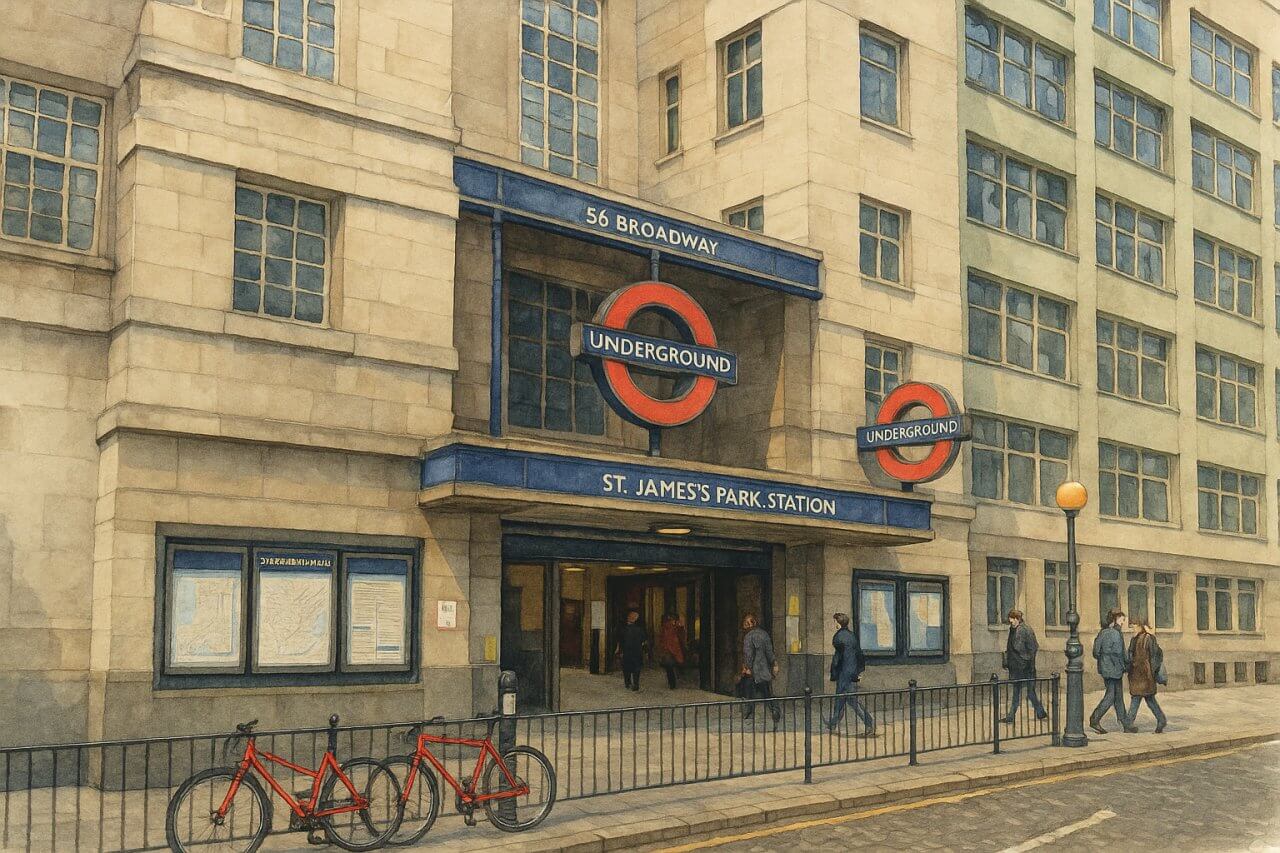
Painting of St James's Park Station, London (View image in full size)

Page Details
This page was created on 7 May 2025. Hi, my name is Timothy and created it from my research, for my own entertainment, knowledge and to satisfy my curiosity. I am providing the information to you in good faith and hope it is useful. I try to get the details as accurate as possible. I also try to update the page whenever I stumble on new details. So this and all my other pages are perpetual work in progress. If you discover any error, please politely inform me, pointing out where the error lies, and I will correct it as soon as possible. Your helpfulness will keep this page accurate, relevant and helpful to those who need the information.Want to share your London travel experiences or get tips from fellow travellers?
Join the London Travel Tips Facebook GroupMore information for visiting London
Here are some related articles to help you get to know London better.- Cost of Living in London: Discover the true cost of living in London, including housing, transport, groceries, and more - plus tips for budgeting in one of the world's most expensive cities.
- Driving in London: Planning to drive in London? Learn about roads, car rentals, parking, tolls, and key tips for tourists and visitors from outside the capital.
- Driving Tips for Visiting London: Thinking of driving to London? Discover the best times to travel, congestion tips, parking apps, breakdown help, and petrol advice for a smoother journey.
- Evolution of London's Streets: Discover the fascinating history of how London's streets developed from ancient footpaths to today's complex network of roads across the capital.
- History of Immigration to London: Discover the rich history of immigration to London, from Huguenots to Bangladeshis, and how diverse communities have shaped the city's vibrant identity.
- How Big Is London Compared to Other World Cities?
- How London's Streets Measure Up: A Global Comparison of Road Widths
- How Streets of London are Named: Discover how London streets get their names, who decides them, and how historic, political, and public influences shape street naming in the capital.
- How the Grosvenor Family Came to Own Much of Mayfair, Belgravia and Pimlico: Explore how the Grosvenor family came to own much of Mayfair, Belgravia, and Pimlico, and learn about their historical connection (or lack thereof) with the British royal family and government.
- Living and working in London
- London's Quiet Collapse: How Living Standards Fell as Costs Skyrockted (1975-2025): Explore how London residents endured rising costs and falling living standards from 1975 to 2025 - from rocketing rents to wage stagnation and inflation.
- Marvel of the London Underground: Discover the history, challenges, and triumphs of the London Underground - the world's first underground railway and a vital transport lifeline for the UK capital since 1863.
- Moving to London: Expat Tips for Settling in Westminster: Essential advice for expats moving to London's Westminster: neighborhood insights, cost of living, transportation, housing, healthcare, schools, and tips to help you feel at home in the heart of the city.
- Places in London that aren't pronounced the way they're spelled
- Shopping in London: Discover London's diverse shopping scene
- Taking the bus in London: This is your complete guide to taking the bus when in London.
- The Anglican Faith: A Visitor's Guide to the Church of England: Learn about the Anglican faith and its deep ties to London's landmarks like Westminster Abbey and St Paul's Cathedral.
- Top 10 London Streets Every Visitor Must See: Discover London through its most iconic thoroughfares - 10 streets every visitor must experience. From historic Abbey Road to vibrant Camden High Street, explore culture, shopping, and hidden gems.
- Why are most roads in Central London so narrow? Learn why there are so few multi-lane roads and elevated highways in the heart of the city.
 Latest Pages & Updates
Buy Me A Coffee
If you enjoy the information I provide and want to support the work I do, please buy me a coffee! I appreciate it immensely, thank you so much!
