
Gerrard Street, London
The Heart of London's Chinatown
A Historic and Lively Centrepiece in London's Chinatown
Gerrard Street stands as the beating heart of London's Chinatown, filled with the aromas of authentic Asian cuisine, striking architecture, and vibrant cultural energy. It is not only a feast for the senses but also a place layered with fascinating history.Where is Gerrard Street?
Gerrard Street is located in the City of Westminster, right in the heart of the Soho district. It forms the main thoroughfare of London's Chinatown and is surrounded by other notable streets including Shaftesbury Avenue to the north and Leicester Square to the south.How Long is Gerrard Street?
Gerrard Street is approximately 270 metres (around 885 feet) in length. While relatively short, it packs a tremendous amount of activity and cultural richness into its small footprint. The street was officially pedestrianised in the 1980s, as part of broader efforts by Westminster City Council to revitalise Soho and support the growing Chinatown area. The exact timeline of pedestrianisation unfolded gradually, with increasing restrictions on vehicle access throughout the decade, culminating in a fully pedestrian-friendly street by the late 1980s.The History of Gerrard Street
Gerrard Street was developed in the late 17th century, around 1677 to 1685, during a period of rapid urban expansion in London. Originally, it was a fashionable residential area, attracting wealthy and influential residents.During the 18th and 19th centuries, the street evolved into a hub for various trades, clubs, and entertainment venues, reflecting the changing character of Soho itself. It was in the 20th century, particularly after World War II, that Gerrard Street began to emerge as the centre of London's growing Chinese community.
Map of Gerrard Street, London
Origin of the Name and Pronunciation
Gerrard Street is named after Charles Gerard, 1st Earl of Macclesfield (1618–1694), a Royalist general and a landowner who owned the land on which the street was built.The name is commonly pronounced as “JERR-ard”
 (/ˈdʒɛr.ərd/ in IPA), not “Guh-RARD” as some might assume by its spelling.
Characteristics and Connecting Roads
Today, Gerrard Street is best known for its striking Chinese gates, lanterns, and vibrant atmosphere. It is a pedestrian-friendly street bustling with restaurants, bakeries, supermarkets, and souvenir shops that represent various regions of China and East Asia. Gerrard Street connects with:- Wardour Street (west)
- Newport Place (north)
- Lisle Street (north)
- Rupert Street (east)
- Macclesfield Street (a small street crossing through Chinatown)
Major Buildings and Landmarks on Gerrard Street
Among the notable spots you will find on Gerrard Street are:- The large ornate Chinese Gate at the eastern entrance (completed in 2016, and the largest Chinese gate in the UK)
- New Loon Moon Supermarket – a landmark Asian grocery store
- Well-known Chinese restaurants such as Golden Dragon, Four Seasons, and Plum Valley
- Various traditional Chinese bakeries offering delicacies like mooncakes and custard buns
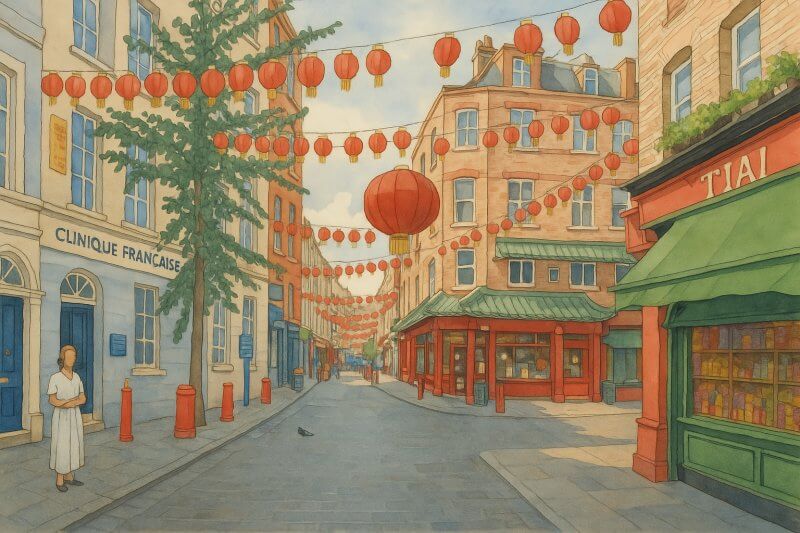
Painting of Gerrard Street (View full-size image here)
Nearest London Underground Stations
Gerrard Street is very centrally located and well-served by several London Underground stations:- Leicester Square Station (Northern and Piccadilly Lines) – about a 3-minute walk
- Piccadilly Circus Station (Bakerloo and Piccadilly Lines) – about a 5-minute walk
- Tottenham Court Road Station (Central, Elizabeth, and Northern Lines) – about a 7-minute walk
Fun Facts About Gerrard Street
- During the 1950s and 1960s, Gerrard Street was a centre for London's emerging jazz scene, hosting clubs where famous musicians such as Ronnie Scott performed before he opened his own legendary jazz club nearby.
- Gerrard Street was officially designated the centre of Chinatown in the 1970s as Chinese businesses and immigrants, many of whom had fled from Hong Kong, established a thriving community there.
- It is a popular filming location, often featured in movies and television shows set in London's Chinatown.
Moving to London?
New to London and need a place to live? Read our Renting A Flat Guide. This guide covers everything you need to know about renting a flat in London, from viewing to signing.Streets of London
Come, let's explore and discover the streets of London together! Listed here afre the Streets of London that I have documented. Dive in and discover!Map of Streets in London
View all the streets that I have documented on Google Maps in this Map of Streets in London.Want to share your London travel experiences or get tips from fellow travellers?
Join the London Travel Tips Facebook GroupMore information for visiting London
Here are some related articles to help you get to know London better.- Cost of Living in London: Discover the true cost of living in London, including housing, transport, groceries, and more - plus tips for budgeting in one of the world's most expensive cities.
- Driving in London: Planning to drive in London? Learn about roads, car rentals, parking, tolls, and key tips for tourists and visitors from outside the capital.
- Driving Tips for Visiting London: Thinking of driving to London? Discover the best times to travel, congestion tips, parking apps, breakdown help, and petrol advice for a smoother journey.
- Evolution of London's Streets: Discover the fascinating history of how London's streets developed from ancient footpaths to today's complex network of roads across the capital.
- History of Immigration to London: Discover the rich history of immigration to London, from Huguenots to Bangladeshis, and how diverse communities have shaped the city's vibrant identity.
- How Big Is London Compared to Other World Cities?
- How London's Streets Measure Up: A Global Comparison of Road Widths
- How Streets of London are Named: Discover how London streets get their names, who decides them, and how historic, political, and public influences shape street naming in the capital.
- How the Grosvenor Family Came to Own Much of Mayfair, Belgravia and Pimlico: Explore how the Grosvenor family came to own much of Mayfair, Belgravia, and Pimlico, and learn about their historical connection (or lack thereof) with the British royal family and government.
- Living and working in London
- London's Quiet Collapse: How Living Standards Fell as Costs Skyrockted (1975-2025): Explore how London residents endured rising costs and falling living standards from 1975 to 2025 - from rocketing rents to wage stagnation and inflation.
- Marvel of the London Underground: Discover the history, challenges, and triumphs of the London Underground - the world's first underground railway and a vital transport lifeline for the UK capital since 1863.
- Moving to London: Expat Tips for Settling in Westminster: Essential advice for expats moving to London's Westminster: neighborhood insights, cost of living, transportation, housing, healthcare, schools, and tips to help you feel at home in the heart of the city.
- Places in London that aren't pronounced the way they're spelled
- Shopping in London: Discover London's diverse shopping scene
- Taking the bus in London: This is your complete guide to taking the bus when in London.
- The Anglican Faith: A Visitor's Guide to the Church of England: Learn about the Anglican faith and its deep ties to London's landmarks like Westminster Abbey and St Paul's Cathedral.
- Top 10 London Streets Every Visitor Must See: Discover London through its most iconic thoroughfares - 10 streets every visitor must experience. From historic Abbey Road to vibrant Camden High Street, explore culture, shopping, and hidden gems.
- Why are most roads in Central London so narrow? Learn why there are so few multi-lane roads and elevated highways in the heart of the city.
 Latest Pages & Updates
Buy Me A Coffee
If you enjoy the information I provide and want to support the work I do, please buy me a coffee! I appreciate it immensely, thank you so much!
