

Light Street (Lebuh Light), George Town
 Go Back - Latest PENANG
  Sights/Streets/New Properties > Malaysia > World | Hokkien : Lessons : Dictionary | YouTube | Facebook | About Me : Contact Me
Please enjoy this English-language song I have created about Penang.
Penang You Are So Beautiful
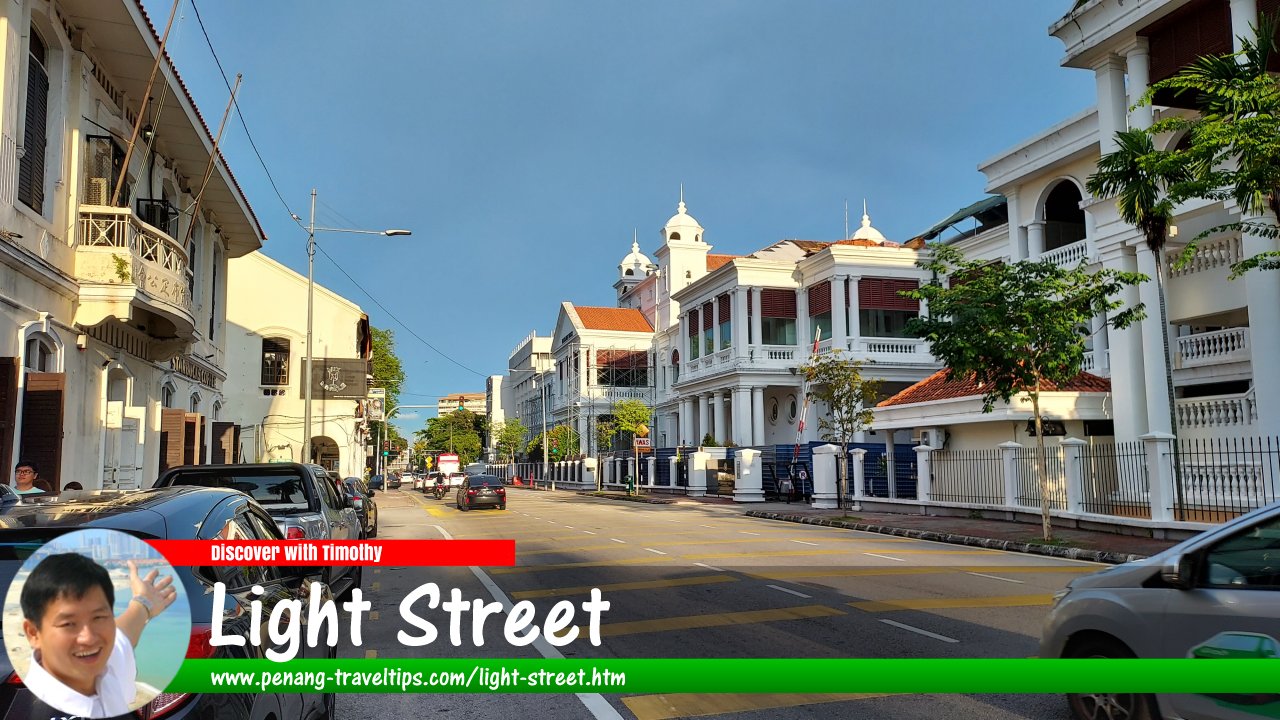 Light Street (Lebuh Light), George Town, Penang (20 May 2023)
Versi B. Melayu
Light Street, or Lebuh Light in Malay, was the first street to be laid on the newly established settlement on George Town. It is said that Captain Francis Light fired a cannon filled with silver coins to induce the locals to clear the humid, mosquito-infested dense jungle. It should be pointed out that Penang Island was not uninhabited when Light landed there - there was already settlements along the banks of Sungai Pinang, at Batu Uban, and Tanjong Tokong.
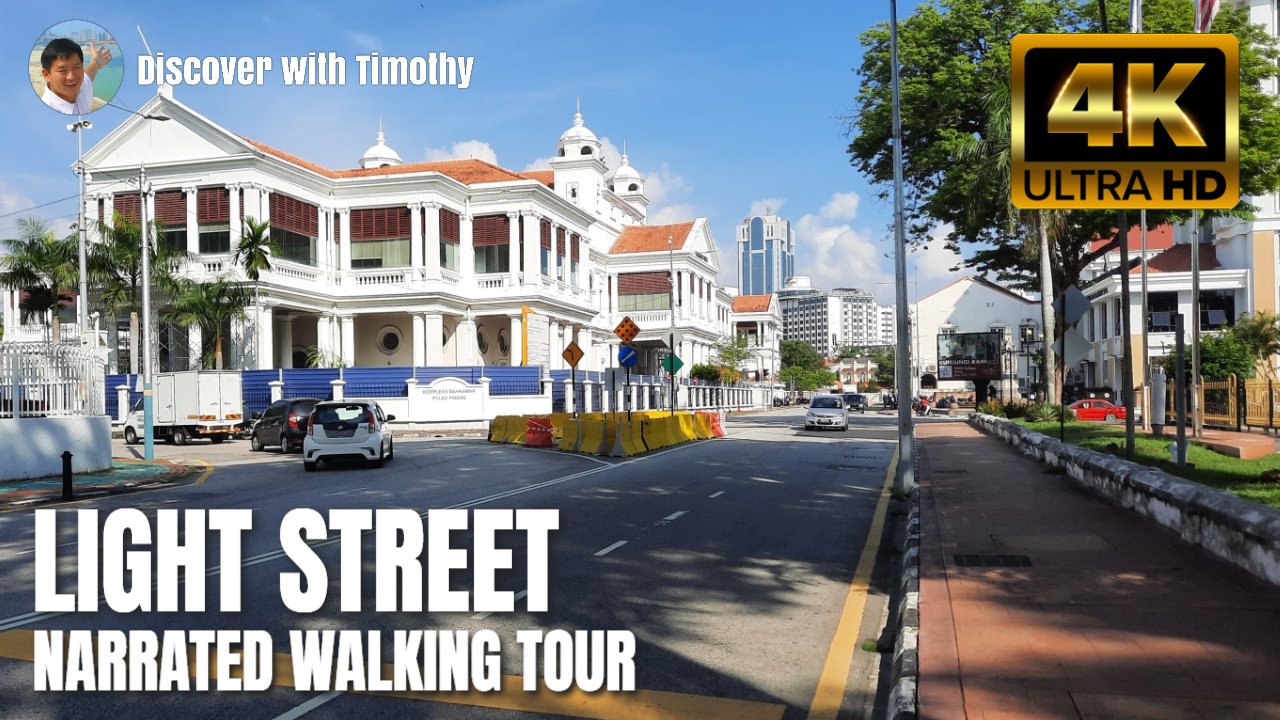
Light Street Narrated Walking Tour
On this walking tour, I take you along Light Street, the oldest street in George Town, Penang, and explain to you the sights as we go along.
 Map of Light Street, Penang
Hotels on Light Street
Historic Buildings on/near Light Street
- Chinese Chamber of Commerce (GPS: 5.42012, 100.34168)

- Foo Tye Sin Mansion (GPS: 5.41975, 100.34209)

- Fort Cornwallis (GPS: 5.4203, 100.34384)

- Francis Light's Well (GPS: 5.42257, 100.33918)

- Government House (GPS: 5.42273, 100.3389)

- House of Yeap Chor Ee (GPS: 5.41982, 100.3418)

Fields on Light Street
- Padang Kota Lama (GPS: 5.42072, 100.34221)

Schools on Light Street
- Convent Light Street (GPS: 5.42146, 100.33856)

Auditoriums on Light Street
- Dewan Sri Pinang (GPS: 5.4213, 100.34045)

Monuments on Light Street
- Logan Memorial (GPS: 5.42107, 100.33984)

- Queen Victoria Memorial Clocktower (GPS: 5.41944, 100.34426)

Fountains on Light Street
- Municipal Fountain (GPS: 5.42076, 100.34098)

- Pinang Fountain (GPS: 5.41912, 100.34408)

Commercial Buildings on Light Street
- Wisma Great Eastern (GPS: 5.42005, 100.34091)

- Wisma Pelaut (GPS: 5.41956, 100.34252)

Government Buildings on Light Street
- Bank Negara Malaysia Building (GPS: 5.42052, 100.34044)

- Immigration Department (GPS: 5.41902, 100.34367)

- Penang Supreme Court (GPS: 5.42076, 100.3398)

- State Assembly Building (GPS: 5.41936, 100.34312)

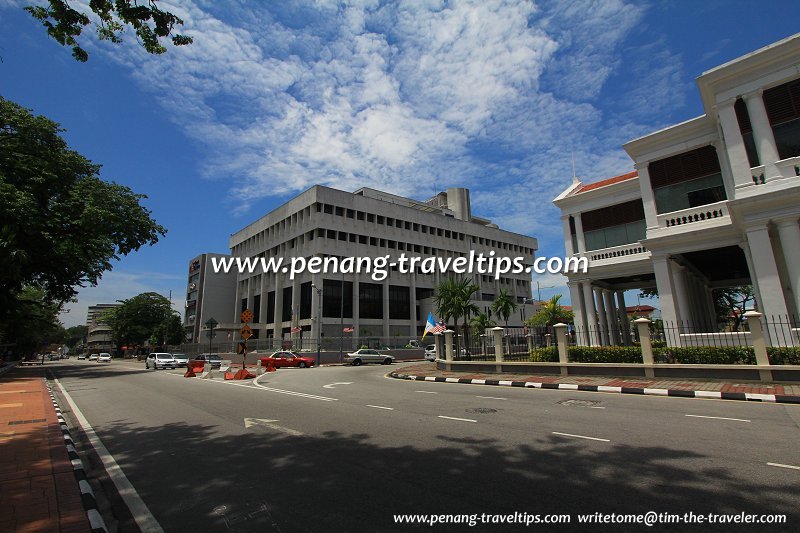 Light Street, with view of Wisma Great Eastern, Bank Negara Malaysia Building and Supreme Court Building (21 August 2011)
After the land was cleared, Light named the first road after himself. Subsequent roads were laid out from Light Street. Light had no experience in town planning (something that would manifest itself in later decades, when British officers reexamined his town layout and found it wanting, as I've described in the historical plan to relocate George Town). He also had limited assistance from the British East India Company, and did the best he could with the resources in hand.
In the earliest days, Light had his house built on Light Street. His friend and trading partner James Scott also had his home on Light Street. Fort Cornwallis as we know it today had not yet existed, but Light had a crude palisaded fortress built of nibong trunks at the tip of the cape. It was not the most ideal site for a fort, and Light, with no military experience, did not know it. He was however successful in repelling an attack mounted by Sultan Abdullah in 1791.
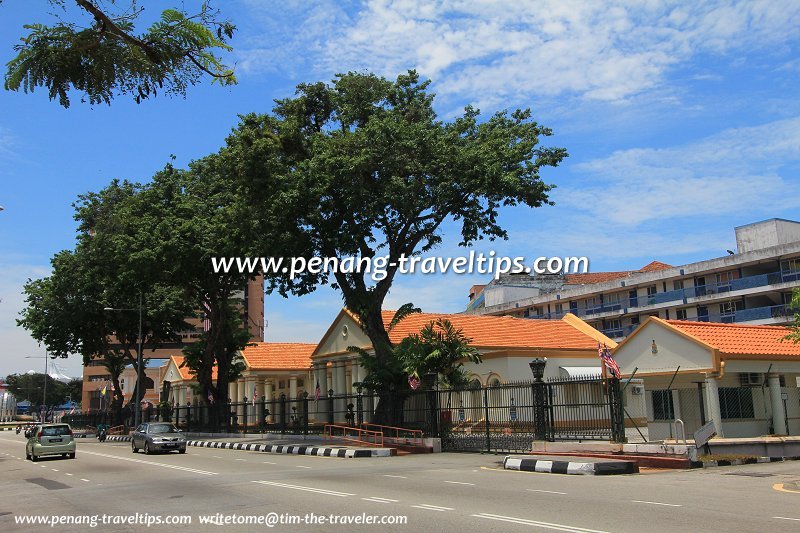 Light Street in front of the State Assembly Building (21 August 2011)
Light built a jetty at one end of Light Street, and at the other, he dug a well for the new settlement (this, I believe, is a different well from the Francis Light Well, which Light dug for his personal use). The jetty was removed when the land was reclaimed to create Swettenham Pier. Light Street was arrow straight. It ended where the gate to Convent Light Street is located today. A short road called Prince Street (now part of Light Street) linked it to Farquhar Street (at that time known as Penang Road)
For the first half of the 19th century, much of Light Street was occupied by the military, the police and the British administrators.
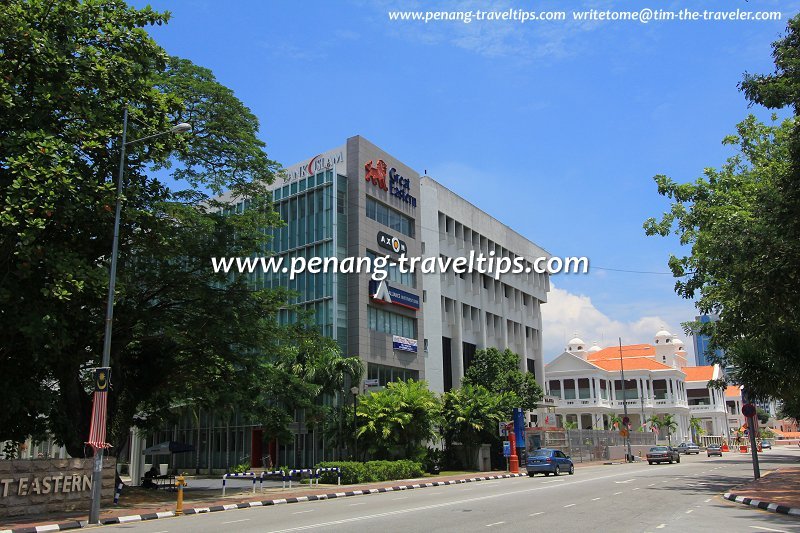 Light Street in front of Wisma Great Eastern (21 August 2011)
Until Penang was elevated to the status of Presidency in 1805, there wasn't much money for public works either. Only after Penang gained that status was there grander buildings erected, among them the Recorder's Courts Building, which today is used as the State Assembly Building. At that time, it was part of the Central Police Station, before the Central Police Station move to Claimant Place, leaving a shadow of itself in the form of the Beach Street Police Station. During this period, Light Street was known in Hokkien as Po3lay3 Khau4
 , meaning "entrance to the police station".
By the second half of the 19th century, as land use was relaxed, rich Chinese tycoons began buying real estate previously occupied by the Europeans. As a result, newly rich entrepreneurs such as Foo Tye Sin, Koh Seang Tat, Goh Ban Bee had their properties on Light Street - to be able to afford a Light Street address would mark a Chinese as "having arrived".
Light Street continues to evolve little by little from the turn of the 20th century and into the 21st century. The Light Street Roundabout did not materialise until after the Second World War.
New buildings added to Light Street since the mid 20th century include Dewan Sri Pinang, Bank Negara Malaysia and Wisma Great Eastern but most of the other buildings along it have remained little changed since at least 70 years ago.
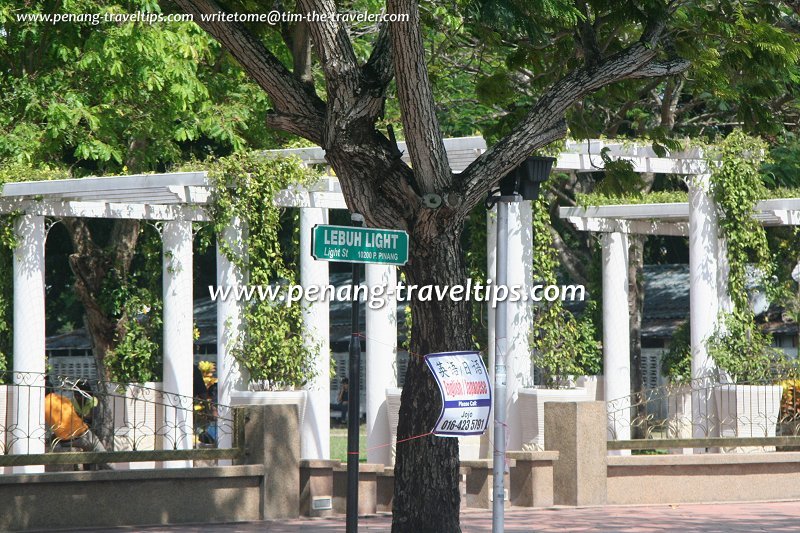 Lebuh Light road sign (30 November 2008)
Getting there
You can reach Light Street by taking the Rapid Penang Free Shuttle Bus to Station No. 5 (Bank Negara).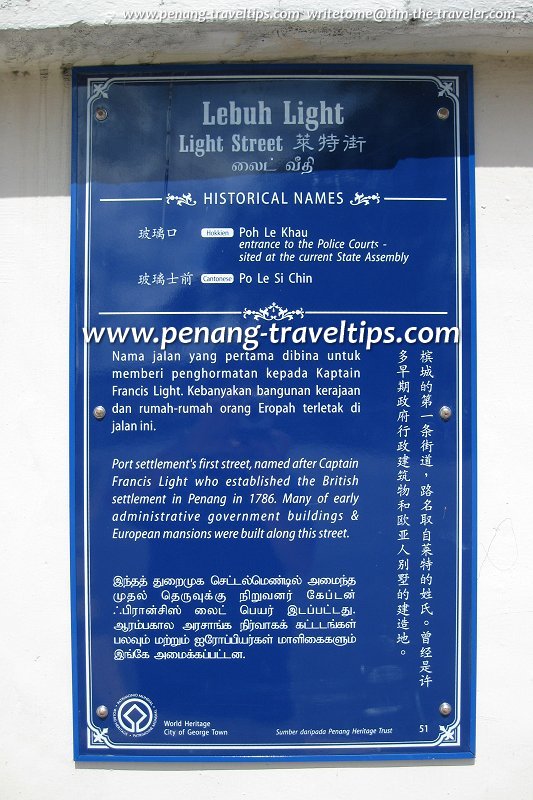 Light Street history plaque (30 November 2008)
List of Streets in Penang and Streets in Malaysia
Private Guided Tours of Penang
If you are seeking private guided tours of Penang, message Penang Tour Guides at penangtourguides@gmail.com and enquire with them. Buy, rent or sell properties in Penang
Do you have a property for sale or to rent out? Are you looking to buy or rent a property? Get in touch with me. WhatsApp me (Timothy Tye) at 012 429 9844, and I will assign one of my property agents to serve you. I will choose the agent for you, according to your property needs. So when you message me, provide me some details of what you need, whether to sell, to buy, to rent or to rent out, and what type of property, is it condo, apartment, house, shop, office or land.Adakah anda mempunyai hartanah untuk dijual atau disewakan? Adakah anda ingin membeli atau menyewa hartanah? Hubungi saya. WhatsApp saya (Timothy Tye) di 012 429 9844, dan saya akan menugaskan salah seorang ejen hartanah saya untuk berkhidmat kepada anda. Saya akan pilih ejen untuk anda, mengikut keperluan hartanah anda. Oleh itu, apabila anda menghantar mesej kepada saya, berikan saya beberapa butiran tentang apa yang anda perlukan, sama ada untuk menjual, untuk membeli, untuk disewakan atau untuk disewakan, dan jenis hartanah apakah itu kondo, pangsapuri, rumah, kedai, pejabat atau tanah.
您有待出售或出租的房产吗? 您想购买或租赁房产吗? 与我联系。 WhatsApp 我 (Timothy Tye) 012 429 9844,我将指派一名房地产经纪人为您服务。 我会根据您的房产需求,为您选择代理。 因此,当您给我发消息时,请向我提供一些您需要的详细信息,无论是出售、购买、出租还是出租,以及房产类型,是公寓、公寓、房屋、商店、办公室还是土地。
New Properties in Penang
Looking to buy property in Penang? Get the e-brochures right here without having to visit or contact individual developers.- Anggun Residences E-Brochure, Batu Kawan
- Aston Acacia E-Brochure, Bukit Mertajam
- Beacon Executive Suites E-Brochure, George Town
- Beverly Heights @ Bukit Gambir E-Brochure, Gelugor
- BM Highland E-Brochure, Bukit Mertajam
- Cypress Villa E-Brochure, Sungai Ara
- D'Zone Condominium E-Brochure, Teluk Kumbar
- Elements Garden E-Brochure, Butterworth
- Ferringhi Residence 2 E-Brochure, Batu Ferringhi
- GEM Residences E-Brochure, Prai
- Golden Triangle 2 E-Brochure, Sungai Ara/Relau
- Grace Residence E-Brochure, Jelutong
- Granito @ Permai E-Brochure, Tanjong Bungah
- Green City Residence E-Brochure, Jelutong
- Havana Beach Residences E-Brochure, Bayan Lepas
- Imperial Residences E-Brochure, Sungai Ara/Relau
- Imperial Grande E-Brochure, Sungai Ara/Relau
- Lucerne Residence E-Brochure, Bayan Lepas
- Mezzo @ The Light City E-Brochure, Gelugor
- Middleton E-Brochure, Gelugor
- Orchard Villa 3 E-Brochure, Simpang Ampat
- Primero Heights E-Brochure, Permatang Pauh
- Queens Waterfront Q2 E-Brochure, Bayan Lepas
- Royale Heights @ Tambun Royale City E-Brochure, Simpang Ampat
- Royale Infinity @ Tambun Royale City E-Brochure, Simpang Ampat
- Rubica @ Harbour Place E-Brochure, Butterworth
- Sensasi Commercial Suites E-Brochure, Batu Kawan
- Setia Sky Ville E-Brochure, Jelutong
- Setia Sky Vista E-Brochure, Sungai Ara/Relau
- Setia V Residence E-Brochure, Gurney Drive
- Sinaran Residence E-Brochure, Batu Kawan
- Sky @ TriPark E-Brochure, Bukit Mertajam
- Skyridge Garden E-Brochure, Tanjong Tokong
- Starhill Luxury Residences E-Brochure, Gelugor
- Straits Residences E-Brochure, Tanjong Tokong
- Taman Nuri Emas E-Brochure, Nibong Tebal
- The Light Collection IV E-Brochure, Gelugor
- The Loft @ Southbay E-Brochure, Batu Maung
- The Terraces Condominium E-Brochure, Bukit Jambul
- Trehaus Condo Villas E-Brochure, Bukit Jambul
- Triuni Residences E-Brochure, Batu Uban
- Urban Suites E-Brochure, Tanjong Tokong
- Valencia Residence E-Brochure, Bayan Lepas
- Vertu Resort E-Brochure, Batu Kawan
- Vivo Executive Apartment E-Brochure, Batu Kawan
- Viluxe E-Brochure, Batu Kawan
- Waterside Residence E-Brochure, Gelugor
Latest updates on Penang Travel Tips
Discover with Timothy YouTube Channel
PG Food Channel
Learn Penang Hokkien YouTube Channel
SojiMart Videos
Share your travels and/or ask a travel-related question
Join the Penang Travel Tips Facebook Group to share photos, tips and anything related to your travels, or ask travel-related questions.
Map of Roads in Penang
Looking for information on Penang? Use this Map of Roads in Penang to zoom in on information about Penang, brought to you road by road. Discover with Timothy
Let me take you to explore and discover Penang through my series of walking tours on YouTube. You may use these videos as your virtual tour guide. At the beginning of each video, I provide the starting point coordinates which you may key into your GPS, Google Maps or Waze, to be navigated to where I start the walk, and use the video as your virtual tour guide.Disclaimer
Please use the information on this page as guidance only. The author endeavours to update the information on this page from time to time, but regrets any inaccuracies if there be any.Songs about Penang
About this website

Hello and thanks for reading this page. My name is Timothy and my hobby is in describing places so that I can share the information with the general public. My website has become the go to site for a lot of people including students, teachers, journalists, etc. whenever they seek information on places, particularly those in Malaysia and Singapore. I have been doing this since 5 January 2003, for over twenty years already. You can read about me at Discover Timothy. By now I have compiled information on thousands of places, mostly in Peninsular Malaysia and Singapore, and I continue to add more almost every day. My goal is to describe every street in every town in Malaysia and Singapore.
Copyright © 2003-2024 Timothy Tye. All Rights Reserved.