
Goddess of Mercy Temple (Kuan Im Teng), George Town
 Go Back
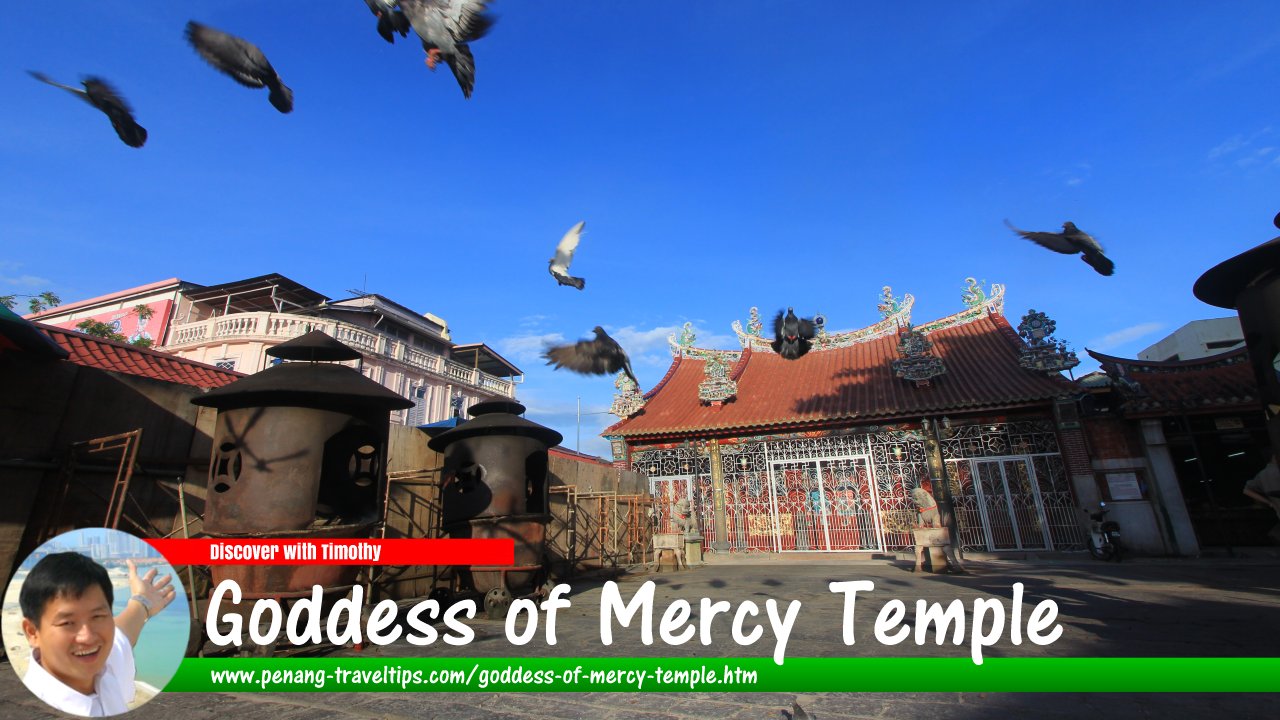 Kuan Im Teng, Temple of the Goddess of Mercy (5 February 2013)
The Goddess of Mercy Temple (GPS: 5.41845, 100.33880) or Kuan Im Teng (Traditional Chinese: 觀音亭, Simplified Chinese: 观音亭; Pinyin: Guānyīn tíng; Penang Hokkien: Kuan3 Im3 Teng2
 ) literally, Pavilion of the Goddess of Mercy, but more commonly known as Goddess of Mercy Temple or Temple of the Goddess of Mercy, is one of the oldest and most important Chinese temples in Penang.
Kuan Im Teng is in fact the colloquial name for the temple. It has an official, the more illustrious name, Kong Hock Keong (Traditional Chinese: 廣福宮; Simplified Chinese: 广福宫; Pinyin: Guǎng fú gōng; Penang Hokkien: Kong3 Hock1 Keong4
), which simultaneously translates as "Palace of Extensive Good Fortune" or "Palace of the Cantonese and the Hokkiens". But as far as most people in Penang are concerned, it is Kuan Im Teng.The Kuan Im Teng is located along Jalan Masjid Kapitan Keling, formerly Pitt Street. Although far from being the biggest or most ornate temple in George Town, it is the oldest. And that makes it the mother temple for the Taoists in the city. If you study the history of the Goddess of Mercy Temple, you would be surprised to learn that at the time it was built, it was not dedicated to Kuan Yin, the Goddess of Mercy, but rather to Mah1 Cor1 Poh2 (Traditional Chinese: 媽祖婆; Simplified Chinese: 妈祖婆; Pinyin: Māzǔ pó; Penang Hokkien: Mah1 Cor1 Poh2
), the patron saint of seafarers.
 Discover with Timothy Videos
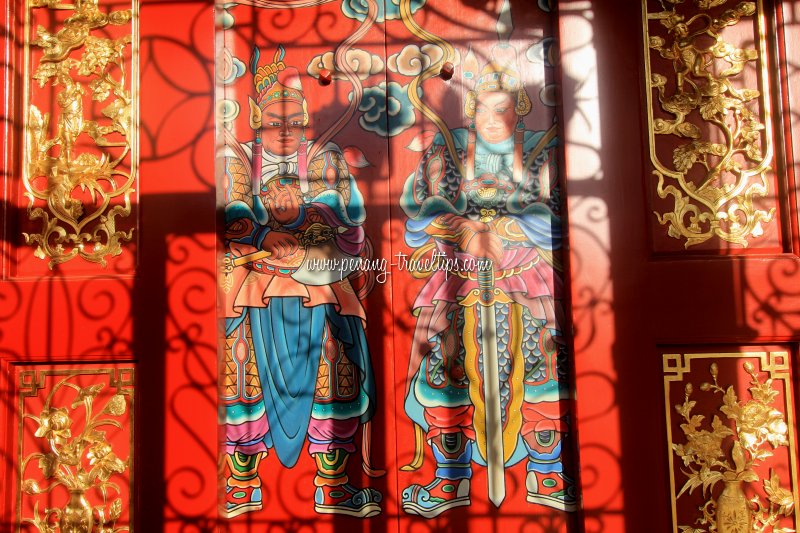 The door gods of Kuan Im Teng (5 February 2013)
This is what I discovered, as I sieved through the documents on this renowned temple. Apparently, and understandably, the Mah1 Cor1 Poh2, as a goddess dedicated to rescuing seafarers from the perils at sea, was the original primary diety of the temple because the Chinese community, being newcomers in a strange land, needed divine protection for their tumultous journey through the South China Sea. A study of the altar tablets shows that the tablet representting the Mah1 Cor1 Poh2 is larger than the one for the Kuan Yin. Also, according to historian Ong Seng Huat, the poems inscribed on the 60 fortune sticks in the temple are similar to those found in Mah1 Cor1 Poh2 temples.
In all likelihood, as the local Chinese community evolved from one dependent on the sea to one which is urban, the virtues of the Goddess of Mercy - motherliness, compassionate, dedicated to saving mortals from tribulation - became more congruent to their needs. This transition from Ma1 Cor1 Poh2 to Kuan Yin 1824, because two stelae erected by the Board of Directors of the temple indicated that the Goddess of Mercy was the main deity even before 1824.
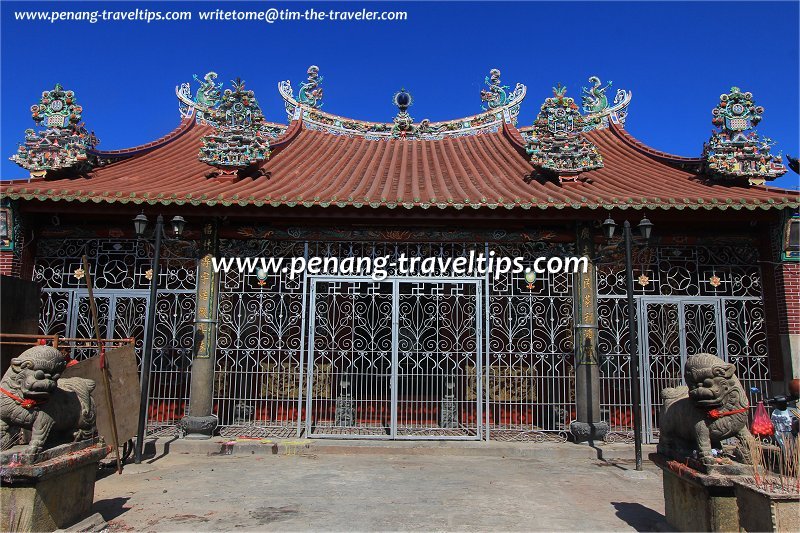 Front façade of the Kuan Im Teng following the 2012-13 restoration (11 February 2013)
Although the Kuan Yin is a very popular diety among the local Chinese, she is not of Chinese origin. Rather, she originates from India, where she is known as the Avalokiteśvara, and is featured where Mahayana Buddhism is practised. In Cambodia, I found a representation of the Avalokitesvara on the gopura or gateways of Angkor Thom, and at the famous Bayon temple, for King Jayavarman VII of Angkor was a Mahayana Buddhist; nowadays however, Cambodia's principal religion is Theravada Buddhism. The original Avalokitesvara is regarded as androgynous, that is to say, neither male nor female. According to Malacca historian Josephine Chua, the Avalokitesvara was a male, but took on a female form so that he can better sympathise with human sufferings and provide compassion.
Now, another discovery I made was that the official name of the Kuan Im Teng is actually Kong Hock Keong, which means, "Temple of the Cantonese and Hokkien community". That's short for "everybody's temple", I suppose. The name Kong Hock Keong is derived from "Kong" for Kong Fu, meaning Cantonese, and "Hock" for Hokkien, and reflects the two main provinces in China from which the majority of the Chinese immigrants in Penang originate. The foundation stone of the temple was laid around 18002, making it one of the oldest temples in Penang, earlier than other clan temples such as Khoo Kongsi.
As with all important Chinese buildings, the choice of site is all dependent on feng shui. The Kuan Im Teng was sited on a gentle knoll, which is regarded as a dragon in feng shui, a geomantically strategic place to locate a temple. In keeping with ceh-sua-kua-hai or viewing-the-sea-from-a-hillside-perch position, the temple was to command a view of the sea all the way to the hills of Province Wellesley. There are two visible wells at the Kuan Im Teng, one at the courtyard for public use, and one within the temple, for the monks. Though now disused, they are significant from feng shui aspect, for they are regarded as the "eyes of the dragon". According to belief, there is supposed to be a third well, right under the front altar, which act as the dragon's "third eye".
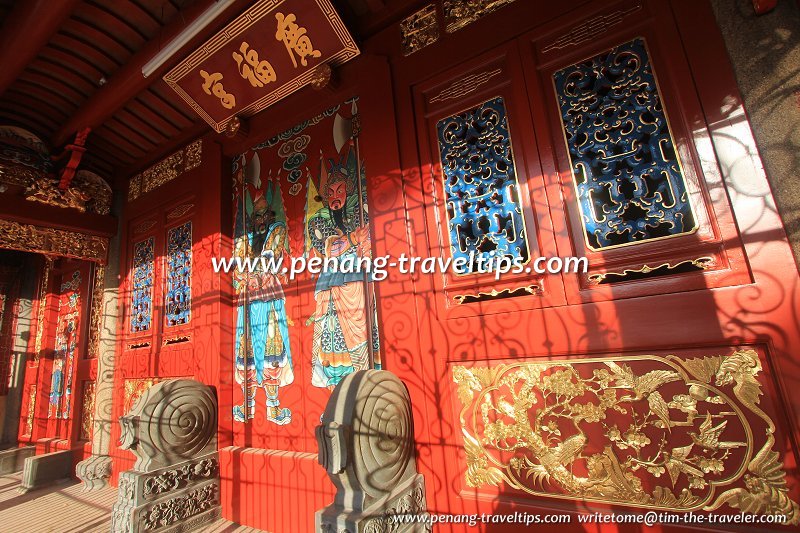 Main entrance to Kuan Im Teng, Temple of the Goddess of Percy, Penang (5 February 2013)
At the time of its construction, the sea reaches Beach Street, which as its name suggests, was a beach-front street. Between the beach and the temple is China Street, lined at that time with Chinese shophouses. The street acted as a funnel for all the goodness to flow in with the tides.
The Chinese community tried to purchase the piece of beach property in front of the temple. However the proprietor refused to sell the Beach Street plot, and instead the sea was reclaimed and a building was erected on it, effectively blocking the temple from direct view of the sea. The temple authorities could do nothing about this; they could only declare that house unlucky for interfering with the feng shui. When the British built the Malayan Railway Building in 1907, the Chinese community regarded this as another dirty trick of the British to destroy the political power of the Chinese in Penang. That's because the clocktower of the Malayan Railway Building is thought to confuse the "land dragon" of the Kuan Im Teng, again diminishing the feng shui value of the temple.
The Kuan Im Teng underwent a major renovation in 1824, when it was enlarged to provide more space for a plethora of new dieties. As a temple for the Cantonese and Hokkien communities, it tried to play a role as mediator to their many squabbles. From 1830 to 1850, the various dialect groups began to polarise, and to assert their respective influences. Rival secret societies were established (by the way, the term "secret society" was an entirely British creation because they were unable to pry into the activities of these groups) to stack claims over farmlands, economic resources, and eventually tin-mining areas in Perak. Alliances were being forged between groups and also with rivalling Malay groups. As the Chinese community became disunited, the Kuan Im Teng found itself not only helpless in its mediating efforts, but also suffered from lack of attention. The rival groups, forming their own clan associations, or kongsis, proceeded to build their own clan temples in George Town. Due to rivalry these clan temples become even more ornate and opulent compared to the Kuan Im Teng. Indeed the list of donors to the Kuan Im Teng in 1862 shows that the directors and donors to the temple came from rival societies.
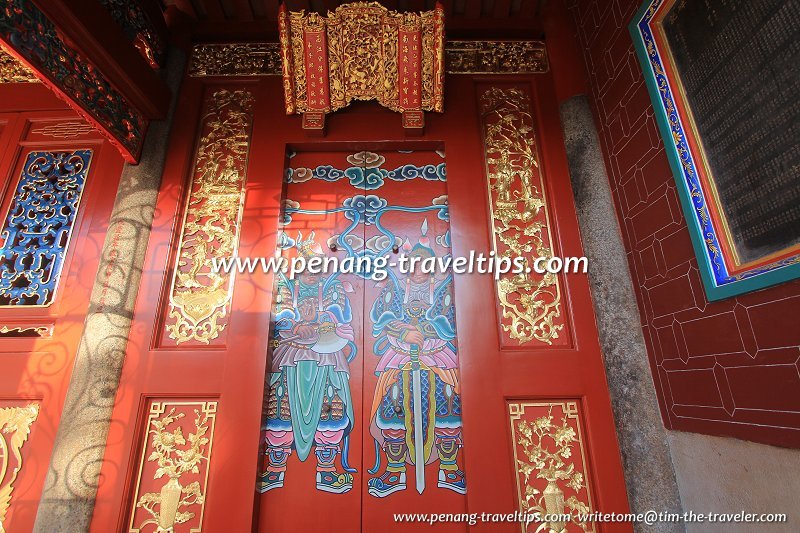 Entrance to the side shrine at Kuan Im Teng (5 February 2013)
The continual polarisation of the Chinese society in 19th century George Town culminated with the Penang Riots of 1867 and the three Larut Wars of 1860-1874, which resulted in British intervention in Perak. Each time, the Kuan Im Teng failed to mediate between the rival groups. Eventually, the Chinese community decided that there should be a separation between spiritual and secular affairs and this led to the founding of the Penang Chinese Town Hall in 1880, to look into the non-spiritual needs of the community.
Despite its long and often tumultuous history, the Kuan Im Teng continues to be one of the most popular temples among the Chinese taoist community of Penang, and throngs come to worship here, especially on Temple Days, which fall on the first and fifteenth of every lunar month, and on the Goddess of Mercy's feast days, which are on the 19th day of the 2nd, 6th and 9th month of the lunar calendar. These feast days mark the anniversaries of the Avalokitesvara's birthday, initiation, and attaining Nirvana. It is common that puppet shows and Chinese operas are staged on these days in her honour.
Night view of the Kuan Im Teng Temple
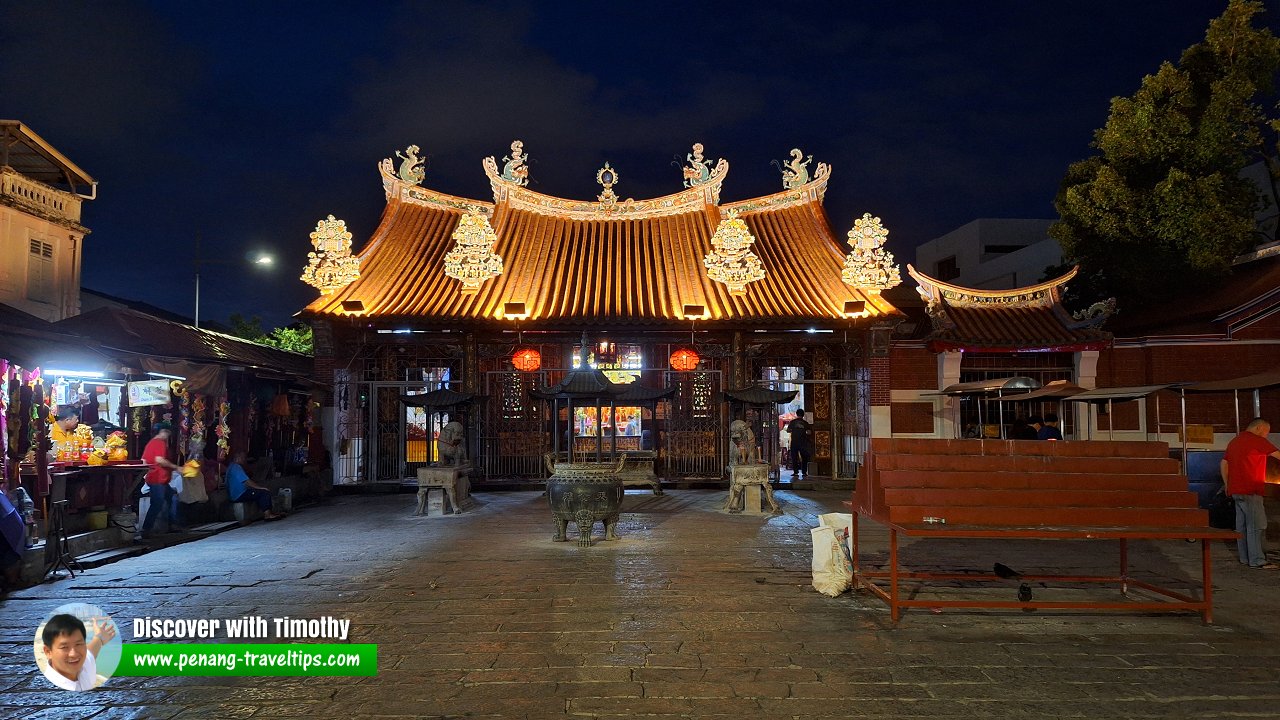 Night view of Kuan Yin Teng Temple (1 December 2024)
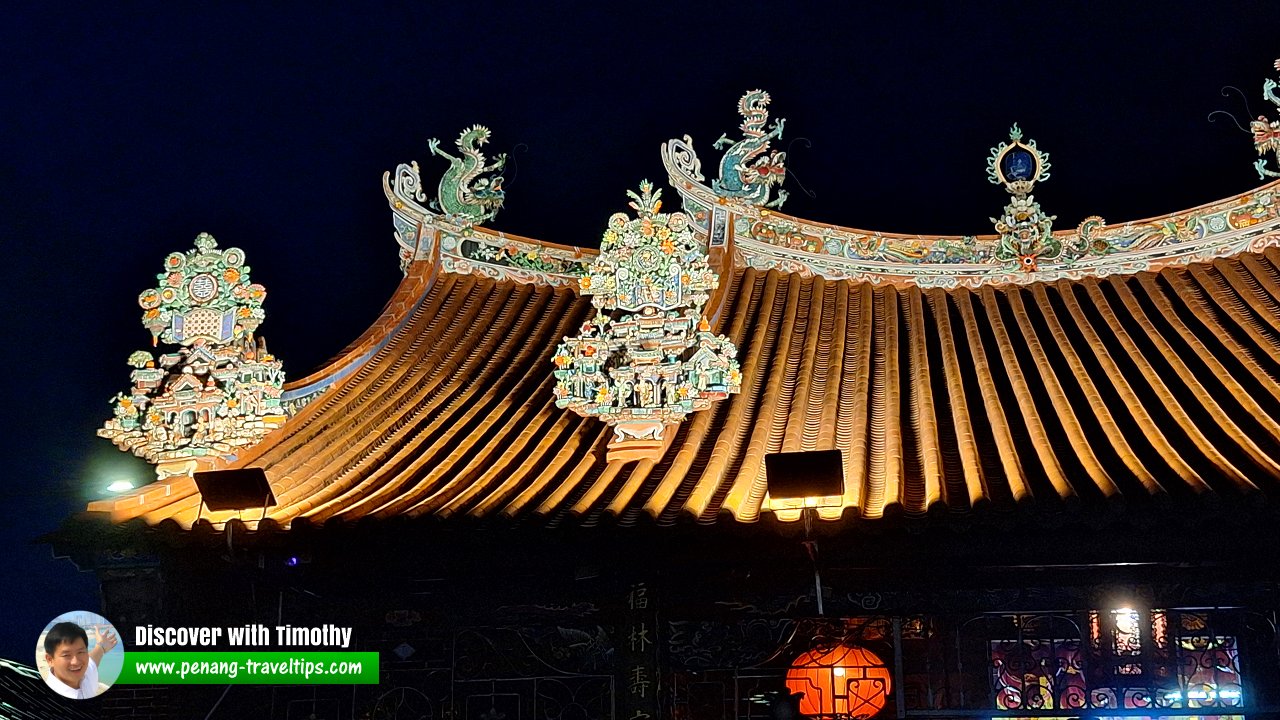 Details of the roof ornamentation of Kuan Yin Teng Temple (1 December 2024)
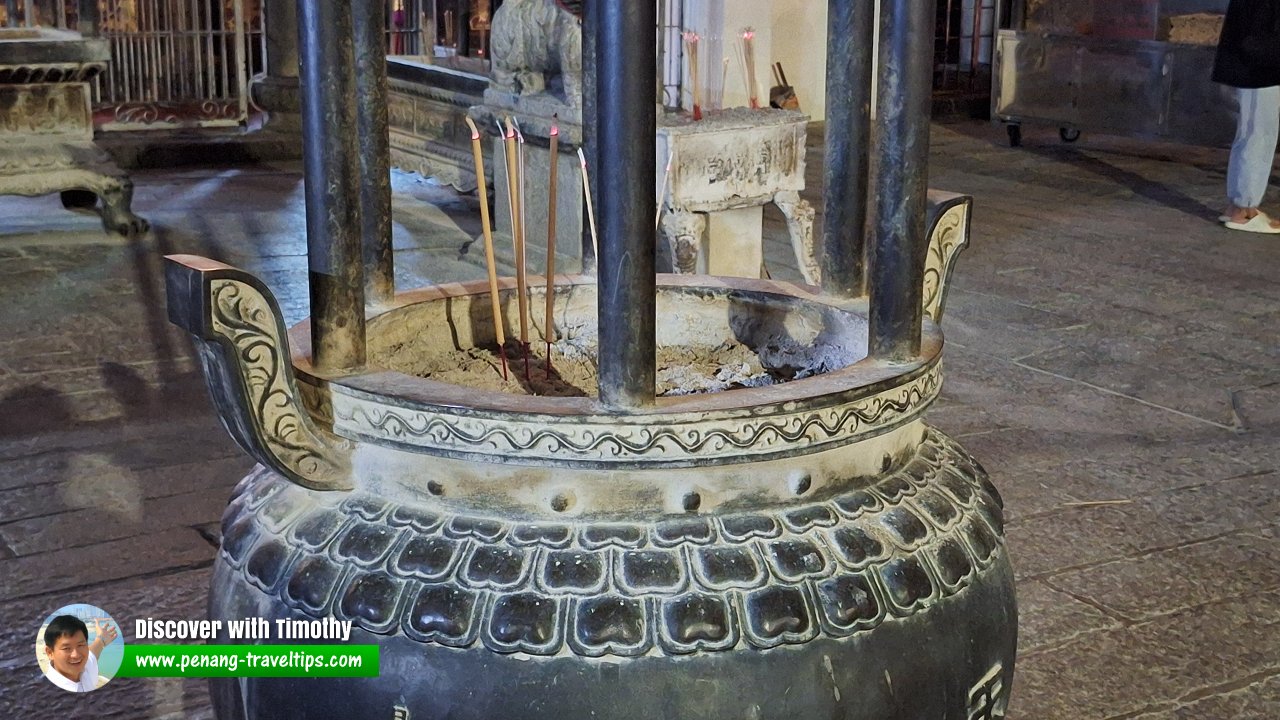 The joss burner of Kuan Yin Teng Temple (1 December 2024)
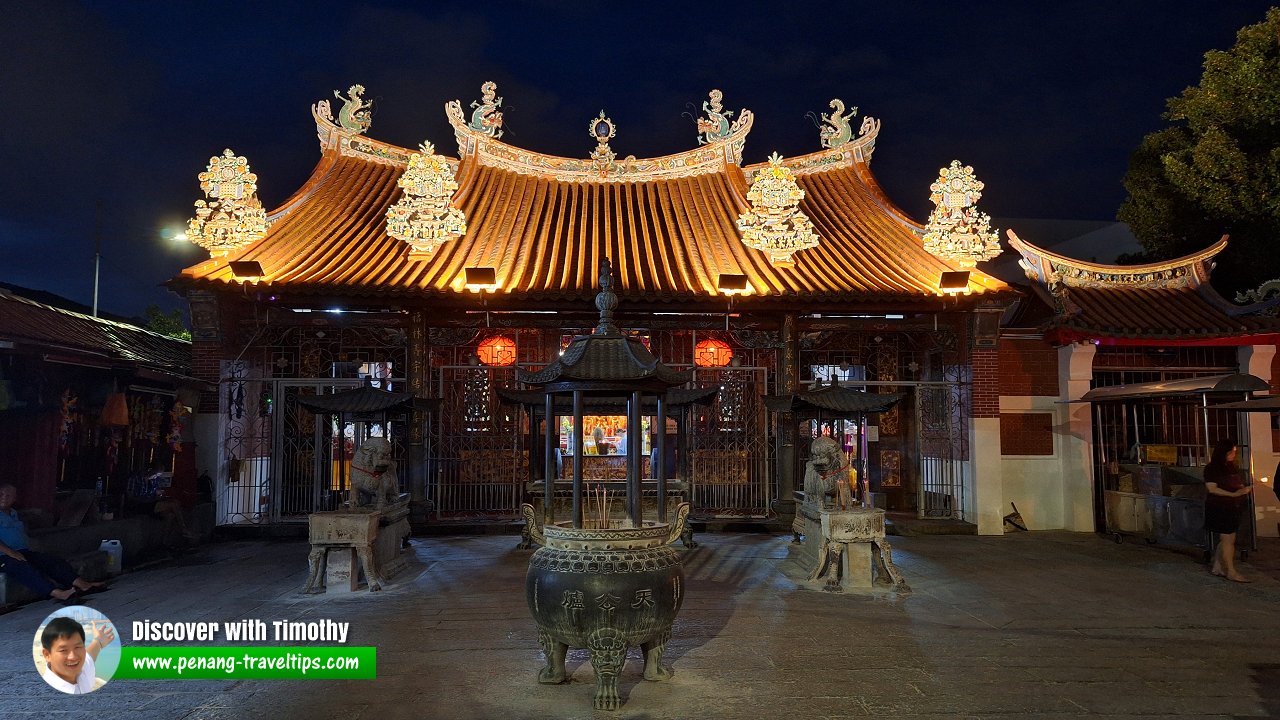 Another view of the Kuan Yin Teng Temple (1 December 2024)
Updates of the Kuan Im Teng
14 January, 2015A covered shelter built at the courtyard of Kuan Im Teng during the course of the renovation of the temple has been dismantled, so now visitors have uninterrupted view of the temple.
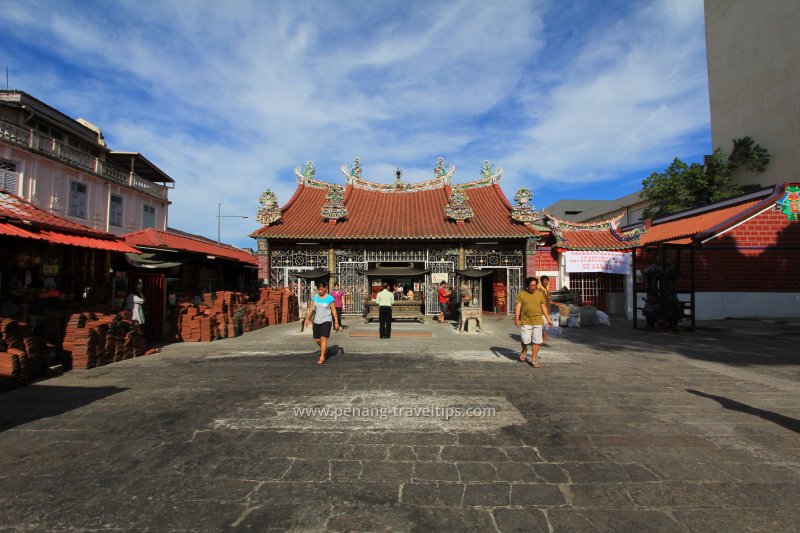 Courtyard of Kuan Im Teng (14 January 2015)
24 July, 2014: I learned from an email contact, Mr Ch'ng Chin Hon, that there is a temple in Jakarta also called Kwan Imm Teng. According to him, it was built in 1650, and hence is regarded as the oldest Chinese temple in the city. As with the Kuan Im Teng of George Town, it also has an image of the deity Ma Cor Poh on the right of the main altar which holds three Buddha images and one of the Kwan Imm. The oracle sticks at this temple in Jakarta is also similar to that in George Town's.
The parallelism between the two temples was uncanny. What Mr Ch'ng found intriguing was that the oracle sticks are used for consulting with Kwan Imm. He suspected that the temple was previously devoted to Mah1 Cor1 Poh2, but was destroyed by the Dutch in 1740, in a massacre that almost completely annihilated the Chinese population of then Batavia.
Mr Ch'ng's mention of the founding date of the Kwan Imm Teng in Jakarta was also intriguing to me. The year 1650 was when Japan-born Ming loyalist Zheng Chenggong (Traditional Chinese: 國姓爺, Simplified Chinese: 国姓爷, English: Koxinga) consolidated his hold on Taiwan, and thereafter staged a number of military offensives against the Qing government1 in Fujian Province. This period of instability saw an influx of Hokkien refugees out of China to populate much of Southeast Asia, including Batavia.
11 February, 2013: The Kuan Im Teng underwent massive restoration in 2012-2013, and was partially opened to worshippers during Chinese New Year. The restoration has provided the temple with a restored front façade. Repair work was also carried out on the roof tiles and particularly the intricate chien nien ("broken pottery") roof ornamentation.
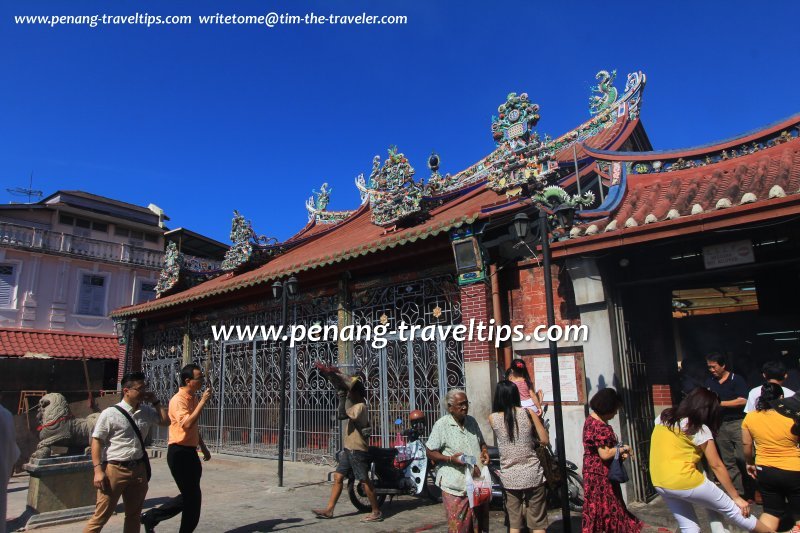 Visitors entering the Kuan Im Teng through the side entrance, when restoration was almost fully completed (11 February 2013)
Getting there
From the Weld Quay Ferry & Bus Terminal, cross Pengkalan Weld using the pedestrian bridge. Then turn right and walk along Pengkalan Weld until you reach Gat Lebuh China, with the Malayan Railway Building in front of you. Turn left into Gat Lebuh China and walk the distance. At the junction of Lebuh Pantai, Gat Lebuh China becomes Lebuh China. Continue along Lebuh China and you will see the Kuan Im Teng right in front of you.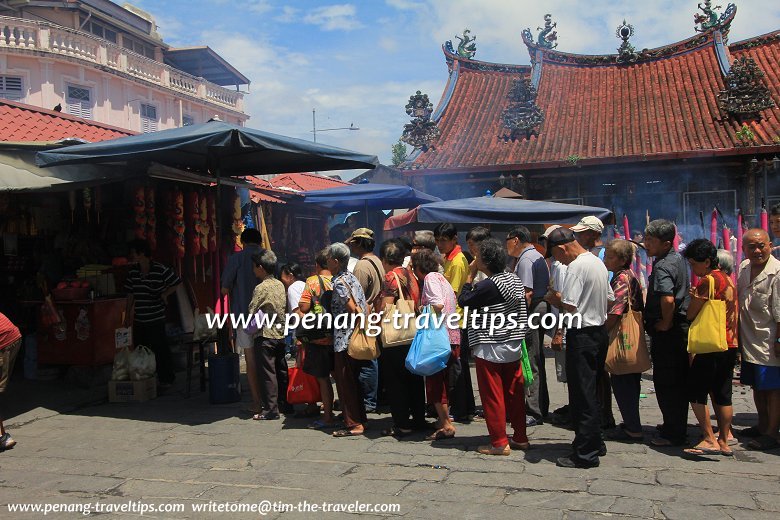 People lining up to receive food donation in front of Kuan Im Teng (31 May 2012)
What to see and do
The Kuan Im Teng offers the best experience of seeing a Taoist temple in action. It is one of the busiest temples within the Inner City of George Town, and there is a great photo opportunity everywhere around the temple compound as well as within.Nearby sights
The Kuan Im Teng is located in the middle of a very heritage-rich area. Within close walking distance are the following sights, which are just a selection of all the places you can visit.- St George's Anglican Church: Just a short walking distance away, at the junction of Jalan Masjid Kapitan Keling and Lebuh Farquhar
- Logan Memorial: Farther down Jalan Masjid Kapitan Keling, at Lebuh Light
- Sri Mahamariamman Temple: Across Jalan Masjid Kapitan Keling, with its entrance at Lebuh Queen
- Teochew Ancestral Temple: Just a short walking distance away, at Lebuh Chulia
- Masjid Kapitan Keling: A short distance down Jalan Masjid Kapitan Keling, on the same side of the road as Kuan Im Teng.
Street Art of Kuan Im Teng
The "Penang: Past, Present & Future" Mural on Magazine Road Ghaut features a scene of the Kuan Im Teng.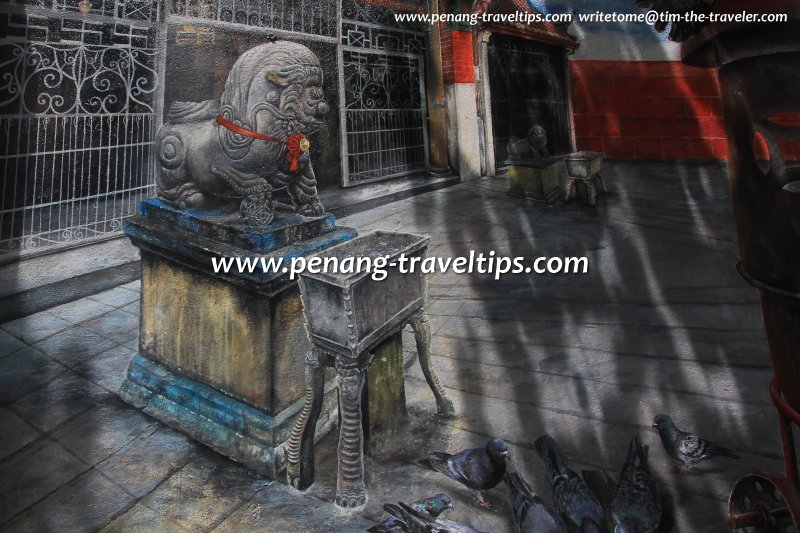 Kuan Im Teng Mural, Penang: Past, Present & Future (11 April 2013)
Reading in Penang Hokkien
Read about Kuan Im Teng in Penang Hokkien with this reading passage for beginners learning the language.Kuan Im Teng is  on the Map of Jalan Masjid Kapitan Keling (Pitt Street), Penang
References
- Koxinga
- Penang: Rites of Belonging in a Malaysian Chinese Community, by Jean De Bernardi
List of Penang Tourist Attractions, Chinese Temples in Penang and Chinese Temples in Malaysia

Copyright © 2003-2025 Timothy Tye. All Rights Reserved.