
Han Jiang Teochew Ancestral Temple 潮州會館
 Go Back - HOME | Latest PENANG | Travel Tips | Penang Hokkien : Dictionary | YouTube | Facebook | Contact Me
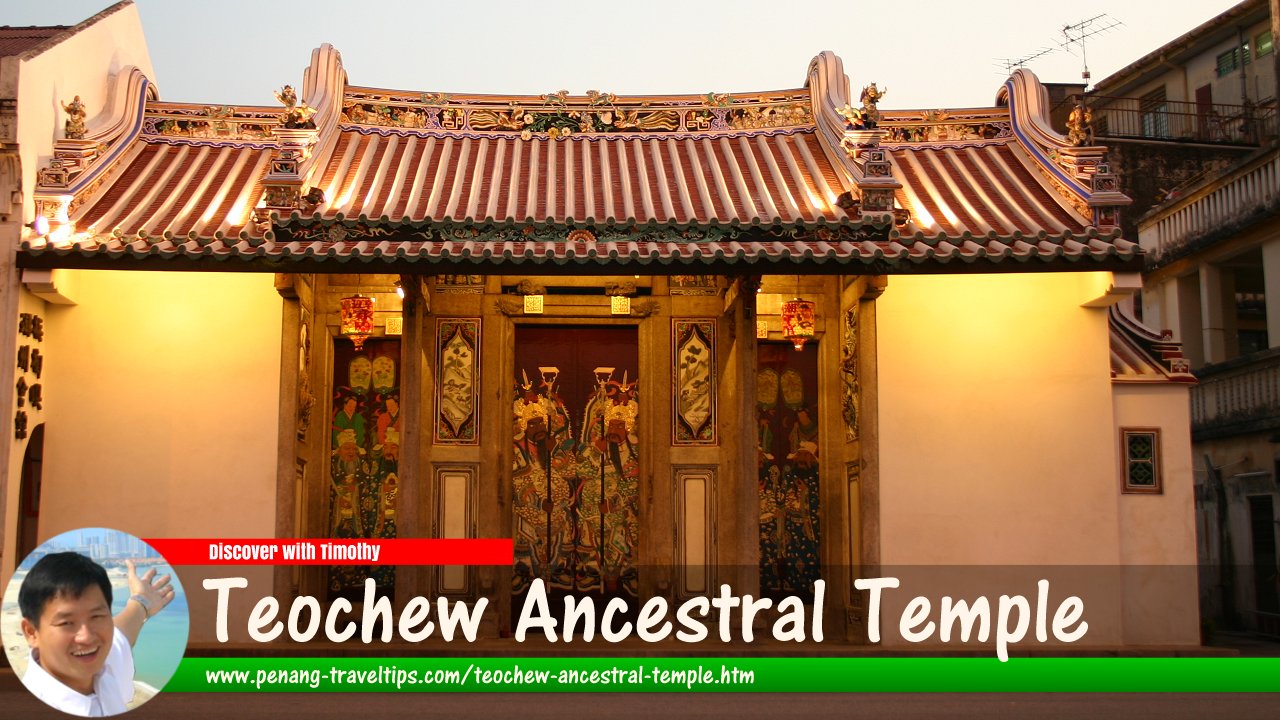 Teochew Ancestral Temple at dusk (17 April 2005)
Han Jiang Teochew Ancestral Temple (GPS: 5.41669, 100.33814; Traditional Chinese: 潮州會館 Simplified Chinese: Teo3chew1 Hoay33kuan4) is a Chinese clan association located along Lebuh Chulia in George Town. The ancestral temple is called Han Jiang Ancestral Temple (Traditional Chinese: 韓江家廟, Simplified Chinese: 韩江家庙). It is within a short distance from the Sri Mahamariamman Temple and the Nagore Durgha Sheriff. It is the community temple of the Penang Teochew Association. The association was form in 1855 by six Teochew migrants. At first they started a lodging house for newly arrived Teochews. It was located at 381 Beach Street. In 1867, they purchased the land along Chulia Street to construct the community temple. The Hanjiang Ancestral Temple was completed in 1870. At the time of completion, it was known as the Teochew Kongsi. It only changed its name to Han Jiang Ancestral Temple in 1935.
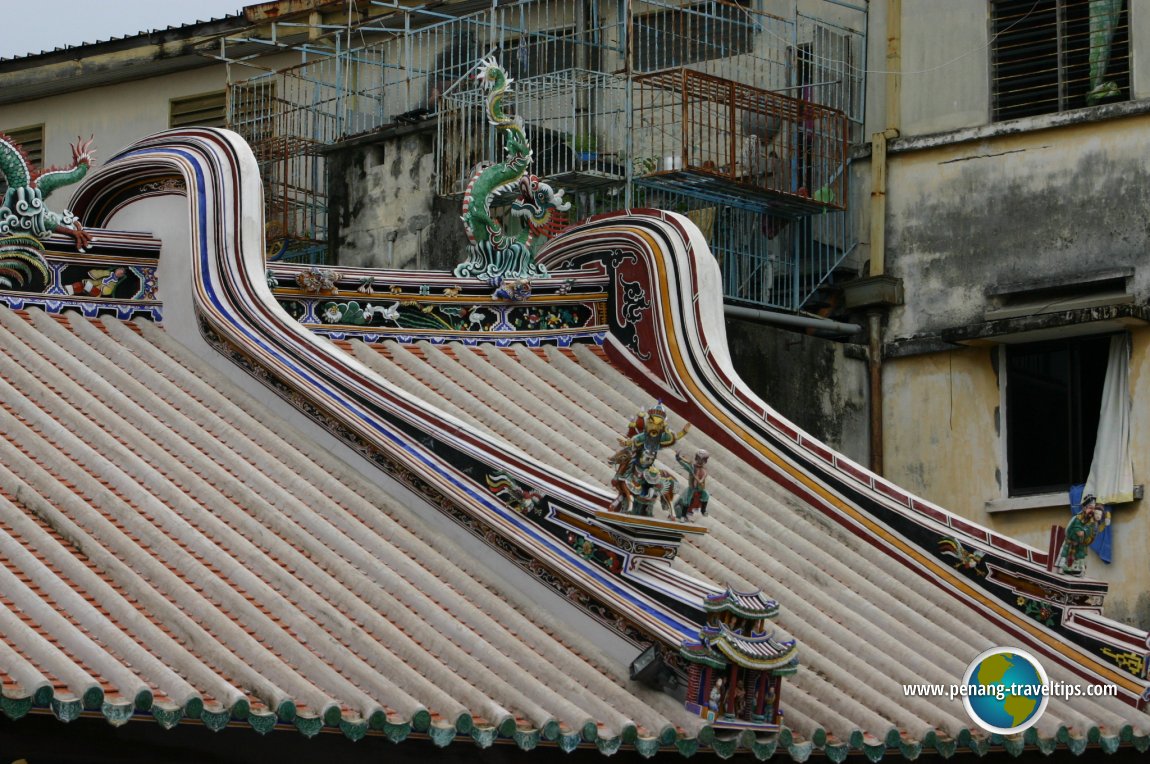 The ornamented roof ridge of Teochew Ancestral Temple. (15 May 2005)
The Teochew is one of six main Chinese dialect groups in Malaysia. The Teochews originate from Chaozhou prefecture, on the eastern part of Guangdong province, bordering Fujian province, in southern China. Early Teochew immigrants arrived in Penang in the mid-19th century and settled as plantation workers in Province Wellesley. Later some moved to George Town, where they established themselves in the wholesale and dried foodstuff trades.
From the late 18th to the early 20th centuries, Chinese migrants to the Nanyang (that is to say, Southeast Asia), form mutual benefitting guilds, not unlike the merchant guilds or Hansa prevailing in mediaval Europe at that time. These guilds or associations are usually based on the people's district of origin, dialect, surname, clan or occupational group. For this reason, we can find in George Town today such associations as the Khoo Kongsi, for the Khoo clan, Teochew association, for the Teochew dialect group, and Carpenter's Guild, the association of carpenters. These associations act as a safe house for early immigrants to find shelter before establishing themselves in the new land.
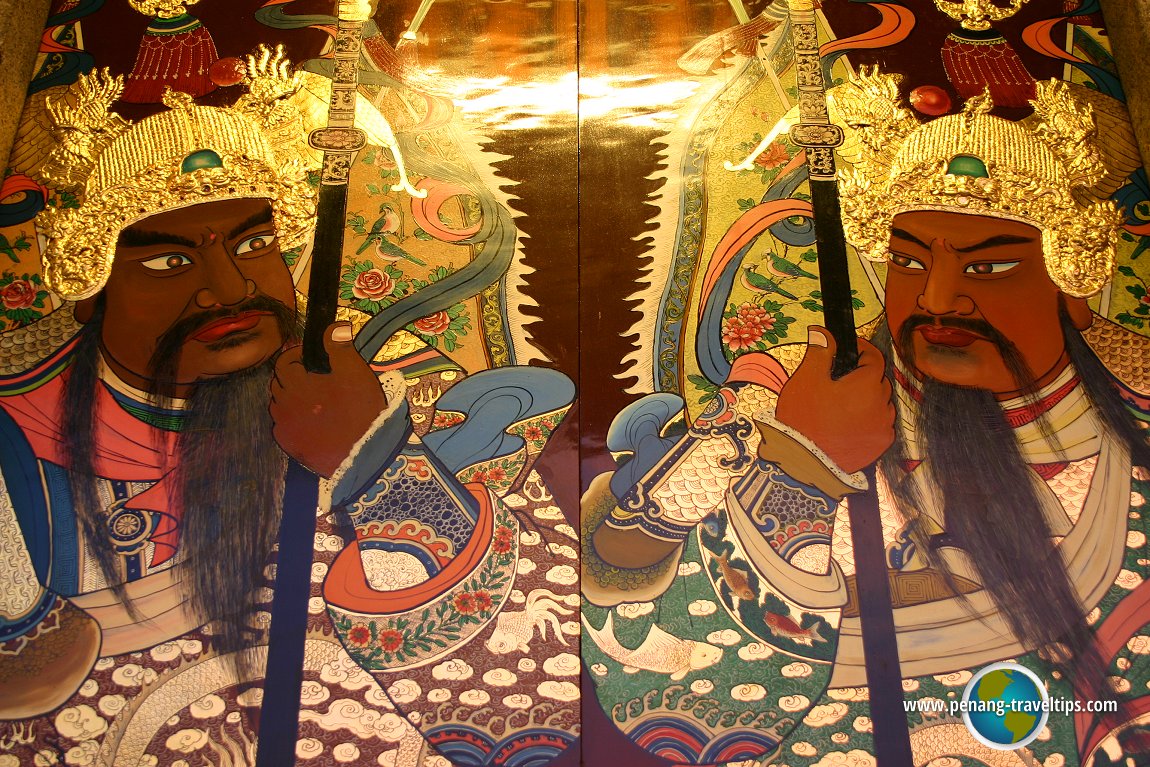 To give you an idea of the size of the doors at the Teochew Ancestral Temple, compare it with the height of its caretaker. (17 April 2005)
 Central court at the Teochew Ancestral Temple (5 February 2013)
The original Han Jiang Teochew temple was in the form of si dian jing, or four-point gold. This is a quadrangle design with an inner courtyard, or atrium. In 1890, an outer gate was added. In reflection of the prosperity of the community at that time, the gate was even more ornate than the original temple. It also has one of the biggest doors of any clan temples in Penang.
The Han Jiang Temple houses the altar to the Teochew patron deity, the Taoist god of the north as well as ancestral tablets of deceased Teochews. In keeping with the high status of the temple's patron deity, the Teochew temple features three pairs of doors instead of only one for most temples.
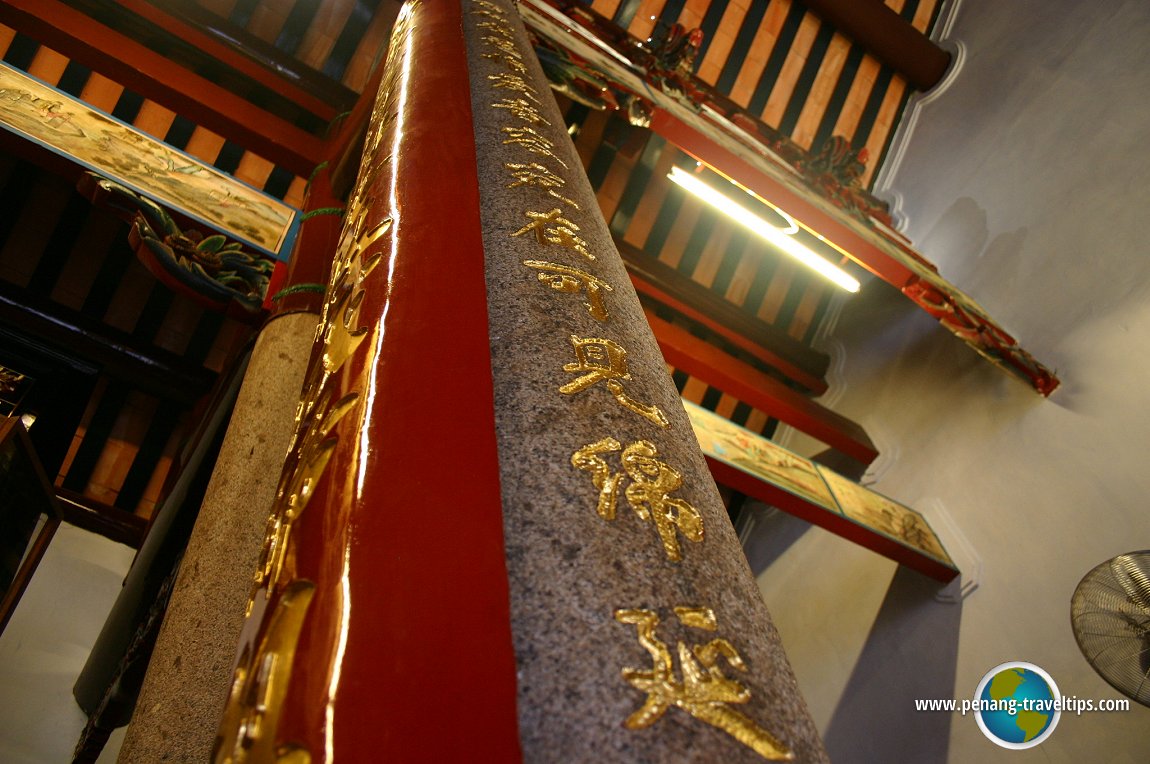 The inscribed columns are overlaid with gold. (15 May 2005)
Over the years, the Han Jiang Ancestral Temple has suffered from long years of wear and tear as well as neglect, particularly during the period when it functioned as a school. Unsympathetic additions and alterations further contributed to marring its original beauty.
The need to restore the Teochew ancestral temple was realised quite some time ago. In July 2002, a restoration committee was formed. It consisted mainly of professionals from the Teochew community who contributed their time and skill for the restoration project. A dilapidation study was conducted on the temple. On 26 July of the same year, a fund raising dinner managed to collect RM900,000 (US$250,000) for the project. Through much of 2003, work was in progress to select a contractor to execute the tremendous task of restoring the temple to its original state.
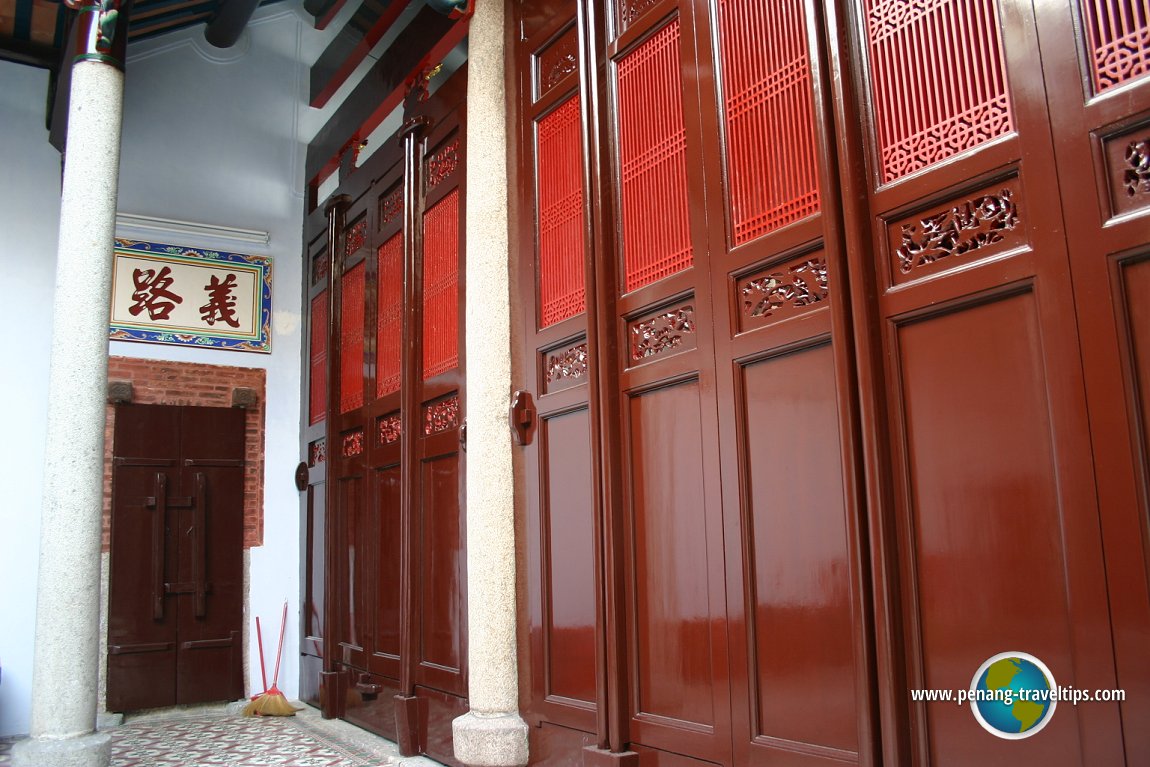 The restored folding doors now gleam from fresh coats of lacquer. (17 April 2005)
Meticulous research conducted both in Malaysia and China to learn the building's history and architecture in order to ensure proper restoration was carried out. As the skill required is not available locally, master craftsmen were brought in from China. This allows for a level of craftsmanship that matches the original standards in terms of materials as well as technique.
As the restoration project was carried out using funds that were contributed, the restoration committee had to provide the public, and particularly the Teochew community, with regular progress reports. Teochew customs and rituals were also observed from the groundbreaking till the completion of the project.
A unique feature of the door gods of the Teochew Ancestral Temple are their golden helmets (17 April 2005)A sophisticated lighting scheme employing fibre optics now showcases the splendid decorative details of the building. By revitalizing cultural and educational programmes, the project has succeeded in reviving the temple's religious and social functions, allowing it to serve once again as the heart of the Teochew community. Finally the Han Jiang Ancestral Temple was completed and open to the public in March 2005.
The Teochew Ancestral Temple is  on the Map of Chulia Street, Penang
Getting there
From the Weld Quay Ferry & Bus Terminal, cross Pengkalan Weld using the pedestrian bridge. Then turn left and walk along Pengkalan Weld until you reach Gat Lebuh Chulia. Turn right into Gat Lebuh Chulia and walk the distance. At the junction of Lebuh Pantai, Gat Lebuh Chulia becomes Lebuh Chulia. Continue along Lebuh Chulia and you will see the Teochew Ancestral Temple on the left side of the road, right in front of Lebuh Queen.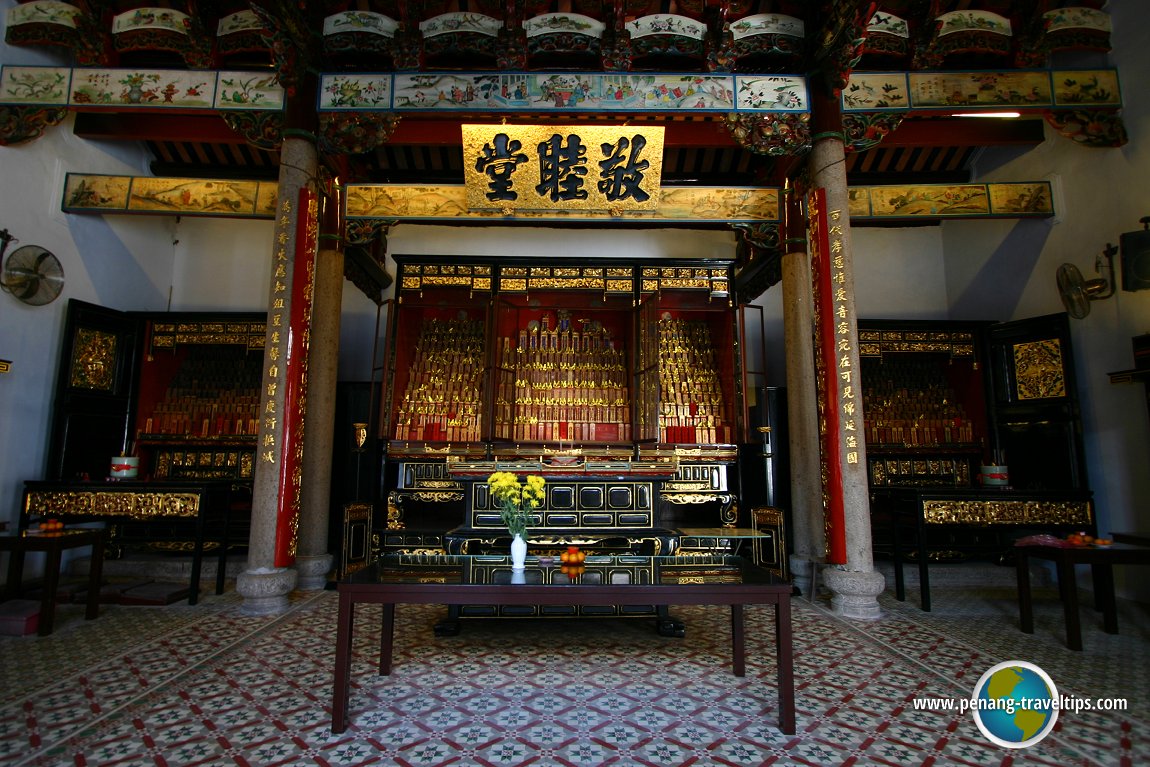 Ancestral tables hall at Teochew Ancestral Temple (30 January 2006)
What to see and do
The Teochew Ancestral Temple is the finest and most exquisite example of early 20th century Teochew architecture in George Town. Admire the door gods with their gold helmets, the sculptures on the roof, the ornaments, even the state-of-the-art fibre-optics lighting element.Nearby sights
The Teochew Ancestral Temple is located in the middle of a very heritage-rich area, within the George Town Unesco World Heritage Site core zone. Within close walking distance are the following sights. The point of reference is the main entrance of the Teochew temple.- Sri Mahamariamman Temple: Cross Lebuh Chulia, and it is on the left side of Lebuh Queen
- Masjid Kapitan Keling: A short distance away. From the Teochew temple, turn left, go until the junction of Jalan Masjid Kapitan Keling, then turn left again. You will see Masjid Kapitan Keling on the right side of the road.
- Kuan Im Teng: From the Teochew temple, turn left, go along Lebuh Chulia until the junction of Jalan Masjid Kapitan Keling, then turn right. You will see Kuan Im Teng on the left side of the road facing Lebuh China.
- Nagore Shrine: Turn left along Lebuh Chulia, and you will find it on the opposite side of the road, on the right side of the junction of Lebuh King.
- Lim Kongsi: Turn left along Lebuh Chulia, and left again at the junction of Lorong Pitt. At the end of Lorong Pitt is Lebuh Ah Quee, with Lim Kongsi right in front.
- Madrasah Hamid Arabi: Turn left along Lebuh Chulia, and left again at the junction of Lorong Pitt. At the end of Lorong Pitt is Lebuh Ah Quee, with Lim Kongsi right in front. To the right of Lim Kongsi is the Madrasah Hamid Arabi.
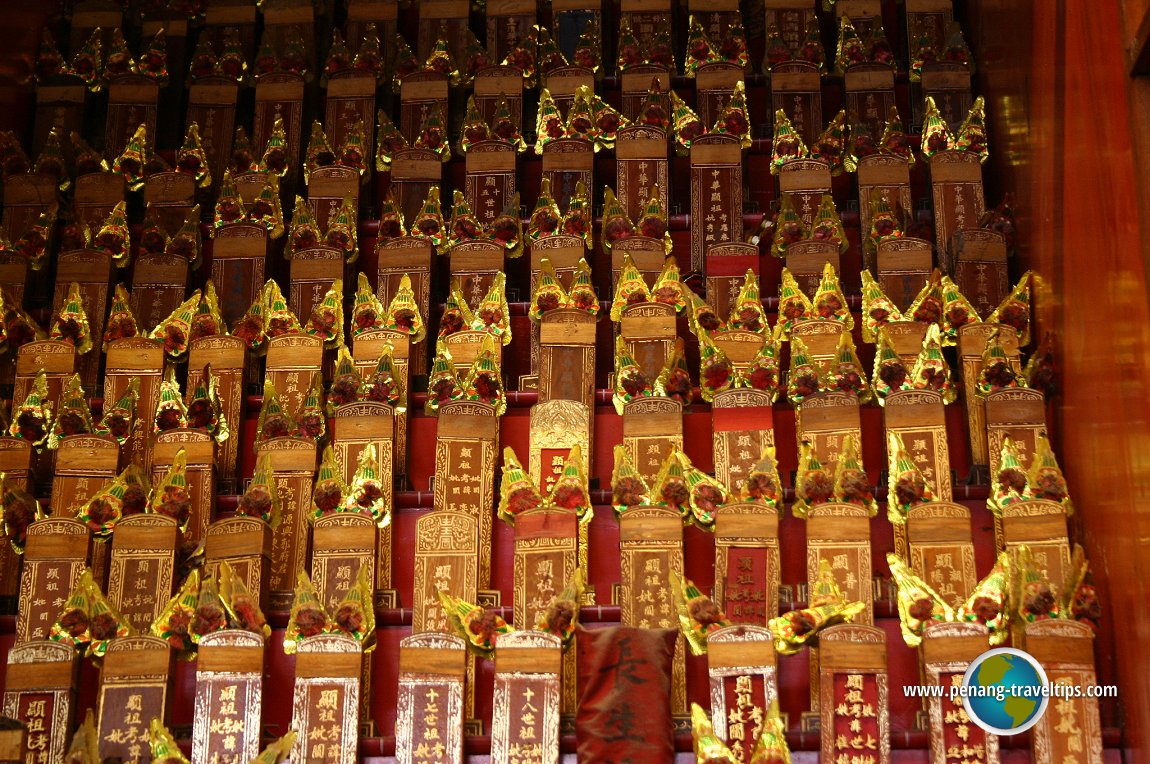 Close up of the ancestral tablets (17 April 2005)
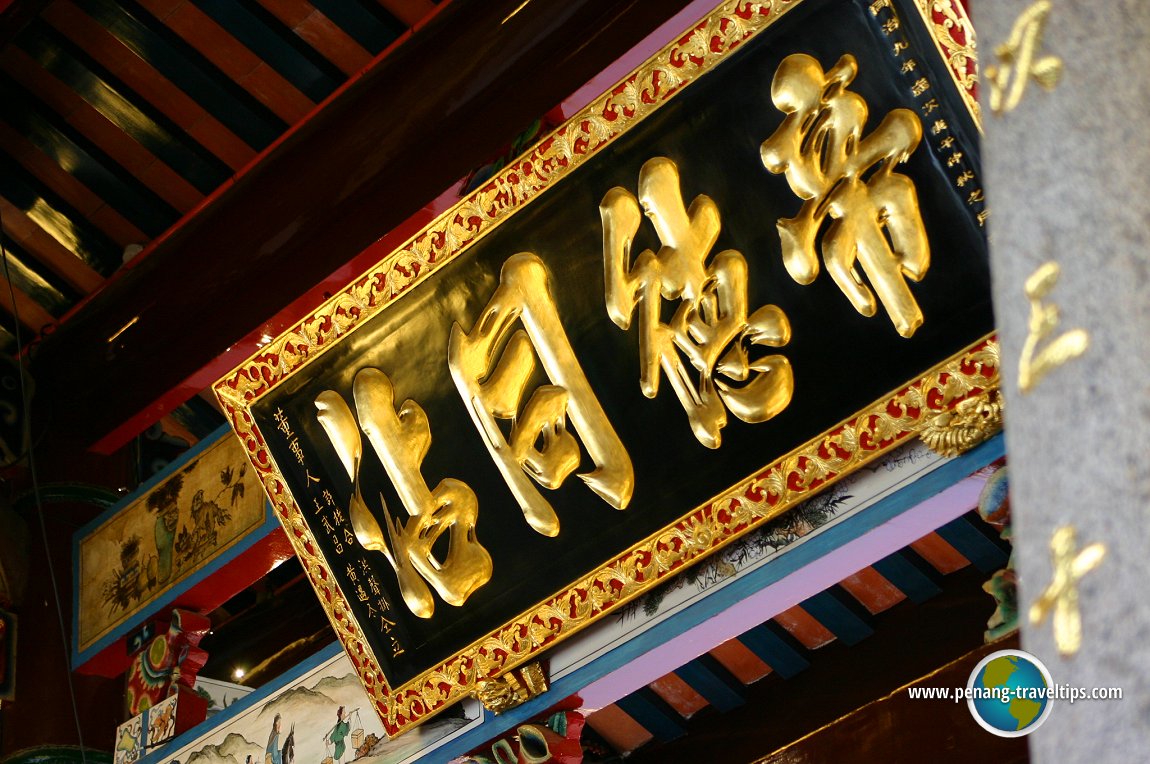 Door plaque with calligraphy overlaid in gold (15 May 2005)
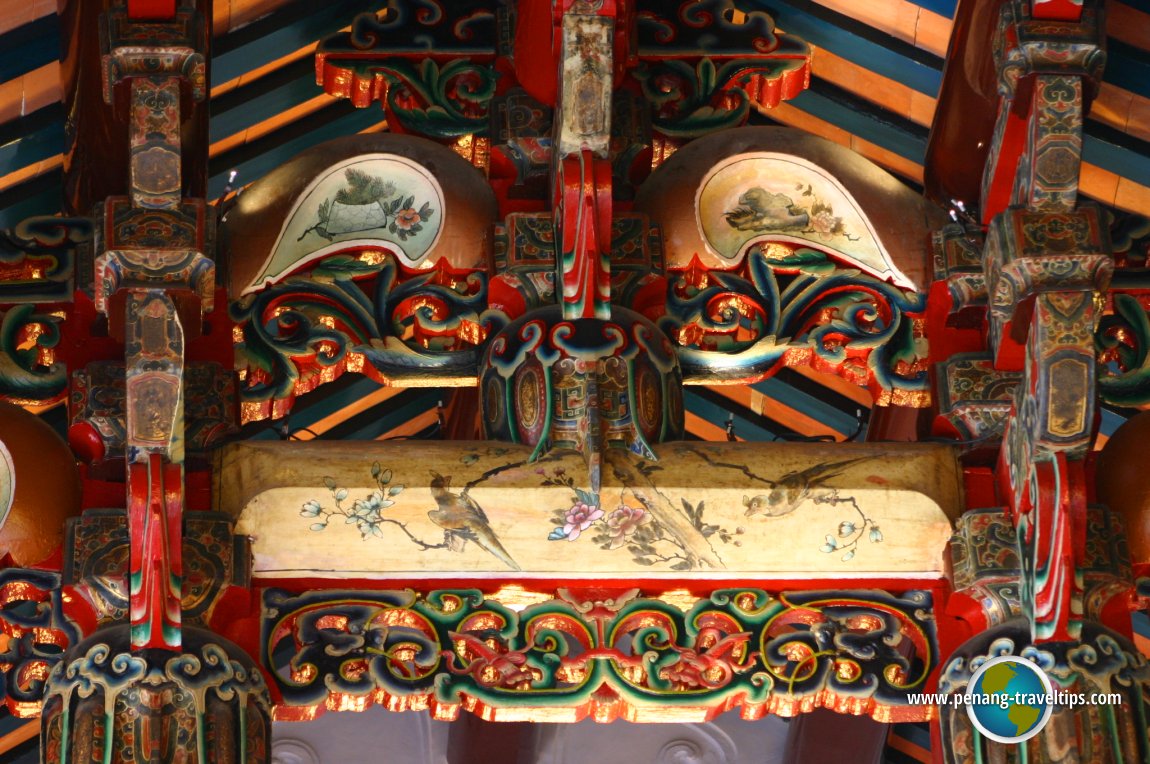 Meticulously rendered designs on the ceiling beams. (15 May 2005)
List of Chinese Temples in Penang and Chinese Temples in Malaysia
Buy Me A Coffee
If you enjoy the information I provide and want to support the work I do, please buy me a coffee! I appreciate it immensely, thank you so much!

Copyright © 2003-2026 Timothy Tye. All Rights Reserved.