
Tasek Gelugor
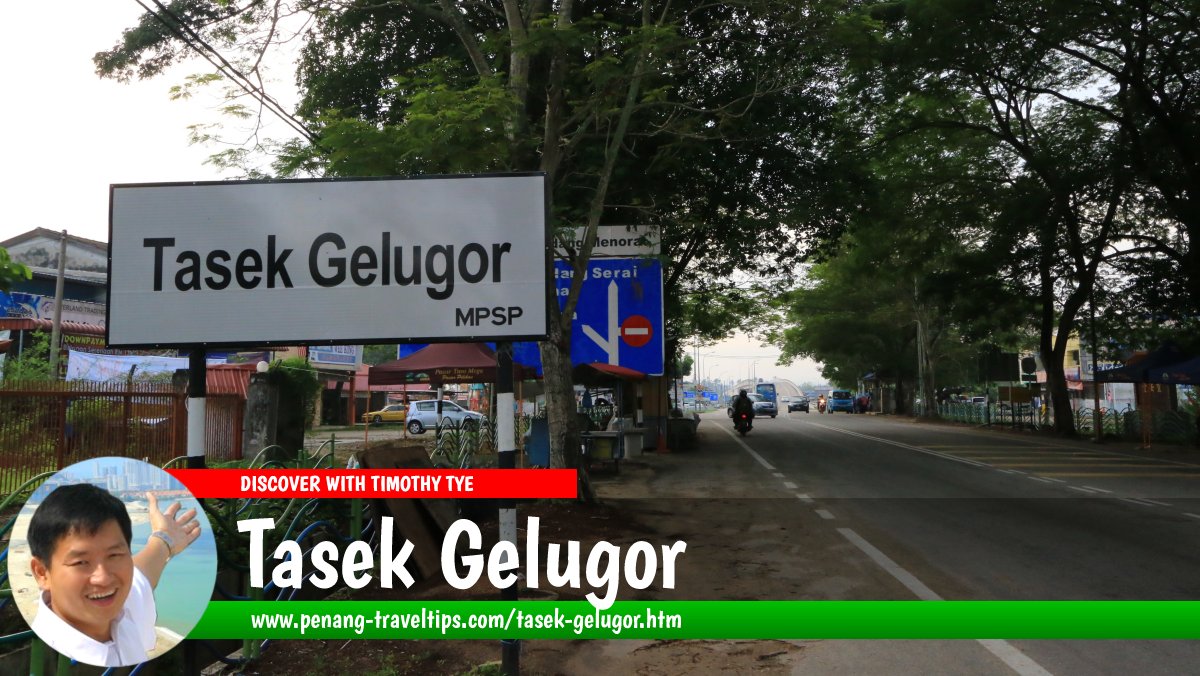 Tasek Gelugor, Seberang Perai Utara (31 August 2016)
Tasek Gelugor is a historic town located in the northern part of Seberang Perai, Penang, Malaysia. Long recognised as a railway town and rural service centre, Tasek Gelugor occupies a strategic position between agricultural hinterlands and emerging townships. The town blends traditional village life, transport-linked development, and gradual urban growth, making it an important node in the social and economic landscape of northern mainland Penang1.
Quick Facts
Location: Northern Seberang Perai, Penang, Malaysia
District: Seberang Perai Utara
Administrative Authority: Seberang Perai City Council (MBSP)
Character: Semi-rural town with transport-oriented development
Known for: Railway station, traditional villages, agricultural surroundings
Connectivity: Rail and road links to Butterworth and northern Peninsular Malaysia
Geographical Setting
Tasek Gelugor is situated on generally flat terrain typical of northern Seberang Perai, surrounded by paddy fields, village settlements, and drainage canals that support agriculture. The area lies inland from the coast but remains influenced by the lowland geography of the mainland, which has historically made it suitable for rice cultivation and rural settlement2.
Small rivers and man-made waterways traverse the surrounding countryside, forming part of an irrigation network that supports farming activities. Seasonal rainfall and a tropical climate shape daily life, agricultural cycles, and infrastructure planning. While flooding can occur during heavy monsoon periods, drainage improvements over time have reduced its impact on residential areas.
Measured from the junction of Jalan Kubang Menderung with Jalan Tasek Gelugor (GPS: 5.483801, 100.490268), Tasek Gelugor is 21.0 km to Penang Sentral, 22.3 km to the Penang Bridge, 42.7 km to the Second Penang Bridge and 40.1 km to the Penang International Airport.
Origins and Early History
The name “Tasek Gelugor” is believed to be derived from local geographical features, possibly referencing a former lake or water body (tasek) and the gelugor tree, which once grew in the area. Early settlements emerged as Malay agricultural communities, relying on rice farming and inland trade routes3.
During the late 19th and early 20th centuries, Tasek Gelugor gained prominence with the expansion of the railway network in British Malaya. The establishment of the railway station transformed the town into a transport and distribution point, linking rural producers to larger markets and facilitating population growth.
The Railway Town Identity
The railway has played a defining role in the development of Tasek Gelugor. The town’s station became a focal point for commerce, travel, and social interaction, supporting small businesses, markets, and services catering to passengers and local residents. This transport-oriented identity set Tasek Gelugor apart from purely agrarian settlements in the region4.
Even today, the railway remains an important feature of the town, reinforcing its connectivity to Butterworth, southern Penang, and other parts of Peninsular Malaysia. The presence of rail infrastructure continues to influence land use patterns and development potential.
Traditional Economy and Agriculture
Despite its railway heritage, agriculture has remained central to Tasek Gelugor’s economy. Surrounding villages are deeply involved in paddy farming, vegetable cultivation, and small-scale livestock activities. These agricultural practices have sustained local livelihoods for generations and contribute to food supply within Seberang Perai Utara5.
Many residents combine farming with other forms of employment, reflecting a diversified rural economy. Local markets and roadside stalls selling fresh produce and traditional food remain integral to daily life and social interaction.
Community and Cultural Life
Tasek Gelugor is characterised by close-knit communities rooted in kampung traditions. Mosques, surau, and community halls serve as social anchors, hosting religious events, celebrations, and gatherings that strengthen communal bonds. Cultural practices associated with Malay heritage continue to shape everyday routines and values.
Festive seasons such as Hari Raya Aidilfitri are widely observed, with open houses and communal activities reinforcing neighbourly ties. These traditions coexist with modern lifestyles, reflecting the town’s balance between continuity and change.
Education and Public Facilities
The town is served by a range of educational institutions, including primary and secondary schools that cater to residents of Tasek Gelugor and nearby villages. Access to education has played an important role in social mobility, enabling younger generations to pursue opportunities beyond traditional agriculture.
Public facilities such as health clinics, markets, and administrative offices further support the town’s role as a local service centre. These amenities reduce reliance on larger urban areas for essential needs, contributing to the town’s self-sufficiency.
Road and Transport Connectivity
In addition to rail services, Tasek Gelugor is connected by state and federal roads that link it to Butterworth, Kepala Batas, and inland areas of northern Peninsular Malaysia. Improved road connectivity has enhanced access to employment, education, and commercial opportunities6.
Tasek Gelugor is still very much a rural part of Penang. It comprises a few small villages surrounding the main town or Pekan Tasek Gelugor. Among the villages and settlements here include Kampung Air Melintas kecil, Kampung Belukar, Kampung Lahar Tembun, Kampung Pengkalan Batu, Kampung Permatang Indah and Kampung Banggul.
The two main roads in Tasek Gelugor are Jalan Gelugor (P119) and Jalan Kubang Menerong (P123). The railway line passes through the town, and a new flyover on Jalan Gelugor enables uninterrupted traffic flow over the railway line. The main river in Tasek Gelugor is Sungai Korek.
Much of the area surrounding Tasek Gelugor is covered with oil palm plantations where the people are mostly Tamils working in the estates, while in the town centre itself, the businesses are run by the Chinese.
Private vehicles remain the dominant mode of transport, though the continued presence of rail offers an alternative for commuting and long-distance travel. This combination of transport modes reinforces Tasek Gelugor’s strategic importance.
Getting to Tasek Gelugor
Exit the North-South Expressway at Exit 166 (Bertam Interchange). At the first T-junction, turn left on state route P123 (Jalan Kubang Menerong). The road makes a turning to the south following the railway line to the left. Continue along the road until you arrive at Pekan Tasek Gelugor. If you are coming from Kepala Batas, the P123 (Jalan Kubang Menerong) would be the road to take heading east and then south to reach Tasek Gelugor.
Urban Influence and Development Trends
Over recent decades, Tasek Gelugor has experienced gradual urban influence as population growth and development pressure spread northward within Seberang Perai. New housing areas, shoplots, and small commercial centres have emerged, particularly near transport corridors.
While development has brought improved infrastructure and services, local authorities face the challenge of managing growth without undermining the town’s rural character and agricultural base. Planning efforts increasingly emphasise balanced development that respects existing communities.
Environmental and Planning Considerations
The flat, low-lying geography of Tasek Gelugor necessitates careful environmental management. Drainage systems, flood mitigation measures, and sustainable land use planning are critical to protecting residential areas and farmland from climate-related risks7.
Preserving green spaces and productive agricultural land remains an important consideration, particularly as urban expansion continues. These environmental assets contribute to local food security and quality of life.
Role within Seberang Perai Utara
Within Seberang Perai Utara, Tasek Gelugor serves as a connective town linking rural villages with larger urban centres. Its railway heritage, agricultural surroundings, and service functions complement the administrative role of Kepala Batas and the coastal activities of Penaga.
This interconnectedness highlights the town’s significance in maintaining regional balance, supporting both economic activity and cultural continuity.
Future Outlook
Looking ahead, Tasek Gelugor is poised to continue evolving as a semi-rural township shaped by transport connectivity and community values. Ongoing improvements in infrastructure and public services are expected to enhance liveability while supporting local economic resilience.
As Seberang Perai develops further as a city-region, Tasek Gelugor’s challenge will be to integrate modern growth with its historical identity, ensuring that its railway legacy, agricultural roots, and strong community ties remain central to its future.
 Map of Tasek Gelugor
Amenities in Tasek Gelugor
- Dewan Muhammad Haji Muhammad Taib (GPS: 5.48179, 100.4938)

- Pejabat Pos Tasek Gelugor (GPS: 5.48141, 100.49431)

- Tasek Gelugor Fire and Rescue Station (GPS: 5.50027, 100.52185)

- Tasek Gelugor Police Station (GPS: 5.48367, 100.49096)

 Businesses in Tasik Gelugor
- Agrobank Taman Gelugor Indah, Jalan Hashim Awang
- CHW Motor, Jalan Hashim Awang
- CSH Electrical, Jalan Hashim Awang
- Insaniah Spa, Jalan Hashim Awang
- Kiat Hin, Jalan Hashim Awang
- Maju Jaya Auto Supplies, Jalan Hashim Awang
- Makro Utara Enterprise (sundry shop), Jalan Hashim Awang
- Maybank Tasek Gelugor, Jalan Hashim Awang
- Pasaraya Ekonomi Yuan Huat
- Pasaraya Rex, Jalan Hashim Awang
- Prima Bookstore
- Pusat Komersial Tasek Gelugor (GPS: 5.48437, 100.48933)

- Puz Mart 24 Jam, Jalan Hashim Awang
- TG Home Furnishing, Jalan Hashim Awang
- Vision Electrical & Hardware Trading, Jalan Hashim Awang
- Zi Yang Auto Sdn Bhd (motorcycle dealer), Jalan Hashim Awang
Eateries in Tasek Gelugor
- Kompleks Tasek Gelugor (GPS: 5.48187, 100.49474)

Hospitals and public clinics in Tasek Gelugor
- Klinik Desa Pokok Sena (GPS: 5.48179, 100.4969)

- Klinik Kesihatan Tasek Gelugor (GPS: 5.48414, 100.49089)

Housing Estates in Tasek Gelugor
- Gelugor Heights (GPS: 5.4758, 100.49887)

- Taman Alamanda (GPS: 5.49149, 100.45738)

- Taman Desa Sena (GPS: 5.485, 100.46323)

- Taman Gelugor Indah (GPS: 5.48471, 100.48594)

- Taman Haji Ahmad Jamil (GPS: 5.47883, 100.49912)

- Taman Koskam (GPS: 5.49301, 100.45088)

- Taman Orkid Permai (GPS: 5.49473, 100.44732)

- Taman Pokok Sena (GPS: 5.49269, 100.45215)

- Taman Pokok Sena Indah (GPS: 5.47996, 100.46076)

- Taman Sena Jaya (GPS: 5.48875, 100.45928)

- Taman Sena Mas (GPS: 5.48749, 100.46423)
 planned
 - Taman Sena Permai (GPS: 5.48729, 100.46307)

- Taman Sepadu (GPS: 5.48786, 100.49625)

- Taman Seri Desa (GPS: 5.48656, 100.50396)

- Taman Seri Gelugor (GPS: 5.49856, 100.48375)

- Taman Sena Sepadu (GPS: 5.47673, 100.4931)
 planned
 - Villa Harmony (GPS: 5.48631, 100.48082)

Localities in Tasek Gelugor
- Bukit Tok Alang (GPS: 5.44309, 100.47733)

- Jarak Atas (GPS: 5.45038, 100.48001)

- Kampung Guar Petai (GPS: 5.44593, 100.47361)

- Kampung Nyior Sebatang (GPS: 5.46716, 100.45516)

- Lahar Yooi (GPS: 5.46949, 100.45736)

- Padang Menora (GPS: 5.45688, 100.47332)

- Permatang Haji Hassan (GPS: 5.48606, 100.43283)

Markets in Tasek Gelugor
- Pasar Awam Tasek Gelugor (GPS: 5.48014, 100.49416)

Petrol Stations in Tasek Gelugor
- Caltex Tasek Gelugor (GPS: 5.481101, 100.503919)

- Petronas Pokok Sena (GPS: 5.48566, 100.45779)

- Petronas Tasek Gelugor (GPS: 5.48451, 100.48848)

Places of worship and religious institutions in Tasek Gelugor
- Beng Hock Sean Siah (GPS: 5.49137, 100.50131)

- Cheng Huang Miao Temple (GPS: 5.50658, 100.5223)

- Sri Maha Mariamman Temple (GPS: 5.483, 100.50334)

- Masjid Al-Ridwan (GPS: 5.46199, 100.44923)

- Masjid At-Taqwa (GPS: 5.4652, 100.46326)

- Masjid Jamek Lahar Tambun (GPS: 5.4788, 100.48106)

- Masjid Jamek Pokok Machang (GPS: 5.48636, 100.47629)

- Masjid Jamek Pongsu Seribu (GPS: 5.49673, 100.44276)

- Masjid Jamek Simpang Tiga (GPS: 5.47776, 100.50264)

- Masjid Jamek Tasek Gelugor (GPS: 5.48208, 100.49316)

- Persatuan Pendidikan Moral Seu Teck Seng Tong (GPS: 5.49137, 100.50131)
- Tasek Gelugor Baptist Church (GPS: 5.47928, 100.50408)

Railway stations in Tasek Gelugor
- Tasek Gelugor Railway Station (GPS: 5.48056, 100.49704)

Roads in Tasek Gelugor
Schools in Tasek Gelugor
- SJK(C) Lee Chee (GPS: 5.48199, 100.49531)

- SJK(C) Mah Hua (GPS: 5.50604, 100.52185)
- SK Ara Rendang (GPS: 5.4843, 100.45317)

- SK Kampung Selamat (GPS: 5.49828, 100.51956)

- SK Pokok Sena (GPS: 5.48926, 100.46166)

- SK Tasek Gelugor (GPS: 5.48291, 100.49232)

- SK Tasek Gelugor II (GPS: 5.47505, 100.48574)

- SM Arab Tahfiz (SMART) (GPS: )

- SMK Bakti (GPS: 5.48519, 100.49221)

- SMK Kampung Selamat (GPS: 5.49878, 100.52054)

- SMK Pokok Sena (GPS: 5.49062, 100.4615)

- SMK Tasek Gelugor (GPS: 5.47805, 100.48502)

Supermarkets in Tasek Gelugor
- Pasaraya Ekonomi Yuan Huat (GPS: 5.48399, 100.48882)

Universities and colleges in Tasek Gelugor
- Kolej Matrikulasi Pulau Pinang (GPS: 5.4922, 100.43633)

Villages in Tasek Gelugor
- Kampung Air Melintas Besar
- Kampung Besar
- Kampung Padang Kerai Kecil
- Kampung Permatang Kerai Besar
- Kampung Pongsu Seribu
- Kampung Selamat
- Kampung Serani
- Pokok Simpor
References
- Seberang Perai City Council (MBSP)
- Penang Institute – Regional Geography and Planning
- Official Portal of the Penang State Government
- Keretapi Tanah Melayu Berhad – Railway History
- Department of Agriculture Malaysia
- Ministry of Transport Malaysia
- Federal Department of Town and Country Planning Malaysia
Page Details
This page was created on 2 January 2026.Want to share your Penang travel experiences or get tips from fellow travellers?
Join the Penang Travel Tips Facebook GroupUseful guides for visiting Penang


