
Portobello Road, London
A world-famous street known for its eclectic market, historic charm, and colourful houses, Portobello Road is one of London’s most iconic destinations.
Portobello Road is located in the City of Westminster and Royal Borough of Kensington and Chelsea, in west London. It runs roughly north to south, cutting through the vibrant neighbourhood of Notting Hill. It begins near Kensal Green in the north and runs south to Notting Hill Gate, intersecting with streets like Golborne Road, Westbourne Park Road, and Pembridge Road.
Portobello Road sits within postal districts W10 and W11. While it is often associated with Notting Hill, parts of the street lie just within the boundaries of Westminster, particularly around its northern tip.
Length and Layout
The total length of Portobello Road is approximately 1.9 kilometres (1.2 miles). It winds through a mixture of residential areas, antique shops, independent cafés, and open-air markets, making it one of the most diverse and walkable streets in west London.
A Brief History of Portobello Road
Portobello Road's roots trace back to the 18th century. In those days, it was little more than a country lane known as Green's Lane, connecting the Kensington Gravel Pits with the village of Kensal. It was surrounded by farmland and woodland, offering a rural contrast to the growing metropolis nearby.
The major transformation came in the mid-19th century with the construction of housing developments and railway lines. These changes triggered rapid urbanisation and gave birth to the characterful Victorian streetscapes we see today.
How Did Portobello Road Get Its Name?
Portobello Road takes its name from Portobello Farm, which once stood in the area. The farm, in turn, was named after the Battle of Porto Bello in 1739—a British naval victory against Spain in what is now Panama. The name was first recorded around 1740, shortly after the battle, and gradually became associated with the road as development progressed in the 19th century.
Despite what might appear to be obvious, Portobello Road has no connection to portobello mushroom. The mushroom got its name more recently, in the 1980s and 1990s, as a marketing term in the US and UK, to make the mature version of the common brown mushroom (Agaricus bisporus) sound more appealing.
So in short:
- Portobello Road = named after a farm → named after a battle.
- Portobello mushroom = modern name for a large brown mushroom, entirely unrelated.
The Character of the Street Today
Portobello Road is best known today as a vibrant shopping street and home to the world-renowned Portobello Market. The market began in the 19th century as a fresh food market, but by the 1950s it had become famous for antiques and bric-a-brac.
Today, it offers a dynamic mixture of:
- Antique stalls (especially on Saturdays)
- Vintage clothing shops
- Street food vendors
- Fruit and vegetable stands
- Books, art, and music stalls
The colourful terraced houses and bohemian vibe add to its appeal. The road is also known for seasonal events, street performers, and as a filming location for films such as Notting Hill (1999).
Real Estate and Property Prices
Portobello Road is among the most desirable (and expensive) residential streets in west London. As of April 2025, the average property price along Portobello Road is approximately £1.65 million, compared to the London-wide average of around £740,000.
Properties here range in size and style. A typical one-bedroom flat may offer around 550 sq ft (51 sq m), while larger three-storey terraced houses often provide 1,800 to 2,200 sq ft (167–204 sq m) of living space.
Due to its famous name and lively surroundings, Portobello Road commands a premium, particularly for period properties with preserved facades and proximity to the market area.
Nearest Tube Stations and Transport Links
Portobello Road is well connected by London Underground services. The closest stations are:
- Ladbroke Grove Station – served by the Circle and Hammersmith & City lines
- Notting Hill Gate Station – served by the Central, Circle, and District lines
- Westbourne Park Station – served by the Circle and Hammersmith & City lines
In addition, numerous London bus routes pass nearby, including the 7, 23, 27, 52, and 70.
Fun Fact
Portobello Road is home to the Electric Cinema, one of the oldest working cinemas in the UK. Opened in 1910, it still operates today with leather armchairs and cashmere blankets, offering an old-school cinema experience that matches the vintage charm of the road itself.
FYI
Portobello Street is one of the streets I include in the Top 10 London Streets Every Visitor Must See
Quick Facts
- Location: City of Westminster and Royal Borough of Kensington and Chelsea
- Length: 1.9 km (1.2 miles)
- Historic Name: Originally Green's Lane
- Current Name Origin: Named after the Battle of Porto Bello (1739)
- Known For: Portobello Market, antiques, fashion, street food
- Property Prices (2025): ~£1.65 million average
- Typical Property Size: 550–2,200 sq ft (51–204 sq m)
- Nearest Tube Stations: Ladbroke Grove, Notting Hill Gate, Westbourne Park
- Underground Lines: Circle, Hammersmith & City, Central, District
- Fun Fact: Home to the historic Electric Cinema (est. 1910)
Map of Portobello Road, London
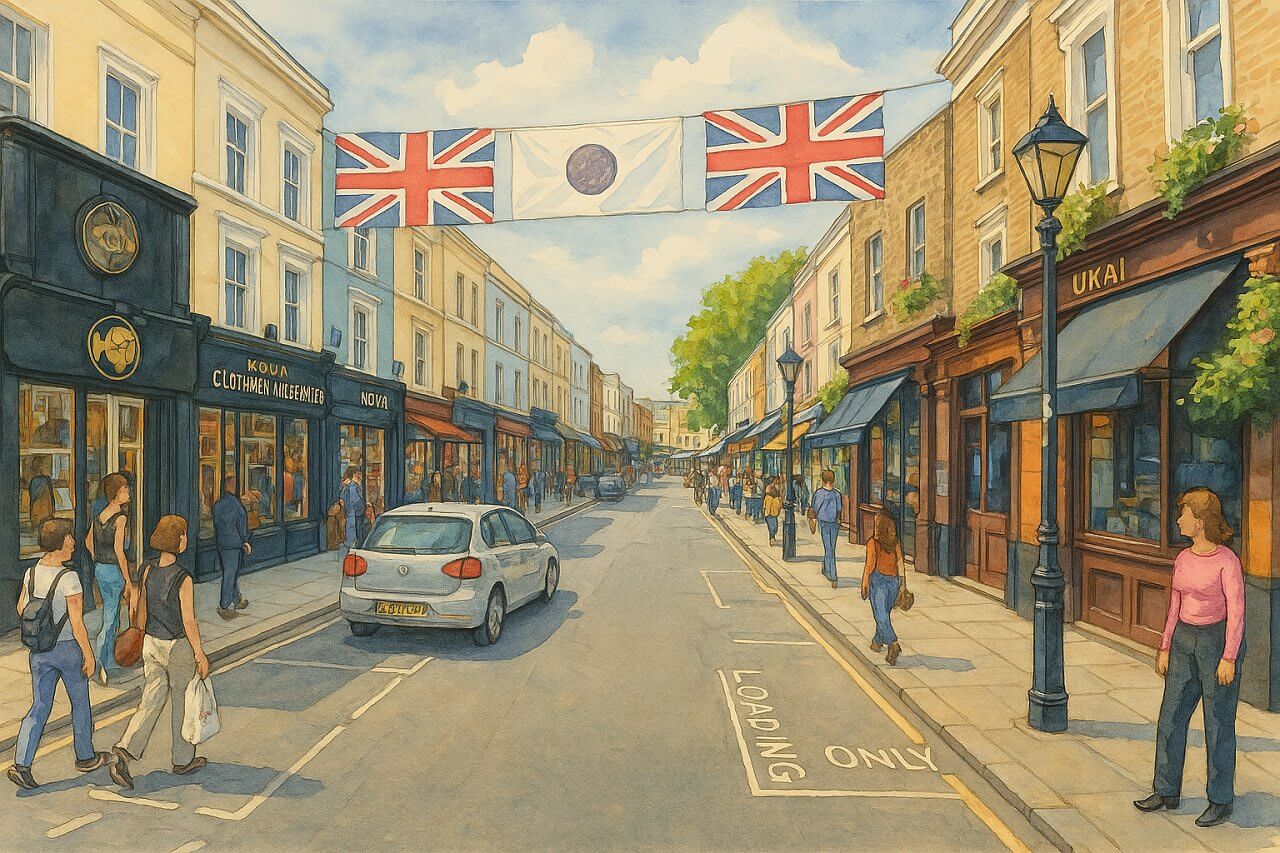
Painting of Portobello Road, London (View image in full size)

Page Details
This page was created on 3 April and modified on 6 May 2025. Hi, my name is Timothy and created it from my research, for my own entertainment, knowledge and to satisfy my curiosity. I am providing the information to you in good faith and hope it is useful. I try to get the details as accurate as possible. I also try to update the page whenever I stumble on new details. So this and all my other pages are perpetual work in progress. If you discover any error, please politely inform me, pointing out where the error lies, and I will correct it as soon as possible. Your helpfulness will keep this page accurate, relevant and helpful to those who need the information.Moving to London?
New to London and need a place to live? Read our Renting A Flat Guide. This guide covers everything you need to know about renting a flat in London, from viewing to signing.Streets of London
Come, let's explore and discover the streets of London together! Listed here afre the Streets of London that I have documented. Dive in and discover!Map of Streets in London
View all the streets that I have documented on Google Maps in this Map of Streets in London.Want to share your London travel experiences or get tips from fellow travellers?
Join the London Travel Tips Facebook GroupMore information for visiting London
Here are some related articles to help you get to know London better.- Cost of Living in London: Discover the true cost of living in London, including housing, transport, groceries, and more - plus tips for budgeting in one of the world's most expensive cities.
- Driving in London: Planning to drive in London? Learn about roads, car rentals, parking, tolls, and key tips for tourists and visitors from outside the capital.
- Driving Tips for Visiting London: Thinking of driving to London? Discover the best times to travel, congestion tips, parking apps, breakdown help, and petrol advice for a smoother journey.
- Evolution of London's Streets: Discover the fascinating history of how London's streets developed from ancient footpaths to today's complex network of roads across the capital.
- History of Immigration to London: Discover the rich history of immigration to London, from Huguenots to Bangladeshis, and how diverse communities have shaped the city's vibrant identity.
- How Big Is London Compared to Other World Cities?
- How London's Streets Measure Up: A Global Comparison of Road Widths
- How Streets of London are Named: Discover how London streets get their names, who decides them, and how historic, political, and public influences shape street naming in the capital.
- How the Grosvenor Family Came to Own Much of Mayfair, Belgravia and Pimlico: Explore how the Grosvenor family came to own much of Mayfair, Belgravia, and Pimlico, and learn about their historical connection (or lack thereof) with the British royal family and government.
- Living and working in London
- London's Quiet Collapse: How Living Standards Fell as Costs Skyrockted (1975-2025): Explore how London residents endured rising costs and falling living standards from 1975 to 2025 - from rocketing rents to wage stagnation and inflation.
- Marvel of the London Underground: Discover the history, challenges, and triumphs of the London Underground - the world's first underground railway and a vital transport lifeline for the UK capital since 1863.
- Moving to London: Expat Tips for Settling in Westminster: Essential advice for expats moving to London's Westminster: neighborhood insights, cost of living, transportation, housing, healthcare, schools, and tips to help you feel at home in the heart of the city.
- Places in London that aren't pronounced the way they're spelled
- Shopping in London: Discover London's diverse shopping scene
- Taking the bus in London: This is your complete guide to taking the bus when in London.
- The Anglican Faith: A Visitor's Guide to the Church of England: Learn about the Anglican faith and its deep ties to London's landmarks like Westminster Abbey and St Paul's Cathedral.
- Top 10 London Streets Every Visitor Must See: Discover London through its most iconic thoroughfares - 10 streets every visitor must experience. From historic Abbey Road to vibrant Camden High Street, explore culture, shopping, and hidden gems.
- Why are most roads in Central London so narrow? Learn why there are so few multi-lane roads and elevated highways in the heart of the city.
 Latest Pages & Updates
Buy Me A Coffee
If you enjoy the information I provide and want to support the work I do, please buy me a coffee! I appreciate it immensely, thank you so much!
